

Executive Overview
For millions of residents across the Japanese archipelago, the arrival of spring is not merely a transition into warmer weather and blooming cherry blossoms; it is the onset of a debilitating seasonal trial. Commonly known in Japan as kafunsho, severe hay fever has evolved into a massive public health and economic crisis. Today, more than 40 percent of Japan’s population suffers from allergic rhinitis triggered by airborne tree pollen—a rate nearly double that found in the United States.
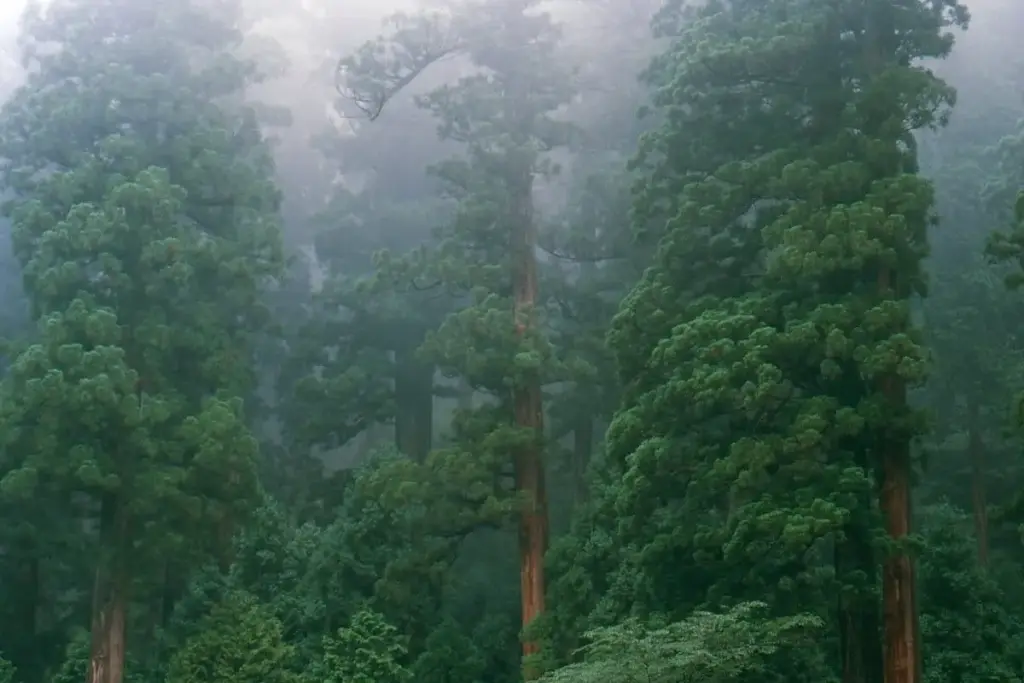
The roots of this modern epidemic trace back directly to the ashes of World War II. In the aftermath of catastrophic wartime bombings, Japan faced an unprecedented housing shortage. To rebuild millions of homes quickly, the nation embarked on a massive, state-sponsored reforestation campaign, planting vast tracts of fast-growing timber species—principally sugi (Japanese cedar, Cryptomeria japonica) and hinoki (Japanese cypress, Chamaecyparis obtusa).
Decades later, those economic lifelines have transformed into ecological and physiological hazards. Today, forests cover roughly 70 percent of Japan, and 41 percent of those woodlands are artificial, human-planted forests. Within these cultivated zones, sugi accounts for roughly 40 percent of the coverage, while hinoki makes up another 25 percent. In total, two-thirds of Japan’s managed forests consist of allergy-inducing timber. Complicating matters further, global climate change has accelerated warming trends, causing sugi trees to release pollen earlier and in greater volumes, thereby lengthening and intensifying the misery of the annual allergy season.
In response, the Japanese government enacted an ambitious, long-term intervention strategy in 2023. The plan aims to cut down 20 percent of the nation’s planted sugi trees across 4.3 million hectares (10.6 million acres) by 2033. As mature trees reach optimal harvesting age, authorities are orchestrating a sweeping transition: felling allergenic timber, replacing remote mountain stands with native broadleaf species, and replanting accessible areas with newly developed, low-pollen or zero-pollen sugi strains.
However, translating policy into ecological restoration is fraught with systemic hurdles. Japan’s forestry sector is plagued by severe labor shortages and an aging workforce, while the nation’s domestic home-construction industry—traditionally the primary consumer of domestic timber—is in structural decline. Navigating these compounding challenges will test the resilience of Japan’s environmental policymakers as they attempt to undo a mid-century forestry miracle that inadvertently birthed a twenty-first-century health crisis.
Detailed Chronology: From Wartime Devastation to Ecological Fallout
To understand why Japan’s landscape is saturated with allergenic timber, one must look back to the devastation of the mid-20th century. The historical trajectory of kafunsho unfolds across distinct eras of crisis, policy, and biological consequence.
1. The Post-War Reconstruction Era (1945–1960s)
In the wake of World War II, Japan’s major urban centers lay in ruins, and millions of displaced citizens required shelter. Simultaneously, wartime timber demands and reckless over-logging had stripped the nation’s hillsides bare. Recognizing that a modern nation required a stable, domestic supply of building materials, the Japanese government launched a massive reforestation initiative.
Foresters prioritized species that were native, adaptable, and—above all—fast-growing. Sugi and hinoki fit these criteria perfectly. They produced straight, durable lumber ideal for traditional and modern residential construction. Across the country, communities and private landowners cleared degraded native broadleaf forests and replaced them with monoculture plantations of sugi and hinoki saplings.
2. The Maturation and Silence Before the Storm (1970s–1980s)
For the first few decades of their existence, these vast artificial forests grew quietly. Because young trees do not produce significant quantities of pollen, the ecological impact of the monoculture plantations remained largely hidden. During this period, Japan experienced rapid economic growth, shifting its reliance toward imported oil and international timber markets, which temporarily reduced the immediate economic pressure on domestic forestry operations.
3. The Onset of the Epidemic (1990s–2010s)
By the late 20th century, the millions of sugi and hinoki trees planted during the post-war reconstruction era had reached full biological maturity—typically defined as 30 years of age or older. Mature conifers begin producing massive quantities of airborne microspores to facilitate wind pollination.
As these trees matured, Japan recorded its first major epidemiological spikes in hay fever. What had once been a localized, minor medical complaint quickly ballooned into a national phenomenon. Medical researchers noted exponential increases in patient diagnostics. By the turn of the millennium, kafunsho was no longer just an inconvenience for a sensitive few; it had become an entrenched systemic burden affecting tens of millions of citizens.
4. Climate Acceleration and Policy Reckoning (2020s–Present)
Entering the 2020s, anthropogenic climate change began to dramatically exacerbate the crisis. Unseasonably warm winters and rising spring temperatures acted as biological triggers, prompting sugi forests to release their pollen loads weeks earlier than historical averages. The pollen seasons grew not only longer in duration, but exponentially more intense in volume.
Recognizing that the situation was unsustainable—both for public health and national productivity—the Japanese government abandoned its hands-off approach to aging timber plantations. In 2023, the Ministry of Agriculture, Forestry and Fisheries (MAFF) announced a targeted national framework: a directive to systematically thin and clear 20 percent of the country’s planted sugi forests over the decade leading to 2033, marking a historic pivot in national land management.
Supporting Context & Metrics: The Scale of the Crisis
The statistics surrounding Japan’s pollen epidemic paint a vivid picture of an ecosystem out of balance and a society grappling with chronic disruption.

- Prevalence of Hay Fever: Over 40 percent of Japan’s total population currently suffers from kafunsho. This figure represents a staggering public health anomaly, sitting at nearly double the allergy rates recorded in the United States and far exceeding regional averages elsewhere in East Asia.
- National Forest Coverage: Forests blanket approximately 70 percent of Japan’s mountainous terrain. Of those forested lands, a staggering 41 percent are artificial, human-planted commercial woodlands.
- The Monoculture Dominance: Within Japan’s planted forests, sugi (Cryptomeria japonica) alone accounts for roughly 40 percent of the total area, while hinoki (Chamaecyparis obtusa) comprises another 25 percent. Combined, these two species make up approximately two-thirds of all cultivated forest acreage.
- Targeted Reduction Metrics: The government’s 2023 mandate requires the systematic removal of 20 percent of all planted sugi trees across 4.3 million hectares (10.6 million acres) of forest land by the year 2033.
- The Economic and Social Toll: Millions of workers experience compromised cognitive function, sleep disruption, and lost workdays during the peak months of February through May. The cumulative drag on national economic productivity is calculated in the tens of billions of dollars annually, factoring in medical consultations, over-the-counter and prescription antihistamines, air purifiers, and protective wear.
Official Statements and Institutional Perspectives
Addressing a crisis of this magnitude requires coordinated efforts across legislative bodies, agricultural ministries, and scientific research institutions. Key stakeholders have offered crucial insights into the complexities of the remediation strategy.
The Human Toll: Daily Realities in Tokyo
For ordinary citizens, the statistics translate into months of physical distress. Mariko Aoki, a secretary working at the National Diet—Japan’s bicameral legislature—shared her personal ordeal with field researchers:
"Right after the New Year in January, my nose starts to get a little itchy," Aoki noted. "It peaks in March, and the sneezing, runny nose, itchy throat and itchy eyes are really bad. It lasts all the way until just before Golden Week," she added, referencing the cluster of national holidays running from April 29 to May 5.
The Forestry Strategy: Pragmatic Harvesting
Government officials emphasize that the national removal plan is not a reactionary destruction of timber, but rather a synchronized harvesting initiative capitalizing on the biological age of the forests. Makoto Nakamura, assistant director of the wood industry division at the Ministry of Agriculture, Forestry and Fisheries, explained the rationale:
"The plan is to start cutting down the trees as they become usable — starting with those that are ready for use as lumber."
Because nearly all of Japan’s planted sugi trees are now well past the 20-year threshold, they possess the structural mass required for commercial applications. This structural maturity provides a narrow window of opportunity to convert a biological liability into usable raw material.
Biodiversity vs. Biotechnology: The Replanting Dilemma
When forestry workers clear an allergenic stand of trees, officials must decide what to put in its place. According to MAFF guidelines, the strategy varies depending on geographic location:
- Deep Forests and Mountain Slopes: Trees felled in remote, inaccessible interior zones or steep mountain gradients will not be replaced with conifers. Instead, these areas will be restored to diverse, native broadleaf tree species, enhancing ecological resilience, soil stability, and biodiversity.
- Roadside and Commercial Perimeters: Trees felled closer to roadways or timber-processing infrastructure will be replanted with specialized, innovative strains of sugi.
Japanese agricultural researchers and prefectural botanical laboratories have successfully bred and cultivated more than 30 distinct strains of sugi that produce little to no pollen. Prefectures like Toyama on the west coast have aggressively adopted these innovations, planting approximately 100,000 zero-pollen saplings in a single operational year.
Future Outlook: Hurdles on the Road to Recovery
While the 2033 target provides a clear horizon for the government’s eradication and replacement campaign, formidable logistical and economic hurdles threaten to impede progress.
1. Labor Shortages and an Aging Workforce
Executing a nationwide forestry transformation requires immense physical labor—from felling mature trees on steep mountainous terrain to hauling timber, clearing underbrush, and planting delicate saplings. However, Japan’s broader demographic crisis—marked by a rapidly aging population and a shrinking rural workforce—has hit the forestry sector exceptionally hard. Finding skilled, able-bodied workers to carry out this rigorous manual labor is a persistent bottleneck.
2. A Contracting Domestic Construction Market
For decades, the domestic timber industry relied heavily on residential housing construction. Today, however, Japan is experiencing a severe demographic contraction, leading to declining demand for new home construction. This downward trend has left the forestry ministry scrambling to identify alternative, non-traditional markets for the massive volume of sugi timber that will be harvested over the next decade. Without viable commercial outlets for the felled wood, the economic incentives for private landowners to participate in the clearing program diminish significantly.
3. Climate Change Adaptation
Even if the government successfully hits its target of removing 20 percent of planted sugi by 2033, the remaining 80 percent—alongside vast tracts of hinoki—will continue to mature and release pollen. Compounding this challenge, shifting climate patterns mean that surviving trees may produce heavier annual yields under warmer atmospheric conditions. Therefore, long-term mitigation will likely require expanded deployment of no-pollen biotechnology, advanced airborne spore-tracking sensor networks, and improved public health prophylactic measures.
Conclusion
Japan’s pollen crisis serves as a cautionary tale of unintended ecological consequences resulting from well-intentioned state-led interventions. What began as a desperate post-war effort to house a devastated population has evolved into an intergenerational public health challenge. As the nation embarks on its decadal mission to reshape its forests, the success of the 2033 initiative will ultimately depend on whether Japan can overcome labor deficits, invent new economic markets for its timber, and successfully harmonize human health with environmental stewardship.



