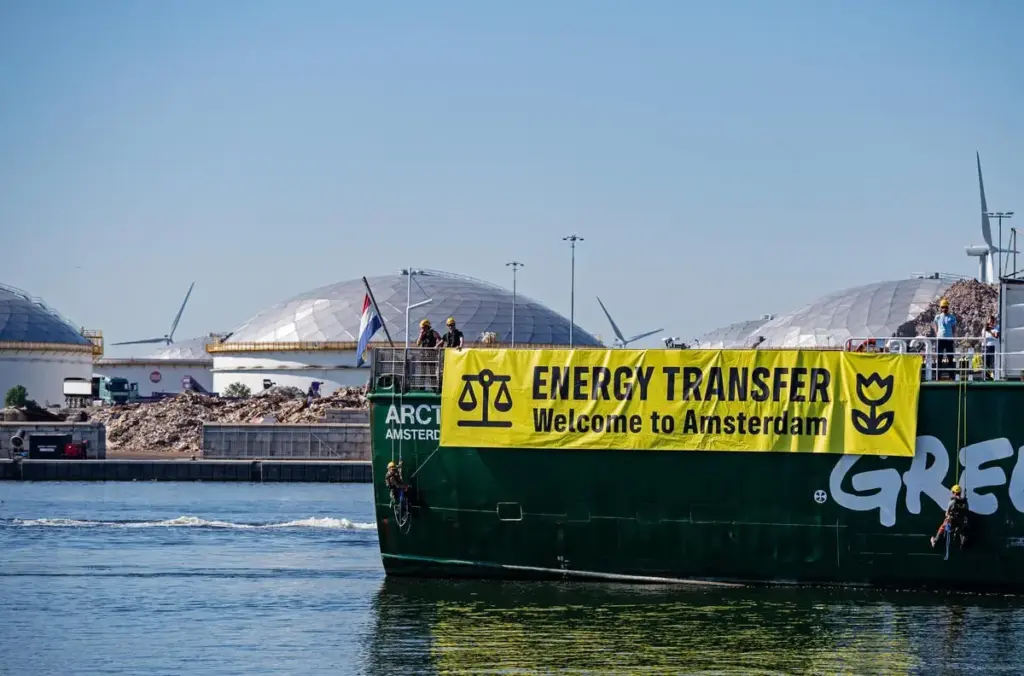
AMSTERDAM — In an ongoing high-stakes transnational legal battle, Greenpeace International has reaffirmed its commitment to pursuing its groundbreaking anti-SLAPP (Strategic Lawsuit Against Public Participation) case against energy infrastructure giant Energy Transfer in the Netherlands.
This resolve follows a recent, carefully circumscribed ruling by the North Dakota District Court, which issued a "narrowly tailored" anti-suit injunction. According to legal representatives for the environmental organization, the core pillars of their defense and claims under Dutch law remain entirely untouched by the U.S. court’s decision, clearing a path for the litigation to proceed in Europe.
Executive Overview
The unfolding legal conflict represents a critical flashpoint in the global debate over corporate accountability, freedom of speech, and the cross-border misuse of the legal system to silence environmental advocacy. At the center of the dispute is a multi-million-dollar lawsuit brought by Energy Transfer—the developer behind the controversial Dakota Access Pipeline—against Greenpeace entities in the United States.
In response, Greenpeace International launched a defensive offensive in the Netherlands, utilizing Europe’s increasingly robust legal frameworks designed to combat SLAPPs. These suits are defined as malicious, meritless lawsuits initiated by powerful entities not to win justice, but to bankrupt, exhaust, and intimidate critics through exorbitant legal fees and protracted litigation.
When the North Dakota District Court attempted to intervene by issuing an anti-suit injunction—a mechanism designed to halt foreign legal proceedings—it walked a tightrope. Guided by prior directives from the North Dakota Supreme Court, the lower court crafted an order narrow enough to avoid stepping on the toes of Dutch jurisdiction regarding core anti-SLAPP protections.
While Greenpeace International can no longer press a specific request for a formal declaration that the original North Dakota proceeding "lacked legal foundation," senior legal strategists insist this limitation is peripheral. The heart of the Dutch litigation—challenging the legitimacy of the U.S. onslaught and seeking redress for abusive litigation tactics—remains robust, setting the stage for a compelling legal showdown in Amsterdam.
Detailed Chronology: From the Dakota Access Pipeline to European Courts
To fully understand the gravity of the current proceedings in Amsterdam and North Dakota, one must examine the timeline of events that transformed a local environmental protest into an international legal war.
1. The Standing Rock Protests (2016–2017)
The friction between Energy Transfer and Greenpeace traces back to the historic protests against the Dakota Access Pipeline (DAPL) near the Standing Rock Indian Reservation in North Dakota. Thousands of water protectors, environmental activists, and Indigenous leaders converged to halt the construction of the 1,172-mile crude oil pipeline, citing threats to local water supplies and sacred ancestral lands. Greenpeace entities supported the movement through public awareness campaigns, research, and advocacy.
2. Energy Transfer’s U.S. Lawsuit (2017–2019)
Following the completion of the pipeline, Energy Transfer filed a massive federal lawsuit in the U.S. District Court for the District of North Dakota against Greenpeace International, Greenpeace Inc., and other environmental organizations. The pipeline developer alleged defamation, tortious interference, and violations of the Racketeer Influenced and Corrupt Organizations (RICO) Act, seeking hundreds of millions of dollars in damages. Environmental watchdogs immediately condemned the action as a classic SLAPP suit designed to drain organizational resources and intimidate critics.
3. Escalation to the Netherlands (2021–2023)
Faced with escalating legal pressure in U.S. courts—where anti-SLAPP statutes are inconsistent and often weak depending on the jurisdiction—Greenpeace International took the fight to its home turf. Headquartered in Amsterdam, Greenpeace International filed an anti-SLAPP suit against Energy Transfer in the Netherlands. The Dutch action sought to establish that the U.S. litigation was abusive, vexatious, and an infringement on fundamental rights to freedom of expression and peaceful assembly protected under European law.
4. Judicial Ping-Pong: North Dakota Supreme Court and District Court (2023–2026)
Seeking to derail the foreign proceedings, Energy Transfer petitioned North Dakota courts to issue an anti-suit injunction, demanding that Greenpeace drop its Dutch lawsuit. The case wound its way up to the North Dakota Supreme Court, which established a nuanced standard: any injunction must be "narrowly tailored" to respect international comity and avoid undue interference with foreign courts.
Complying with this mandate, the North Dakota District Court issued its recent order. The ruling bars Greenpeace from asking the Dutch court to declare the U.S. case legally baseless, but explicitly permits the core of the anti-SLAPP suit to move forward.
Supporting Context & Metrics: The Global Threat of SLAPPs
The legal skirmish between Greenpeace and Energy Transfer is not an isolated incident; it reflects a troubling global surge in Strategic Lawsuits Against Public Participation.
Understanding SLAPPs
SLAPPs are increasingly recognized by international human rights bodies, the European Union, and legal scholars as a severe threat to democracy. Unlike legitimate tort claims, SLAPPs are characterized by:
- Massive Financial Disparities: Wealthy corporations facing public criticism deploy armies of high-priced corporate lawyers against non-profits, independent journalists, and grassroots activists.
- Jurisdictional Forum Shopping: Plaintiffs file lawsuits in jurisdictions perceived as hostile to defendants or favorable to expansive interpretations of corporate damages (such as certain U.S. state courts).
- The Chilling Effect: The primary goal is not necessarily winning a court judgment, but creating a climate of fear. The mere threat of multi-million-dollar liabilities forces organizations to divert critical donations and staff time away from environmental and social missions toward legal defense.
The European Anti-SLAPP Landscape
The choice of the Netherlands as a battleground is highly strategic. Europe has been at the forefront of legislative reforms to protect public watchdogs. The European Union recently adopted the "Anti-SLAPP Directive" (often referred to as "Daphne’s Law," named after murdered Maltese investigative journalist Daphne Caruana Galizia), which empowers courts to throw out manifestly unfounded lawsuits early in the process and forces plaintiffs to bear the full costs of the litigation.
By grounding its defense in Dutch jurisprudence, Greenpeace International is testing the teeth of these emerging European protections against aggressive cross-border corporate litigation originating in the United States.
Official Statements and Legal Analysis
Weighing in on the North Dakota District Court’s latest order, Daniel Simons, Greenpeace International Senior Legal Counsel for Strategic Defence, provided an authoritative breakdown of the legal reality on the ground:
"Greenpeace International’s anti-SLAPP case against Energy Transfer in the Netherlands will continue and the central arguments are not impacted by the anti-suit injunction issued by the North Dakota District Court. As directed by the North Dakota Supreme Court, the anti-suit injunction is ‘narrowly tailored’ so as not to interfere with key claims in Greenpeace International’s anti-SLAPP case."
Simons emphasized that the U.S. court’s limitations do not blunt the core objective of the Dutch proceedings. He noted:
"The North Dakota courts have cleared the way for Greenpeace International to continue pursuing justice under Dutch law. The only limitation imposed pertains to Greenpeace International asking for a finding that the North Dakota District Court case ‘lacked legal foundation.’ However, these are not central claims for the anti-SLAPP case."
Legal scholars reviewing the decision point out that the North Dakota court walked a fine line. By acknowledging the limits of its own extraterritorial reach, the court avoided a direct judicial conflict with the Dutch judiciary, which jealously guards its prerogative to interpret European human rights law and protect organizations operating within the Netherlands.
Future Outlook: What Lies Ahead for the Greenpeace vs. Energy Transfer Saga?
As the legal teams prepare for the next phases of litigation in both Amsterdam and North Dakota, several critical developments warrant close observation:
1. The Dutch Proceedings Accelerate
With the North Dakota injunction formally defined and restricted, the Amsterdam court can now proceed to examine the merits of Greenpeace’s anti-SLAPP claims. Legal analysts expect the Dutch court to scrutinize whether Energy Transfer’s U.S. litigation constitutes an abuse of procedural law designed to penalize lawful environmental activism. If Greenpeace prevails in the Netherlands, it could establish a powerful international precedent, creating a reverse-enforcement mechanism where foreign entities can penalize U.S. corporations for abusive domestic litigation.
2. Implications for Global Activism
The case is being closely monitored by human rights organizations, civil liberties unions, and environmental NGOs worldwide. A victory for Greenpeace in the Netherlands would signal to multinational corporations that launching sprawling, multi-jurisdictional SLAPP suits against critics carries tangible legal and financial risks outside the United States. Conversely, a victory for Energy Transfer could embolden corporate actors to increasingly utilize cross-border litigation as an unchecked tool for silencing dissent.
3. Mobilization and Transparency
Recognizing the public interest nature of the trial, Greenpeace International continues to mobilize its global support network. The organization maintains an active press desk and has established dedicated communication channels—such as the Greenpeace SLAPP Trial WhatsApp Group—to keep supporters, journalists, and legal observers informed of real-time updates as the trial dates approach.
Conclusion
The legal tug-of-war between Greenpeace International and Energy Transfer is far from over, but the latest maneuvers in the North Dakota District Court have removed procedural roadblocks, allowing the substantive battle to unfold in the Netherlands. As the judicial systems of the U.S. and Europe intersect over questions of free speech, corporate power, and abusive litigation, the outcome in Amsterdam will undoubtedly resonate across boardrooms and courtrooms around the globe for years to come.