

By Global Civil Society Desk
Published October 2026
Executive Overview
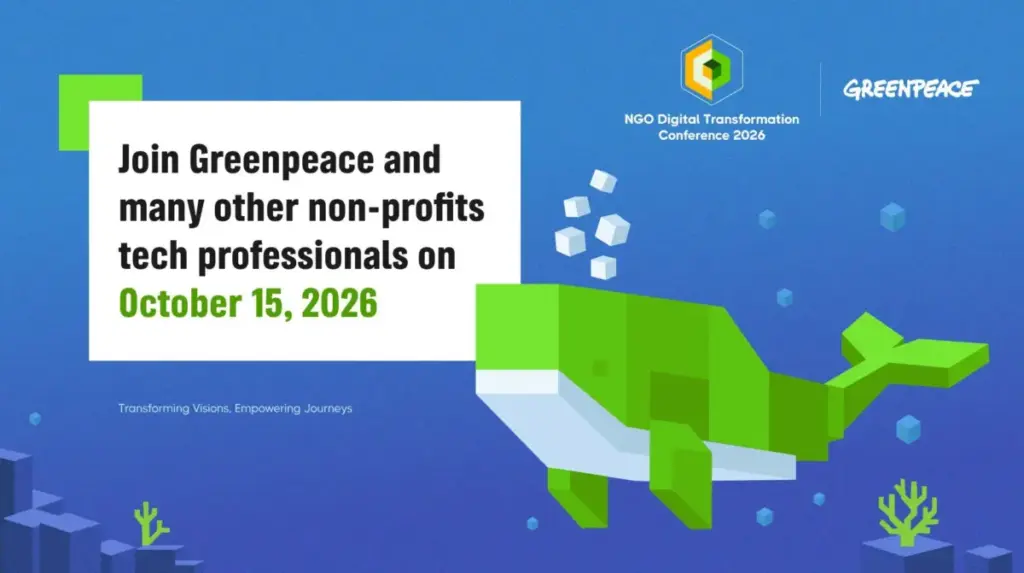
As the architecture of global democracy undergoes unprecedented strain, the civil society organizations tasked with defending human rights, environmental sustainability, and social justice find themselves at a historic crossroads. On Thursday, October 15, 2026, Greenpeace—in strategic collaboration with international civil society organization Tactical Tech—will host its third annual digital transformation conference for non-profits. Entitled “Leveraging our collective power in times of democratic crisis, AI and misinformation,” this landmark virtual event aims to unite visionaries from civil society, academia, and international development to forge a resilient path forward.
For values-based organizations, technology has long served as the lifeblood of mass mobilization, supporter engagement, and operational delivery. However, the contemporary digital landscape is fraught with paradoxes. Non-profits are increasingly forced to navigate severe resource disparities, complex cybersecurity threats, spiraling software costs, and the urgent ethical dilemmas posed by the rapid proliferation of artificial intelligence (AI).
Simultaneously, the sector faces an external onslaught: widening authoritarian governance, the ascendance of right-wing populism and fascism, systemic erosion of civic spaces, and a tidal wave of state- or corporate-sponsored misinformation. Big Tech companies, driven by boundless growth models, construct sprawling data centres that exact heavy environmental tolls while centralizing information power.
This conference is not merely an exercise in technology adoption; it is an urgent political and strategic intervention. The core question facing the global non-profit community on October 15 will not be how to consume more technology, but rather how to intentionally select tools that serve people and the planet, defend fundamental human rights, and systematically reduce institutional dependence on monopolistic tech giants.
Detailed Chronology: The Evolution of NGO Digital Transformation
To understand the weight of the upcoming October 2026 summit, one must trace the rapid evolution of digital strategy within the international non-governmental organization (INGO) sector over recent years.
The Genesis: 2024’s Foundational Awakening
When Greenpeace convened its inaugural digital transformation conference for non-profits in 2024, the global civil society sector was still reckoning with the post-pandemic digital pivot. Non-profits were scrambling to adapt remote work infrastructures, manage fractured data pipelines, and confront rudimentary forms of automated disinformation. The 2024 event established a vital baseline, offering a closed, peer-driven forum where technologists, campaigners, and executive leadership could candidly discuss software dependencies, data sovereignty, and the hidden operational costs of cloud migration. It became immediately clear that civil society could no longer rely on off-the-shelf corporate software solutions designed without values or human rights in mind.
Scaling Up: The 2025 Strategic Consolidation
Building directly on the momentum of its predecessor, the 2025 conference broadened its aperture. As generative AI exploded across mainstream markets throughout 2023 and 2024, non-profits found themselves confronted with unprecedented challenges: deepfakes targeting climate activists, automated hate speech drowning out marginalized voices, and proprietary AI models consuming vast tracts of public data without consent or compensation. The 2025 summit shifted the conversation from basic digital hygiene to proactive strategic alignment. Organizations began mapping out the ecological footprint of their data consumption and questioning the ethics of relying on proprietary AI ecosystems built by the very corporations exacerbating the climate crisis.
The 2026 Imperative: Convergence of Crises
As the sector approaches the October 15, 2026 conference, the converging crises of democratic backsliding, ecological collapse, and unregulated technological acceleration have reached a boiling point. The 2026 agenda reflects this heightened reality. Organized in close partnership with Tactical Tech—a pioneer in investigating the impacts of technology on society—this year’s program moves beyond abstract debates.
The event is engineered to deliver actionable frameworks. It addresses the immediate operational needs of campaigning, supporter engagement, and fundraising teams while simultaneously carving out long-term strategic horizons. Furthermore, the conference features an immersive, interactive workshop designed to feed directly into a comprehensive upcoming report on non-profit technology utilization. Every participant will receive this definitive document following the event, ensuring that the insights generated on October 15 ripple outward across the global civil society ecosystem.
Supporting Context & Metrics: The Dual Crisis of Tech and Democracy
The urgency driving the 2026 Greenpeace-Tactical Tech conference is underscored by a sobering confluence of environmental, political, and economic data points.
The Ecological Cost of the Algorithmic Age
While non-profits champion environmental protection and climate justice, many are inadvertently tethered to the high-carbon infrastructure of Big Tech. The exponential rise of generative AI models and hyper-scaled cloud computing has driven an unprecedented surge in global energy demand. Modern data centres consume vast quantities of electricity—frequently generated by fossil-fuel-reliant grids—and millions of gallons of water for cooling purposes.
For environmental organizations like Greenpeace, this creates an acute ethical contradiction: utilizing cloud services and AI tools that directly accelerate the climate breakdown they are fighting to stop. The conference directly tackles this tension, asking how values-based organizations can decouple their digital operations from unsustainable energy practices.
Information Warfare and the Erosion of Civic Space
Democracy is sliding backward across multiple continents. Authoritarian regimes and right-wing populist movements increasingly deploy sophisticated information operations—weaponizing social media algorithms, deepfakes, and state-backed troll farms—to discredit civil society, silence independent journalism, and polarize electorates.
- The Misinformation Epidemic: NGOs attempting to mobilize populations around climate action, anti-corruption, or human rights find their messaging continuously diluted or actively suppressed by coordinated disinformation campaigns.
- Shrinking Civic Space: Around the globe, legal and digital restrictions on public assembly, online organizing, and free speech are multiplying. Surveillance tech, spyware, and predictive policing algorithms are increasingly utilized by governments to track, intimidate, and dismantle activist networks.
- The Big Tech Monopoly: A handful of multinational technology corporations exercise unchecked control over the digital public square. Their algorithmic sorting mechanisms dictate which voices are amplified and which are marginalized, placing the infrastructure of global democracy in private hands driven entirely by engagement-based advertising models.
Financial and Resource Asymmetries
Unlike corporate entities with vast capital reserves, values-based non-profits operate under permanent resource constraints. They must make agonizing trade-offs between investing in core mission delivery and maintaining secure, up-to-date IT infrastructure.
Cybersecurity presents a stark example: as state-sponsored threat actors and predatory ransomware syndicates increasingly target civil society organizations, underfunded NGOs often lack the specialized personnel and technical defenses required to protect sensitive donor records, activist databases, and internal communications. The cost of commercial software licensing continues to climb, forcing non-profits into perpetual cycles of technological dependency on vendors whose corporate values directly conflict with their mission statements.
Official Statements and Interdisciplinary Collaboration
The 2026 conference is distinguished by its truly multidisciplinary and cross-sectoral lineup. By breaking down traditional silos between civil society practitioners, academic researchers, and international development agencies, the event fosters an environment of rigorous critique and pragmatic problem-solving.
A Safe Space for Radical Candor
A foundational tenet of the Greenpeace-hosted digital transformation series has been the deliberate creation of a safe, confidential space for technology professionals within values-based organizations. Bureaucracy, institutional pride, and donor pressures often mask the true vulnerabilities and technological shortcomings NGOs face. By requiring institutional email addresses or formal proof of affiliation for registration, the event ensures that participants can speak with total transparency.
Attendees can unpack shared failures, debate the pitfalls of failed digital transformations, and strategize candidly about how to build independent, open-source technological alternatives without fear of public exposure or corporate retaliation.
A World-Class Faculty of Speakers and Moderators
The intellectual rigor of the October 15 event is guaranteed by an exceptional roster of contributors drawn from across the global civic technology ecosystem. Confirmed speakers and moderators represent a powerful cross-section of organizational excellence, including:
- Greenpeace International Leadership: Featuring core strategic insights from Luca Tiralongo (Head of Digital Transformation), Maria Julia van Boekel Cheola Torres (Digital Transformation Analyst), and Priscilla Chanda Chomba (Chief Technology Officer). Their collective expertise anchors the event in the day-to-day realities and long-term ambitions of large-scale global campaigning.
- International Human Rights and Humanitarian Defenders: Contributions from Amnesty International and the Norwegian Refugee Council bring critical perspectives on frontline digital security, human rights protection in hostile digital environments, and the safeguarding of vulnerable populations.
- Civil Society and Campaigning Catalysts: Representatives from Tactical Tech, 350.org, and various regional Greenpeace offices will share ground-level tactical innovations in grassroots mobilization, digital campaigning, and counter-surveillance.
- Academic and Foundation Thought Leaders: Insights from Loughborough University, Data Tank, the Bertelsmann Foundation, Nethope, and Aldeias SOS Portugal will bridge empirical research with institutional application, offering macro-level analysis of democratic resilience, algorithmic governance, and cross-sector technological collaboration.
Future Outlook: Building a Sovereign Civil Society Digital Ecosystem
As the virtual doors open on October 15, 2026, the stakes could not be higher. The outcomes of this conference will reverberate far beyond a single day of virtual panels and workshops. They will lay the conceptual and structural groundwork for the next decade of civil society resistance and resilience.
Moving Beyond Vendor Lock-In
A central pillar of the future outlook championed by Greenpeace and Tactical Tech is the urgent need for digital sovereignty. For too long, the non-profit sector has outsourced its digital infrastructure to Silicon Valley giants, accepting terms of service and data extraction models that undermine privacy and public trust.
The 2026 conference challenges organizations to explore and invest in open-source alternatives, decentralized platforms, and cooperative technology networks. By pooling resources and expertise, values-based organizations can build shared digital infrastructure that remains accountable to the public interest rather than corporate shareholders.
Operationalizing Ethical AI and Data Ethics
Looking toward 2030 and beyond, non-profits must establish rigorous ethical frameworks governing their own data collection and use of AI tools. Whether utilizing machine learning for predictive donor modeling or deploying automated translation tools for global campaigns, civil society must demand transparency, data minimization, and absolute protection against algorithmic bias. The insights harvested during the interactive workshop sessions on October 15 will directly inform the upcoming sector-wide report, establishing industry standards for ethical technology deployment.
Solidarity in the Face of Authoritarian Backlash
Ultimately, the 2026 Digital Transformation Conference underscores a fundamental truth: technological resilience cannot be achieved in isolation. In an era defined by the convergence of democratic crises, unchecked corporate surveillance, and environmental degradation, the power of civil society lies exclusively in its collective solidarity.
By uniting technologists, campaigners, researchers, and human rights defenders across international borders, Greenpeace and Tactical Tech are not merely helping non-profits adapt to a changing world—they are empowering them to reshape it.
Event Details At a Glance
- Event Leveraging our collective power in times of democratic crisis, AI and misinformation
- Date: Thursday, October 15, 2026
- Format: Online Virtual Conference
- Hosts: Greenpeace and Tactical Tech
- Registration: Open to verified professionals from values-based non-profit organizations, civil society, academia, and international development via institutional email verification.



