Executive Overview
In the modern urban landscape, the boundary between public art and architecture has increasingly blurred. As cities densify and public spaces become more digitized, fragmented, and commercially driven, the demand for interventions that do more than merely "fill a void" has never been higher. Enter FUTUREFORMS, the acclaimed San Francisco-based interdisciplinary studio led by Jason Kelly Johnson and Nataly Gattegno. For the past decade, the studio has challenged traditional silos, operating at the dynamic intersection of art, architecture, urban design, and advanced computation.
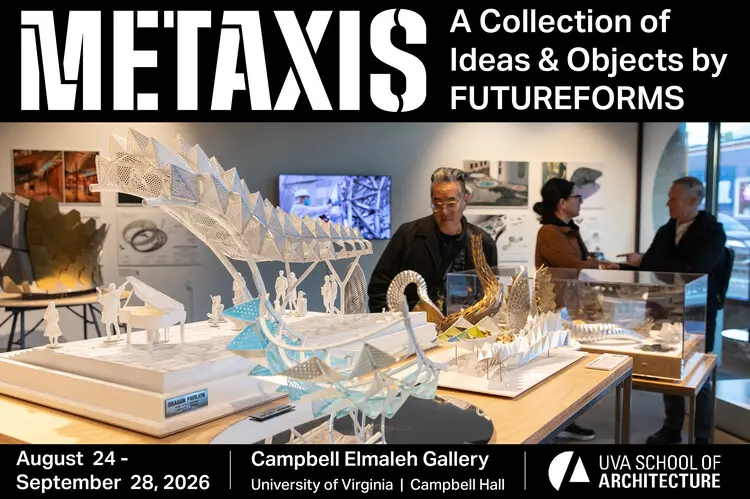
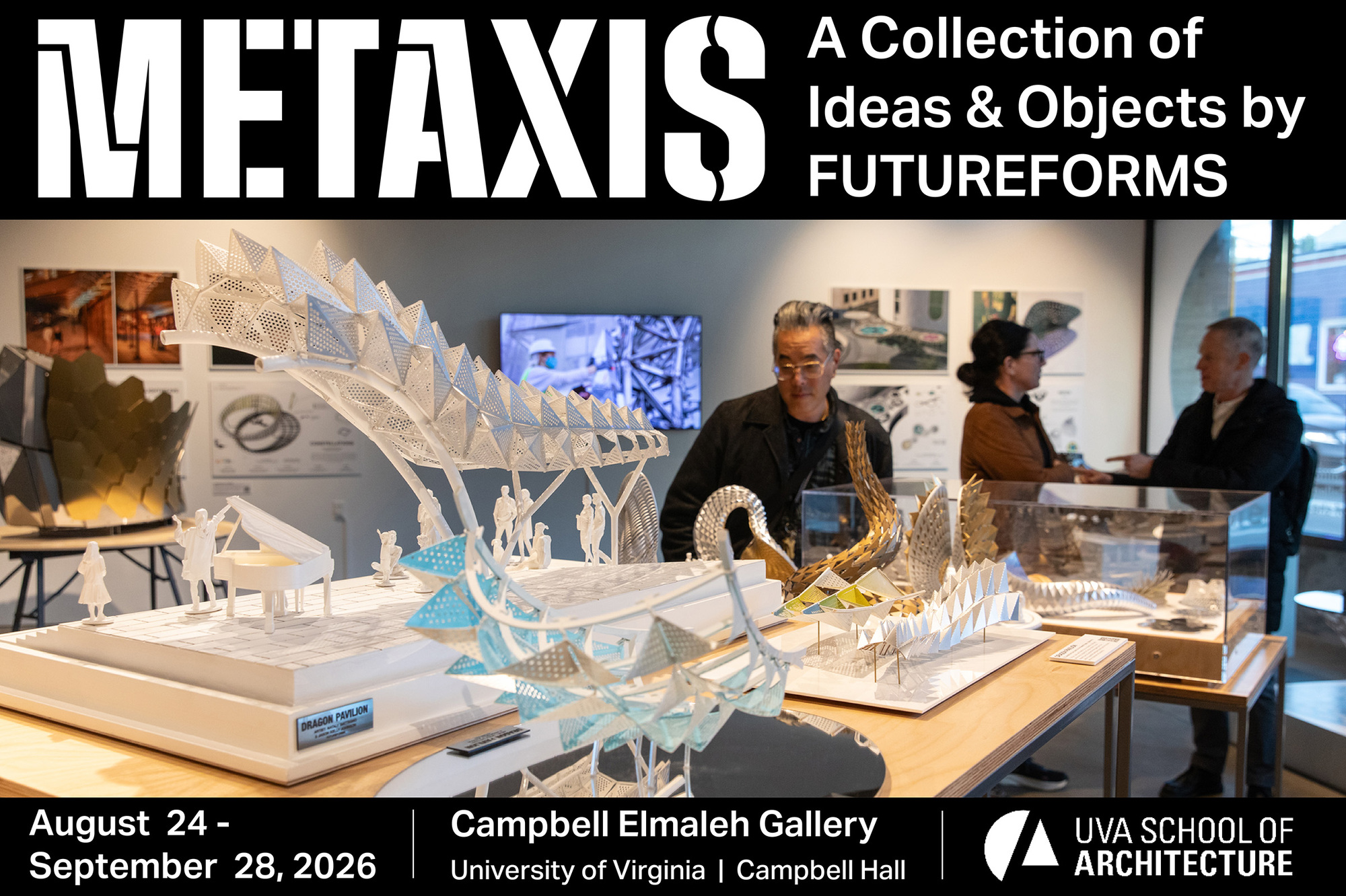
Their latest milestone, an immersive exhibition titled METAXIS: A Collection of Ideas and Objects by FUTUREFORMS, captures a decade of this rigorous exploration. Taking its conceptual anchor from the ancient Greek word metaxi—denoting an in-between condition, a state of belonging to two realms simultaneously—the exhibition serves as a physical and intellectual manifest of transition. Rather than treating design as a fixed outcome, METAXIS investigates the fertile tension that exists between ideas and objects, perception and imagination, presence and absence, and, ultimately, art and architecture.
Structured to mirror an intimate studio visit rather than a standard retrospective, METAXIS exhibits raw process models alongside finished, site-specific installations. The exhibition provides a rare, transparent look into how interdisciplinary tools—ranging from robotic fabrication and algorithmic computation to traditional craftsmanship and structural engineering—converge to shape the public realm. By interrogating what it means to create public art and architecture in the 21st century, FUTUREFORMS positions the "in-between" not as an ambiguous gray zone, but as the primary locus of innovation, community engagement, and spatial identity.
Detailed Chronology: A Decade of Transdisciplinary Evolution
The trajectory of FUTUREFORMS cannot be understood through a linear timeline of completed buildings; rather, it is best mapped as an evolving dialogue between theoretical computation and material reality. Over the last ten years, Johnson and Gattegno have steadily built a portfolio defined by kinetic sculptures, interactive lighting installations, civic monuments, and experimental pavilions that actively reshape how humans experience shared space.
The Foundation Years (Early 2010s): Computation Meets Craft
The roots of FUTUREFORMS are deeply intertwined with the academic and experimental design scene of the San Francisco Bay Area. Following their respective educations at elite institutions—Johnson studying at the University of Virginia and Princeton University, and Gattegno at Cambridge University and Princeton—the duo established their collaborative practice with a shared fascination for digital craftsmanship.
In 2009, both began teaching at the California College of the Arts (CCA), where Johnson founded the pioneering Digital Craft Lab in Architecture, and Gattegno eventually assumed the role of Chair of the Graduate Architecture program. This academic anchor allowed FUTUREFORMS to treat the studio and the classroom as interconnected incubators. During this formative decade, the studio experimented heavily with parametric design, material responsiveness, and environmental feedback loops. They moved away from static, monolithic structures, favoring instead architectures that breathe, shift, and respond to environmental triggers such as wind, sunlight, and human proximity.
Mid-Decade Expansion (2015–2020): Scaling Up to the Public Realm
As computational design matured from theoretical scripts into scalable building practices, FUTUREFORMS successfully transitioned from ephemeral gallery pavilions to permanent civic installations. This era marked a crucial shift: the studio began deploying interactive art pieces in major urban nodes, transportation hubs, and public parks across the United States.
During this period, their work began to consistently answer a pressing contemporary question: How can public infrastructure foster genuine human connection in an increasingly digital world? By embedding sensor technologies, custom-milled metals, and complex geometric patterns into civic spaces, FUTUREFORMS demonstrated that public art could be both technologically sophisticated and emotionally resonant. Each project served as a catalyst for placemaking, turning anonymous transit zones and public plazas into vibrant landmarks.
The Present Era (2020–2026): Retrospection and the METAXIS Manifest
Marking a decade of sustained output, METAXIS (unveiled in August 2026) represents a critical turning point for the studio. It steps back from individual commissions to evaluate the overarching methodology that unites their diverse portfolio. By laying bare the messy, iterative realities of their studio practice—showcasing failed prototypes, structural test prints, digital wireframes, and final production pieces side-by-side—FUTUREFORMS demystifies the creative process. The exhibition asserts that the true value of 21st-century design lies not merely in the polished final object, but in the rigorous, speculative journey required to get there.
Supporting Context & Metrics: The Mechanics of Metaxi
To fully appreciate the depth of METAXIS, one must examine the philosophical and technical frameworks that prop up FUTUREFORMS’ body of work. The exhibition’s title relies heavily on phenomenological and spatial theories, translated into physical materiality through advanced computational engineering.
The Philosophy of Metaxi
In classical Greek philosophy, particularly in the dialogues of Plato, metaxi describes the mediating state—the bridge between the mortal and the divine, ignorance and wisdom, or the physical and the ideal. FUTUREFORMS co-opts this term to describe the contemporary human condition in mediated public spaces. Today’s citizens exist in a perpetual metaxi: between the physical built environment and digital interfaces, between solitary isolation and dense urban crowds, between permanent infrastructure and ephemeral experiences.
By framing their work around this condition, Johnson and Gattegno create installations that refuse to settle into simple categorizations. Is a kinetic canopy over a public plaza a piece of architecture, a sculpture, or an environmental engineering device? By operating deliberately in the metaxi, it is all of these simultaneously.
| Dimension of Metaxi | Traditional Approach | FUTUREFORMS Approach (METAXIS) |
|---|---|---|
| Discipline | Siloed (Art or Architecture or Engineering) | Radical Interdisciplinarity (Synthesized into a single workflow) |
| Public Space | Static monuments meant to be viewed | Responsive, interactive environments meant to be inhabited and co-created |
| Design Process | Linear progression from sketch to construction document | Iterative, computational feedback loop integrating failure and prototyping |
| Materiality | Standardized, cost-driven construction materials | Custom-fabricated, algorithmically optimized geometries and sensors |
The Studio-as-Exhibition Methodology
METAXIS breaks away from the conventional white-cube architectural exhibition, which typically showcases glossy photographs of completed buildings alongside sleek, heroic scale models. Instead, the exhibition adopts the chaotic, generative atmosphere of the FUTUREFORMS studio itself. Visitors encounter:
- Parametric Wireframes: Early digital iterations that reveal how algorithmic scripts govern complex curves and structural loads.
- Material Test Fragments: Full-scale physical mock-ups demonstrating how aerospace-grade metals, composites, and plastics behave under stress.
- Kinetic and Robotic Components: Functional mechanisms that hint at the responsiveness embedded in their completed public projects.
This transparency highlights the reality of 21st-century architectural production: it is messy, highly collaborative, and heavily reliant on the cross-pollination of seemingly disparate technical fields.
Official Statements & Design Philosophy
The intellectual backbone of FUTUREFORMS is shaped by the dual leadership of Jason Kelly Johnson and Nataly Gattegno. Their combined backgrounds—spanning North America and Europe, traditional architectural history and cutting-edge computation—inform a cohesive philosophy on the future of the built environment.
In describing the motivation behind their practice and the genesis of METAXIS, the founders emphasize the necessity of emotional resonance within technological design:
"Public art and architecture in the 21st century cannot afford to be passive. We live in spaces saturated by screens, data, and rapid transformation. Our goal has always been to slow down that velocity—to create moments of friction, pause, and genuine human exchange within the shared urban fabric. Through METAXIS, we wanted to expose the machinery of our thinking, showing that every finished landmark is actually the tip of an iceberg made of hundreds of discarded ideas, failed models, and relentless digital iterations."
Furthermore, their academic positions at the California College of the Arts have heavily influenced their collaborative ethos. By directing the Digital Craft Lab and leading the Graduate Architecture program, Johnson and Gattegno view education and professional practice as a continuous feedback loop. The studio serves as a testing ground for ideas first conceptualized in academic seminars, while real-world civic commissions frequently feed back into student research projects regarding digital fabrication, material science, and ecological urbanism.

Future Outlook: The Next Decade of Civic Interventions
As METAXIS opens a window onto the past ten years of FUTUREFORMS’ output, it simultaneously projects an ambitious vision for the future of public design. The challenges facing 21st-century cities—climate change, rapid urbanization, social alienation, and the integration of artificial intelligence into physical infrastructure—demand spatial solutions that are radically adaptable.
Towards Adaptive Civic Infrastructure
Looking ahead, FUTUREFORMS is positioning itself at the forefront of adaptive civic infrastructure. The lessons learned from a decade of creating site-specific installations point toward a future where buildings and public art installations are not merely "smart" in a digital sense, but ecologically and materially resilient. By continuing to merge computational design with advanced manufacturing techniques, the studio aims to design public spaces that can physically reconfigure themselves in response to environmental shifts or shifting community needs.
Redefining Community Participation
Another critical frontier for the studio is the evolution of community participation in the design process. Traditional public art commissions often rely on top-down decision-making processes that alienate local populations. FUTUREFORMS’ methodology, highlighted in METAXIS, suggests a different paradigm: one where public installations act as interactive platforms that invite citizens to actively shape the identity of their neighborhoods.
As cities worldwide grapple with the need for more inclusive, engaging, and mentally restorative public realms, the work of FUTUREFORMS offers a vital roadmap. By mastering the art of the metaxi—the productive space between disciplines, technologies, and ideas—Johnson, Gattegno, and their team prove that the most compelling architecture happens when you refuse to stand still on either side of the boundary.