Executive Overview
For decades, one of the most persistent enigmas in marine biology has centered on the early life stages of sea turtles. Following their frantic, instinctual hatch from coastal nests into the surf, juvenile sea turtles vanish into the vast expanse of the open ocean. For years—sometimes up to a decade—these creatures seemingly disappear from scientific observation. This mysterious phase in their life cycle is universally referred to by marine researchers as the "lost years."
Today, however, the veil is finally lifting. In a groundbreaking collaborative initiative between the Two Oceans Aquarium Turtle Conservation Centre, Upwell Turtles, and Mission Blue, cutting-edge miniature satellite telemetry is shedding unprecedented light on this elusive developmental window. By outfitting rehabilitated juvenile loggerhead sea turtles—such as patients affectionately named Tolkien and Mpho—with advanced tracking devices, conservationists are mapping their precise trajectories as they navigate South Africa’s officially designated "Hope Spots" and transition into the deep pelagic zones of the open ocean.
This comprehensive report examines the intersection of marine rehabilitation, advanced geospatial tracking, and conservation policy. By following the remarkable journeys of Tolkien, Mpho, and their cohort, we explore how empirical data gathered from satellite tags is not only demystifying turtle biology but also reshaping international frameworks for marine protection. As human pressures on the global ocean intensify, understanding where these young reptiles feed, drift, and mature has never been more critical to preventing their decline.
Detailed Chronology: From Rescue to Pelagic Pioneer
To understand the magnitude of these turtles’ satellite-tracked journeys, one must first appreciate the harrowing origins of their second chance at life. The chronology of a rehabilitated sea turtle’s life is a testament to the resilience of marine wildlife and the tireless efforts of veterinary rehabilitation teams.
Phase One: Rescue and Triage Along the South African Coastline
The stories of juvenile loggerheads like Tolkien and Mpho typically begin in distress. Along the rugged, dynamic coastline of South Africa’s Western and Eastern Capes, young turtles often wash ashore. Many are victims of severe environmental stressors: hypothermic stunning due to dropping water temperatures, entanglement in marine debris, or boat strikes.
Upon intake at the Two Oceans Aquarium Turtle Conservation Centre, these fragile patients undergo immediate, rigorous medical evaluations. Dehydration, shell trauma, and secondary bacterial infections are common. Veterinary teams utilize advanced diagnostics—including blood panels, radiographs, and endoscopic procedures—to stabilize the animals. For months, these turtles receive intensive care, specialized diets, and physical therapy in controlled aquatic environments designed to mimic natural conditions while ensuring safe recuperation.
Phase Two: Pre-Release Assessment and Technological Integration
Once a turtle achieves target weight milestones, demonstrates robust foraging behaviors, and passes exhaustive health clearances, it is cleared for release. However, modern conservation biology demands more than simply returning an animal to the wild; it requires gathering data to evaluate the success of the rehabilitation process.
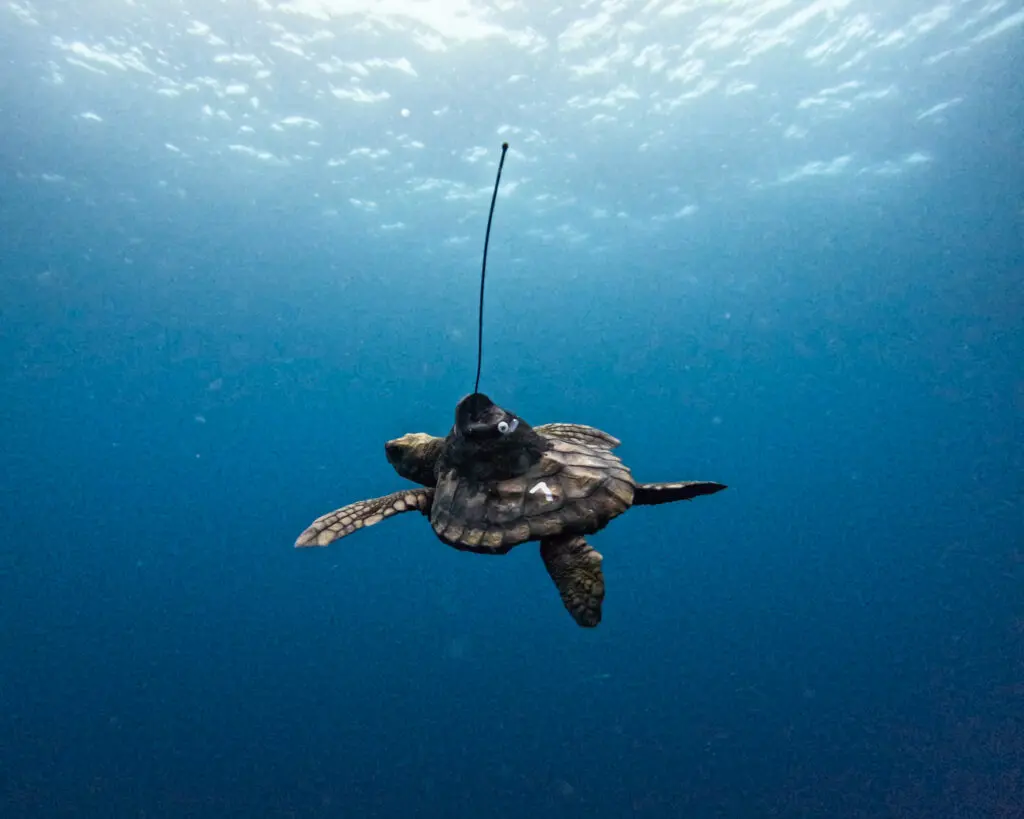
Prior to release, specialized, low-profile satellite transmitters are securely affixed to the carapace (top shell) of the turtles using marine-grade epoxy. These tags are aerodynamically and hydrodynamically engineered to minimize drag and prevent interference with the turtle’s natural swimming mechanics. As the turtle surfaces to breathe, the tag transmits positional data via the Argos satellite system, allowing researchers in Cape Town, California, and across the globe to monitor their movements in near real-time.
Phase Three: The Odyssey Through South Africa’s Hope Spots
Upon release into the wild coastal waters, the tracking data reveals a fascinating behavioral choreography. Rather than plunging immediately into the abyss, individuals like Tolkien and Mpho often spend initial weeks navigating South Africa’s designated Hope Spots—special areas of the ocean that are scientifically identified as critical to the health of the marine ecosystem.
The tracking maps illustrate how these juvenile loggerheads utilize complex coastal currents, upwellings, and nearshore thermal fronts. These zones act as biological nurseries, providing an abundance of microscopic prey and sheltered waters where the newly released turtles can recalibrate their natural navigational compasses.
Phase Four: Transitioning Into the Open Ocean and the "Lost Years" Unlocked
As the weeks progress, the satellite telemetry records a dramatic shift in behavior. The turtles venture further offshore, caught up in the powerful, swirling currents of the Agulhas Current system and the broader South Indian Gyre. This is the moment they officially re-enter their "lost years"—with one crucial difference: human scientists are now watching every move.
By mapping these offshore dispersals, researchers can finally pinpoint where juvenile loggerheads spend their pelagic developmental phase. Instead of a complete black box, science now has a dynamic, data-driven window into the oceanic highways used by these resilient marine reptiles.
Supporting Context & Metrics: Decoding the Data
The partnership between the Two Oceans Aquarium Turtle Conservation Centre, Upwell Turtles, and Mission Blue represents a paradigm shift in marine conservation. By merging hands-on veterinary medicine with macro-scale satellite telemetry, this coalition is generating unprecedented empirical datasets.
The Significance of Hope Spots
Endorsed by Mission Blue—the global initiative founded by legendary oceanographer Dr. Sylvia Earle—Hope Spots are special places that are critical to the health of the ocean. They are akin to national parks on land, yet the vast majority of marine environments lack enforceable boundaries.
The tracking data collected from Tolkien, Mpho, and other rehabilitated loggerheads provides empirical justification for the establishment and expansion of these Hope Spots. When telemetry reveals that multiple juvenile sea turtles systematically utilize specific oceanic corridors for feeding and migration, conservationists gain undeniable proof that these areas require strict legislative safeguards against industrial fishing, shipping lanes, and pollution.
Technological Breakthroughs in Telemetry
The miniature satellite tags utilized in this project represent a triumph of bio-logging engineering. Decades ago, tracking animals as small as juvenile sea turtles was nearly impossible due to the sheer size and weight of transmitters. Today, micro-transmitters weigh mere grams, operating on ultra-low-power consumption cycles that maximize battery life while remaining completely inert to the animal’s physical well-being.
The metrics captured by these devices include:
- Geographic Position: Latitude and longitude fixes accurate to within a few hundred meters.
- Dive Profiles: Time spent submerged versus time spent resting or breathing at the surface.
- Surface Temperature: Environmental water temperature readings that help scientists track how turtles respond to thermal fronts and climate-induced ocean warming.
Official Statements and Expert Perspectives
The collaborative nature of this project has drawn commentary from leading figures in international marine conservation, highlighting the global importance of local rehabilitation efforts.
"What we are witnessing through the journeys of Tolkien, Mpho, and their fellow travelers is nothing short of a revelation. For generations, the pelagic phase of a sea turtle’s life was completely obscured from science. Today, thanks to the synergy between dedicated veterinary teams and advanced geospatial tracking, we are peering directly into the ‘lost years.’ This data is not just academic; it is the blueprint for how we must protect our blue planet’s most critical migration corridors."
— Dr. Sylvia Earle, Founder of Mission Blue
Marine biologists at the Two Oceans Aquarium Turtle Conservation Centre emphasize that every rehabilitated turtle tells a broader story about the health of the marine environment.
"When a turtle comes into our facility, our immediate goal is clinical recovery. But our ultimate responsibility is to understand why they got here and what happens when they leave our care. By collaborating with Upwell Turtles and Mission Blue, we bridge the gap between local rescue work and global ocean conservation. When we watch Tolkien and Mpho navigate the open ocean via satellite, we are reminded that ocean conservation knows no borders."
— Lead Conservation Scientist, Two Oceans Aquarium Turtle Conservation Centre
Upwell Turtles, an organization dedicated to the conservation of sea turtles throughout their marine habitats, underscores the policy implications of telemetry data.
"Satellite tracking transforms anecdotes into evidence. Policymakers cannot protect what they cannot see. By mapping the exact pathways juvenile loggerheads travel through South Africa’s Hope Spots and into the high seas, we are providing governments and international bodies with the actionable data required to draft legally binding marine protected areas."
— Director of Field Research, Upwell Turtles
Future Outlook: The Road Ahead for Marine Protection
As climate change, plastic pollution, and industrial overfishing continue to exert unprecedented pressures on marine ecosystems, the future of sea turtles remains precarious. However, initiatives like the collaborative StoryMap project offer a beacon of hope through innovation and education.
Scaling Up Tracking and Research
Looking forward, the consortium aims to expand the tagging program to include a wider demographic of sea turtles, encompassing different species—such as green turtles and hawksbills—as well as varying age classes. By increasing the sample size of tracked individuals, researchers can construct robust, multi-year statistical models of oceanic dispersal patterns. These models will be crucial for predicting how shifting ocean currents and rising sea temperatures driven by climate change will impact sea turtle migration routes.
Influencing International Marine Policy
The ultimate goal of this telemetry-driven research is policy transformation. Data gathered from Tolkien, Mpho, and future satellite-tracked turtles will be directly fed into international conservation bodies, including the International Union for Conservation of Nature (IUCN) and the Convention on Migratory Species (CMS). By demonstrating the precise ecological value of South Africa’s Hope Spots and high-seas corridors, advocates can lobby for the creation of fully protected marine reserves that shield vulnerable sea turtles from pelagic longline fishing and seismic testing.
Engaging the Global Public
Scientific data alone cannot save the oceans; it requires public engagement and grassroots support. Through the interactive ArcGIS StoryMap created in collaboration between Mission Blue, Upwell Turtles, and the Two Oceans Aquarium, everyday citizens from around the globe can virtually accompany these rehabilitated turtles on their epic odysseys.
By visualizing the immense distances traversed by animals that once lay helpless on a South African beach, the public is invited to connect emotionally and intellectually with the broader crisis facing the world’s oceans.
Call to Action: Follow the Journey
The story of ocean conservation is still being written, and every individual has a role to play. To experience the interactive mapping, dive deeper into the behavioral metrics of Tolkien and Mpho, and discover how these remarkable young reptiles are teaching humanity how to safeguard the open ocean, visit the official ArcGIS StoryMap:
🔗 Explore the StoryMap at storymaps.arcgis.com
Support marine conservation efforts by visiting the Two Oceans Aquarium Turtle Conservation Centre, Upwell Turtles, and Mission Blue websites to learn how you can contribute to protecting our blue planet for generations to come.