
Executive Overview
For decades, the travel and tourism industry has relied on a familiar lexicon of ecological marketing. Words like “green,” “eco-friendly,” “sustainable,” and “responsible” have served as baseline descriptors for everything from multi-city tour packages to boutique hotel stays. While many tourism operators adopt these terms with genuine intentions to protect destinations and minimize ecological damage, the landscape has long been plagued by ambiguity. Broad, sweeping green claims made without verifiable data have left modern travelers struggling to distinguish genuine conservation efforts from strategic greenwashing.
This era of unchecked environmental messaging is rapidly drawing to a close. Set to take full effect on September 27, 2026, the European Union’s new Empowering Consumers for the Green Transition (EmpCo) Directive introduces a rigorous regulatory framework designed to overhaul sustainability marketing. The directive imposes strict legal boundaries on how corporations—including global travel providers—communicate their environmental impact to consumers.
For the tourism sector, compliance is no longer a matter of ethical branding or voluntary corporate social responsibility; it is an urgent legal mandate. The regulation affects any enterprise selling travel products to EU consumers, regardless of whether the business is headquartered in Berlin, New York, Tokyo, or Buenos Aires.
The core message for tourism operators is clear: environmental marketing must transition from unsupported claims to demonstrable metrics. While the new mandates present an operational hurdle, they also offer a vital opportunity for transparent businesses to build authentic trust with an increasingly skeptical consumer base. This comprehensive guide examines the architecture of the EmpCo Directive, explores its catalysts, breaks down its core mandates, and outlines actionable steps for travel brands preparing for the 2026 enforcement deadline.
Detailed Chronology: The Road to the EmpCo Directive
Understanding the gravity of the EmpCo Directive requires examining the regulatory and consumer timeline that led to its enactment. Over the last decade, public demand for sustainable products has surged exponentially. However, regulatory bodies failed to keep pace with the explosion of green marketing, creating a Wild West of corporate claims.

- January 2020: The European Commission published a landmark study evaluating environmental claims across consumer markets. The findings were stark: 53% of all environmental claims evaluated were found to be vague, misleading, or entirely unfounded, while 40% lacked any supporting evidence whatsoever. This report served as the foundational wake-up call for EU lawmakers.
- March 2023: Recognizing the systemic deception eroding consumer confidence, the European Commission formally proposed the EmpCo Directive alongside complementary circular economy initiatives. The proposal aimed to amend existing consumer protection laws (specifically the Unfair Commercial Practices Directive and the Consumer Rights Directive) to explicitly target deceptive environmental marketing.
- Early 2024: Following intensive legislative negotiations, the European Parliament and Council officially adopted the EmpCo Directive. The final text was published in the Official Journal of the European Union, setting strict timelines for member states to transpose the rules into national law.
- March 27, 2026: Member states are legally required to adopt and publish the laws, regulations, and administrative provisions necessary to comply with the EmpCo Directive.
- September 27, 2026: The official enforcement date. From this point forward, businesses marketing to EU consumers must fully comply with the EmpCo standards, facing severe penalties for non-compliance.
- The Horizon: While the EmpCo Directive governs business-to-consumer (B2C) marketing communications and general commercial practices, the EU continues to deliberate on the highly anticipated Green Claims Directive. Once adopted, the Green Claims Directive will introduce even more granular, pre-approval substantiation and verification requirements for specific environmental claims, reinforcing the regulatory moat around corporate green marketing.
Supporting Context & Metrics: Consumer Skepticism and the Travel Industry
The urgency behind the EmpCo Directive is rooted in empirical data tracking consumer behavior and skepticism. As travelers become more aware of the environmental footprint of tourism—ranging from carbon-heavy aviation to overtourism pressures on local communities—their trust in corporate sustainability messaging has plummeted.
Key Industry Metrics
- Over 50% Consumer Skepticism: According to global research by YouGov, more than half of all consumers express deep skepticism regarding corporate sustainability claims, doubting whether brands are truly delivering on their green promises.
- The Credibility Gap: Booking.com’s sustainable travel research highlights a persistent paradox: while travelers increasingly express a desire to explore the world responsibly, they routinely cite a lack of transparent, trustworthy information as a primary barrier to booking eco-friendly options.
- The Certification Problem: European Commission audits revealed that nearly 50% of all green labels, badges, and sustainability seals offer weak, superficial, or entirely absent verification mechanisms. This proliferation of unverified self-awarded seals directly inspired EmpCo’s strict rules governing sustainability labels.
These statistics underscore a commercial reality for tour operators, hoteliers, and travel advisors: greenwashing is no longer just an ethical issue—it is a financial liability. Brands that fail to substantiate their claims risk alienating discerning travelers and exposing themselves to aggressive legal and financial penalties under EU law.
Official Scope and Requirements: Who Is Affected and What Is Demanded?
Who Do the Rules Apply To?
The jurisdictional reach of the EmpCo Directive is broad. A simple rule of thumb dictates compliance: If your business sells travel services to consumers located within the European Union, or provides products to companies that do, these standards govern your public communications.
This includes:
- International and regional tour operators.
- Hotels, resorts, eco-lodges, and alternative accommodations.
- Travel agencies, advisors, and online booking platforms (OTAs).
- Destination Marketing Organizations (DMOs) promoting regional travel.
- Business-to-Business (B2B) suppliers whose marketing copy, brochures, or data feeds are reused in consumer-facing channels.
Crucially, the physical location of the business is irrelevant. Whether a safari lodge is based in East Africa, a boutique adventure company operates out of South America, or a cruise line is headquartered in North America, marketing to EU citizens brings them squarely under the jurisdiction of the EmpCo Directive.

Core Mandates of the EmpCo Directive
The legislation targets several pervasive marketing practices, transforming them from standard copywriting tactics into illegal commercial activities.
1. The Ban on Vague and Generic Claims
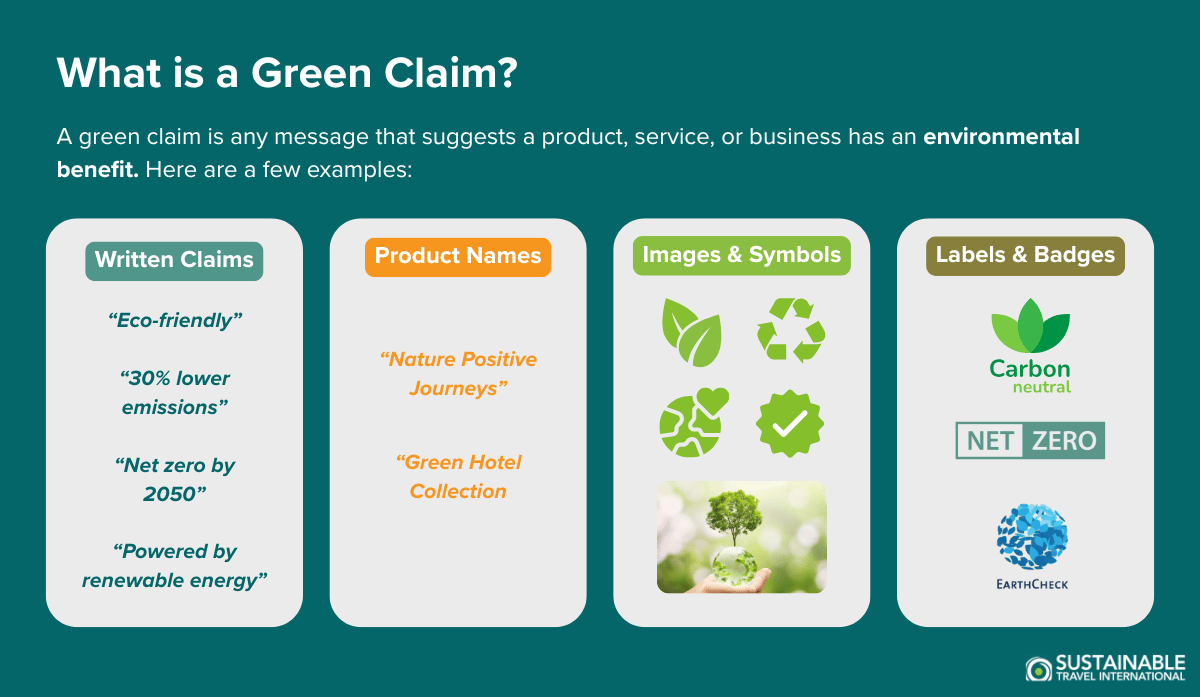
Generic environmental statements—such as “eco-friendly,” “green,” “nature-positive,” or “conscious travel”—are prohibited unless the business can prove outstanding environmental performance backed by a recognized, independent certification (such as the EU Ecolabel, Nordic Swan Ecolabel, or Austrian Ecolabel).
- What to avoid: Labeling a tour catalog as "Climate-Friendly Journeys" without quantitative backing.
- What to do instead: Use precise, transparent language detailing specific operational changes. For example: "We have replaced 90% of domestic flights on our itineraries with electric rail transit, reducing route-specific transport emissions by 34%."
2. Prohibition of Overstated Claims and Scope Creep
Businesses must accurately represent the scope of their environmental achievements. If an office building utilizes 100% renewable energy, the company cannot market its entire tour portfolio as "powered by renewable energy." Similarly, mandatory practices required by local law (such as the legal elimination of single-use plastics within a specific municipality) cannot be marketed as unique, voluntary sustainability achievements.
3. Strict Separation of Carbon Offsets and Emission Reductions
One of the most consequential impacts of the EmpCo Directive on the travel sector involves how companies communicate carbon offsets.
Under the new rules, businesses cannot describe a tour, hotel stay, flight, or travel package as “carbon neutral,” “net zero,” or “climate compensated” simply by purchasing external carbon offsets. The Directive draws a rigid legal line between internal emission reductions (efforts made within a company’s own value chain to reduce physical footprint) and external climate funding (investments in global projects like forest conservation or renewable energy infrastructure).
While investing in external climate solutions remains vital for global climate action, marketing must frame these investments accurately:
- Prohibited phrasing: "This trek is 100% carbon neutral thanks to our offset program."
- Compliant phrasing: "We invest in certified ecosystem protection projects that deliver carbon sequestration equivalents matching the estimated footprint of our trips, running parallel to our direct emissions reduction roadmap."
4. Mandatory Substantiation for Future Commitments
Aspirational goals are no longer sufficient. If a travel brand publicizes future commitments—such as pledging to "achieve net-zero emissions by 2040" or "eliminate single-use plastics across all properties"—that commitment must be supported by:
- A detailed, publicly accessible implementation plan.
- Time-bound, measurable intermediary targets.
- Dedicated financial and operational resources.
- Regular, independent monitoring and progress reviews conducted by qualified third-party experts.
5. Crackdown on Unverified Labels and Trust Marks
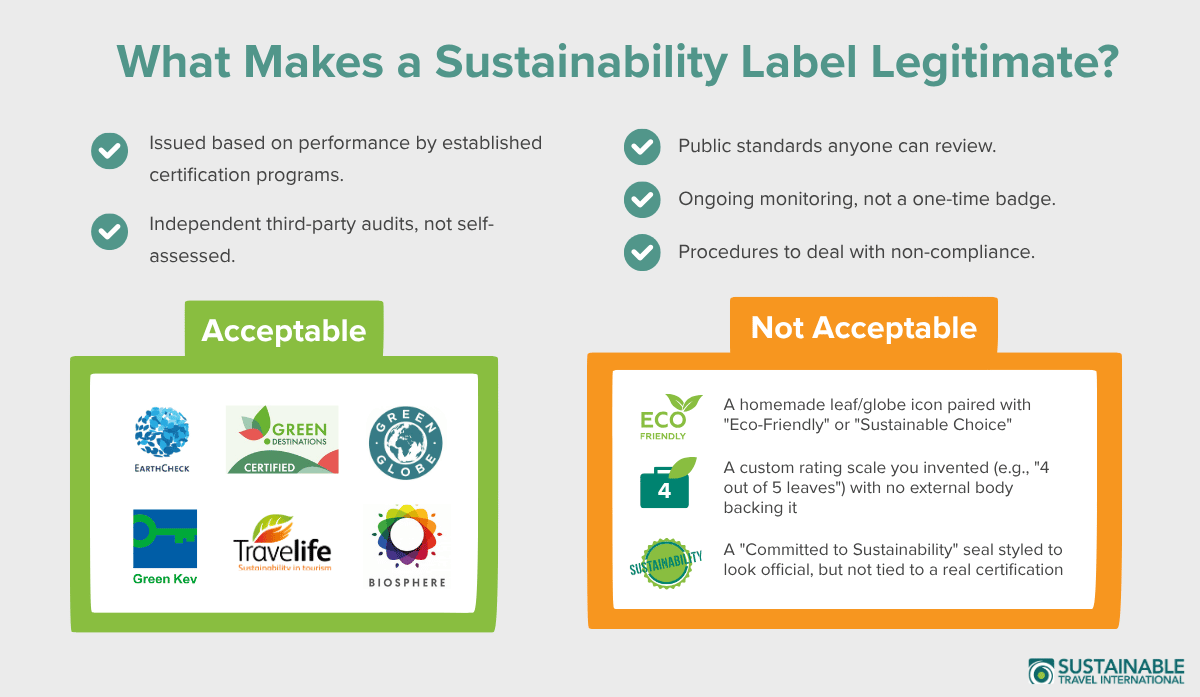
The display of self-created badges, homemade stamps (e.g., placing a custom "Green Certified" leaf icon on a website), or unverified seals is strictly outlawed. Any seal, logo, or trust mark displayed by a tourism business must originate from a recognized public authority or a rigorous certification scheme featuring independent, ongoing third-party auditing. Established tourism certifications that meet these criteria include Travelife, Green Key, Green Globe, EarthCheck, and Green Destinations.
Future Outlook: Preparing Your Business for September 2026
As the September 2026 enforcement deadline approaches, tourism businesses must proactively audit their marketing collateral, supply chains, and operational data. Preparation does not require abandoning sustainability marketing; rather, it demands shifting from rhetorical branding to data-backed transparency.
Step-by-Step Preparation Checklist
- Conduct a Comprehensive Marketing Audit: Review all active digital assets—including websites, booking portals, brochures, social media channels, and partner materials—to identify every instance of green terminology, eco-badges, and environmental imagery.
- Eliminate Unsubstantiated Buzzwords: Purge generic, unverified claims such as "eco-friendly" or "sustainable" unless backed by recognized type-1 ecolabels. Replace them with granular, verifiable operational facts.
- Audit Your Carbon and Sustainability Data: Implement robust tracking mechanisms to measure resource consumption. Utilize recognized measurement tools—such as dedicated hotel carbon measurement frameworks and tour emissions calculators—to establish baseline metrics for waste, water, energy, and carbon.
- Revise Carbon Offset Messaging: Immediately remove terms like "carbon neutral," "climate neutral," or "offset-compensated" from product descriptions. Reframe offset investments as parallel contributions to global climate projects that complement, rather than neutralize, direct reduction efforts.
- Verify Your Certifications: Ensure that any external sustainability labels or seals displayed on your channels are issued by accredited third-party verification bodies with transparent, publicly available standards.
- Formalize Sustainability Roadmaps: If your brand promotes forward-looking environmental commitments, work with independent advisors to formalize an actionable, time-bound transition plan with verifiable milestones.
Accessing Industry Support
Navigating complex European regulatory frameworks can be daunting for independent tour operators, boutique hotels, and travel agencies. Industry groups and specialized resource networks—such as comprehensive Sustainable Travel Memberships—offer vital support systems. These platforms provide access to practical carbon calculation tools, staff training programs, expert regulatory guidance, and streamlined sustainability marketing frameworks.
By embracing the EmpCo Directive not as a bureaucratic burden, but as a framework for genuine integrity, forward-thinking tourism enterprises can restore consumer trust, future-proof their operations, and lead the global transition toward truly responsible travel.