

Executive Overview
For two decades, the Biodiversity Heritage Library (BHL) has served as the digital cornerstone of natural history preservation, safeguarding the fragile, ink-stained foundational records of global ecology. As the organization celebrates its 20th anniversary through its commemorative series, "BHL at 20: Treasures from the Biodiversity Heritage Library," the spotlight turns inward to the fertile prairies and river valleys of Illinois. Here, two towering figures of 19th- and 20th-century natural science—Stephen A. Forbes and Charles Robertson—forged methodologies that permanently redefined humanity’s understanding of environmental systems.
The University of Illinois Urbana-Champaign Library has played a vital role in this anniversary milestone by contributing rare archival materials, foundational texts, and field logs authored by Forbes and Robertson to the BHL ecosystem. These contributions bridge the gap between historical discovery and contemporary climate and biodiversity research. While Forbes revolutionized aquatic ecology, fisheries science, and environmental management through a holistic lens, Robertson dedicated decades to meticulous, localized pollination networks, documenting the delicate interactions between insects and flora. Today, their preserved specimens, meticulously annotated ledgers, and beautifully illustrated publications are not mere historical artifacts; they serve as irreplaceable baselines for modern conservation biologists tracking ecological collapse and species loss in an era of rapid environmental change.
Detailed Chronology: The Lives and Legacies of Forbes and Robertson
Stephen A. Forbes: The Architect of Applied Ecology
Born on May 29, 1844, Stephen Alfred Forbes emerged as a transformative figure in American zoology and entomology. Operating primarily out of the University of Illinois Urbana-Champaign, Forbes rejected the narrow, compartmentalized approach to natural history typical of his era. Instead, he pioneered a holistic worldview, studying insects, crustaceans, fishes, and birds not in isolation, but as deeply interconnected threads within a complex environmental fabric.
Forbes’s rigorous scholarship earned him international renown. In 1886, his groundbreaking scientific publications were honored with the first-class medal of the Société d’Acclimation de France. Continuing his administrative and scientific leadership, he was appointed director of the Natural History Survey Division in 1917, a post he held until his death on March 13, 1930, in Urbana, Illinois.

Among his most enduring contributions is the monumental work The Fishes of Illinois. This comprehensive volume meticulously documented over 150 fish species, drawing upon an astonishing repository of more than 200,000 specimens collected systematically across all 102 counties of Illinois. The publication’s visual impact matched its scientific rigor, featuring exquisitely detailed color paintings by talented illustrators Lydia M. (Hart) Green and Charlotte M. Pinkerton, alongside highly accurate distribution maps.
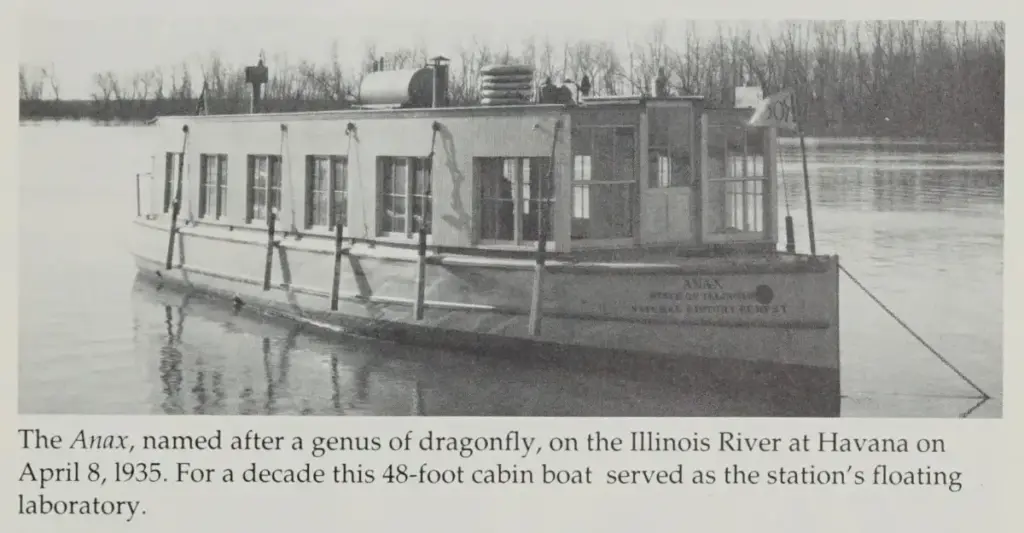
Forbes’s commitment to continuous, field-based research led him to establish the Forbes Biological Station in 1894 along the Illinois River in Havana, Illinois. Two years later, in 1896, he directed the construction of a pioneering 48-foot floating biological laboratory at the site. This floating station facilitated immersive, uninterrupted aquatic research. The Illinois Natural History Survey (INHS) later commemorated these massive contributions by celebrating the 150th anniversary of Forbes’s birth on May 26, 1994.
Charles Robertson: The Quiet Observer of Prairie Pollinators
While Forbes mapped the aquatic ecosystems of Illinois, Charles Robertson unlocked the intricate choreography of its terrestrial flora and fauna. Born on June 12, 1858, in Carlinville, Illinois, Robertson pursued his early academic education at Blackburn College in his hometown before advancing his studies in botany and zoology at Harvard University. He eventually returned to Blackburn College, imparting knowledge as a professor of biology and Greek.
Robertson’s life and work were characterized by an unhurried, monastic patience. He spent more than two decades systematically recording the visitors to native plants in and around Carlinville. Over this extraordinary span, he cataloged 1,429 pollinating insect species—including diverse flies, beetles, butterflies, and bees—interacting with 456 plant species. His personal life mirrored his academic discipline; born and raised in the same small town, he maintained lifelong, steady relationships and approached his fieldwork with a quiet tenacity that defied the frantic pace of the industrializing world. He was actively collecting insect specimens in Florida just months before his death on June 1, 1935.

His magnum opus, Flowers and Insects, published in 1928, remains one of the most exhaustive, localized studies of flower-visiting insects ever undertaken. Every single insect recorded in the volume was explicitly cross-referenced with the exact plant specimen upon which it was gathered, creating a gold standard for ecological data collection.
Supporting Context & Metrics: Data, Archives, and Modern Relevance
The enduring value of the Forbes and Robertson collections extends far beyond historical curiosity; they provide critical empirical datasets for 21st-century conservation science.
The Metrics of Discovery
- 200,000+: The number of fish specimens collected across 102 Illinois counties, forming the empirical foundation for The Fishes of Illinois.
- 150+: Fish species meticulously cataloged, mapped, and illustrated within Forbes’s landmark aquatic surveys.
- 1,429: Pollinating insect species meticulously documented by Charles Robertson in Carlinville, Illinois.
- 456: Native plant species cross-referenced against insect visitors in Robertson’s lifetime database.
- 1877–1935: The chronological span of Robertson’s preserved correspondence, reprints, five comprehensive ledgers, and bee-research data books housed in the University Archives at the University of Illinois Urbana-Champaign.
Modern Scientific Applications
In an era grappling with insect apocalypse and global pollinator decline, Robertson’s historical field logs have assumed Lazarus-like scientific importance. Because contemporary ecosystems in places like Carlinville have undergone severe fragmentation and industrialization, modern researchers can no longer observe pristine historical baselines firsthand.
Instead, scientists rely on Robertson’s specimen collection logs—which document specimen numbers, scientific names, sexes, precise collection dates, localities, and host plants—to measure ecological degradation. Notably, Robertson’s archives served as the foundation for a landmark investigation into species extinction and localized plant-pollinator network collapse published in Ecology & Society by John Marlin, a research affiliate with the Illinois Sustainable Technology Center and INHS. Furthermore, a quantitative analysis published in July 2026 in the Data Science Journal unlocked the deep, latent computational value hidden within Robertson’s century-old correspondence and collection logs, proving that analog archival records are indispensable to modern digital biodiversity modeling.

Similarly, the infrastructure built by Forbes continues to drive environmental policy. Today, the Forbes Biological Station houses the Frank C. Bellrose Waterfowl Research Center, focusing intensely on the conservation of wetlands, waterfowl, and marsh birds. The station forms part of a robust network of seven active field stations operated by the Illinois Natural History Survey—including the Great Rivers, Illinois River, Kaskaskia, Lake Michigan, Ridge Lake, and Sam Parr biological stations—providing generations of researchers with vital infrastructure for ecological monitoring.
Official Statements and Institutional Perspectives
The profound impact of these pioneers on their academic community and the state of Illinois is permanently etched into the historical record. Upon Forbes’s passing, the University Senate drafted a poignant resolution that captured the essence of his character and public service:
"The Senate knew him as Professor of Zoology and Entomology and Dean of the College of Science; it admired his sagacity and patience as chairman of its Committee on Educational Policy; its members loved him for his simplicity, sincerity and broad human interests. The University and the State are immeasurably indebted to him as one of their most useful and eminent laborers for the common good."
Archivists and modern librarians emphasize that digitizing these collections through the Biodiversity Heritage Library accomplishes something far greater than simple preservation: it contextualizes the human pulse behind scientific discovery. BHL bridges the gap between official, peer-reviewed scientific literature—such as The Fishes of Illinois and Flowers and Insects—and the intimate, vulnerable human experience of doing science, revealed through handwritten logs, personal correspondence, and field journals.

Abubakari Ssemwogerere, a graduate assistant at the Funk ACES and Veterinary Medicine Libraries at the University of Illinois Urbana-Champaign, notes that preserving these narratives enriches information literacy and digital library stewardship, ensuring that the foundational DNA of ecological research remains open and accessible to the global community.
Future Outlook: Connecting Past Research to Tomorrow’s Discoveries
As the Biodiversity Heritage Library marks two decades of open-access digital preservation, the imperative to digitize, enrich, and share historical ecological archives has never been more urgent. Climate change, habitat loss, and accelerating biodiversity decline threaten the stability of global ecosystems. In confronting these contemporary crises, scientists increasingly recognize that the answers to tomorrow’s ecological challenges often lie hidden within yesterday’s archives.
The collaborative efforts between the University of Illinois Urbana-Champaign Library and the Biodiversity Heritage Library ensure that the lifework of Stephen A. Forbes and Charles Robertson remains immune to physical decay, institutional isolation, or geographical barriers. By making landmark publications, specimen logs, and rich artistic illustrations freely available to researchers, historians, educators, and nature enthusiasts worldwide, BHL creates a continuous feedback loop between historical observation and modern ecological stewardship.
Preserving these irreplaceable records does more than honor the memory of two meticulous Illinois naturalists; it arms the next generation of scientists with the empirical baselines required to understand, protect, and restore the natural world. Through continued global support and digital innovation, the treasures of the Biodiversity Heritage Library will continue to illuminate the path forward for the next twenty years and beyond.



