As the Biodiversity Heritage Library (BHL) marks its momentous 20th anniversary, a retrospective look into its expansive collections illuminates the foundational architects of modern ecology and entomology. Among these intellectual giants are Stephen Alfred Forbes and Charles Robertson, two 19th- and early 20th-century scientists whose meticulous, pioneering field studies in Illinois laid the structural groundwork for how contemporary researchers understand ecosystems, species interactions, and biodiversity loss.
Through rare archival materials and landmark publications contributed by the University of Illinois Urbana-Champaign Library, the BHL continues to bridge the gap between historical field logs and cutting-edge ecological research. Forbes, a visionary zoologist and the founding director of the Illinois Natural History Survey (INHS), revolutionized aquatic biology and environmental systems thinking. Simultaneously, Robertson, a quiet and steadfast botanist and entomologist, spent decades cataloging the intricate web of plant-pollinator relationships in a single Illinois township, creating an irreplaceable baseline dataset.
Today, these digitized manuscripts, field ledgers, and color-illustrated monographs are not merely historical relics; they are active, indispensable tools utilized by modern data scientists, climate researchers, and conservationists tracking environmental degradation and insect population collapses. This article explores the lives, methodologies, and enduring legacies of Forbes and Robertson, examining how their historic archives illuminate the evolution of ecological science in North America.
Detailed Chronology: The Lives and Milestones of Forbes and Robertson
The parallel paths of Stephen A. Forbes and Charles Robertson map out the maturation of American natural history from exploratory specimen collection to rigorous, holistic ecological science.
Stephen A. Forbes: The Architect of Applied Ecology (1844–1930)
May 29, 1844: Stephen Alfred Forbes is born, eventually rising to become a preeminent professor of zoology and entomology at the University of Illinois Urbana-Champaign. His early career spans diverse biological investigations, examining insects, crustaceans, fishes, and birds, always emphasizing their dynamic relationships with the surrounding environment.
1886: Forbes receives the prestigious first-class medal of the Société d’Acclimation de France in recognition of his groundbreaking scientific publications.
1894: Recognizing the need for continuous, localized aquatic research, Forbes establishes the foundational structures that will become the Forbes Biological Station along the Illinois River.
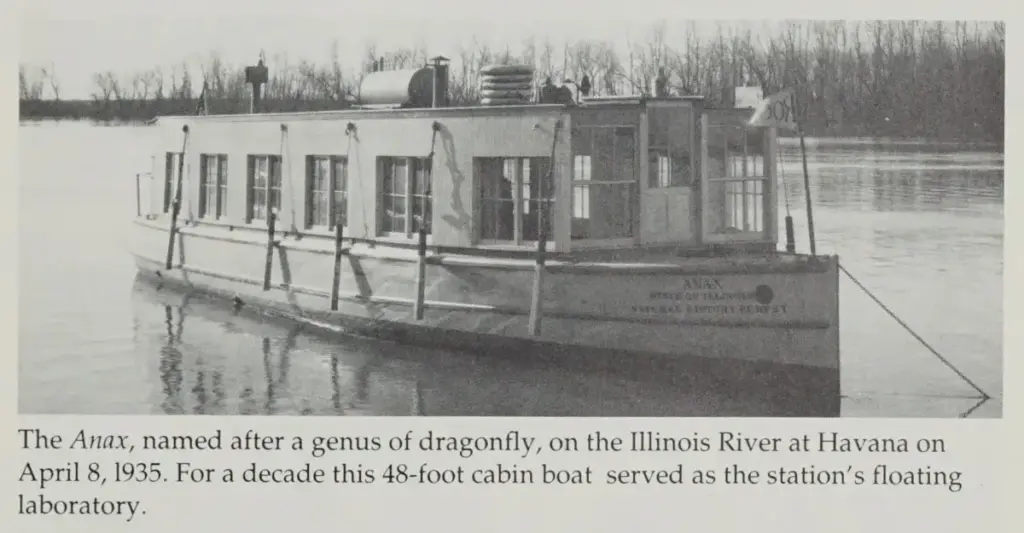
1896: Under Forbes’s directorship, a 48-foot floating biological laboratory is constructed and anchored in Havana, Illinois, providing a mobile and dedicated platform for aquatic researchers.
1917: Forbes is officially appointed director of the Natural History Survey Division, a leadership post he maintains with tireless dedication until his death.
March 13, 1930: Forbes passes away in Urbana, Illinois, leaving behind a massive intellectual corpus that defines the early paradigms of environmental management and aquatic ecology.
May 26, 1994: The Illinois Natural History Survey celebrates the sesquicentennial (150th anniversary) of Forbes’s birth, cementing his status as a pioneer of conservation and ecological science.
Charles Robertson: The Scribe of Plant-Pollinator Networks (1858–1935)
June 12, 1858: Charles Robertson is born in Carlinville, Illinois, a small town that would serve as both his lifelong home and his primary ecological laboratory.
Early Education & Harvard Years: Robertson begins his formal academic training at Blackburn College in his hometown before traveling east to study botany and zoology at Harvard University.
Return to Academics: He returns to Blackburn College, taking up a professorship in biology and Greek, which allows him to balance classical humanities with rigorous empirical observations of nature.
The Carlinville Survey (Decades of Fieldwork): Over a span of more than twenty years, Robertson methodically records every insect visit to flowering plants within his local region, ultimately documenting 1,429 pollinating insect species visiting 456 plant species.
1928: Robertson publishes his magnum opus, Flowers and Insects, synthesizing decades of intensive, localized observations into one of the most comprehensive single-locality pollination studies ever conducted.
Early 1935: Demonstrating a lifelong, unwavering dedication to his craft, Robertson travels to Florida to collect insect specimens just months before his death.
June 1, 1935: Robertson passes away in Carlinville, Illinois, leaving behind detailed specimen logs, personal correspondence, and ledgers that would lay dormant before becoming vital keys to modern conservation biology.
Supporting Context & Metrics: Data, Discoveries, and Digital Preservation
The historical impact of Forbes and Robertson is best quantified by the sheer scale of their empirical outputs and the modern analytical frameworks that rely upon them.
The Fish of Illinois and Aquatic Ecosystem Science
Stephen A. Forbes’s classic publication, The Fishes of Illinois, stands as a monumental achievement in regional ichthyology. The work catalogs over 150 fish species, drawing from an immense repository of more than 200,000 individual specimens collected methodically across all 102 counties of Illinois.
The scientific utility of this text is enhanced by its artistic and cartographic precision. The volume features richly detailed color paintings produced by scientific illustrators Lydia M. (Hart) Green and Charlotte M. Pinkerton. Furthermore, it incorporates meticulous geographical distribution maps.
Forbes’s institutional footprint expanded dramatically with the creation of the Forbes Biological Station in Havana, Illinois. Today, the station houses the Frank C. Bellrose Waterfowl Research Center, specializing in wetlands, waterfowl, and marsh bird preservation. The INHS currently operates six additional field stations across the state:
Great Rivers Field Station
Illinois River Biological Station
Kaskaskia Biological Station
Lake Michigan Biological Station
Ridge Lake Biological Station
Sam Parr Biological Station
These stations collectively provide modern researchers at the University of Illinois Urbana-Champaign—and visiting scientists worldwide—with uninterrupted access to diverse aquatic ecosystems.
Quantifying a Lost Ecosystem: Robertson’s Pollinator Logs
Charles Robertson’s field collection logs contain an extraordinary level of granular data. Each entry records:
Unique specimen tracking numbers
Taxonomic scientific names
Specimen sex
Exact dates and geographic localities of collection
Insect taxonomic orders
The precise scientific name of the host plant utilized by the insect
This rigorous bookkeeping has transcended its 19th-century origins to become an essential baseline for modern ecological rescue missions. In landmark studies published in Ecology & Society—spearheaded by John Marlin, a research affiliate with the Illinois Sustainable Technology Center and INHS—Robertson’s historic logs were used to measure severe species decline and local extinction rates in Carlinville over a century later.
Furthermore, a quantitative analysis published in the Data Science Journal highlights the immense informational density preserved within Robertson’s correspondence, five surviving data ledgers, and bee-research data books housed in the University Archives at the University of Illinois Urbana-Champaign.
Official Statements and Archival Tributes
The profound intellectual and cultural debt owed to these scientists is formally recognized in institutional archives and academic resolutions. Following Forbes’s passing, the University Senate put forth an official memorial resolution capturing his character and institutional impact:
"The Senate knew him as Professor of Zoology and Entomology and Dean of the College of Science; it admired his sagacity and patience as chairman of its Committee on Educational Policy; its members loved him for his simplicity, sincerity and broad human interests. The University and the State are immeasurably indebted to him as one of their most useful and eminent laborers for the common good."
Reflecting on the broader implications of digitizing these collections through the Biodiversity Heritage Library, project contributors emphasize the unique intersection of human narrative and hard science. Abubakari Ssemwogerere, a graduate assistant at the Funk ACES and Veterinary Medicine Libraries at the University of Illinois Urbana-Champaign, notes:
"Archival documents such as these reveal the values, culture, and identity that shaped the Illinois Natural History Survey and science in Illinois. Being able to trace the legacy of scientific research and lives of those behind these discoveries provides richer context and understanding for future scientific research. BHL provides a unique juxtaposition between the human experience of doing science, revealed through archival documents, and the official scientific record preserved in books and journal articles."
Future Outlook: Connecting Past Discoveries to Modern Conservation
As the Biodiversity Heritage Library celebrates two decades of open-access digital preservation, the relevance of foundational archives has never been more pronounced. In an era marked by global climate change, habitat fragmentation, and catastrophic pollinator declines, historical datasets provide the only reliable baseline against which modern ecological shifts can be measured.
Robertson’s records of 1,429 insect species visiting 456 plant types in Carlinville offer a rare, pre-industrial snapshot of a temperate ecosystem. Conservation biologists now utilize these digitized logs on BHL to evaluate which species have vanished, which have adapted, and how plant-pollinator networks fracture under anthropogenic pressure. Similarly, Forbes’s holistic approach to watershed management and aquatic biodiversity continues to inform environmental policy across the Illinois River Valley and the American Midwest.
By liberating these rare manuscripts, field notebooks, and hand-colored folios from physical archives and distributing them freely to a global audience, the BHL ensures that the legacies of Stephen A. Forbes and Charles Robertson remain active engines of scientific discovery. As academic institutions, digital libraries, and citizen scientists collaborate to preserve our natural heritage, the work of these Illinois pioneers will continue to inspire and guide the next generation of environmental stewards for decades to come.