Executive Overview
The waste and recycling industry has long operated on the frontlines of heavy industry, balancing the mechanical brutality of sorting massive volumes of municipal solid waste with the delicate economics of commodity markets. For decades, material recovery facility (MRF) operators have relied heavily on manual labor, visual inspections, and institutional intuition to manage complex, ever-changing waste streams. However, as labor shortages persist, incoming materials grow more complex, and environmental regulations tighten, the sector has entered a rapid phase of technological modernization.
Over the past several years, the integration of automation and optical sorting robotics has fundamentally altered the landscape of modern MRFs. These systems have successfully captured valuable commodities, boosted purity rates, and relieved human workers from some of the most hazardous tasks on the sorting floor. Yet, as automation has scaled, a new bottleneck has emerged: data overload. Modern robotic sorters and optical scanners generate staggering mountains of telemetry, throughput data, and quality metrics. Traditionally, this data has been presented to plant managers via static dashboard screens, requiring human operators to manually interpret complex data sets, diagnose equipment failures, and make operational adjustments based largely on guesswork and historical precedent.
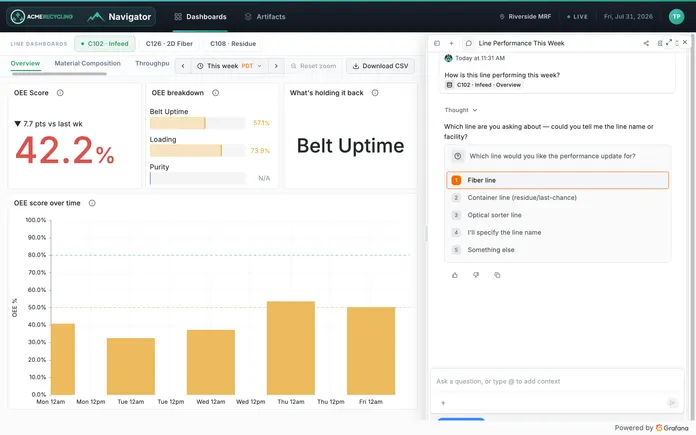
Enter agentic artificial intelligence. EverestLabs, a prominent player in AI-powered recycling robotics since 2021, has announced a paradigm shift in how MRFs process information. The company has introduced "Navigator," a sophisticated AI platform designed to act as an autonomous process engineer, data analyst, and controls specialist rolled into one. By leveraging advanced edge-vision models, vision-language models, and conversational AI, Navigator moves beyond the traditional boundaries of industrial automation. Instead of merely displaying data on a screen, Navigator actively interprets operational metrics, coordinates equipment and workflows, and allows plant operators to converse with the system as though it were a human colleague.
As pilot programs roll out across facilities like Caglia Environmental, early adopters are reporting that agentic AI is successfully removing the guesswork from daily operations, paving the way for the fully autonomous, AI-driven material recovery facility of the future.
Detailed Chronology: The Evolution of MRF Automation
To understand the significance of EverestLabs’ latest technological leap, it is necessary to examine the evolutionary trajectory of material recovery facilities over the last decade.
Phase 1: The Era of Mechanical Separation and Manual Labor
Historically, MRFs relied heavily on a combination of basic mechanical sorting—such as trommels, disc screens, and magnets—followed by extensive lines of human workers standing along conveyor belts. These workers hand-picked recyclables, pulled contaminants, and separated materials under harsh, dusty, and potentially dangerous conditions. While human eyes and hands are remarkably adaptable, manual sorting is inherently limited by fatigue, high turnover rates, safety risks, and fluctuating efficiency.
Phase 2: The Integration of Optical Sorters and Robotics (2018–2023)
As labor markets tightened and global recycling standards (such as China’s National Sword policy) demanded near-zero contamination levels, the industry pivoted toward automation. Optical sorters utilizing near-infrared (NIR) spectroscopy became standard for identifying polymer types and paper grades at high speeds. Concurrently, companies began introducing AI-powered robotic sorters equipped with computer vision to pick specific commodities off belts with superhuman speed and precision.
EverestLabs entered this space in 2021, deploying its AI-powered robotic systems to help facilities sort commodities more reliably. While these robots successfully improved commodity quality and productivity, they also began flooding facility management systems with data. Operators suddenly had access to millions of data points regarding belt speeds, pick rates, error frequencies, and material composition.
Phase 3: The Data Bottleneck and the Need for Interpretation
By the mid-2020s, MRF operators faced a new paradox: they had more data than they could effectively analyze. While dashboards showed that equipment was running or idling, and that contamination rates were fluctuating, figuring out the root cause of these issues still required specialized human intervention.
Furthermore, the regulatory landscape shifted dramatically. Across the United States, states began implementing Extended Producer Responsibility (EPR) laws for packaging. These legislative frameworks placed new legal and financial demands on producers and processors alike, requiring MRFs to track, report, and optimize the sorting of specific materials with unprecedented precision. Operators needed tools that could cut through the noise of raw data and provide actionable, real-time insights tailored to changing regulatory standards.
Phase 4: The Rise of Agentic AI and "Navigator"
Recognizing that the next major leap in efficiency would not come from adding more physical robots, but rather from smarter software, EverestLabs shifted its focus. Drawing on years of operational experience within processing plants, the company developed Navigator. Rather than acting as a standalone software dashboard, Navigator is engineered to sit at the intersection of data analytics, equipment control, and conversational interaction. Announced as a pioneering agentic AI solution for the recycling sector, Navigator represents the transition of MRFs from automated facilities to cognitive, self-optimizing ecosystems.
Supporting Context & Metrics: The Mechanics of Agentic AI in Waste Management
What sets Navigator apart from traditional industrial software is its underlying architecture and its ability to execute autonomous workflows. To fully appreciate its impact, it is helpful to examine the technological components that make up the system and the practical challenges it addresses.
The Technological Stack
Navigator is built on a convergence of advanced AI tools that have rarely, if ever, operated as a unified system within a recycling facility:
- Edge-Vision Models: These models operate locally at the equipment level, continuously tracking and analyzing materials as they move along the conveyor belts. They capture high-resolution visual data regarding material flow, volume, and composition.
- Vision-Language Models (VLMs): VLMs bridge the gap between visual data and human comprehension. They interpret complex material streams, identifying nuances in the waste mix that traditional sensors might miss, such as distinguishing between different grades of plastics or identifying problematic contaminants.
- Reasoning and Conversational Models: These models form the "agentic" core of the platform. They synthesize data from edge-vision and vision-language models, apply logical reasoning to diagnose operational bottlenecks, and provide a conversational interface for human operators.
Operational Problem-Solving: Upstream and Downstream Insight
In a typical MRF, a contamination spike or a sudden drop in throughput can trigger a cascade of troubleshooting steps. If a PET (polyethylene terephthalate) line begins showing high levels of contamination, an operator traditionally has to walk the line, inspect various stages of the process, review separate equipment logs, and guess at the underlying cause.
With Navigator, that diagnostic process is radically streamlined. An operator can interact with the system to investigate the contamination issue. The AI analyzes data not just at the point of the error, but both upstream and downstream. It can trace back to determine whether the contamination originated from a specific incoming load, or whether an upstream screen is malfunctioning.
Similarly, financial forecasting and material valuation—previously tasks requiring tedious data exports and manual spreadsheet modeling—can now be handled dynamically. An operator can ask Navigator to examine current PET sorting operations and use customized charts and graphs to predict the financial value of PET gains or losses over time.
Closing the Loop: From Insights to Direct Equipment Control
Many industrial analytics tools stop at offering recommendations on a screen. Navigator, however, is designed to close the loop between analysis and execution. Because the system is integrated with equipment controls and operational workflows, it doesn’t just tell the operator what is happening; it can actively assist in executing the solution. Whether it is adjusting machine settings, altering sorting recipes, or modifying equipment parameters in response to changing waste stream compositions, Navigator translates cognitive reasoning into mechanical action.
Official Statements and Industry Perspective
The rollout of Navigator marks a critical milestone for EverestLabs and its partners, signaling a broader cultural and operational shift within the waste management sector.
Apurba Pradhan, Chief Product Officer at EverestLabs, highlighted the company’s deep roots in plant operations when discussing the motivation behind the new platform.
"We’ve had a lot of working experience in how these plants operate, what kind of problems they have, and we’ve been trying to figure out how to help them solve it. A lot of the solutions don’t come from robots; they come from AI," Pradhan explained.
Pradhan emphasized that the platform is designed to mirror human collaboration, noting that operators can interact with Navigator "as if he’s interacting with one of his employees." He added: "We’re tying that reasoning into equipment controls and also the workflow for that operator. So we can change recipes, we can change settings on different pieces of equipment."
JD Ambati, founder and chief strategy officer of EverestLabs, elaborated on the transformational nature of the software in an official company statement, positioning Navigator as a multi-disciplinary digital professional:
"Navigator will be an AI process engineer, a data analyst and a controls specialist working for facility operators who have relied on manual guesswork for far too long," Ambati stated.
The transition from theory to real-world application is currently being tested through pilot programs at leading facilities, including Caglia Environmental. Corey Stone, plant manager at Caglia Environmental, shared an enthusiastic endorsement of the technology’s impact on daily plant management:
"Navigator has removed the guesswork from our daily operations and makes our MRF a fully AI run and managed plant," Stone said in a statement. "It takes the complexity out of data analytics, giving us immediate, actionable answers that drive productivity so we can focus on keeping safety our top priority."
Future Outlook: The Fully Autonomous MRF
As pilot programs like the one at Caglia Environmental yield deeper operational insights, the launch of Navigator offers a compelling glimpse into the future of materials recovery. Several key trends are likely to shape the trajectory of this technology and the industry at large in the coming years.
1. Scaling Autonomous Workflows
As trust in agentic AI grows, the scope of autonomous decision-making within MRFs is expected to expand. While current systems assist operators with diagnostics and recipe changes, future iterations may take on increasingly complex scheduling, predictive maintenance, and dynamic sorting adjustments with minimal human intervention. This will allow facility managers to shift their focus entirely from reactive troubleshooting to long-term strategic planning, quality assurance, and facility safety.
2. Adapting to Evolving EPR Regulations
With Extended Producer Responsibility laws expanding across multiple states and international jurisdictions, MRFs face mounting pressure to provide granular, verifiable data on material recovery rates and contamination levels. AI platforms like Navigator will become indispensable compliance tools. By continuously tracking, analyzing, and reporting on commodity streams with absolute precision, AI-driven facilities will be uniquely positioned to meet stringent regulatory reporting requirements without placing an administrative burden on plant staff.
3. Redefining Labor and Expertise in Waste Management
There is a common misconception that automation and AI will entirely eliminate human presence in industrial facilities. However, technologies like Navigator actually elevate the role of the human worker. By absorbing the cognitive strain of data analysis, manual guesswork, and routine troubleshooting, AI empowers plant operators to act as high-level supervisors and technologists. As the industry modernizes, the demand for skilled workers who can collaborate effectively with advanced AI systems will continue to rise.
Conclusion
The introduction of EverestLabs’ Navigator underscores a mature phase in the industrialization of recycling. By moving beyond physical robotics and into the realm of agentic artificial intelligence, the waste management sector is overcoming the data bottlenecks that have historically limited efficiency. As more facilities adopt these cognitive tools, the material recovery facility of the 21st century is rapidly evolving from a chaotic, manual sorting floor into a streamlined, self-optimizing, and fully AI-managed powerhouse of sustainability.