

Executive Overview
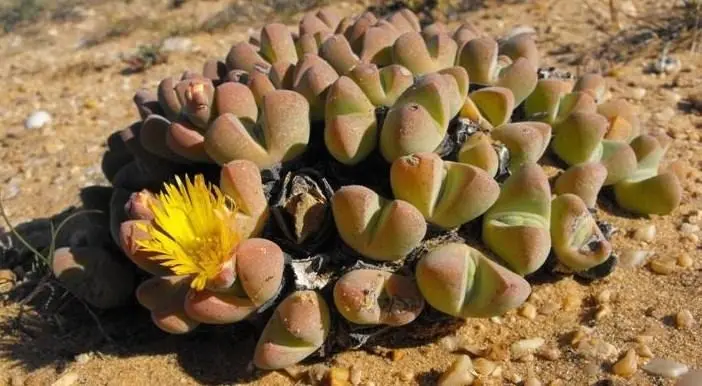
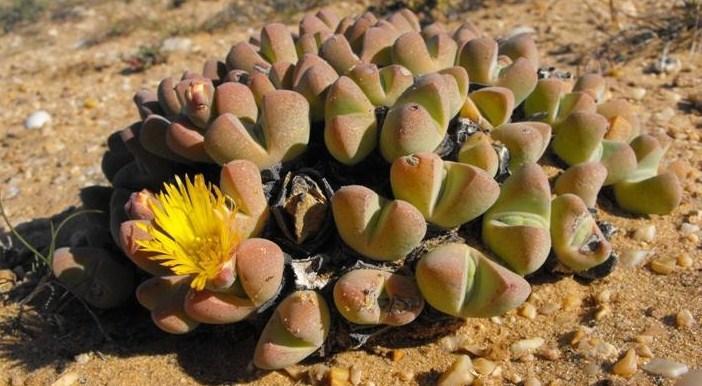
In the searing, hyper-arid borderlands where Namibia meets South Africa, a botanical survivor is quietly sliding toward extinction. The brown clockfig (Cheiridopsis brownii), an extraordinarily resilient succulent characterized by thick, moisture-storing leaves and vibrant, daisy-like yellow flowers, has been officially classified as Critically Endangered by the International Union for Conservation of Nature (IUCN).
Confined to the unforgiving terrain of the western Gariep Valley—a vast landscape spanning the southern reaches of Namibia’s Tsau ǁKhaeb National Park and South Africa’s Richtersveld region in the Northern Cape—this rare plant clings to quartz ridges, shale bands, gravel plains, and the rocky fissures of desert mountains. Yet, its legendary ability to withstand hyper-arid conditions, intense solar radiation, and blistering temperatures has proven no match for the relentless march of human industrialization and the escalating crises of global climate change.
Between 1992 and 202, a punishing, decade-long regional drought, compounded by compounding anthropogenic pressures, decimated the species, wiping out an estimated 50% to 90% of its total population. Today, the brown clockfig occupies a precarious total geographical range of just 424 square kilometers (164 square miles), with its actual physical footprint restricted to a meager 60 square kilometers (23 square miles) within that zone.
Without immediate, aggressive, and well-funded conservation interventions, models project that the species could face near-total functional extinction—losing another 80% to 100% of its remaining populations by the year 2052. Despite these harrowing forecasts, targeted, institutional conservation initiatives for the plant remain virtually non-existent, leaving its survival in the hands of a few dedicated botanists and localized, grassroots rescue operations.
Detailed Chronology: The Decline of Cheiridopsis brownii
To understand the plight of the brown clockfig, one must examine the timeline of ecological degradation that has transformed the western Gariep Valley from a stable, albeit harsh, desert ecosystem into an accelerating hazard zone for endemic flora.
- Pre-1992 (The Baseline Era): Historically, Cheiridopsis brownii thrived in relative isolation across the rugged transfrontier landscape of the Gariep Desert. Adapted to micro-habitats provided by quartz patches and rock crevices, the plant played a vital, foundational ecological role. By supporting specialized desert insects, it indirectly sustained the region’s diverse web of heat-adapted spiders and reptiles.
- 1992–2012 (The Onset of Pressures): Gradual intensification of localized land-use practices began to fragment the plant’s limited habitat. Unchecked livestock overgrazing started to transform vast swathes of the Richtersveld, leading to the severe desertification of ecological plains such as the Aniesvlakte. Concurrently, exploratory and industrial mining operations began staking claims across the mineral-rich quartz and alluvial fields of the border region.
- 2012–202 (The Decadal Megadrought): A prolonged, punishing drought gripped southwestern Africa. During this window, the compounding effects of water scarcity, rising baseline temperatures, and unchecked habitat destruction drove a catastrophic population collapse, eliminating between 50% and 90% of all living brown clockfigs.
- 2021 (The Rescue Mission): Recognizing the imminent threat of localized extirpation due to impending industrial footprints, botanist Pieter van Wyk of South African National Parks (SANParks) spearheaded emergency salvage efforts. Operating independently through the Richtersveld Desert Botanical Garden, van Wyk collected vital seed stocks from populations slated for immediate destruction by incoming diamond mining operations.
- Present Day (The IUCN Assessment & Green-Energy Threat): The IUCN officially updates the status of Cheiridopsis brownii to Critically Endangered. Compounding historical threats, the region faces a new wave of industrial-scale development, notably massive green-energy projects that threaten to pave over the last remaining refugia of the species.
Supporting Context & Metrics: Anatomy of a Desert Crisis
The existential crisis facing the brown clockfig is defined by stark geographical metrics and multifaceted ecological pressures.
Range and Habitat Constraints
The plant is an ultra-specialist, relying on specific geomorphological features within the western Gariep Valley. It cannot simply migrate or re-establish itself elsewhere; its life cycle is inextricably bound to the quartz ridges, shale, and rocky fissures of the desert mountainscape.
- Total Extent of Occurrence (EOO): ~424 km² (164 mi²)
- Area of Occupancy (AOO): ~60 km² (23 mi²)
- Population Reduction (1992–202): 50% to 90%
- Projected Future Decline (by 2052): 80% to 100% loss of remaining populations under current trajectories.
The Converging Threats
1. Overgrazing and Desertification
In South Africa’s Richtersveld region, pastoralism is a traditional and vital way of life, but unregulated stocking rates have outstripped the carrying capacity of the fragile land. The resulting overgrazing has triggered massive desertification across the Aniesvlakte plain, stripping away topsoil and altering surface hydrology, directly threatening to swallow remaining plant populations.
2. Mineral Extraction and Diamond Mining
The ancient alluvial and geological formations of the Gariep Valley are rich in mineral wealth, particularly diamonds. Mining permits granted across both South African and Namibian jurisdictions have carved up the landscape. Unrehabilitated mining practices allow coastal winds to drive shifting sands inland, burying endemic flora under waves of sterile sediment.
3. The Green-Energy Paradox
In a cruel twist of ironic timing, the global transition away from fossil fuels poses a fresh, existential threat to the brown clockfig. Massive-scale green hydrogen projects and renewable energy infrastructure developments are currently being planned and zoned across vast swaths of the hyper-arid border region—precisely where Cheiridopsis brownii makes its last stand.
4. Climate Change and Prolonged Aridity
Global climate models for southwestern Africa project escalating temperatures and a precipitous drop in already scarce rainfall. The severe drought of 2012–202 was a harbinger of future climatic norms, threatening to push a plant already operating at its physiological limits past the absolute threshold of survival.
Official Statements and Expert Perspectives
The gravity of the brown clockfig’s situation has drawn stark warnings from the scientific community. Pieter van Wyk, a botanist with South African National Parks (SANParks) and the curator of the Richtersveld Desert Botanical Garden who conducted the definitive IUCN assessment, has emerged as the leading voice for the species.
Reflecting on the absurdity and tragedy of the plant’s impending doom, van Wyk offered a poignant observation to Mongabay:
"It remains shocking that a highly resilient species like the brown clockfig can easily grow in circumstances where no human can survive, yet simply cannot survive the land use practices wrought by humans."
Detailing the compounding mechanics of localized habitat destruction, van Wyk emphasized how industrial negligence accelerates natural disasters:
"The vast desertification of the Aniesvlakte as a direct result of severe overgrazing, as well as the mass desertification caused by sand moving from the coast due to unrehabilitated mines, are threatening to swallow most of the remaining population in South Africa."
Furthermore, van Wyk highlighted the blind spots of modern industrial planning, warning that the global green transition is inadvertently trampling biodiversity hotspots:
"Another threat comes from new green-energy developments—massive-scale green hydrogen projects—planned over vast sections of where this species occurs."
Beyond the intrinsic value of the plant itself, van Wyk stresses that the brown clockfig serves a critical keystone function within its harsh ecosystem. Protecting the low-lying, extremely dry areas of the Gariep Desert adjacent to the Orange River is non-negotiable, he argues, because these plants sustain specialized desert insects. In turn, these insects form the foundational prey base for the region’s highly heat- and arid-adapted spiders and reptiles. If the clockfig falls, a cascading trophic collapse could sweep through the local desert food web.
Future Outlook: A Race Against Time
The trajectory of Cheiridopsis brownii over the next three decades is hanging by a thread. With the IUCN forecasting an 80% to 100% population collapse by 2052, the window for effective mitigation is closing rapidly.
Presently, the outlook is grimly characterized by institutional neglect. There are currently no large-scale, government-backed, or targeted conservation programs dedicated to preserving the brown clockfig in its native habitat. Protection measures are largely ad-hoc and reactive.
Hope, for now, rests in the hands of dedicated regional institutions like the Richtersveld Desert Botanical Garden. By stepping into the vacuum left by policy failures, the garden has initiated emergency ex-situ conservation protocols. Seeds harvested by van Wyk in 2021—rescued mere moments before the bulldozers rolled in to clear terrain for diamond mining—represent a genetic ark for the species.
However, seed banking and botanical garden propagation are defensive stopgaps, not permanent solutions. For the brown clockfig to endure in the wild, a paradigm shift in transfrontier land management is urgently required:
- Strict Habitat Zoning: Governments in both Namibia and South Africa must re-evaluate mining permits and green-energy infrastructure footprints, designating absolute no-go zones across the 60 square kilometers of the plant’s true Area of Occupancy.
- Grazing Reform: Collaborative rangeland management frameworks must be implemented in the Richtersveld to curb overgrazing and halt the artificial desertification of plains like the Aniesvlakte.
- Mine Rehabilitation Enforcement: Regulators must strictly enforce land rehabilitation laws for diamond and mineral extraction operations to prevent wind-blown coastal sands from burying adjacent endemic ecosystems.
- Climate-Resilient Conservation Funding: International conservation bodies and climate funds must direct capital toward hyper-arid desert biomes, which are frequently overlooked in favor of lush tropical forests, despite harboring irreplaceable, highly specialized biodiversity.
Without these decisive measures, the brown clockfig—a masterclass of evolutionary adaptation that outlasted millennia of natural climatic volatility—will be erased by the ledger of modern human progress, vanishing quietly into the sands of the Gariep Valley.



