

Executive Overview
The European automotive landscape is undergoing a profound and accelerating transformation. Driven by stringent European Union clean car targets, the market for battery-electric vehicles (BEVs) is breaking previous boundaries, transitioning from a niche luxury sector into the mainstream of personal mobility. According to a comprehensive new EV progress report published by Transport & Environment (T&E), regulatory frameworks implemented by Brussels are achieving their intended purpose: flooding the market with accessible, high-volume, and competitively priced electric cars.
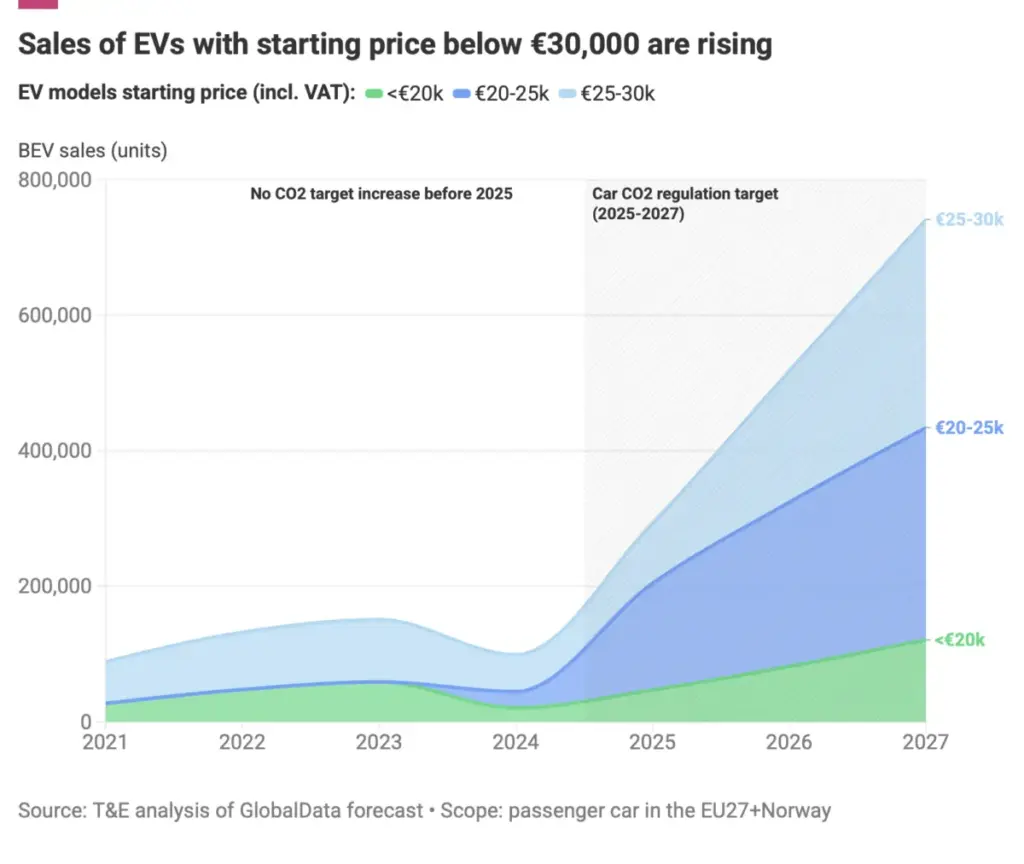
Far from stifling industry innovation, these binding CO₂ emission standards have compelled legacy automakers to rethink their product pipelines. The result is a historic wave of affordable electric vehicles boasting starting prices below €25,000. In 2026, sales for these sub-€25,000 models are projected to skyrocket sevenfold compared to 2024 levels.
This pivot toward affordable electrification is taking place against a volatile geopolitical and economic backdrop. Ongoing instability in the Middle East and subsequent oil price shocks have exposed the inherent vulnerabilities of fossil fuel dependency, making the transition to electric mobility not merely an environmental imperative, but an economic shield for everyday European drivers.
Yet, this success story faces a critical juncture. Despite clear evidence that consumer demand for affordable EVs is robust—as demonstrated by massive backlogs and immediate sell-outs of newly launched models—industry lobbyists and certain policymakers continue to debate weakening upcoming 2030 and 2035 targets. Analysts and environmental advocates warn that any retreat from these benchmarks would choke off the supply of affordable models, compromise European automakers in the fiercely contested global EV race, and lock millions of citizens into enduring fossil fuel reliance.
Detailed Chronology: From Regulatory Stagnation to the 2026 Breakthrough
To understand the current surge in European electric vehicle adoption, one must examine the regulatory and market trajectory that preceded it. The evolution of the European BEV market over the past half-decade can be divided into two distinct chapters: a period of regulatory stagnation followed by an era of aggressive, compliance-driven innovation.
The Stagnant Years (2021–2024)
Between 2021 and 2024, EU fleet-wide CO₂ reduction targets for passenger cars remained largely flat. During this window, legacy original equipment manufacturers (OEMs) faced limited regulatory pressure to rapidly scale up mass-market electric vehicle production. Instead, automakers largely focused their limited EV development budgets on larger, higher-margin premium segments—such as heavy SUVs and performance crossovers—where profit margins could offset the high initial costs of battery manufacturing.
During these years, automotive executives frequently argued that European consumers simply did not want electric cars, pointing to sluggish adoption rates outside of early-adopter demographics and affluent urban centers. Critics inside the industry claimed that high battery costs made the production of a profitable sub-€25,000 electric vehicle practically impossible without devastating profit margins. Consequently, the average new car buyer was left with few viable electric options, reinforcing a self-fulfilling prophecy of subdued mass-market demand.
The Regulatory Catalyst and the 2025–2027 Compliance Window
The landscape shifted dramatically as the EU’s next phase of tighter fleet-wide emission limits approached. To avoid multi-billion-euro regulatory fines for non-compliance, European carmakers were forced to completely overhaul their product strategies. The 2025–2027 compliance targets served as the primary catalyst for a massive industry pivot.
Recognizing that luxury and premium EV segments were nearing saturation among early adopters, manufacturers finally unlocked investments in smaller vehicle architectures. The payoff has been immediate and quantifiable.

In the first half of 2026 alone, nearly 40 new electric models were introduced to the European market, bringing the total number of available mass-market BEVs to over 150. Industry projections indicate that approximately 60 new electric models will debut by the end of 2026. To put this acceleration into perspective, this output represents nearly four times the historical average of just 15 new model launches per year recorded during the 2021–2024 stagnation period.
Crucially, automakers have finally turned their attention to the sub-€25,000 price bracket, doubling the number of entry-level models available to consumers. The market response has obliterated the long-standing narrative that European drivers are unwilling to embrace affordable electric mobility.
Supporting Context & Metrics: Sales Records and the True Cost of Oil Shocks
The convergence of regulatory pressure, an unprecedented influx of new models, and severe macroeconomic disruptions has driven European BEV adoption to historic heights in 2026.
Record-Breaking Sales and Market Share Milestones
Data compiled across the European Union demonstrates the sheer velocity of this transition. Between January and August 2026, a staggering 1.64 million battery-electric vehicles were registered across the bloc. This figure represents a robust 45% increase compared to the exact same period in the previous year.
Perhaps the most psychological and structural milestone occurred in the second quarter of 2026. For the first time in automotive history, BEVs officially outsold pure internal combustion engine (ICE) petrol cars across an entire quarter, capturing a dominant 22% market share.
Industry analysts project that all major European carmakers are currently on track to achieve full compliance with the 2025–2027 fleet targets, proving that stringent environmental regulations act as a vital industrial policy tool rather than an insurmountable burden.
The Real-World Economics: Oil Volatility vs. Electric Stability
While climate change mitigation remains a foundational goal of the EU’s green transition, the immediate economic driver for everyday consumers in 2026 has been energy security and fuel price volatility.
Global geopolitical instability—including the ongoing fallout from the Iran conflict and subsequent disruptions in petroleum supply chains—triggered a severe oil price shock. This latest crisis has collectively cost EU road users an estimated €53 billion in inflated fuel expenditures.
By mid-September 2026, the real-world financial pain was acutely visible at service stations across the continent:

- The Diesel Penalty: Filling a standard 50-litre tank of diesel cost approximately €30 more than it did prior to the geopolitical escalation.
- The EV Savings Shield: Consumers who had transitioned to a battery-electric vehicle at the onset of the crisis realized immediate financial insulation. Data indicates that driving an electric car instead of an ICE vehicle from the beginning of the crisis through mid-September saved individual motorists roughly €350 in pure running costs.
The Case Study of the Volkswagen ID. Polo
Nothing exemplifies the mismatch between automaker skepticism and actual consumer demand quite the launch of Volkswagen’s long-anticipated entry-level EV, widely referred to in industry circles as the ID. Polo.
When Volkswagen finally opened order books for the compact, sub-€25,000 electric hatch, demand instantly overwhelmed factory capacity. The model was rapidly sold out, racking up over 40,000 firm customer orders in a matter of weeks and triggering a staggering 10-month waitlist.
This phenomenal commercial reception validated T&E’s core assessment: the historical lag in European EV sales was never a reflection of consumer indifference, but rather a failure of legacy manufacturers to supply the right vehicles at the right price point.
Official Statements and Industry Perspectives
The debate surrounding the future of European climate policy has drawn sharp commentary from industry analysts, environmental advocates, and economic researchers.
Lucien Mathieu, Cars Director at Transport & Environment, offered a scathing critique of historical automaker claims while highlighting the stakes of current policy discussions:
"European drivers are finally seeing more of the smaller and more affordable electric cars they have been waiting for. The oil crisis has further fuelled the rush by European consumers for affordable small electric cars. VW’s ID. Polo was quickly sold out, with over 40,000 orders and a 10-month waitlist. European car makers were complaining about the lack of demand for a long time. Now we can clearly see: The issue was not the demand, but what they had to offer. The consumer’s appetite for small affordable electric cars proves the car makers’ claims wrong."
Mathieu further emphasized the existential danger of tampering with the EU’s long-term regulatory architecture in the face of intense lobbying from conservative political factions and select industrial players seeking to dilute compliance standards:
"The EU’s car targets are expanding consumer choice, bringing down the cost of going electric and giving European manufacturers a chance to compete in the global EV race. Weakening the 2030 target now would choke off affordable models by nearly three-quarters just as they are reaching the market and lock millions across Europe into debilitating oil dependency."
Economic analysts echo these warnings. While Chinese manufacturers continue to scale up production and export aggressive, low-cost electric vehicles into global markets, a weakened European regulatory framework would grant domestic legacy brands a temporary, false sense of security. Without the mandatory push of strict CO₂ caps, European firms risk falling permanently behind in battery chemistry, software integration, and high-volume cost optimization—surrendering leadership in the defining industrial shift of the 21st century.

Future Outlook: The Global Race and the Road to 2030 and Beyond
As Europe looks toward the remainder of the decade, the trajectory of its automotive sector hangs in a delicate balance. The progress achieved in the first half of 2026 proves that when policy provides clear, immutable direction, the industrial ecosystem responds with breathtaking ingenuity and capital investment.
The Threat of Regulatory Rollbacks
Despite the proven success of the sub-€25,000 EV wave, political headwinds remain formidable. Laced with arguments regarding international competitiveness and short-term economic friction, some industry stakeholders continue to lobby the European Commission and the European Parliament to dilute the 2030 and 2035 zero-emission vehicle mandates.
Independent policy models reviewed in the T&E progress report suggest that watering down the 2030 targets would have catastrophic downstream effects. Specifically, it would reduce the anticipated market penetration of affordable, entry-level electric cars by nearly 75%. Such a policy reversal would pull the rug out from under domestic battery supply chains, strand billions in capital expenditures already committed by component suppliers, and deny working-class European families access to low-cost, domestically produced electric transport.
The Imperative of Global Competitiveness
The global automotive paradigm has shifted permanently toward electrification. Emerging markets across Asia, Latin America, and North America are transitioning rapidly. China has established a formidable lead in the manufacturing of affordable battery technology, vertical supply chain integration, and electric vehicle exports.
For Europe’s historic automotive giants—rooted in Germany, France, Italy, and beyond—surviving this global race requires leaning into, rather than retreating from, the clean vehicle transition. The successful launch and immediate sell-out of vehicles like the ID. Polo demonstrate that European engineering excellence can win the mass-market battle if given the regulatory runway to do so.
Conclusion
The electric vehicle revolution in Europe is no longer a theoretical projection or an elite luxury experiment; it is an economic and industrial reality delivering tangible benefits to millions of citizens. By holding firm on ambitious CO₂ reduction targets, the European Union has successfully compelled its automotive sector to innovate, bringing affordable, oil-independent mobility within reach.
To retreat now—in the face of temporary geopolitical storms and short-sighted corporate hesitation—would be a historic strategic blunder. The path forward demands unwavering regulatory commitment to ensure that Europe secures its economic resilience, cleanses its air, and retains its rightful place at the forefront of the global automotive future.



