For two decades, the Biodiversity Heritage Library (BHL) has served as the global digital archive for the foundational texts of natural history. In celebration of its milestone 20th anniversary, the BHL is spotlighting transformative regional collections that continue to shape modern ecological and entomological thought. Among the most enduring contributions to this digital repository are the rare archival materials and foundational publications provided by the University of Illinois Urbana-Champaign Library. At the heart of these contributions are two towering intellectual figures of the late 19th and early 20th centuries: Stephen Alfred Forbes and Charles Robertson.
Operating primarily out of Illinois, Forbes and Robertson were visionary scientists whose rigorous field observations, meticulous data collection, and holistic approaches to the natural world anticipated modern environmental science by generations. While Forbes revolutionized aquatic ecology, fisheries science, and environmental management, Robertson mapped the intricate, co-evolutionary dependencies between native flora and insect pollinators with unprecedented precision.
Today, as contemporary researchers grapple with unprecedented biodiversity loss, habitat fragmentation, and climate change, the historical archives of Forbes and Robertson have transitioned from dusty library shelves into vital, living baselines. Through digitized monographs, comprehensive collection logs, and extensive correspondence preserved within the BHL, scientists and historians can trace the historical health of North American ecosystems, quantifying ecological shifts over more than a century. This article explores the extraordinary lives, methodologies, and enduring legacies of these two scientific pioneers, examining how their historic efforts continue to inform 21st-century conservation science.
Detailed Chronology
The intellectual trajectories of Stephen A. Forbes and Charles Robertson spanned pivotal decades in the evolution of American science, transforming natural history from a hobbyist pursuit into a rigorous, quantitative academic discipline.
The Life and Scientific Ascent of Stephen A. Forbes (1844–1930)
May 29, 1844: Stephen Alfred Forbes is born in Silver Creek, Illinois. His early life is shaped by the American Civil War, during which he serves as a Union soldier in the 7th Illinois Cavalry, enduring capture and imprisonment before his eventual release and return home.
1870s–1880s: Forbes turns his attention to the natural sciences, rapidly establishing himself as a self-taught polymath. His early investigations encompass botany, ornithology, ichthyology, and entomology. Crucially, he rejects the narrow specialization common in his era, adopting a holistic approach that views organisms not in isolation, but as dynamic components of interconnected ecological webs—most famously articulated in his landmark 1887 essay, The Lake as a Microcosm.
1886: In international recognition of his empirical contributions, Forbes is awarded the prestigious first-class medal of the Société d’Acclimation de France for his pioneering scientific publications.
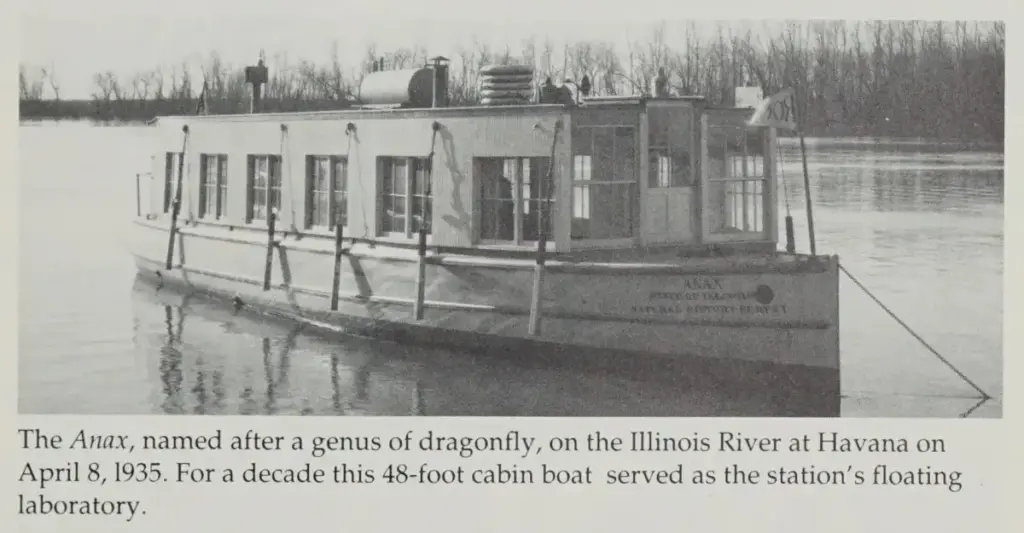
1894–1896: Seeking a permanent base for continuous aquatic and terrestrial investigation, Forbes establishes the Forbes Biological Station in 1894. By 1896, he oversees the construction of a 48-foot floating biological laboratory anchored on the Illinois River in Havana, Illinois—a groundbreaking mobile platform for long-term riverine research.
1917: Appointed director of the newly organized Natural History Survey Division (forerunner to the Illinois Natural History Survey, or INHS), Forbes guides the agency with visionary administrative and scientific leadership until the end of his life.
March 13, 1930: Forbes passes away in Urbana, Illinois, leaving behind an institutional framework that forever anchors ecological monitoring within state governance and academic research.
The Focused Dedication of Charles Robertson (1858–1935)
June 12, 1858: Charles Robertson is born in Carlinville, Illinois, a small Midwestern town that will serve as the geographic epicenter of his life’s work.
Late 1870s–Early 1880s: Robertson pursues formal education at Blackburn College in Carlinville, followed by advanced studies in botany and zoology at Harvard University, where he engages directly with the intellectual currents of post-Darwinian biology.
Academic Tenure: Returning to his roots, Robertson accepts a dual appointment as a professor of biology and Greek at Blackburn College, balancing classical humanities with rigorous empirical fieldwork.
Decades of Observation (1880s–1910s): For more than twenty years, Robertson conducts exhaustive, single-locality field studies in and around Carlinville. Braving the elements, he records every insect visitor to local flora, amassing an astronomical dataset of 1,429 pollinating insect species visiting 456 plant species.
1928: Robertson synthesizes his life’s work into his masterwork, Flowers and Insects, published privately after struggling to find commercial academic publishers willing to back such a data-dense, localized monograph.
June 1, 1935: Demonstrating a relentless scientific curiosity to his final days, Robertson is actively collecting insect specimens in Florida only a few months before his death in his hometown of Carlinville at the age of 76.
Supporting Context & Metrics
The enduring value of the Forbes and Robertson collections lies not merely in their historical resonance, but in the sheer scale, empirical density, and contemporary utility of the data they preserved.
The Scale of Forbes’ Ichthyological and Ecological Surveys
Forbes’ monumental 1908 publication, The Fishes of Illinois (co-authored with Robert Earl Richardson), stands as a masterpiece of descriptive zoology and cartography. The project was underpinned by staggering fieldwork metrics:
Geographic Scope: Specimens were systematically gathered from all 102 counties across the state of Illinois.
Specimen Volume: The research drew upon an astonishing repository of over 200,000 individual fish specimens, documenting more than 150 distinct fish species.
Visual Documentation: The publication features exquisite, scientifically precise color illustrations created by pioneering botanical and zoological illustrators Lydia M. (Hart) Green and Charlotte M. Pinkerton, transforming a taxonomic ledger into a work of art.
Spatial Analysis: The integration of detailed distribution maps provided early baseline metrics for aquatic biodiversity, allowing modern conservationists to track species extirpations, invasions, and range contractions over a century of profound industrial and agricultural alteration.
Furthermore, the institutional network forged by Forbes—including the flagship Forbes Biological Station and the Frank C. Bellrose Waterfowl Research Center—has expanded under the Illinois Natural History Survey to encompass six additional specialized field stations (Great Rivers, Illinois River, Kaskaskia, Lake Michigan, Ridge Lake, and Sam Parr). These facilities continue to anchor cutting-edge research in wetland ecology, avian conservation, and aquatic resource management.
Robertson’s Unrivaled Plant-Pollinator Matrix
While contemporary ecologists often rely on massive, multi-institutional databases to model ecological networks, Charles Robertson accomplished a similar feat single-handedly in a rural Illinois township. His specimen collection logs, spanning from 1877 to 1935, contain granular metadata: specimen numbers, exact collection dates, precise localities, taxonomic classifications down to the sex of the insect, and corresponding host plant identities.
The metrics of Robertson’s dataset represent a gold standard in historical ecology:
Network Density: Documentation of over 1,400 insect species (spanning flies, beetles, butterflies, and bees) interacting with 456 flowering plant species.
Long-Term Resiliency Studies: In landmark modern assessments published in journals such as Ecology & Society, researchers like John Marlin utilized Robertson’s historic logs to revisit Carlinville and measure local species extinction rates. By comparing Robertson’s 19th-century baseline against modern censuses, scientists quantified severe declines in native bee and plant populations, proving that specialized mutualisms are highly vulnerable to habitat degradation.
Digital Data Science Integration: A quantitative analysis published in the Data Science Journal highlights how machine learning and advanced data extraction are now being applied to Robertson’s surviving ledgers and correspondence archived at the University of Illinois Urbana-Champaign, turning handwritten 19th-century field notes into accessible, machine-readable nodes for global biodiversity informatics.
Official Statements and Institutional Perspectives
The preservation and digitization of these archival treasures represent a triumph of inter-institutional collaboration, bridging the gap between historical preservation and active biological research.
Reflecting on the legacy of Stephen A. Forbes, the University Senate formally commemorated his character and contributions through an official memorial resolution that captures the esteem in which he was held by his contemporaries:
"The Senate knew him as Professor of Zoology and Entomology and Dean of the College of Science; it admired his sagacity and patience as chairman of its Committee on Educational Policy; its members loved him for his simplicity, sincerity and broad human interests. The University and the State are immeasurably indebted to him as one of their most useful and eminent laborers for the common good."
In the context of the Biodiversity Heritage Library’s 20th-anniversary initiative (BHL at 20: Treasures from the Biodiversity Heritage Library), curators and administrators emphasize the vital synergy between institutional archives and global digital access. By making rare monographs like The Fishes of Illinois and Flowers and Insects freely accessible worldwide, platforms like BHL ensure that foundational science is never locked behind paywalls or restricted by geographic distance.
Project coordinators note that archival documents—such as Robertson’s personal correspondence, ledgers, and field notebooks—do more than just list species names; they reveal the human culture, philosophy, and grit that powered early American science. This juxtaposition of the official scientific record with the intimate human experience of fieldwork provides future generations of researchers with essential historical context, illuminating how early naturalists perceived and interacted with pristine ecosystems that have since vanished.
Future Outlook
As the Biodiversity Heritage Library enters its third decade, the digital reunification of scattered historical texts and localized archives points toward an exciting, technology-driven future for ecological research. The painstaking field notes of Stephen A. Forbes and Charles Robertson are no longer static relics residing solely in the rare book rooms of the University of Illinois Urbana-Champaign Library; they are active, dynamic datasets fueling 21st-century conservation biology.
Looking ahead, several key trajectories define the intersection of these historical collections and modern science:
Baseline Calibration for Climate Change Research: As global warming and land-use changes disrupt phenological synchrony—the timing of plant flowering versus pollinator emergence—historical datasets like Robertson’s Flowers and Insects provide irreplaceable temporal baselines. Modern biologists utilize these historical records to measure how much climate velocity has altered natural interactions over the past 130 years.
Informatics and AI-Driven Archival Extraction: With initiatives highlighted in contemporary data science literature, handwritten ledgers, marginalia, and faded specimen labels are increasingly subjected to advanced optical character recognition (OCR) and machine learning algorithms. This integration transforms unstructured historical archives into structured relational databases, opening new avenues for meta-analyses in macroecology.
Open-Access Conservation Policy: By maintaining free, global access to foundational literature through BHL, researchers in developing nations, undergraduate students, and local policymakers can leverage historical ecological baselines to craft informed, science-based regional conservation strategies.
Ultimately, the enduring work of Stephen A. Forbes and Charles Robertson reminds the scientific community that profound insight often stems from patient, localized observation combined with a holistic understanding of nature. Through the continued stewardship of institutions like the University of Illinois Urbana-Champaign Library and the Biodiversity Heritage Library, the pioneering vision of these Midwestern scientists will continue to illuminate the path toward a sustainable ecological future.