Executive Overview
Poland’s energy landscape is undergoing one of the most dramatic structural transformations in modern European industrial history. Long characterized by its heavy reliance on domestic coal—a legacy of communist-era industrial planning and deep-seated geopolitical security calculations—the nation is shedding coal-fired electricity at a pace that routinely surprises international observers. What was once viewed as an immovable behemoth of high-carbon generation is rapidly losing ground to a rising tide of wind, solar, and natural gas.
Yet, beneath the headline-grabbing figures of plummeting coal output and surging renewable capacity lies a complex, high-stakes operational paradox. While coal is rapidly disappearing as a source of everyday electricity generation, dependable high-emitting coal capacity remains anchored at the heart of Poland’s reliability calculations.
This dichotomy exposes a fundamental friction in the global energy transition: the stark difference between energy production (measured in megawatt-hours over a year) and system capacity (measured in dependable megawatts available during a grid crisis). Poland is successfully winning the battle to clear coal out of its daily energy mix, but it faces a much more formidable second act—removing coal from its power system entirely without compromising grid stability. As Warsaw navigates supplementary capacity auctions, European Union exemptions, and a rapidly evolving infrastructure matrix of batteries, interconnections, and offshore wind, the country serves as a vital case study for industrial economies attempting to balance aggressive decarbonization with absolute system security.
Detailed Chronology: How Poland’s Energy Mix Shifted
To understand the speed of Poland’s current transition, one must look at the compression of timelines over the past half-decade. For decades, the Polish power sector moved at a glacial pace due to economic protectionism, labor union resistance in the Silesian coal basins, and a lack of capital incentives to pivot. However, a convergence of European Union carbon pricing, plummeting renewable hardware costs, and domestic strategic shifts has violently accelerated the timeline.
2021: The Baseline of Dominance
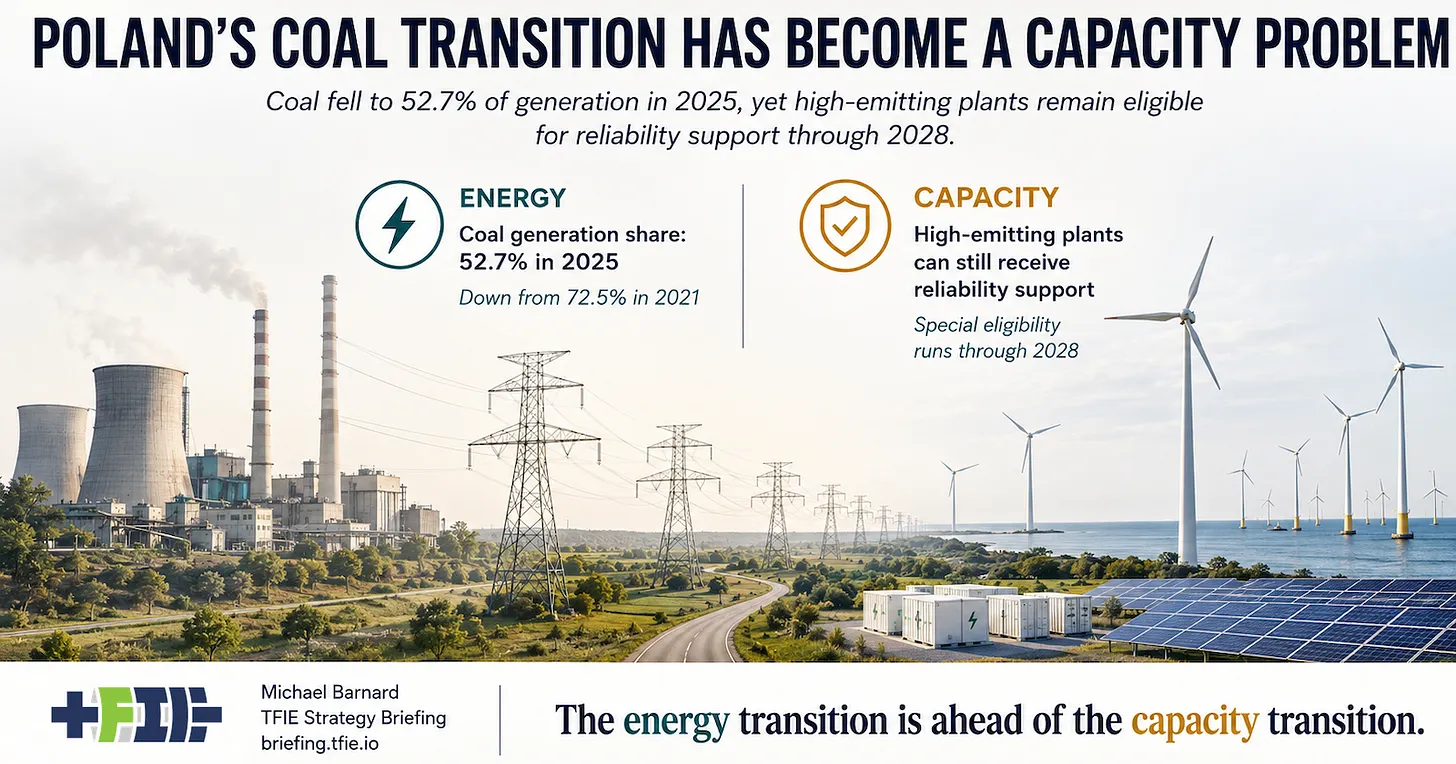
Just a few years ago, Poland’s grid was virtually synonymous with coal. In 2021, hard coal and lignite combined to supply a staggering 72.5% of the nation’s total electricity. The system was centralized, heavily polluting, and utterly dependent on domestic mining operations that enjoyed robust state subsidies. At this stage, renewables were viewed by traditional policymakers as a volatile supplement rather than a core pillar of energy security.
2024–2025: The Acceleration and the Gas Bridge
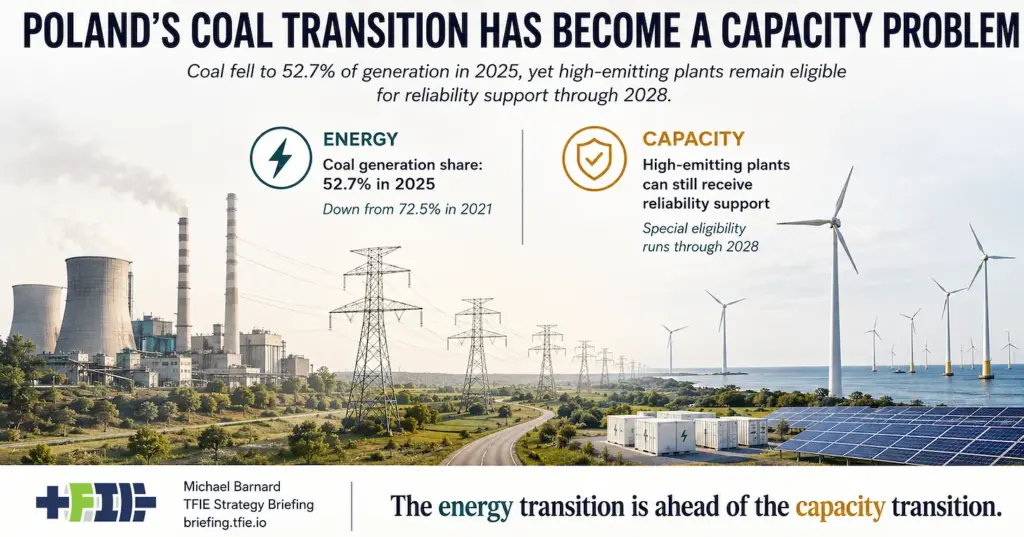
By 2025, the landscape had fundamentally inverted. Coal’s share of electricity generation plummeted to 52.7%, while renewables climbed to 31.4%. More symbolically, coal supplied less than half of Poland’s monthly generation in five separate months throughout the year. In June 2025, a historic milestone was crossed: for the first time in history, renewables generated more electricity than coal over the course of a full calendar month.
However, a closer look at the data reveals that renewables were not replacing coal on a neat, one-to-one basis. Natural gas emerged as a powerful intermediate force. In both 2024 and 2025, natural gas recorded the largest single-year increases in generation share. By 2025, Poland produced 24.4 TWh from gas, closely shadowing onshore wind at 23.8 TWh and solar PV at 20.3 TWh. The transition was not transitioning straight from brown coal to green electrons; instead, it was forging a transitional hybrid of renewables backed by flexible gas.
2026: The Offshore Frontier and Grid Friction
The pivot gained further industrial reality in July 2026, when Poland’s first offshore wind project, the Baltic Power farm, successfully delivered its first electricity to the national grid. Designed to reach 1.2 GW of total capacity when fully commissioned, Baltic Power is slated to produce roughly 4 TWh annually—satisfying approximately 3% of the country’s total electricity demand.
Yet, this rapid influx of intermittent generation has created immediate operational stress. In 2025, Poland was forced to curtail 1.4 TWh of renewable energy—double the volume curtailed in 2024. Significantly, this curtailment was driven primarily by system balancing requirements rather than physical transmission line bottlenecks. On peak generation days, the country frequently experiences periods of low-marginal-cost oversupply that its current, relatively inflexible grid infrastructure struggles to absorb.
Supporting Context & Metrics: Energy vs. Capacity
The central misunderstanding in evaluating Poland’s energy transition lies in conflating energy with capacity.
- Energy (MWh / TWh): Refers to the total volume of electricity produced over time. This is where coal is in freefall. As wind and solar flood the market with cheap power, coal plants find themselves pushed down the merit order, running fewer hours per year, losing market share, and becoming economically unviable as day-to-day energy producers.
- Capacity (MW): Refers to the immediate availability of power generation to meet peak demand during the grid’s most vulnerable moments—such as a freezing, windless winter evening with no solar output, constrained energy imports, and simultaneous plant maintenance outages.
+--------------------------------------------------------------------------+
|                     POLAND'S POWER GENERATION DYNAMICS                   |
+--------------------------+-----------------------+-----------------------+
| Metric                   | 2021 Baseline         | 2025 Status           |
+--------------------------+-----------------------+-----------------------+
| Coal Generation Share    | 72.5%                 | 52.7%                 |
| Renewable Share          | Low (~10-15%)         | 31.4%                 |
| Gas Generation           | Minor                 | 24.4 TWh              |
| Onshore Wind             | —                     | 23.8 TWh              |
| Solar PV                 | —                     | 20.3 TWh              |
+--------------------------+-----------------------+-----------------------+
Because Poland’s legacy coal fleet was engineered to be the entire electricity system, the infrastructure required to replace its reliability functions has not kept pace with the sheer speed of renewable generation buildout.
This tension is laid bare in Poland’s capacity market mechanisms. In September 2025, a supplementary capacity auction for the 2026 delivery year successfully contracted 7.58 GW of capacity obligations. Crucially, high-emitting plants—those exceeding the strict European emissions threshold of 550 kg of CO₂ per MWh—were permitted to participate via a special temporary derogation. Similar auctions are slated for 2027 and 2028, operating under an EU exemption that is legally mandated to expire at the close of 2028.
Far from being a sign of policy contradiction or foot-dragging, this reliance on coal-fired capacity is a calculated risk management strategy. Renewables are stripping away coal’s commercial business model as an energy producer faster than the rest of the power system can deploy the necessary alternatives to replicate coal’s reliability functions. The energy transition has decisively outpaced the capacity transition.
Official Statements and Institutional Insights
Industry analysts and international bodies have closely monitored Poland’s tightrope walk between decarbonization and system adequacy.

According to assessments highlighted by energy transition analysts at TFIE Strategy Briefing, the core problem facing Polish policymakers is no longer convincing utilities to shutter coal assets on paper, but rather justifying the continued financial life support extended to high-emitting units.
"The more interesting problem now is not how quickly coal generation is falling, but why Poland still pays to keep high-emitting coal capacity available," notes the briefing’s systemic analysis. The distinction between annual energy yields and worst-case hour reliability dictates that older coal plants function increasingly as expensive insurance policies rather than baseload workhorses.
Meanwhile, institutional forecasts validate the permanence of the downward trend for coal. The International Energy Agency (IEA) projects that Polish renewable generation will expand at an annualized rate of roughly 13% through 2030. Under the IEA’s trajectory, renewables are expected to officially overtake coal on an annual generation basis by 2028, capturing approximately 53% of total Polish power generation by the end of the decade. Concurrently, coal generation is forecast to decline by an average of 11% annually, while natural gas continues its steady upward trajectory as a flexible balancing fuel.
Future Outlook: The Hard Second Act
As Poland looks toward 2030 and beyond, the pathway forward is clear in destination but daunting in execution. The country’s ongoing transformation can be tracked through two distinct metrics:
- The Energy Share Metric: Tracking how quickly renewable penetration drives coal’s share of annual generation down toward single digits. This metric proves that the technological deployment of wind and solar is working.
- The Capacity Insurance Metric: Tracking how many gigawatts of fossil-fuel capacity Warsaw believes it must keep on life support for emergency hours. This metric will reveal when the supporting architecture of the grid is finally mature enough to let coal disappear altogether.
Solving the second metric requires far more than simply building another solar farm or erecting another wind turbine. Poland is realizing that replacing a centralized coal fleet requires constructing an intricate, multi-layered mesh of grid reinforcements, high-voltage cross-border interconnectors, utility-scale battery storage, flexible industrial demand-response programs, modernized district heating networks, and smart EV-charging infrastructure.
Getting coal out of the daily energy mix was the first, monumental challenge—and Poland is clearing that hurdle at a historic pace. But purging coal entirely from the power system without risking blackouts during the grid’s darkest, coldest hours remains the definitive, hard second act of the Polish energy transition.