

Executive Overview
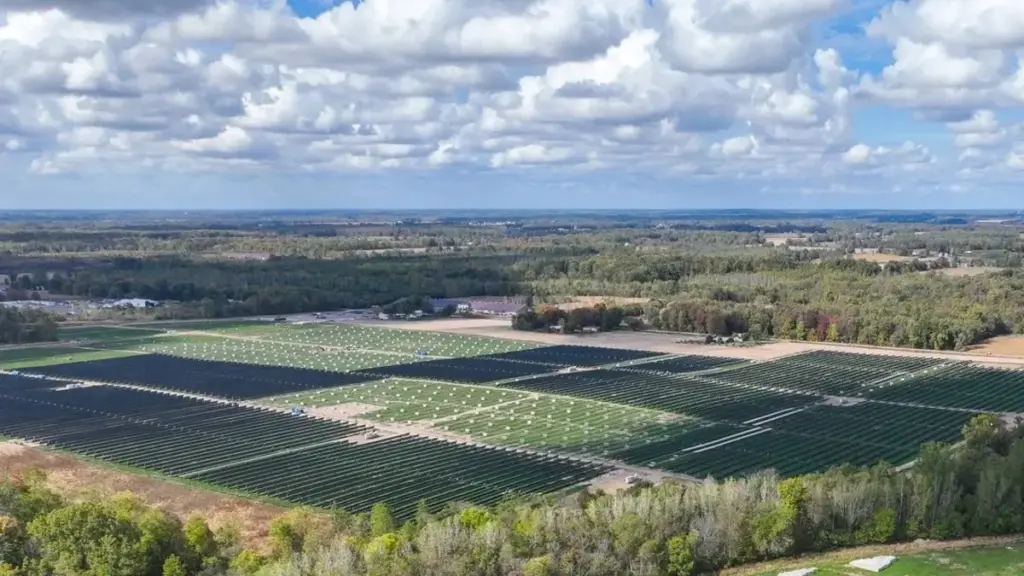
In a significant milestone for American corporate sustainability, Detroit-based utility provider DTE Energy has officially completed construction on the Cold Creek Solar Park. Situated near Coldwater, Michigan, this sprawling $194 million, 100-megawatt (MW) clean energy installation represents a cornerstone in Ford Motor Company’s aggressive decarbonization roadmap. Financed directly by Ford through its participation in DTE’s voluntary renewable energy program, CleanVision MIGreenPower, the newly energized solar farm is engineered to generate enough zero-emission electricity to power roughly 23,000 to 25,000 typical Michigan households annually.
However, the completion of Cold Creek is far more than a localized green energy project; it is a physical manifestation of a massive structural shift within America’s automotive heartland. For decades, the factories of Detroit and surrounding Michigan municipalities have hummed on the backbone of fossil fuels. Today, that narrative is being rewritten. Ford has committed to utilizing the renewable generation capacity of Cold Creek—and several forthcoming DTE utility projects—to overhaul its domestic manufacturing footprint.
Despite the profound environmental achievements, the initiative also highlights the complex realities of large-scale green infrastructure rollouts. While the Cold Creek facility broke ground right on schedule in April 2025 and has now crossed the finish line, broader timelines within the partnership have experienced subtle recalibrations. Ford’s overarching goal to assemble every vehicle in its home state with the equivalent of 100% carbon-free electricity has seen its target date shifted from 2025 to the end of 2027.
As corporate America races against tightening climate benchmarks and global ESG (Environmental, Social, and Governance) mandates, the DTE-Ford collaboration serves as a compelling case study. It illustrates how legacy industrial titans and regional utilities can forge massive public-private clean energy pathways, while simultaneously navigating the logistical, economic, and scheduling hurdles inherent in the global energy transition.
Detailed Chronology: From Blueprint to Megawatts
The genesis of the Cold Creek Solar Park and its deep integration into Ford’s supply chain did not happen overnight. It is the product of years of strategic negotiations, regulatory navigation, and intensive civil engineering.
The 2022 Agreement: Laying the Groundwork
The foundational partnership was struck in August 2022, when Ford and DTE Energy announced what was, at the time, the largest corporate renewable energy purchase ever verified in the state of Michigan. Under the terms of the landmark agreement, Ford committed to purchasing up to 650 megawatts of clean energy through DTE’s CleanVision MIGreenPower program.
MIGreenPower is designed to allow both residential and corporate customers to attribute a specific percentage of their monthly electricity consumption directly to wind and solar projects constructed within Michigan. For Ford, this mechanism provided a seamless path to bypass the administrative complexities of building proprietary off-site generation assets, opting instead to leverage DTE’s vast utility network to finance and scale new renewable capacity. At the announcement, leadership from both companies expressed immense optimism, setting an aggressive target for Ford’s Michigan vehicle assembly plants to achieve 100% carbon-free electricity operations by 2025.
Groundbreaking in April 2025
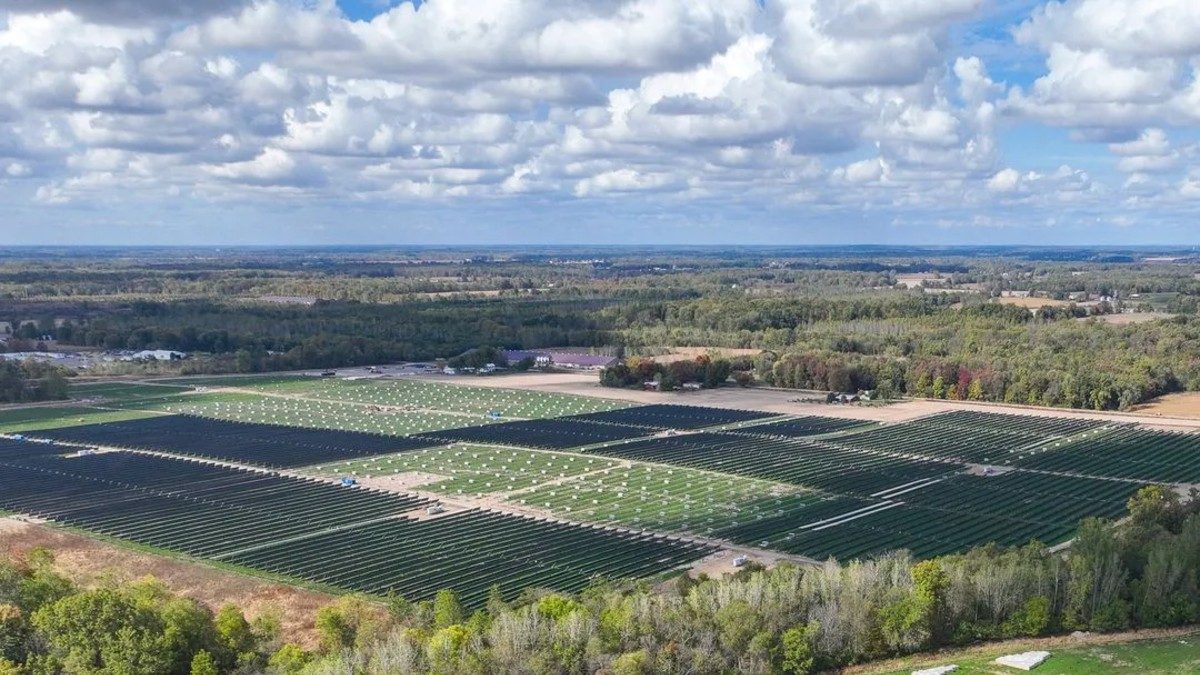
Following years of site acquisition, environmental impact assessments, and electrical grid interconnection studies, physical development of the Cold Creek project officially commenced in April 2025. Construction management firm Roncelli spearheaded the physical buildout, turning the rural landscape near Coldwater into a sophisticated mosaic of photovoltaic arrays.
Over the course of roughly a year and a half, the site transformed into a 100-MW powerhouse. Thousands of advanced solar panels, mounted on sophisticated tracking systems designed to follow the sun’s trajectory across the Michigan sky, were wired into high-capacity inverters and step-up transformers. These systems ensure that the direct current (DC) harvested from sunlight is cleanly converted into alternating current (AC) ready to be injected directly into the regional electrical grid.
October 2026: Project Completion and Commissioning
By October 2026, DTE Energy officially announced the completion and commercial commissioning of the Cold Creek Solar Park. As the first major project to come online explicitly under the 650-MW procurement umbrella, Cold Creek stands as the vanguard for a series of upcoming utility-scale clean energy installations slated for the region. The successful completion of this $194 million capital project validates the collaborative model between heavy industry and energy providers, proving that large-scale decarbonization is achievable even within traditional heavy-manufacturing economies.
Supporting Context & Metrics: Unpacking the Numbers
To fully comprehend the scale of the Cold Creek Solar Park and its integration into Ford’s broader operational matrix, one must examine the hard metrics driving the project. The economics, energy outputs, and employment dynamics tell a compelling story of industrial transformation.
Financial and Generation Footprint
- Total Capital Investment: $194 million, funded via Ford’s corporate enrollment in DTE’s CleanVision MIGreenPower program.
- Nameplate Capacity: 100 megawatts (MW) of clean solar generation capacity.
- Household Equivalency: Generates enough electricity to power between 23,000 and 25,000 average Michigan households annually.
- Broader Procurement Scale: Part of a massive 650-MW total clean energy acquisition deal established between Ford and DTE in 2022.
Economic Development and Community Impact
Utility-scale renewable energy installations are frequently praised for their environmental benefits, but their secondary economic impacts on rural host communities are equally critical. DTE Energy has consistently emphasized that projects built under the MIGreenPower umbrella inject substantial financial vitality into local economies through job creation and municipal tax revenues.
While specific, localized economic metrics exclusively isolated to the Cold Creek facility are tightly integrated into the broader 650-MW program data, the macroeconomic projections for the wider buildout remain substantial. When the sweeping Ford-DTE agreement was originally unveiled, utility estimates indicated that the sweeping solar and wind buildout would generate roughly 250 temporary construction jobs alongside approximately 10 permanent operational and maintenance roles.
Furthermore, the tax revenues funneled into host municipalities from these industrial-scale energy developments provide crucial long-term financial support. Local governments typically allocate these funds toward vital public infrastructure, including:
- Road paving and structural maintenance programs.
- Enhanced funding for local public school districts.
- Upgrades and operational support for community libraries.
- Resource expansion for local first responders, police, and fire departments.
The Timeline Adjustment
A notable detail emerging from the latest project disclosure is the adjustment of Ford’s target completion date for its Michigan manufacturing facilities. When the partnership was initially codified in August 2022, executives established an ambitious target to transition all Michigan vehicle assembly operations to 100% carbon-free electricity by 2025.
The updated announcements from DTE Energy now place that goal at the end of 2027. While the nearly two-year extension has not been explicitly dissected with detailed justifications in the utility’s official press releases, industry analysts note that supply chain intricacies, complex grid interconnection queues, and the sheer logistical hurdles of scaling manufacturing power demands often necessitate timeline recalibrations in multi-year industrial transitions.
Official Statements and Industry Perspectives
The convergence of automotive manufacturing and utility-scale energy generation requires deep synergy between corporate executives, energy regulators, and environmental stakeholders. While specific direct quotes from the latest October 2026 milestone press announcements focus heavily on the structural achievements, the underlying corporate philosophy of both entities remains transparently aligned with global climate targets.
Ford’s overarching strategy views energy procurement not merely as an operational overhead cost, but as a critical lever in its comprehensive ESG framework. By utilizing programs like MIGreenPower, Ford avoids the capital expenditures and regulatory burdens of owning and operating energy generation facilities directly, while still achieving absolute additionality—meaning their corporate demand directly funds the creation of new renewable energy assets that would not have otherwise existed on the grid.
DTE Energy, meanwhile, continues to position its CleanVision MIGreenPower initiative as the premier vehicle for corporate sustainability in the Midwest. As one of Michigan’s largest electric and gas utilities, DTE has faced mounting pressure from state regulators, consumer advocacy groups, and corporate clients to accelerate its transition away from coal and natural gas. Programs like MIGreenPower allow the utility to transfer a significant portion of the capital risk associated with new solar and wind farms directly onto deep-pocketed corporate off-takers like Ford, GM, and various tech and manufacturing entities operating within the state.
Environmental watchdogs have largely lauded the partnership for bringing tangible megawatts online rather than relying solely on abstract Renewable Energy Certificates (RECs) purchased from remote markets. By anchoring the clean energy generation locally—right in Michigan’s backyard—the project ensures that the economic, environmental, and grid-reliability benefits remain concentrated within the state.
Future Outlook: The Road to 2035 and Beyond
The completion of the Cold Creek Solar Park is far from the final chapter; rather, it is a major operational milestone in a multi-decade decarbonization marathon.

Ford’s Global and Domestic Roadmap
Ford’s environmental commitments extend far beyond the borders of Michigan. The company’s comprehensive sustainability architecture is mapped out in distinct, phased milestones:
- Michigan Manufacturing (End of 2027): Every vehicle assembled within Ford’s home state is targeted to be powered by the equivalent of 100% carbon-free electricity.
- Global Manufacturing (2035): Ford has committed to achieving 100% carbon-free electricity across all of its global manufacturing facilities worldwide.
- Total Carbon Neutrality (No Later than 2050): The ultimate corporate horizon involves eliminating carbon emissions entirely across the company’s entire value chain, encompassing vehicle tailpipes, internal manufacturing processes, and the sprawling global supply network of tier-one and tier-two parts suppliers.
To hit these ambitious benchmarks, the remaining capacity of the 650-MW agreement between Ford and DTE will need to materialize rapidly over the next several years. Additional solar parks, potentially paired with utility-scale battery energy storage systems (BESS), will be required to manage the intermittency of solar generation and ensure round-the-clock reliability for power-hungry automotive paint shops, stamping presses, and final assembly lines.
The Broader Clean Energy Transition in Michigan
Cold Creek also serves as a bellwether for the broader Midwestern energy landscape. As legacy industrial states pivot away from coal-fired generation in compliance with state-level renewable portfolio standards and corporate ESG demands, the landscape is experiencing an unprecedented land-use transformation. Agricultural acreage is increasingly being dual-purposed for photovoltaic deployment, prompting ongoing community discussions regarding land preservation, agrivoltaics, and rural economic diversification.
For DTE Energy, the success of Cold Creek validates its long-term CleanVision plan, proving that corporate partnerships can successfully underwrite the multi-billion-dollar investments required to modernize the grid. As more Fortune 500 companies establish stringent net-zero targets, utilities that offer flexible, transparent, and scalable green tariff programs will undoubtedly capture the lion’s share of industrial economic development.
Ultimately, the Cold Creek Solar Park stands as a monument to modern industrial pragmatism. It bridges the gap between the heavy-metal legacy of Detroit’s automotive past and the digital, electrified, and decarbonized reality of its future—proving that building iconic American vehicles and protecting the global climate can, and must, go hand in hand.



