

Executive Overview
VALENCIA, SPAIN — In what legal experts and human rights organizations are heralding as a monumental victory for freedom of expression and the right to peaceful assembly, a Spanish court has fully acquitted 11 Greenpeace activists. The defendants had faced severe criminal charges stemming from a 2021 peaceful climate protest against a fossil gas shipment at the Port of Sagunto.
The ruling brings to a close a high-stakes legal saga that saw the Public Prosecutor’s Office initially demand a staggering five years in prison for each individual—representing one of the harshest punitive threats ever leveled against peaceful environmental defenders in modern European history. Although the prosecution later reduced its demand to two and a half years as the trial progressed, the presiding court firmly rejected the core charge of aggravated public disorder. The judicial panel concluded that the prosecution utterly failed to substantiate any claims of violence, intimidation, or disruption of the public peace during the demonstration.
While the verdict has been celebrated by civil liberties advocates worldwide, it has simultaneously reignited an intense international debate regarding the shrinking space for civic dissent, the overreach of prosecutorial powers against climate activists, and the legal systems across Europe that increasingly target environmental defenders rather than the systemic drivers of the climate crisis. Despite today’s judicial relief, the case underscores the profound personal, psychological, and financial tolls inflicted on activists through protracted litigation, even when courts ultimately vindicate their actions.
Detailed Chronology: The Sagunto Action and Its Legal Aftermath
The October 2021 Protest at the Port of Sagunto
The events leading up to this landmark judgment unfolded in October 2021, at the height of growing European anxieties surrounding energy security, carbon dependency, and volatile fossil fuel markets. A multinational coalition of 11 Greenpeace activists—representing 18 different nationalities—embarked from the environmental organization’s iconic flagship, the MY Esperanza, to stage a targeted, peaceful demonstration at the Port of Sagunto, located near Valencia.
Operating with meticulous planning and transparency, the activists successfully blocked a massive commercial tanker carrying liquefied natural gas (LNG) imported from the United States for a duration of 12 hours. Their objective was clear and urgent: to draw immediate public and political attention to Europe’s dangerous and unsustainable reliance on foreign fossil gas imports, while demanding an accelerated, equitable transition toward renewable energy infrastructures.
True to Greenpeace’s decades-long ethos of non-violent direct action, the protest was executed without a single injury to personnel, without causing any structural damage to property, and without obstructing the broader commercial traffic or general operations of the port. Throughout the 12-hour blockade, the activists maintained open, peaceful, and respectful communication channels with local maritime authorities, port police, and law enforcement agencies.
The Escalation of Criminal Charges
Despite the peaceful nature of the demonstration, the Spanish state responded with unprecedented legal severity. Instead of handling the trespass or maritime infraction through standard administrative channels or civil penalties—as is customary for non-violent protests of this nature—authorities pursued aggressive criminal indictments.
The Public Prosecutor’s Office charged the 11 individuals with aggravated public disorder, a severe criminal offense typically reserved for violent riots or dangerous civil disturbances. The initial sentencing demand of five years in prison per activist shocked legal scholars across the continent. Even when the prosecution conceded to reduce the demand to two and a half years as the trial advanced, the threat of lengthy incarceration hung over the defendants like a Damocles sword, transforming a symbolic act of environmental dissent into a high-risk trial over fundamental civic rights.
The Trial and the Court’s Definitive Ruling
During the courtroom proceedings, testimony from a diverse array of witnesses—including law enforcement officers who managed the scene, maritime authorities who monitored the vessel, and independent journalists who covered the event live—unanimously corroborated that the protest was strictly non-violent, orderly, and harmless.
In its comprehensive judgment handed down today, the Valencia court thoroughly dismantled the prosecution’s narrative. The bench ruled that the essential legal thresholds for aggravated public disorder had not been met, explicitly noting that the state failed to demonstrate any credible evidence of violence, intimidation, or intent to breach the public peace.
Yet, while the criminal convictions were successfully avoided, the financial penalties stemming from the action remain a contentious battleground. The Spanish government has previously levied administrative fines totaling approximately €160,000 against the organizers and participants—penalties that are currently undergoing active legal appeal.
Supporting Context & Metrics: The Global Criminalization of Climate Dissent
A Growing Trend of "Lawfare" Against Environmental Defenders
The Valencia trial is not an isolated incident; rather, it is a prominent case study in a broader, deeply concerning global pattern. Across Europe and the Americas, governments and corporate entities are increasingly utilizing heavy-handed legal mechanisms—colloquially known as "lawfare"—to neutralize climate activism.
Legal experts point to the systematic deployment of counter-terrorism laws, injunctions, exorbitant civil damage suits, and severe criminal charges against climate defenders. The objective of such tactics often transcends simple law enforcement; it is designed to exert a profound "chilling effect" on civil society, exhausting grassroots organizations financially and emotionally, and deterring ordinary citizens from stepping forward to exercise their democratic rights to protest.
International Scrutiny and United Nations Intervention
The sheer disproportionateness of the five-year prison demands drew intense international scrutiny, capturing the attention of several United Nations Special Rapporteurs. High-ranking UN human rights officials monitored the developments closely, with some attending the trial proceedings in Valencia as independent observers.
The involvement of the United Nations highlights a growing international consensus that peaceful climate protest is not merely a localized legal infraction, but a vital cornerstone of global human rights and environmental protection. As ecosystems degrade and global greenhouse gas emissions continue to push planetary boundaries, the international community is increasingly scrutinizing how nation-states balance commercial interests with fundamental democratic freedoms.
Pre-Trial Mobilization: "The World Is Observing"
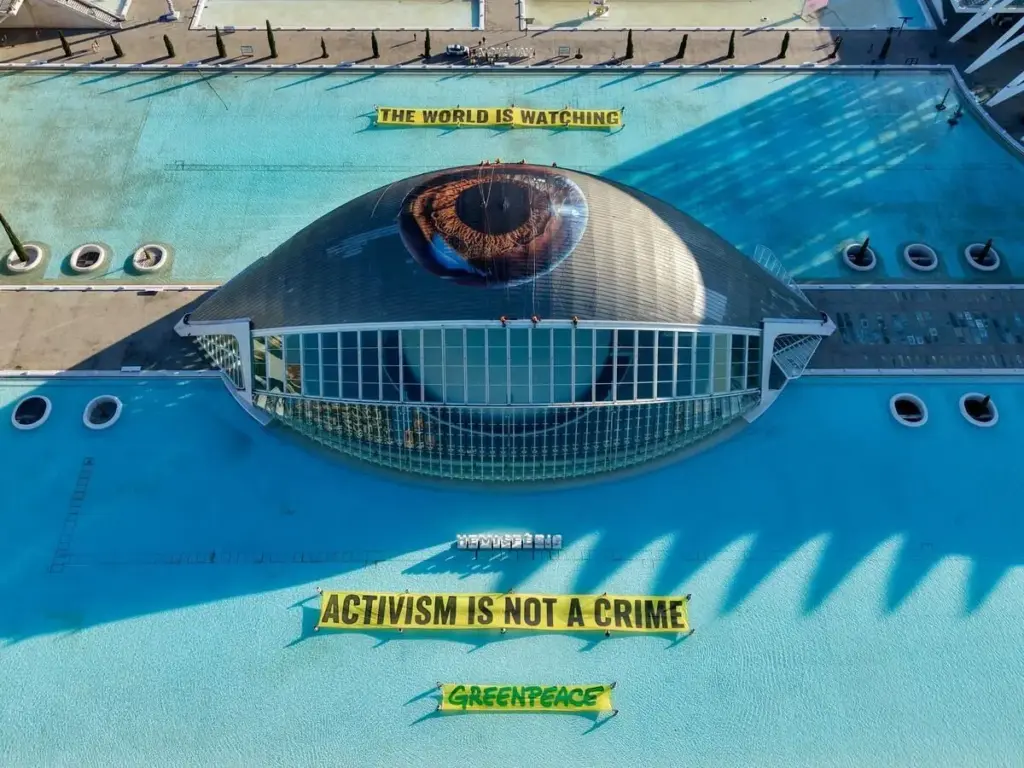
Recognizing the monumental stakes of the Sagunto case for the broader European climate movement, Greenpeace Spain and allied civil society networks launched a robust pre-trial solidarity campaign. In a striking visual statement ahead of the court dates, activists unveiled a massive, 530-square-meter art installation shaped like a giant human eye on the roof of Valencia’s iconic Hemisfèric building. The display featured bold, unmissable banners proclaiming: "The world is watching" and "Activism is not a crime." This public mobilization galvanized local support and underscored the transnational solidarity underpinning contemporary climate movements.
Official Statements and Expert Perspectives
The historic nature of the Valencia court’s ruling elicited powerful reactions from legal scholars, human rights advocates, and organizational leaders:
Daniel Simons, Senior Legal Counsel Strategic Defence, Greenpeace International
"This is a win for freedom of expression, and a rebuke to the attempt to repress peaceful climate activism. But an acquittal does not erase the years of anxiety, legal costs, and disruption to activists’ lives. This charge never should have been brought in the first place. The only threat to public order here was Europe’s continued reliance on fossil gas imports. We hope the prosecution does not appeal, and turns its attention towards those endangering, not defending life on this planet."
Gina Romero, United Nations Special Rapporteur on the Rights to Freedom of Peaceful Assembly and of Association
"The Sagunto case demonstrates how easily the legal system can be used to deter people from exercising a fundamental right, even when the law agrees in the end they did nothing wrong. It’s part of a broader, global pattern of using the legal system, criminal charges, punitive fines, and restrictive laws to shrink civic space. I will continue to raise the alarm and raise my voice to ensure that peaceful protest is not treated as a crime — in Spain or anywhere else."
Jose Manuel Marraco, Defense Attorney for the Greenpeace Activists
"I have been defending Greenpeace activists for 35 years, and it is an honour to do so. When people put themselves on the line to protect our planet, it is a generous act, not a criminal offence. The State should avoid the chilling effect that criminalisation and long-running proceedings have."
Future Outlook: Implications for Climate Justice and Civil Liberties
What Lies Ahead for Spanish and European Environmental Law?
While today’s acquittal represents an unmitigated triumph for the 11 defendants and a symbolic victory for environmental justice, significant legal and political challenges remain on the horizon.
- The Risk of Appeal: Legal teams are monitoring whether the Public Prosecutor’s Office will choose to appeal the Valencia court’s decision to a higher appellate instance. An appeal would prolong the legal uncertainty and continue to drain resources from environmental defense organizations.
- Pending Administrative Fines: The ongoing legal battles over the €160,000 in administrative penalties levied by the Spanish government will serve as the next critical legal test regarding the financial criminalization of protest.
- The Broader European Landscape: As the European Union grapples with energy transitions, security policies, and escalating climate impacts, the treatment of civil disobedience will remain a vital litmus test for European democratic values.
A Defining Crossroads for Civic Space
The Sagunto trial will long be remembered as a watershed moment in the intersection of climate action, jurisprudence, and human rights. It has forced judicial authorities to confront the fundamental reality of the climate crisis: that citizens who act to sound the alarm on ecological collapse are driven by conscience and necessity, not criminal intent.
As the world watches how European legal systems adapt to the escalating realities of climate disruption, the acquittal in Valencia stands as a resilient reminder that the fundamental right to protest—and to demand a livable, sustainable future—cannot be easily silenced by the heavy hand of the state.



