

Executive Overview
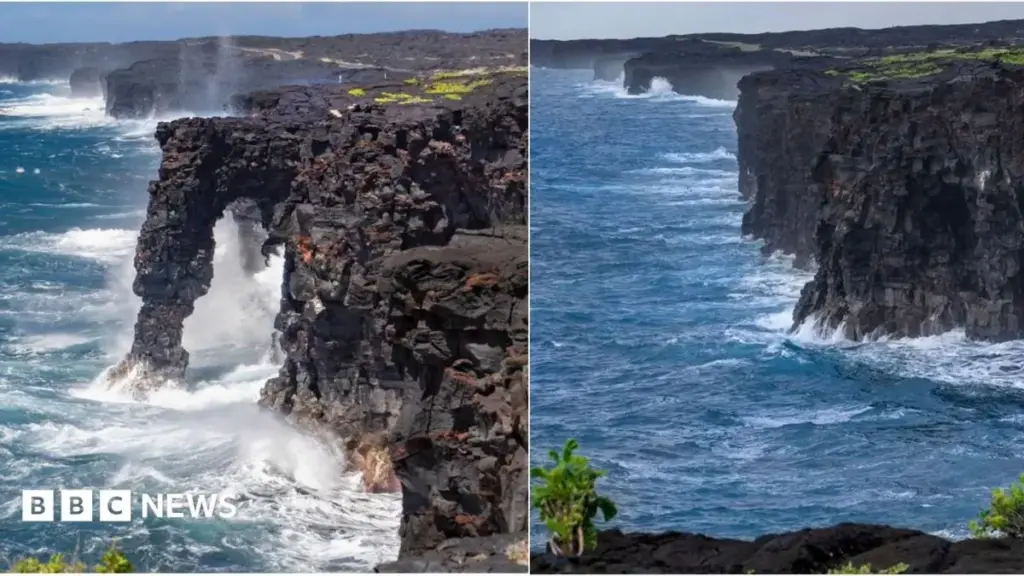
The dramatic shifting sands—and shifting stones—of the Hawaiian archipelago have delivered another sobering reminder of the planet’s volatile, ever-changing nature. The Hōlei Sea Arch, a towering 90-foot (27.4-meter) natural geological marvel sculpted from basaltic lava approximately five and a half centuries ago, has plunged into the Pacific Ocean. Located along the remote and rugged southern coastline of the Big Island within Hawaiʻi Volcanoes National Park, the majestic arch vanished from the seascape sometime between September 23 and September 27, 2024.
Its disappearance closes the chapter on one of the most photographed and heavily visited landmarks in the United States National Park system. Accessible via the scenic, dead-end route of the Chain of Craters Road, the arch stood as a testament to the raw, creative, and destructive forces of vulcanism and coastal erosion. While the exact moment of its structural failure remains undocumented—largely obscured by the temporary closure of the park during the hazardous sweep of Tropical Storm Nolo last weekend—the National Park Service (NPS) confirmed that the formation is entirely gone.
The loss of the Hōlei Sea Arch is far more than the falling of a tourist hotspot; it serves as a profound case study in geomorphology, highlighting the relentless war between relentless ocean waves and fragile volcanic coastlines. For years, park geologists and rangers monitored the escalating fragility of the cliffs flanking the structure. The writing had long been on the wall—or, more accurately, fracturing within it. Seismic activity, particularly the cataclysmic 2018 eruption and summit collapse of the nearby Kīlauea volcano, severely compromised the structural integrity of the surrounding palī (cliffs).
As park officials, environmental scientists, and the global public process the loss of the arch, the event has triggered a sweeping conversation regarding the ephemeral nature of natural monuments in an era of accelerating environmental shifts. Social media platforms have flooded with nostalgic tributes from travelers who once stood in awe before the basalt span, while scientists view the collapse through a lens of geological inevitability. The Hōlei Sea Arch is gone, but the forces that birthed it continue to reshape the Pacific rim in real-time, promising that while this titan has fallen, the dynamic landscape of Hawaii will forever remain a work in progress.
Detailed Chronology of a Collapse
To understand the sudden disappearance of the Hōlei Sea Arch, one must trace a timeline characterized by mounting geological stress, increasing human intervention, and the final, invisible coup de grâce delivered by a Pacific storm.
Pre-2018: A Stable Giant
For centuries, the Hōlei Sea Arch stood as a resilient sentinel along the southern coast of Hawaiʻi Island. Estimated to have formed approximately 550 years ago through the relentless pounding of ocean waves against hardened fingers of basaltic lava flows, the arch achieved a rare architectural equilibrium. Standing nearly 90 feet above the crashing surf, its thick, sturdy span bridged a gap of churning blue water, captivating generations of Native Hawaiians, explorers, and modern tourists alike. Long before the asphalt of Chain of Craters Road was laid, the coastline here was defined by this slow, grinding dance between fire and water.
The 2018 Kīlauea Eruption and Seismic Trauma
The modern countdown to the arch’s demise accelerated dramatically during the summer of 2018. Kīlauea, one of the world’s most active volcanoes, experienced a historic lower East Rift Zone eruption accompanied by the catastrophic collapse of its summit caldera. For months, the region trembled under the rhythm of tens of thousands of earthquakes.
While the major lava flows bypassed the immediate vicinity of the sea arch, the relentless seismic churning severely fractured the surrounding coastal cliffs. Internal faults opened, and micro-fractures spiderwebbed through the ancient lava formations supporting the arch. Though the structure continued to stand, it was now structurally compromised—built upon a foundation of shaken, unstable rock.
January 2020: The First Major Red Flag
As the cumulative impacts of the 2018 seismic events manifested physically, park officials noted alarming new cracks and accelerated instability along the cliffs framing the landmark. Recognizing an imminent public safety hazard, the National Park Service took decisive action in January 2020 by closing the original, highly popular sea arch viewing area. Visitors were barred from walking directly onto the promontory immediately adjacent to the span.
Mid-2020: The First Structural Loss
The vulnerability of the Hōlei Sea Arch was laid bare later in 2020. During the passage of a severe tropical storm, aggressive storm-surge waves hammered the base of the formation. The violent hydraulic pressure dislodged and broke off a substantial chunk of rock from the bottom of the arch. This event served as a stark physical demonstration that the arch was no longer merely weathering; it was actively disintegrating from the bottom up.
August 2021: The Official Warning
With the writing visibly etched into the basalt walls, the National Park Service issued a remarkably candid public advisory in August 2021. In an official statement, park authorities informed the public that the formation was living on borrowed time.
"This formation is beautiful, but temporary, and has a limited life span," the NPS declared at the time. "The sea arch will eventually crumble into the sea. However, others will replace it as the cliff slowly migrates inland."
This prophetic warning prepared seasoned park-goers for the inevitable, though few anticipated how rapidly the timeline would condense.
September 23–27, 2024: The Final Hours During Tropical Storm Nolo
The final chapter of the Hōlei Sea Arch unfolded in late September 2024. As Tropical Storm Nolo churned through the region, Hawaiʻi Volcanoes National Park enacted temporary public closures to ensure visitor safety amid high winds and heavy rainfall.
On September 23, routine patrols and tourist photographs confirmed that the arch was still standing, albeit battered by the heavy swells preceding the storm. However, when park staff returned to assess the area following the storm’s clearance on September 27, the arch was completely gone. Debris field analysis suggests the massive structure fractured under the combined strain of wave action, storm surges, and the preexisting structural weaknesses, collapsing silently into the Pacific Ocean while the park remained closed to human observation.
Supporting Context & Metrics
The collapse of the Hōlei Sea Arch cannot be understood in isolation; it is a textbook illustration of coastal geomorphology operating on a volcanic island chain. Examining the physical metrics, regional geology, and environmental pressures provides a comprehensive view of why this structure fell and what its loss means for the broader ecosystem of Hawaiʻi Volcanoes National Park.
Physical Dimensions and Composition
- Height: Approximately 90 feet (27.4 meters) from the waterline to the top of the span.
- Age: Estimated at roughly 550 years old, placing its formation around the 15th century.
- Material: Compacted, layered basaltic lava flows derived primarily from prehistoric eruptive phases of Kīlauea and Mauna Loa.
- Location: Situated at the southern terminus of Chain of Craters Road, within the coastal boundary of Hawaiʻi Volcanoes National Park on the Big Island of Hawaii.
The Mechanics of Sea Arch Formation and Erosion
Sea arches are inherently ephemeral geological features. They are born through differential erosion—a process where softer or more fractured layers of rock are eroded by wave action much faster than surrounding, more durable sections.
- Hydraulic Action: Waves crashing against coastal cliffs trap air in small cracks and fissures. As the water retreats, the compressed air expands violently, widening the fractures.
- Abrasion: Ocean waves carry sand, gravel, and rock fragments, acting like a natural sandpaper that scours and undercuts the base of the rock face.
- Subaerial Weathering: Rainwater, wind, and thermal expansion/contraction further weaken the rock from above.
In the case of the Hōlei Sea Arch, centuries of this relentless hydraulic battering carved a tunnel through a projecting headland. Once the tunnel was established, the roof of the arch was left to support its own immense weight. As the base was progressively undercut—accelerated by the 2018 seismic activity and 2020 storm damage—the structural load exceeded the tensile strength of the basalt. Gravity completed the work, pulling the monolithic span down into the deep waters below.
The Dynamic Nature of the Chain of Craters Road Corridor
The loss of the arch also underscores the precarious nature of infrastructure in this region. The Chain of Craters Road itself is famous for having portions repeatedly cut off, buried, and reclaimed by advancing lava flows over the decades. The road serves as a literal and metaphorical reminder that human engineering in Hawaiʻi Volcanoes National Park is perpetually engaged in a dialogue with a landscape that refuses to remain static. The road ends abruptly where prehistoric and historic lava flows meet the ocean, making the Hōlei Sea Arch an organic focal point for visitors who reached the end of the line.
Official Statements and Public Reaction
The disappearance of such a beloved landmark has elicited a profound mix of institutional reflection and emotional public mourning across digital platforms.
National Park Service Statements
In its official press release detailing the collapse, the National Park Service emphasized that while the loss is emotionally heavy for park staff and visitors alike, it is fundamentally a natural process.
"The coastline flanking the sea arch has shown signs of instability for years," the NPS noted in its statement, reflecting on the long-term monitoring efforts that dated back well before the 2020 viewing area adjustments.
Park rangers and geologists have continually sought to balance public access with safety, a challenge made acute by a landscape undergoing rapid, violent transformations. Highlighting the philosophical takeaway of the event, the park service reiterated its 2021 sentiment: while individual formations like the Hōlei Sea Arch possess a strictly limited lifespan, the continuous marine erosion and cliff migration guarantee that new geological wonders will eventually emerge along the jagged shoreline.
Public Outcry and Digital Nostalgia
Within hours of the NPS posting the news on social media, the announcement went viral, accumulating thousands of likes, shares, and heartfelt comments. For many travelers, the Hōlei Sea Arch was a mandatory stop during their pilgrimage to the Big Island, representing a tangible connection to the primal beauty of the earth.
Travelers flooded the comments section with vintage photographs, family snapshots, and deeply personal reflections:
- "I proposed to my wife near this arch ten years ago," wrote one user on Facebook. "It breaks my heart to see it gone, but I am grateful we have our memories and photographs of such a magnificent place."
- Another follower philosophized on the impermanence of the natural world, writing: "Nothing and no one is here forever. Millions of years from now the sun will die. Appreciate the good, the beauty, now."
This outpouring of sentiment highlights the unique psychological role that national parks play. They are sanctuaries not only for wildlife and geology, but for human memory. The sudden erasure of the arch serves as a collective meditation on mortality, change, and the humbling scale of geological time versus human lifespans.
Future Outlook: The Ever-Changing Hawaiian Coastline
As the dust settles over the empty stretch of coastline at the end of Chain of Craters Road, scientists, park planners, and visitors are left to look forward. What does the fall of the Hōlei Sea Arch mean for the future of Hawaiʻi Volcanoes National Park, and how will the landscape evolve in the decades and centuries to come?
Geomorphological Succession
Geologists are quick to point out that nature abhors a vacuum—even a marine one. The same relentless wave action that destroyed the Hōlei Sea Arch is currently carving into adjacent headlands, fracturing new sections of basalt cliffs, and testing other projecting rock formations along the southern shore.
While the iconic arch is gone, the continuous cycle of coastal migration means that new sea caves, notches, and eventually new sea arches will form. The coastline of the Big Island is among the youngest and most active on Earth, continually growing outward via volcanic eruptions on land and being shaved inward by the Pacific Ocean. This dynamic equilibrium ensures that the seascape of Volcanoes National Park will look entirely different to future generations.
Park Management and Visitor Access
For the National Park Service, the collapse reinforces the necessity of adaptive management strategies in geologically volatile regions. As climate change accelerates coastal erosion rates through rising sea levels and more intense tropical storm systems, park infrastructure and viewing areas will require increasingly nimble relocation protocols.
The successful foresight demonstrated by the NPS in 2020—when officials closed the original viewing platform and established a safer distance alternative—serves as a model for future hazard mitigation. Moving forward, park planners will continue to monitor the remaining accessible coastal zones, ensuring that visitors can experience the sublime power of the park without placing themselves in the path of inevitable geological collapses.
A Lasting Legacy
The Hōlei Sea Arch may now rest quietly on the ocean floor, buried beneath the deep blue waters of the Pacific, but its legacy is firmly cemented in the cultural and geological history of Hawaii. It stood for over half a millennium as a masterpiece of natural architecture, reminding all who beheld it of the delicate balance between creation and destruction. As the waves continue to crash against the basalt cliffs of the Big Island, the spirit of the Hōlei Sea Arch lives on in the ongoing, unbroken story of the earth reshaping itself anew.



