


Executive Overview
The modern electrical grid is undergoing the most profound structural transformation since its inception. Once designed to operate as a predictable, one-way highway delivering electricity from centralized fossil-fuel power plants to passive consumers, the grid is now buckling under the weight of a decentralized, bi-directional energy revolution. Surging electric vehicle (EV) adoption, the proliferation of rooftop solar arrays, utility-scale renewable energy projects, smart thermostats, home battery systems, and the staggering electricity demands of artificial intelligence data centers are converging all at once. Compounding these pressures are increasingly violent, climate-driven extreme weather events that regularly test the limits of aging infrastructure.
In response to this multi-front operational crisis, Texture, an innovative grid software startup, has successfully closed a $12.5 million Series A funding round. Co-led by climate tech-focused investment firms VoLo Earth Ventures and Equal Ventures, with additional participation from Lerer Hippeau and Abstract Ventures, this latest injection of capital brings Texture’s total lifetime funding to approximately $23 million.
The newly secured funds will be deployed directly into scaling the company’s workforce and aggressively expanding its platform capabilities. Texture’s core value proposition addresses a glaring bottleneck in the energy sector: rather than forcing utilities to adopt yet another fragmented, siloed software tool, Texture provides operators with a unified, real-time "single source of truth" dashboard. By seamlessly integrating data streams from meters, smart devices, and grid infrastructure, Texture empowers grid operators to monitor localized stresses and intervene proactively long before catastrophic equipment failures occur.
Detailed Chronology and Strategic Partnerships
Texture’s ascent in the competitive energy tech landscape has been accelerated by targeted deployment strategies and major industry alliances. While many enterprise software companies chase massive, slow-moving investor-owned utilities (IOUs) from day one, Texture took a calculated detour. The startup initially focused its efforts on utility cooperatives (co-ops)—a vital segment of the American energy grid that serves roughly 42 million citizens, predominantly across rural and semi-rural regions.
These co-ops face the exact same modernization pressures as their multibillion-dollar investor-owned counterparts, but with a fraction of the budget, smaller engineering teams, and legacy systems that are decades behind the curve.

“Co-ops kept telling me the same thing,” explains Texture co-founder and CEO Sanjiv Sanghavi. “They wanted to run modern grid programs, but didn’t have software built for their scale or budget.”
Recognizing this market gap, Texture engineered its platform to integrate smoothly into existing utility infrastructure. Rather than demanding a multi-year software overhaul or bloated engineering teams, Texture’s cloud-native architecture allows utilities to get systems up and running within days.
This agility caught the attention of regional leaders. The Vermont Electric Cooperative (VEC)—widely recognized as one of the few carbon-neutral utilities in the United States—adopted Texture’s software to monitor its complex grid territory and coordinate the behavior of hundreds of distributed home batteries. Furthermore, Texture has forged direct software integrations with over 50 prominent Original Equipment Manufacturers (OEMs) and energy technology giants, including Tesla, FranklinWH, Honeywell, Ecobee, SolarEdge, Leap Energy, and WattTime.
These deep device integrations enabled Ann Arbor’s Sustainable Energy Utility to deploy an innovative community battery program earlier this year, linking FranklinWH energy storage systems across 100 residential homes.
The NRTC Alliance: Scaling to 850 Cooperatives
In a milestone development for the startup, Texture recently announced a major strategic partnership with the National Rural Telecommunications Cooperative (NRTC). Representing a network of 850 utility cooperatives across the United States, the NRTC acts as a powerhouse vehicle for technological adoption among rural providers.
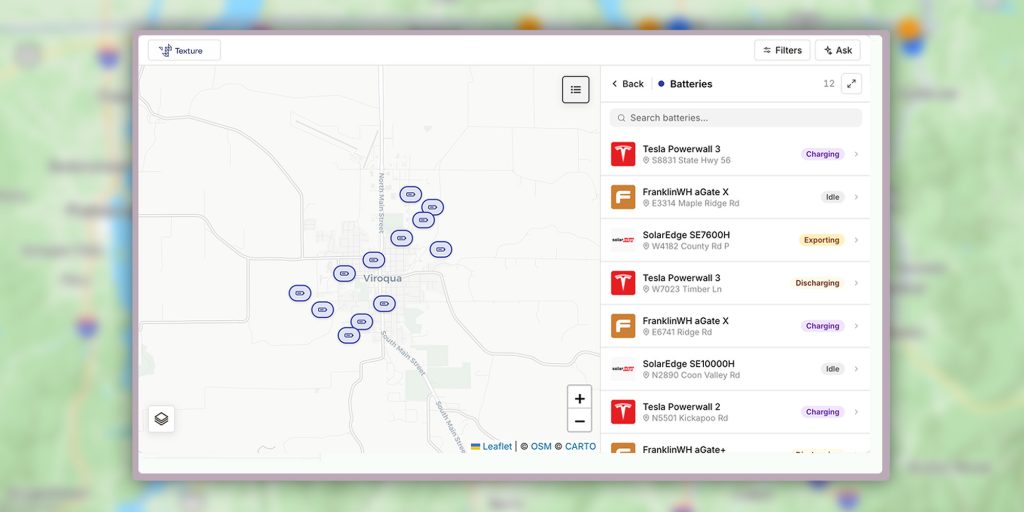
Through this partnership, NRTC member co-ops will gain direct access to advanced Distributed Energy Resource Management Systems (DERMS) powered by Texture. This software layer enables rural utilities to orchestrate and coordinate home batteries, smart thermostats, EVs, and other localized assets in real time.
Industry analysts note that many traditional Virtual Power Plant (VPP) and demand response platforms operate blindly, lacking direct access to real-time meter-level data. Texture bridges this gap, giving operators the granular visibility needed to make precise dispatch decisions based on absolute, current grid conditions rather than outdated historical estimates.
Supporting Context & Metrics: The Anatomy of Modern Grid Stress
To fully understand why venture capital firms are pouring tens of millions of dollars into grid software startups like Texture, one must examine the unprecedented stress points fracturing local distribution networks.
The EV Charging Squeeze and Transformer Crisis
The mass adoption of electric vehicles represents an environmental victory, but it poses an operational nightmare for local distribution grids. Unlike steady, predictable residential loads of the past, EV charging creates sudden, hyper-localized spikes in electricity demand. When multiple neighbors plug in their vehicles simultaneously after work, local distribution transformers are pushed past their thermal limits.
Texture’s software is designed to detect these sudden load surges directly at the meter level, tracing how escalating demand cascades down through specific transformers and feeders. This early-warning capability is critical given the current economic realities of utility equipment supply chains.

According to data compiled by Wood Mackenzie, transformer prices have skyrocketed by as much as 95% since 2019. Furthermore, global manufacturing bottlenecks mean that lead times for large electrical transformers can stretch beyond two years. For a small utility co-op, losing a major transformer due to unmanaged EV charging spikes can mean catastrophic financial and operational downtime. By providing predictive analytics and real-time monitoring, Texture helps operators mitigate these risks before hardware fails.
The Shift Toward Decentralized Intelligence
For over a century, the grid operated on a hierarchical, top-down model. Today, however, millions of endpoints are generating, storing, and consuming electricity simultaneously. This paradigm is known as the proliferation of Distributed Energy Resources (DERs).
- Rooftop Solar: Generates unpredictable generation peaks during midday hours, causing reverse power flows that traditional grid hardware was never engineered to handle.
- Home Batteries: Systems like the Tesla Powerwall or FranklinWH units can either draw power from the grid or inject stored energy back into it, requiring dynamic management.
- Smart Thermostats & Appliances: Devices from brands like Ecobee and Honeywell allow utilities to shift demand dynamically during peak heatwaves or freezing winter storms.
- AI Data Centers: Massive commercial loads requiring uninterrupted, gigawatt-scale power supplies that strain regional transmission systems.
Historically, utilities attempted to manage these moving parts by deploying disconnected software silos—one database for smart meters, another for SCADA (Supervisory Control and Data Acquisition) systems, and yet another for third-party thermostats. Texture’s software acts as a unified abstraction layer, pulling data from advanced metering infrastructure (AMI), smart meters, and connected devices into a single, cohesive operational dashboard.
Official Statements and Industry Perspectives
The rapid funding and expansion of Texture highlight a broader realization across the energy sector: the clean energy transition cannot succeed on hardware alone. Software is the connective tissue required to keep lights on amid extreme electrification.
Reflecting on the investment thesis behind the $12.5 million Series A round, leadership from VoLo Earth Ventures and Equal Ventures emphasized the critical timing of Texture’s platform. Investors noted that as climate change accelerates severe weather events—such as the infrastructure-testing conditions witnessed during major winter storms—utilities can no longer afford the multi-month data lag typical of legacy utility software.

Sanjiv Sanghavi, CEO and co-founder of Texture, emphasized that simplicity and speed of deployment are non-negotiable for modern utility operators.
"Co-ops kept telling me the same thing: They wanted to run modern grid programs but didn’t have software built for their scale or budget," Sanghavi stated. By focusing on rapid implementation—getting systems operational in days rather than years—Texture has carved out a distinct defensive moat in the utility tech market.
Industry observers also point to the growing pains of Virtual Power Plants. While VPPs have been touted as the holy grail of grid stabilization—aggregating thousands of consumer batteries and EVs to act as a unified peaker plant—many legacy VPP architectures fail because they lack the real-time metering telemetry needed to verify local grid safety. By tying DER management directly to real-time meter-level data, Texture ensures that VPP dispatch commands do not inadvertently overload localized neighborhood transformers.
Future Outlook: The Road Ahead for Texture and the Grid
As Texture absorbs its latest $12.5 million funding injection, the company’s roadmap focuses heavily on engineering talent acquisition and platform scalability. With the NRTC partnership opening doors to hundreds of new utility co-ops, the startup is positioned to transition from an emerging regional player into a foundational utility software standard across rural and suburban America.
However, challenges remain. The energy sector is notoriously conservative when it comes to adopting new software, largely due to strict cybersecurity regulations, legacy bureaucratic hurdles, and deep-seated institutional inertia. Texture’s ability to maintain its rapid onboarding timeline while scaling up to handle thousands of concurrent OEM integrations will dictate its long-term market penetration.

Looking further ahead, the convergence of artificial intelligence, localized electrification, and decentralized power generation means that grid management will only grow more complex. The era of the passive consumer is definitively over; every home with an EV charger, solar array, or smart thermostat is now a micro-node in a massive, living energy network.
Platforms like Texture—designed to harmonize this chaotic symphony of distributed power into a clear, actionable picture for grid operators—will likely form the operational backbone of the 21st-century power grid. As utilities race against the clock to modernize before the next wave of extreme weather or demand spikes hits, software startups bridging the gap between legacy hardware and modern intelligence will determine whether the grid bends or breaks.



