In an era defined by intensifying climate breakdown, escalating corporate ecological exploitation, and unprecedented crackdowns on peaceful assembly, visual documentation remains one of civil society’s most potent instruments. For over half a century, Greenpeace has pioneered photo-activism, utilizing the uncompromising lens of the camera to bear witness, pierce corporate greenwashing, and expose environmental injustices that powerful entities would prefer to keep hidden in the shadows.
This week’s global dispatch captures a panoramic view of this ongoing resistance. From massive judicial intimidation tactics targeting peaceful protesters in Spain to towering pillars of peatland smoke in Indonesia, and from the high-stakes political theater of New York Climate Week to the legislative battles unfolding in New Zealand and Brazil, activists worldwide are putting their bodies—and their freedoms—on the line.
This report provides an in-depth, structured chronicle of these pivotal developments. By examining the intersections of state crackdowns, corporate accountability, and grassroots mobilization, we explore the multifaceted strategies deployed by environmental defenders as they demand a livable, just future for the planet.
Detailed Chronology of Global Actions
1. Spain: The "Sagunto Case" and the 530-Square-Meter Warning
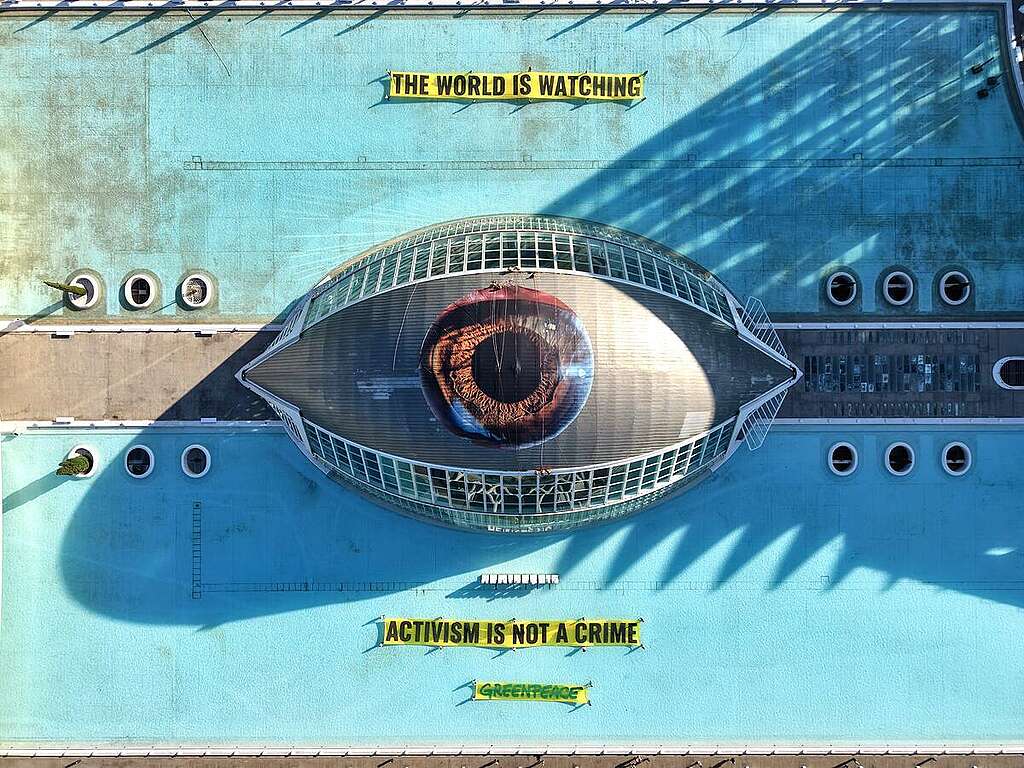
Location: Valencia, Spain Action: Unveiling of a massive 530 m² installation at the Hemisfèric bearing the message: "The world is watching."
The week’s actions opened with a high-profile escalation in Spain, where more than 40 Greenpeace activists gathered in Valencia for a peaceful protest in solidarity with the "Sagunto Eleven." The demonstration served as a direct response to an upcoming trial at the Ciudad de la Justicia, stemming from a 2021 protest against a liquefied natural gas tanker docked in the port of Sagunto.
What makes this judicial proceeding particularly alarming to international human rights and environmental observers is the severity of the state’s response. Prosecutors are seeking a staggering five-year prison sentence for each of the 11 charged activists—representing one of the harshest punitive measures ever sought against peaceful climate protesters in modern European history.
In defiance of these intimidation tactics, Greenpeace Spain hoisted a massive 530-square-meter art installation featuring a giant, unblinking eye. Positioned strategically at the iconic Hemisfèric architecture complex, the display carried a chillingly clear message to the Spanish judiciary and corporate polluters alike: "The world is watching." Legal experts warn that if these five-year sentences are upheld, it could establish a dangerous precedent, opening the floodgates for the criminalization of dissent across the European Union.
2. Brazil: "Untangling the Senate Mess" Ahead of 2026
Location: Brasília, Federal District, Brazil Action: Construction of a precarious "House of Cards" in front of the National Congress.
Shifting the lens to South America, Greenpeace Brazil took its campaign directly to the steps of the federal legislature in Brasília. As part of the broader #YourVoteMatters initiative, activists erected a literal, towering House of Cards directly in front of the National Congress.
The demonstration anchored the launch of the "Desembaralho do Senado" (Untangling the Senate Mess) project. This targeted campaign aims to educate and mobilize the Brazilian electorate regarding the critical importance of the upcoming 2026 Senate elections. Activists underscored that environmental deregulation, land grabs, and climate policy rollbacks are deeply tied to the legislative maneuvering within the upper house of Congress. By visualizing the country’s ecological and political stability as a fragile house of cards, Greenpeace highlighted how short-sighted political deals and anti-environmental agendas threaten to collapse the nation’s democratic and natural safeguards.
3. Indonesia: Peatland Fires and the Human Cost of Deforestation
Location: Ogan Komering Ilir, South Sumatra, Indonesia Action: Fire prevention monitoring and banner deployment within industrial concession areas.
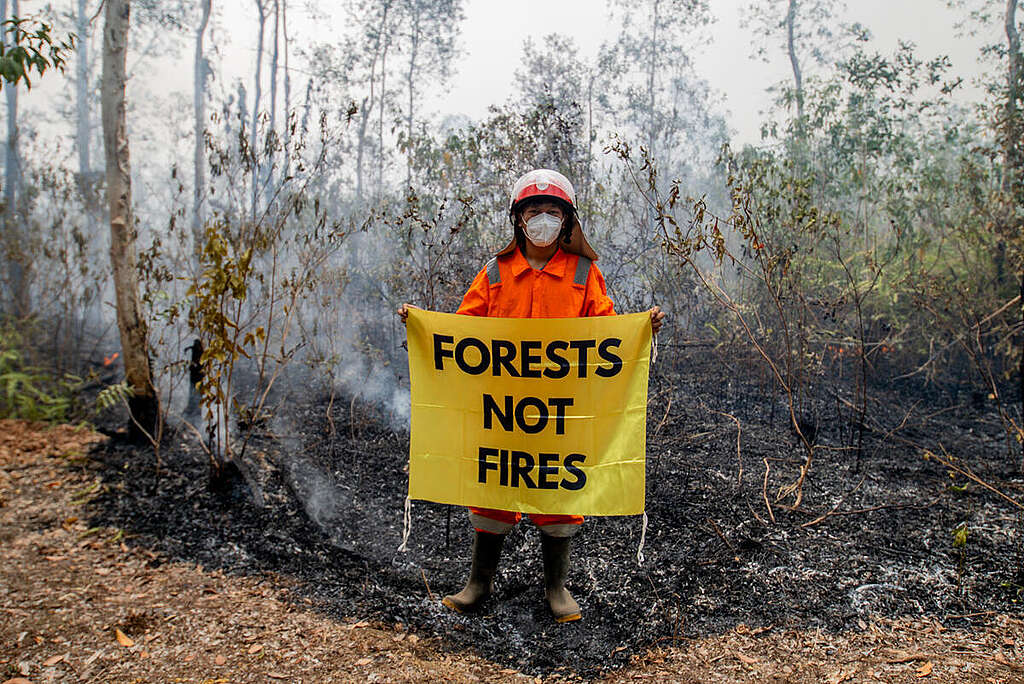
In Southeast Asia, the frontline of the climate crisis burns quite literally. Ali, a dedicated operative with Greenpeace Indonesia’s Fire Prevention Team, was photographed standing deep within the concession area of PT Bintang Harapan Palma (BHP) in Ogan Komering Ilir, South Sumatra. Holding a stark banner reading "Forest Not Fires," Ali’s presence brought international attention to the recurring devastation of Indonesia’s carbon-rich peatlands.
These deliberate and mismanaged fires are not isolated ecological tragedies; they are systemic events driven by industrial agricultural expansion. The resulting toxic haze routinely blankets regional population centers, choking cities like Palembang and surrounding rural districts. The health repercussions are severe. Vulnerable populations—particularly young children and the elderly—face surging rates of Acute Respiratory Infections (ARI) and long-term pulmonary damage, compounding the daily socioeconomic struggles of communities whose traditional lands have been co-opted for corporate profit.
4. New Zealand: Thousands March Against the Conservation Amendment Bill
Location: Auckland, Aotearoa New Zealand Action: Mass street mobilization opposing the exploitation of protected lands.
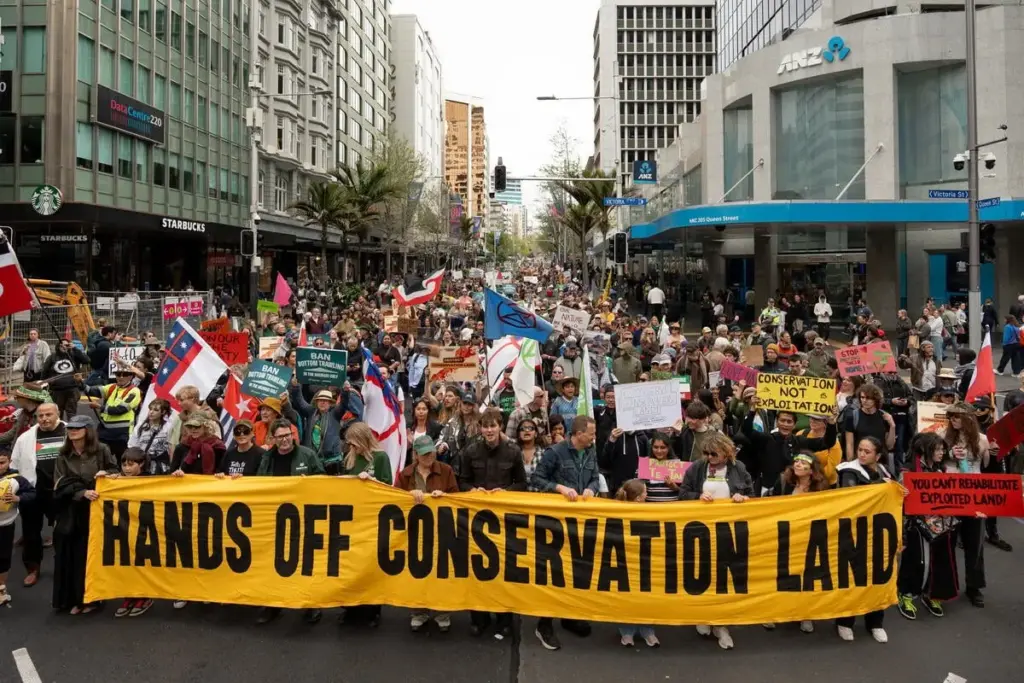
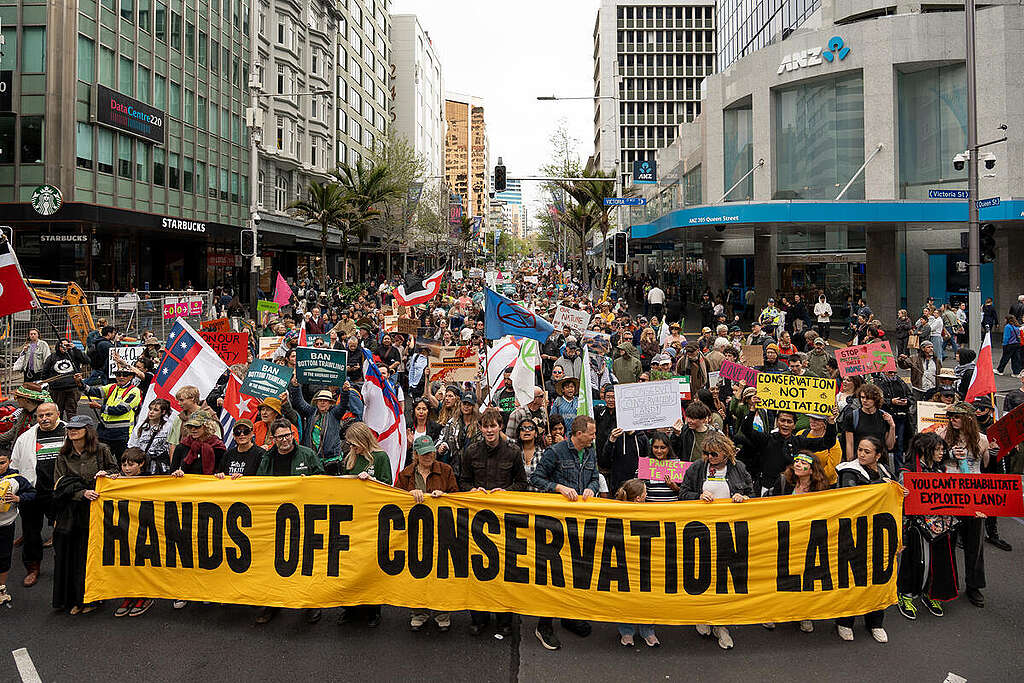
Turning to the Southern Hemisphere, Aotearoa New Zealand witnessed an extraordinary display of people power. On Saturday, September 19th, thousands of citizens flooded the streets of Auckland in unified opposition to the government’s controversial "Conservation Amendment Bill."
The proposed legislation has drawn fierce criticism from conservationists, Indigenous Māori leaders, and civil society groups alike, as it seeks to open up strictly protected conservation land to commercial exploitation and industrial extraction. Marchers carried placards demanding the absolute preservation of native forests, waterways, and wildlife habitats. The massive turnout signaled a resolute warning to lawmakers: New Zealanders are prepared to vigorously defend their natural heritage against legislative rollbacks designed to benefit extractive industries at the expense of biodiversity.
5. United States: New York Climate Week and the Battle for Corporate Accountability
Location: New York City, New York, USA Action: Projections, mobile billboard trucks, and Wall Street interventions.
As global leaders descended upon Manhattan for the United Nations General Assembly (UNGA) and New York Climate Week, Greenpeace USA executed a triad of high-impact visual interventions to disrupt the status quo and call out the architects of ecological destruction.
Defending Freedoms and the Planet
To kick off Climate Week, Greenpeace projected a massive, luminous message across prominent urban architecture, beaming directly onto the AT&T building and the stonework of the Manhattan Bridge. Targeting the billionaires, oligarchs, and autocrats whose economic models drive planetary collapse, the projection delivered an uncompromising triad: "Defend your Freedoms + Defend your Rights = Defend the Planet. RESIST!"
Exposing Deep Sea Mining Lobbyists
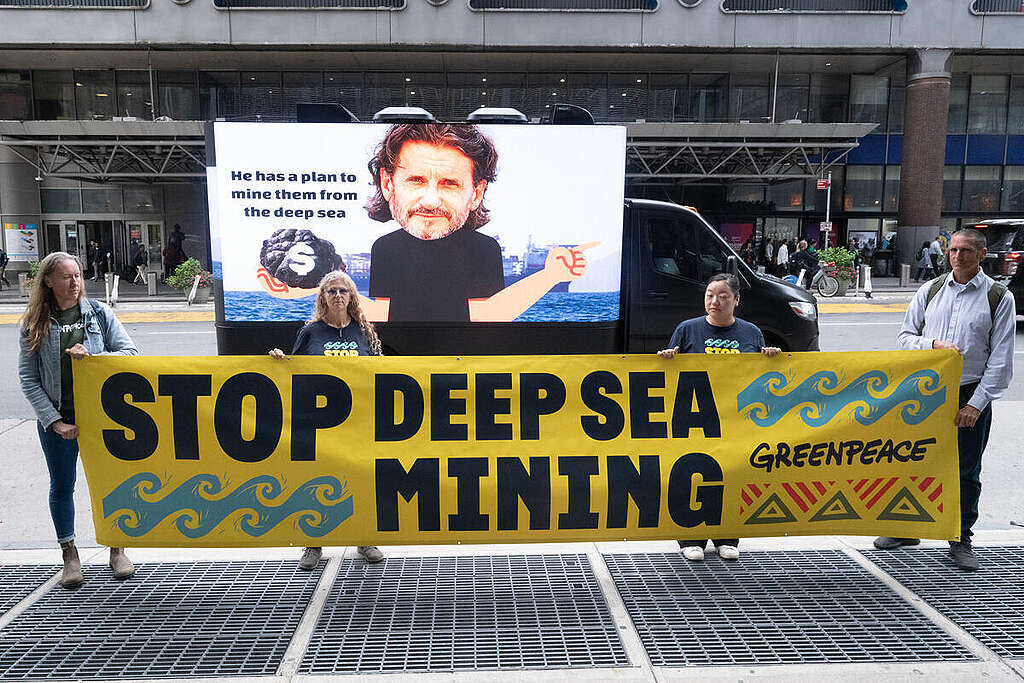
Simultaneously, a Greenpeace digital billboard truck endlessly circled The New York Times building during the publication’s "Climate Forward" event. The mobile display directly targeted Gerard Barron, CEO of The Metals Company (TMC), exposing his cozy ties to the incoming administration and his aggressive PR campaign to rebrand deep-sea mining as a "green climate solution." Greenpeace activists pointed out that TMC is actively attempting to bypass the International Seabed Authority by fast-tracking U.S. permits—despite a complete lack of scientific consensus regarding the safety, necessity, or irreversible ecological devastation deep-sea mining would inflict on fragile marine ecosystems.
Unmasking the Carbon Footprint of Artificial Intelligence
Rounding out the New York actions, activists brought literal "AI bubbles" to the heart of Wall Street. The striking street theater targeted major financial institutions and tech giants heavily investing in hyperscale data centers across the United States. These massive computational hubs, required to train and run power-hungry generative AI models, are placing an unprecedented strain on local power grids. To meet their energy demands, these data centers are increasingly turning to fossil gas, threatening surrounding communities with toxic emissions and single-handedly projected to cause the largest surge in corporate carbon pollution in the coming years.
Supporting Context & Metrics
To fully understand the gravity of these global actions, one must examine the quantitative metrics underpinning each environmental threat:
Spain (Sagunto Case): The prosecution’s demand for 5-year prison sentences for 11 peaceful activists is unprecedented in modern Spanish legal history for direct action protest, representing a worrying escalation in the criminalization of climate defense.
Indonesia (Peatland Destruction): Industrial peatland conversion and fires in regions like South Sumatra release gigatons of stored carbon dioxide into the atmosphere while driving regional healthcare crises. In areas surrounding Ogan Komering Ilir, rates of Acute Respiratory Infections (ARI) spike exponentially during the dry season, disproportionately affecting children under five and senior citizens.
New Zealand (Conservation Threats): The "Conservation Amendment Bill" threatens millions of hectares of public conservation land that currently serve as critical carbon sinks and irreplaceable sanctuaries for endangered endemic species, including the kiwi and long-tailed bat.
United States (AI and Energy Consumption): Hyperscale data centers in the U.S. are projected to consume massive volumes of electricity—equivalent to the power draw of entire medium-sized nations—relying heavily on gas-fired generation that threatens to derail national carbon reduction targets.
Official Statements
Greenpeace representatives and international campaigners have issued strong statements contextualizing the urgency of this week’s global actions:
"When governments attempt to silence peaceful dissent with draconian five-year prison sentences—as we are seeing in Spain—they are not showing strength; they are showing fear. The fossil fuel executives and industrial polluters are failing to stop the transition away from carbon, so they rely on the courts to do their dirty work. But as our 530-square-meter eye in Valencia demonstrates: the world is watching, and we will not be intimidated."
— Greenpeace International Spokesperson
Regarding the tech sector’s hidden carbon footprint in New York, a Greenpeace USA organizer noted:
"Big Tech wants the public to believe that artificial Intelligence is an ethereal cloud floating harmlessly in cyberspace. The reality on Wall Street is much dirtier. These hyperscale data centers are essentially coal and gas plants in disguise, burning fossil fuels to power massive server farms while threatening local air quality and blowing past global climate goals."
Future Outlook
As the world hurtles toward critical climate tipping points, the friction between civil disobedience and state-backed corporate impunity is reaching a boiling point. The events documented this week across Spain, Brazil, Indonesia, New Zealand, and the United States highlight an undeniable truth: grassroots movements will not be pacified by empty corporate pledges or neutralized by judicial overreach.
Looking ahead, several key milestones will define the environmental movement in the coming months:
The Sagunto Trial Verdict: The legal outcome in Valencia will serve as a bellwether for human rights and protest freedoms across Europe, determining whether peaceful blockades can be systematically categorized as aggravated felonies.
The 2026 Brazilian Elections: Campaigns like "Desembaralho do Senado" will intensify as civil society attempts to build defensive walls against legislative land grabs and anti-environmental policymaking in Brasília.
Deep-Sea Mining Governance: The international battle to stop companies like TMC from fast-tracking seabed extraction will reach a critical diplomatic and regulatory showdown, testing the authority of global maritime bodies against corporate lobbying.
Tech Accountability: Pressure on Wall Street financiers and Silicon Valley executives to disclose and curb the staggering energy emissions of AI infrastructure will become a central pillar of climate justice organizing.
Through the unblinking lens of photo-activism, Greenpeace continues to shine a light into the darkest corners of ecological exploitation. Whether hoisting a giant eye in Spain, holding banners amid the smoke of Sumatra, or projecting truths onto the skyscrapers of Manhattan, the message remains clear: the resistance is global, vigilant, and unyielding.