Across the United States, a quiet revolution is taking shape within industrial parks and agrarian outskirts. Mountains of discarded groceries, expired supermarket stock, and unsold food and beverages—materials that historically met their end rotting in landfills—are being funneled into high-tech processing plants to be reborn as renewable natural gas (RNG).
Fueling this operational expansion is a confluence of tightening state environmental mandates, mounting corporate financial pressures, and ambitious corporate sustainability goals. As businesses face steeper penalties for organic waste disposal and seek aggressive reductions in their carbon footprints, industrial-scale food waste processing has graduated from a niche environmental strategy into a booming commercial sector.
At the forefront of this movement is Divert, a specialized food-waste processor founded in 2007. The company’s state-of-the-art facility in Turlock, California, represents the vanguard of a broader national push. It is just one piece of a growing 14-facility portfolio that Divert maintains across the United States.
The economic and environmental viability of these operations is underscored by strategic partnerships across the supply chain. For instance, United States Cold Storage (USCS)—which operates 40 temperature-controlled warehouses nationwide—recently reported that Divert processed 2.5 million pounds of unsold food and beverages from just seven of its California warehouses over a compressed 15-month timeline.
When scaled across Divert’s nationwide network, these partnerships yielded monumental environmental returns. In 2025 alone, operations at the Turlock facility and its sister plants generated enough RNG to heat nearly 3,000 homes for an entire year. More impressively, these initiatives successfully averted the emission of more than 140,000 metric tons of carbon dioxide equivalent ($CO_2e$).
Yet, as the industry experiences an unprecedented growth spurt, it attracts both enthusiastic adoption and cautious scrutiny. While proponents point to immediate greenhouse gas mitigation and circular economy benefits, critics and industry analysts raise valid concerns regarding regulatory efficacy, supply chain vulnerabilities, and whether locking in RNG infrastructure risks prolonging society’s reliance on fossil-gas distribution networks.
Detailed Chronology
To understand how the renewable natural gas industry reached its current inflection point, it is necessary to examine the trajectory of food waste management over the past two decades.
2007: Divert is founded with a vision to address the staggering volume of edible and organic waste generated by the American retail and supply chain sectors. In its early years, the company focuses on foundational logistics, waste auditing, and diversion strategies.
The 2010s: State-level environmental regulations begin to shift. Forward-thinking jurisdictions, most notably California, draft legislation aimed at diverting organic materials away from municipal landfills to curb the release of methane—a potent greenhouse gas generated by rotting food in anaerobic landfill environments.
Late 2010s to 2020s: Recognizing the commercial pain points of traditional waste hauling—such as tipping fees, long-distance transport costs, and Scope 3 emissions liabilities—retail giants like Kroger and cold-chain operators like USCS forge strategic alliances with specialized processors like Divert. Technology scales rapidly, moving from rudimentary composting to sophisticated anaerobic digestion that captures energy.
2023–2024: Market consolidation and aggressive capital expenditure sweep the sector. Competitor Denali scales its operations rapidly, processing over 1 million tons of food waste in 2024—a significant leap from the 850,000 tons processed the previous year. Meanwhile, firms like Vanguard Renewables pivot and expand their business models to encompass comprehensive waste collection alongside anaerobic digestion.
The Present Era (2025 and Beyond): Facilities like the Turlock plant come fully online, serving as hubs for industrial processing. Divert prepares to bring two additional grid-connected natural gas facilities online within the year. Concurrently, academic debates flare regarding the true net emissions impact of organic diversion mandates, pushing the industry toward greater transparency, advanced traceability (such as RFID bin tracking), and intense operational scrutiny.
Supporting Context & Metrics
The economic engine driving the renewable natural gas boom is rooted in the harsh financial realities of traditional waste management. For decades, commercial entities treated waste disposal as a straightforward, albeit costly, operational overhead. Today, however, regulatory penalties and the corporate imperative to account for Scope 3 emissions—indirect emissions that occur in a company’s value chain—have fundamentally rewritten the calculus.
The Mechanics of Industrial Processing
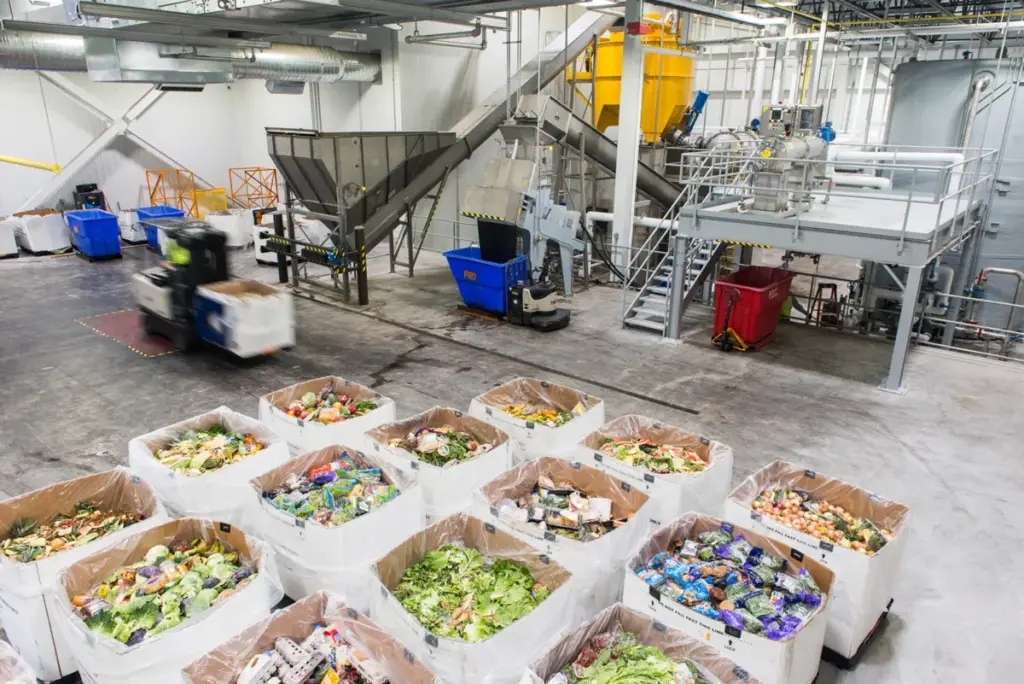
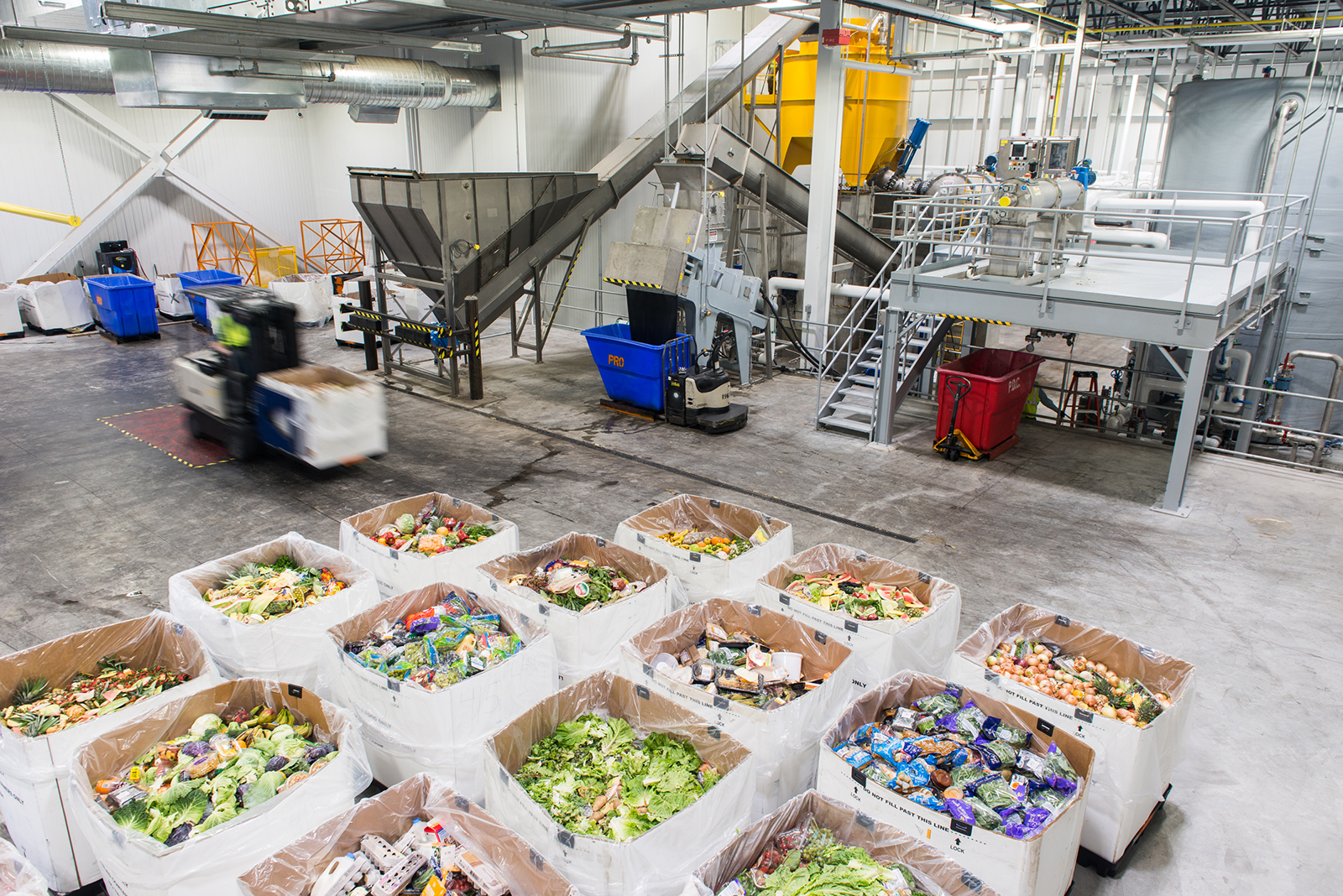
When pallets of expired, damaged, or unsold food arrive at facilities like the Turlock plant, they undergo a remarkably efficient mechanical transformation:
Depackaging and Separation: Divert’s specialized depackaging machinery tears open containers—ranging from cardboard boxes and plastic wrapping to aluminum cans—separating the packaging waste from its organic contents.
Slurry Generation: The liberated organic material is processed into a dense, nutrient-rich organic slurry.
Anaerobic Digestion: The slurry is pumped into massive anaerobic digesters. In the absence of oxygen, specialized microbial communities break down the organic matter.
Energy Harvest: This biological breakdown yields two primary outputs: high-grade agricultural fertilizer and raw biogas. The biogas is purified into pipeline-grade renewable natural gas and injected directly into the regional utility grid.
Quantitative Impact and Traceability
The scale of this infrastructure yields substantial measurable metrics:
Energy Generation: Divert’s network operations generate enough clean natural gas annually to supply continuous heating to approximately 3,000 residential homes.
Emissions Avoidance: By diverting millions of pounds of organic waste from landfills—where it would otherwise generate fugitive methane emissions—the process prevented the atmospheric release of more than 140,000 metric tons of $CO_2e$ in 2025 alone.
Granular Data Tracking: Modern processing plants are no longer black boxes. Utilizing advanced tracking technologies, such as RFID labels affixed to thousands of incoming collection bins, operators can trace specific waste streams down to the originating retail store. This transparency provides corporate clients with verifiable audit trails for their sustainability reports.
Official Statements
Industry stakeholders emphasize that the shift toward industrial-scale food waste processing is no longer driven solely by corporate altruism, but by hard financial sense and regulatory foresight.
Henry Lewis, a sustainability specialist at United States Cold Storage, highlights the immediate economic advantages of the transition:
"Paying Divert to process unsold food makes sense purely from a cost perspective because the transport fees are lower than those of haulers."
Lewis also points out the downstream environmental benefits for USCS and its clientele:
"Because Divert’s processing avoids methane release from landfills and displaces production of fossil natural gas, USCS and its food-industry customers also lower their Scope 3 emissions."
As the commercial ecosystem expands, technology providers are leaning heavily into data-driven accountability. Ben Kuethe Oaks, Senior Vice President for Commercial at Divert, emphasizes the sheer volume of material managed daily and the technological infrastructure required to monitor it:
"We have thousands of bins that are coming into our facilities every day. Each bin has an RFID label on it, so the company can track how much comes from a particular store."
Despite the industry’s rapid commercial growth, external observers and industry publications urge caution. Nora Goldstein, editorial chairperson of BioCycle, underscores the systemic risks inherent in building massive, centralized processing hubs:
"When you build facilities that can take 100,000 to 200,000 tons a year of food waste feedstock, you are putting all your eggs in one basket. There’s a vulnerability to that aggregation."
Goldstein notes that plastic contamination remains a persistent threat to digester health, which can easily destabilize large-scale operations if incoming waste streams are not meticulously screened.
Future Outlook
As the renewable natural gas sector looks toward the horizon, it stands at a critical crossroads characterized by rapid expansion, technological maturation, and intense debate over long-term sustainability frameworks.
Expansion and Market Consolidation
Major players are doubling down on infrastructure development. Divert is actively integrating two additional grid-connected natural gas facilities into its portfolio this year. Meanwhile, competitors are carving out distinct operational niches. Denali continues to dominate high-volume collection and processing by partnering with specialized energy producers, while Vanguard Renewables leverages its foundational expertise in anaerobic digestion to build out end-to-end waste collection networks.
Validating the Hierarchy of Waste Management
Notwithstanding the economic success of RNG plants, advocacy groups like ReFED and various academic researchers remind the public that energy recovery sits below waste prevention and reduction in the environmental hierarchy. Critics argue that treating food waste as a valuable industrial feedstock could inadvertently disincentivize upstream supply chain optimization—meaning retailers might focus less on ordering accurate amounts of food if disposing of surpluses into an RNG pipeline remains cheap and politically palatable.
Furthermore, environmental purists question whether pumping renewable natural gas into municipal utility grids prolongs society’s economic and physical dependence on fossil-gas infrastructure, potentially delaying the complete electrification of residential and commercial heating.
Navigating Vulnerability and Policy Shifts
Operationally, the future of the industry will depend on its ability to mitigate systemic vulnerabilities. The reliance on massive, centralized processing plants leaves the sector exposed to disruptions caused by contamination—particularly microplastics and packaging debris that slip past sorting mechanisms. Industry experts suggest that future investments may need to pivot toward a hybrid model: combining large centralized digesters with decentralized, hyper-local composting and pre-processing modules to enhance network resilience.
Ultimately, the industrial-scale processing of food waste into renewable natural gas is a testament to human ingenuity in turning environmental liabilities into energetic assets. Whether this boom matures into a permanent pillar of the circular economy or serves as an interim stepping stone toward total electrification will depend on regulatory rigor, technological refinement, and an uncompromising commitment to true sustainability across the global food supply chain.