

Executive Overview
For the first time in a century and a half, the haunting, nocturnal calls of the kiwi echo once more through the rugged hills surrounding Wellington, the capital city of Aotearoa New Zealand. Through an extraordinary collaborative effort known as the Capital Kiwi Project, more than 250 manu (birds in the Māori language) have been successfully translocated back to a sweeping 24,000-hectare (59,300-acre) landscape of working farms, forestry blocks, and suburban fringes.
This milestone represents far more than a standard wildlife reintroduction. It is a profound masterclass in community-led conservation, resting equally upon three foundational pillars: deep-rooted partnerships with iwi (Māori nations), active stewardship from private landowners, and widespread mobilization of local communities. By weaving together Western ecological science and Te Ao Māori (the Māori world view), the Capital Kiwi Project has transformed a landscape once written off as a biodiversity desert into a thriving, resilient ecosystem, proving that humans and endangered endemic species can successfully coexist in shared environments.
Detailed Chronology: A Decade of Ambition and Action
The return of the kiwi to Wellington’s skyline is the culmination of years of meticulous planning, relationship-building, and intensive landscape-scale predator management.
Laying the Groundwork (2014–2022)
A decade ago, the ambition to reintroduce New Zealand’s most iconic flightless bird to a peopled landscape was widely viewed as dangerously idealistic. Wellington’s surrounding hills had been devoid of kiwi since the late 19th century, victims of habitat clearance and introduced mammalian predators.
Before a single bird could step foot back on the mainland, the project team had to tackle the region’s apex predator: the stoat. Stoats are relentless hunters that prey on young kiwi before they reach "fighting weight"—approximately 1 kilogram (2.2 pounds), the threshold at which a juvenile kiwi can successfully defend itself using powerful, dinosaur-like claws. Between 2019 and 2022, project organizers deployed a staggering network of more than 5,300 traps across the sprawling 24,000-hectare project area.
Concurrently, project leaders Paul Ward and Rawiri Walsh spent nearly two years holding cups of tea in village wool sheds, Marae (traditional Māori meeting houses), and community halls. They built essential trust with landowners and iwi, asking a fundamental question: Would you like to bring the kiwi back?
The Homecoming (Late 2022)
In late 2022, the first wave of kiwi arrived, sourced from established, predator-fenced sanctuaries and captive-breeding operations that were reaching maximum capacity. Their arrival was marked by a powerful pōwhiri (traditional welcoming ceremony) held behind a local school in Makara. Hundreds of community members, school children, farmers, and iwi representatives gathered in absolute silence as a legendary, nearly 50-year-old female kiwi named Anahiera—rescued from a pine harvest in 1980 and housed for four decades in a zoological facility—was brought out to touch the soil of her ancestors.
Expanding Horizons (2023–Present)
Subsequent translocations and naturally hatched chicks have steadily swelled the ranks. As of 2024, the population in the Wellington hills is estimated at well over 300 individuals. The project has expanded its engagement, culminating in high-profile releases at national sites like the Beehive (New Zealand’s parliamentary building), cementing the kiwi’s return as a matter of national pride and responsibility.
Supporting Context & Metrics: Breaking Expectations
The ecological metrics emerging from the Capital Kiwi Project have shattered conservative projections, offering a beacon of hope for global conservation biology.
The Predator-Prey Equation
In areas without active pest control, 95% to 100% of wild kiwi chicks succumb to stoats before reaching maturity. When the Capital Kiwi Project secured its Department of Conservation permits, the mandated survivorship target for monitored chicks was a sobering 30%—a figure acknowledging the brutal reality of nature "tooth and claw."
Instead, the results have been nothing short of astonishing. After losing a single chick to predation in 2023, the project recorded virtually zero further predation losses over a multi-year monitoring period, pushing chick survivorship to well over 90%.
Nutritional Abundance in Modified Landscapes
Surprisingly, this success is occurring not within pristine, ancient rainforests, but within highly modified ecosystems: sheep and cattle farms, commercial pine forestry, and regenerating scrublands dominated by introduced gorse and barberry.
- Accelerated Growth Rates: While kiwi typically take six to eight months to reach the stoat-proof weight of one kilogram, many juveniles in the Wellington hills are hitting this milestone in just four months, effectively halving their window of vulnerability.
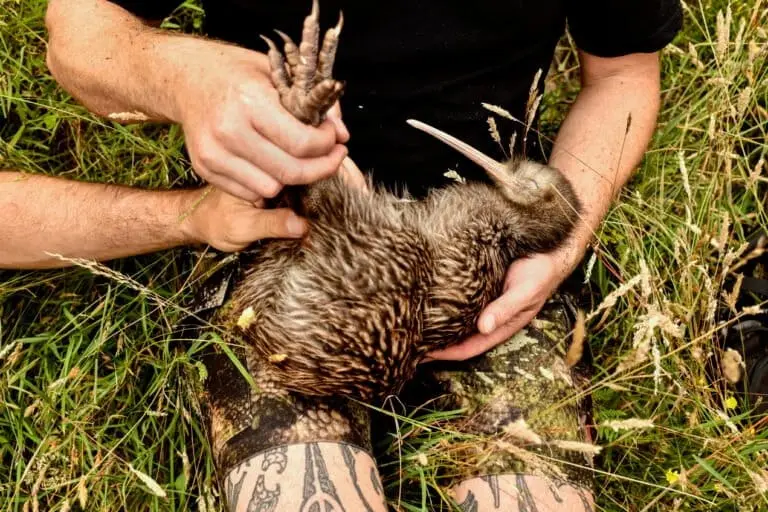
- Exceptional Body Condition: During routine health checks, field workers evaluate birds on a 1-to-5 body condition scale (where 1 indicates emaciation with prominent ribs and spines). Released birds are consistently scoring 4s and 5s, displaying abundant fat stores due to the rich subterranean invertebrate life thriving beneath the pasturelands and scrub.
- Early Breeding: Demonstrating profound adaptation to their restored home, translocated females have begun laying eggs mere months after release—a biological indicator of optimal health and low stress.
Official Statements & Indigenous Perspectives
The heartbeat of the Capital Kiwi Project is its absolute commitment to Te Ao Māori, ensuring that conservation is driven by cultural reciprocity and interconnectedness rather than clinical detachment.
The Power of Relationships
Paul Ward, founder and project lead, emphasizes that the initiative’s survival depends on a three-legged tripod: relationships with iwi, landowners, and the local community. Pulling away any single leg causes the entire structure to collapse.
"This is a relational project as much as it is what you might traditionally call a conservation project," Ward reflects. "And I think at a fundamental level that if we lose our relationship with these animals, with these manu… they risk becoming a museum species."
The Cultural Framework: Tono and Pōwhiri
Rawiri Walsh, the project’s Kaimanaaki Kiwi (kiwi guardian) and iwi liaison, explains that modern conservation in Aotearoa must honor Te Tiriti o Waitangi (the Treaty of Waitangi). Tribes hold historic guardianship over native fauna, requiring formal protocols for any wildlife movement.
To acquire birds, recipient iwi must issue a tono—a formal, traditional request to source populations residing on another tribe’s ancestral lands.
"From a Māori perspective, we just had to agree with the iwi that we were receiving from, and they had to agree with us that they wanted to give us kiwi," Walsh explains.
Upon arrival, the responsibility for the birds is ceremonially transferred via a pōwhiri, mirroring familial bonds of trust and care.
"When you take that bird, and you release it, and you’re placing it in a burrow, you’re putting something back into that whenua [land]," Walsh notes. "And for us as a people, we believe that we’re an integral part of that whenua, and when we are able to go out there and release kiwi… we’re putting ourselves and something back into that environment that has a net positive benefit."
Future Outlook: Beyond Complacency
With a robust population of over 300 kiwi now wandering the hills of Wellington, the Capital Kiwi Project has proven that landscape-scale rewilding is viable outside of pristine wilderness areas or fenced islands. However, project leadership is quick to warn against resting on its laurels.
Combating Complacency
The primary challenge of the next decade is not logistical ambition, but complacency. The extensive trap networks must be maintained perpetually, and public awareness regarding urban threats—such as domestic dogs and vehicle traffic—must remain sharp.
A Blueprint for Other Taonga Species
The overwhelming success of the kiwi’s return has served as a powerful proof of concept. Project organizers are currently leaning into their collaborative networks with iwi, landowners, and regional communities to explore the reintroduction of other taonga (treasured) species that have long been absent from the capital’s skies and forests.
While specific release plans remain under wraps, the philosophy guiding the project remains clear: nature is not a distant place to be visited in a national park, but an intrinsic component of human identity, citizenship, and daily life. As the Capital Kiwi Project looks forward, it offers the global conservation community a vital lesson: saving wildlife requires healing our relationships with both the land and one another.



