

By Nicole Kearney, Communications Director, Biodiversity Heritage Library
Published with editorial enhancements and structural expansion.
Executive Overview
For nearly two decades, the Biodiversity Heritage Library (BHL) has stood as the definitive digital repository for the natural world, safeguarding humanity’s collective knowledge of life on Earth. Operating quietly behind the scenes of global scientific research, education, art, and conservation, BHL transformed the landscape of biodiversity literature. By digitizing and providing free, open-access availability to over 64 million pages of historic literature, field notes, and artistic illustrations, the library became an indispensable tool for researchers tracking endangered species, historians mapping colonial-era expeditions, and artists drawing inspiration from historic natural science plates.
However, in 2025, this monumental engine of global science faced an existential crisis. Following nearly twenty years of foundational support from the Smithsonian Institution, BHL encountered the abrupt loss of its primary institutional backing. Stripped of its historical safety net and facing an uncertain future with no guarantees of survival, the library was thrust into a high-stakes race against time. To survive, BHL needed to completely reinvent itself—migrating its technical infrastructure, establishing a new independent global governance model, securing ongoing funding, and retaining its specialized staff—all while ensuring that millions of pages of irreplaceable data remained online and freely accessible to the public.
What followed was a remarkable testament to the power of the global scientific and conservation community. Through the #GiveBHLWings campaign and a wave of international philanthropy, supporters from 46 countries rallied to rescue the institution, raising over $113,000 during its transition phase and successfully orchestrating a complex migration of its core technical servers to the Field Museum in Chicago by July 2026.
Today, BHL operates under a resilient, partner-supported distributed model. Yet, as the dust settles on its heroic rescue, a new chapter begins. Having successfully saved the library from extinction, the global community must now pivot toward sustaining it. This is the inside story of how BHL survived its darkest hour—and why its future depends on a new generation of recurring supporters.
Detailed Chronology: From Institutional Crisis to Global Independence
To understand the magnitude of BHL’s 2025–2026 transition, one must first recognize the structural weight the library carried. Founded in 2006 as a consortium of major natural history museum libraries, botanical libraries, and research institutions, BHL was designed to solve a fundamental barrier in biological research: the physical decentralization and rarity of foundational taxonomic literature. Much of the world’s biodiversity literature—describing species discoveries, anatomical studies, and ecological surveys spanning five centuries—was locked away in climate-controlled rare book rooms, accessible only to a privileged few who could travel to major metropolitan institutions.
BHL shattered these physical barriers, scanning millions of pages and making them text-searchable and freely downloadable. For the first twenty years, the Smithsonian Institution served as BHL’s primary institutional anchor, providing vital administrative, financial, and technical housing.
The Turning Point: The Loss of Smithsonian Support
The crisis arrived unexpectedly. The sudden withdrawal of Smithsonian institutional support stripped BHL of its core operating foundation. For an organization operating at global scale—managing petabytes of scanned archival material, continuous web traffic, complex metadata pipelines, and international partnerships—the loss of a primary institutional sponsor could easily have been fatal.
Without immediate intervention, BHL faced the distinct possibility of service termination, staff layoffs, and the potential gating or degradation of the world’s largest open-access biodiversity repository. The clock began ticking toward a hard deadline: January 1, 2026, the date by which BHL had to operate independently or risk permanent administrative collapse.
The Mobilization and the #GiveBHLWings Campaign
Recognizing that the library belonged not to any single institution, but to the global scientific and public community, BHL leadership took a bold step. On October 17, 2025, the organization launched public fundraising for its transition, codenamed #GiveBHLWings.
The campaign struck a nerve across the international scientific and conservation communities. Donations began pouring in not just from wealthy benefactors or major grant-making foundations, but from grassroots supporters whose lives and careers had been touched by the archive: botanists in remote field stations, amateur naturalists, historians, teachers, and nature enthusiasts.
In the final seven weeks leading up to the January 1 independence deadline, supporters contributed $51,000 specifically through the #GiveBHLWings initiative. By the time the formal transition window closed, contributions from 46 countries had surpassed a remarkable USD $113,000. This influx of capital provided the critical financial runway needed to retain essential staff, keep servers running, and prevent any disruption to the daily delivery of millions of research pages.
The Technical Migration: Moving to the Field Museum
While financial contributions secured BHL’s immediate administrative survival, a massive logistical hurdle remained: the physical and digital relocation of BHL’s core technical infrastructure.
Throughout the first half of 2026, a meticulous, high-stakes transition period was executed. The final and most complex phase of this migration concluded in July 2026, when BHL officially moved its primary servers and technical architecture from the Smithsonian Institution to the Field Museum in Chicago.
This migration marked the formal realization of BHL’s new identity: a decentralized, globally governed, partner-supported entity. Rather than relying on the single-institution model of its past, BHL successfully transitioned to a robust, collaborative network of international institutions and stakeholders, ensuring that no single policy shift or institutional realignment could ever threaten the library’s existence again.

Supporting Context and Metrics: The Scale of the Achievement
The survival of BHL is not merely an institutional victory; it is a monumental win for global open science. To appreciate what was saved, one must examine the raw scale of the Biodiversity Heritage Library’s digital ecosystem and the diverse audiences it serves.
The Numbers That Matter
- 64,000,000+: The number of pages of biodiversity literature, field notes, taxonomic descriptions, and historical archives currently hosted, digitized, and freely accessible online.
- 46 Countries: The geographic breadth of the donor base that stepped forward during the transition crisis to fund BHL’s independent future.
- $113,000+ USD: The total amount raised through public transition fundraising since October 2025.
- $51,000 USD: The funds raised during the intensive seven-week
#GiveBHLWingspush leading up to the January 1, 2026 independence date. - 20 Years: The foundational heritage of BHL, which has spent two decades pioneering open-access biodiversity literature.
- 135+ Currencies: The global accessibility of BHL’s donation platforms, allowing supporters from nearly every corner of the globe to contribute in their local currency.
Who Relies on BHL?
The impact of BHL extends far beyond academic taxonomists. Its users form a diverse global tapestry:
- Taxonomists & Conservation Biologists: Researchers describing new species or assessing extinction risks require historic baseline literature to verify original type descriptions and historical species distributions. BHL provides instant access to rare volumes published centuries ago.
- Historians of Science & Archivists: Scholars mapping the evolution of evolutionary theory, colonial exploration, and ecological thought rely on BHL’s digitized expedition logs and personal journals.
- Artists, Illustrators, & Writers: Natural history illustration represents one of the greatest intersections of art and science. Artists use BHL’s high-resolution plates of flora, fauna, and geological formations for creative inspiration, educational exhibits, and modern conservation campaigns.
- Educators & Citizen Scientists: Teachers bring the wonder of historic natural science into classrooms, while amateur naturalists use the library to identify local species and deepen their connection to the natural world.
Official Perspectives: Reflections from BHL Leadership
Reflecting on the turbulent transition period, BHL Communications Director Nicole Kearney emphasized the profound emotional and structural significance of the community’s response:
"Last year, our community gave BHL wings. When we faced the sudden loss of the institutional support on which we had depended for nearly two decades, the future of the world’s largest open-access digital library for biodiversity literature was genuinely on the line. Thanks to supporters from 46 countries who contributed over $113,000, we retained our staff, kept our services online, and successfully completed our migration to a new home at the Field Museum in Chicago by July 2026. Together, we saved BHL. Now, we must sustain it."
Kearney noted that the success of the transition proves the viability of BHL’s new distributed governance model. However, she was quick to caution that one-time emergency fundraising is only the first step in a much longer journey.
"An emergency campaign saves a life, but ongoing nutrition is what keeps it healthy," Kearney explained. "Now that we have secured our independence, our operational focus must shift from crisis response to long-term sustainability."
Future Outlook: The Path to Long-Term Sustainability
With its administrative independence secured and its technical infrastructure successfully rehoused at the Field Museum, the Biodiversity Heritage Library enters a new era of resilience. Yet, the challenges facing digital archives in the twenty-first century are immense.
Digital preservation is not a static task; it requires constant maintenance, software updates, server scaling, metadata enhancement, and active digitization of new materials. To meet these demands, BHL is launching a new initiative aimed at transforming casual supporters into long-term partners: The BHL Sustainers Program.
Why Monthly Support Matters
While major gifts, institutional partnerships, and legacy bequests provide critical capital for long-term planning, day-to-day operational stability relies on predictable, recurring revenue. Monthly gifts allow BHL to:
- Maintain Essential Staff: Ensure that the data architects, librarians, and technical specialists who manage the platform remain employed and focused on core operations.
- Modernize Technical Infrastructure: Continuously upgrade search algorithms, improve image viewing interfaces, and implement modern web standards to ensure lightning-fast access for users worldwide.
- Expand and Connect Collections: Ingest newly digitized literature, link taxonomic names to global databases like the Global Biodiversity Information Facility (GBIF) and the Catalogue of Life, and bridge historical texts with modern conservation data.
- Keep Knowledge Free: Resist the pressures of paywalls, subscription models, or commercialization, ensuring that biodiversity knowledge remains a universal public good.
How to Get Involved
BHL is inviting everyone—from professional researchers and educators to artists and nature lovers—to become a BHL Sustainer by establishing a monthly contribution.
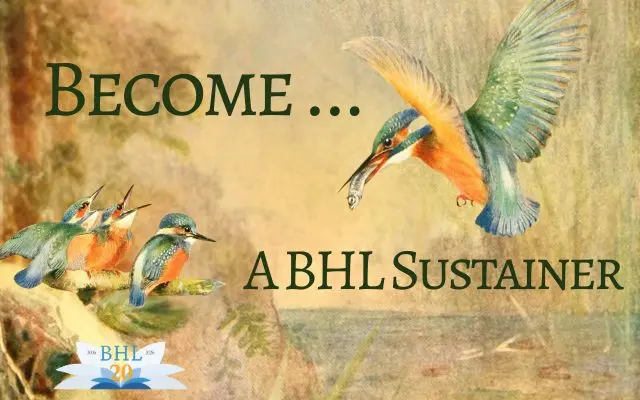
Just like the delicate eggs illustrated in historic plates from BHL’s own collections or the tiny, resilient nestlings of a kingfisher, gifts come in all sizes, and every single contribution matters. Donations can be processed in more than 135 currencies through BHL’s fiscal sponsor, the Council on Library and Information Resources (CLIR). Tax deductibility varies depending on the donor’s country of residence and individual circumstances.
For those in a position to offer higher-level support, BHL also welcomes major gifts, wire transfers, and legacy bequests through its established giving channels.
A Call to Action for the Global Community
For twenty years, the Biodiversity Heritage Library has opened the treasures of natural history literature to the world. It exists today not because of corporate endowments or government mandates, but because a global community believes fiercely in open access, shared infrastructure, and the democratic right to biodiversity knowledge.
Last year, that community gave BHL wings. Now, as the library navigates its newly independent future, the call goes out once more: Help us keep flying.
If BHL matters to your work, your research, your teaching, your art, your writing, or your deep love of the natural world, consider becoming a monthly donor today by visiting the official BHL Sustainers Donation Portal.



