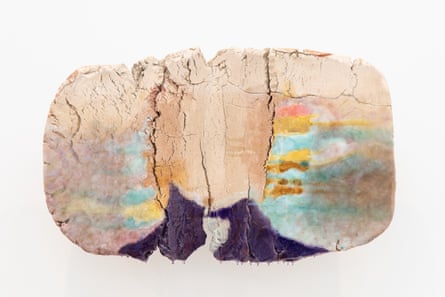
In an era saturated by the flattening, pre-packaged glare of social media and the looming anxieties of environmental collapse, American sculptor Liz Larner remains fiercely committed to the physical, the unpredictable, and the corporeal. Marking her first major UK exhibition—fittingly titled A Hard Line to Bend at the Camden Arts Centre in London—Larner brings together decades of radical material exploration. Her work moves fluidly from the microscopic to the cosmic, utilizing everything from discarded single-use plastics and human breath to ceramic asteroid simulations and surgical gauze.
Larner’s artistic trajectory reads as an ongoing interrogation of humanity’s imprint on the planet. Whether she is transforming mountains of unrecyclable plastic into towering ceiling installations, culturing international breath bacteria inside petri dishes, or channeling the defiant spirit of mythological figures like Lilith, Larner refuses easy categorizations. This comprehensive profile examines her monumental retrospective, her roots in the vibrant yet gritty 1980s Los Angeles art scene, her engagement with eco-feminism, and her belief that physical sculpture remains one of our last bastions for unmediated human reflection.
Detailed Chronology: From California Childhoods to London Exhibitions
The California Crucible: 1960–1980s
Born in 1960 to a farming family in California, Larner’s early life was intimately bound to the shifting, often heavy-handed interventions of human technology on the natural world. In a formative detail that would later inform her ecological consciousness, she recalls that the state sprayed DDT—a notoriously toxic insecticide later banned globally—over her family home for the first seven years of her life.
As she matured into her artistic voice, Larner found herself at the epicenter of a uniquely fertile and gritty countercultural movement in Los Angeles. She studied at the California Institute of the Arts (CalArts) under the legendary conceptual artist John Baldessari. While many art schools of the period were bogged down by rigid ideological posturing and tense theoretical divides, Baldessari fostered an environment of fluid, cross-disciplinary experimentation.
Following her studies, Larner immersed herself in the vibrant 1980s LA avant-garde scene. Alongside peers, poets, and writers such as Dennis Cooper, Bob Flanagan, and Mike Kelley, she frequented the Beyond Baroque arts center. It was an era defined by raw, physical proximity and direct community engagement—a stark contrast to the mediated, algorithm-driven art world of the 21st century.
Microscopic Milestones and Material Shifts: 1988–2020
Larner’s early career quickly established her penchant for unorthodox, living, and decaying materials. In 1988, she realized Every Artist Gave a Breath, an ambitious and fragile international collaborative piece. Artists from around the globe breathed over agar-filled petri dishes, creating a living colony of breath bacteria. Exhibited decades later in a 2022 retrospective, the piece had undergone a fascinating transformation: some bacterial strains had morphed into vibrant, fragile, dried color wafers, while others had devolved into murky, ominous blackish-green formations.
Throughout the decades, Larner continued to experiment with substances loaded with biological and psychological resonance, including human hair, false eyelashes, leather, and surgical gauze. However, a massive geopolitical shift in the late 2010s radically altered her material palette. When China abruptly stopped accepting American plastic waste—which the United States had long shipped abroad for recycling—the physical reality of the global waste crisis landed squarely in Larner’s studio.
"I was living in LA at the time when China stopped accepting American plastic," Larner recalls. "I started taking it to my studio—it got so huge, I had to hang it from the ceiling." This accumulation birthed haunting assemblages like Meerschaum Drift (2020–21), serving as a dystopian analogue to the world’s plastic-choked oceans.
A Hard Line to Bend at Camden Arts Centre: Present Day
Today, Larner’s first major institutional exhibition in the UK brings these threads together. At the Camden Arts Centre, her newly engineered plastic sculptures bristle with a volatile duality: they are simultaneously alluring and menacing. They challenge viewers to confront the invisible ubiquity of disposable culture.
"I realised there’s so many smart people designing these objects made of plastic that are made to be discarded," Larner reflects. "We don’t even see them, all these different forms. We can’t see it. We just use it."
Supporting Context & Metrics: The Ecology of Sculpture
To fully grasp the weight of Larner’s contemporary work, one must contextualize it within the broader landscape of late-stage capitalism, ecological degradation, and what eco-feminists term the "Posthuman" era.
The Scale of Plastic Consumption
The Global Waste Crisis: Since the implementation of China’s National Sword policy in 2018, which banned the import of most plastics and recyclable materials, Western nations have struggled to process billions of tons of single-use waste. Larner’s studio practice—hoarding, sorting, and suspending industrial detritus—acts as a localized monument to this macro-level policy failure.
Eco-Feminist Alignment: Larner’s recent work draws deeply from eco-feminist discourse, notably philosopher Rosi Braidotti’s Posthuman Knowledge (2019). Braidotti argues for an ethical framework that accounts for non-human agents, technology, and the environment. Larner acknowledges her own complicity as a material-based artist while simultaneously reframing how those materials are perceived: "Maybe I’m implicated because I’m a sculptor. But I feel like we need to see these materials in different ways. To try and imagine something different."
Cosmic Anxieties and Anthropocene Art
Beyond the terrestrial crisis of waste, Larner’s gaze has expanded into the cosmos. In our current era—marked by technocratic space races and billionaire-backed extra-planetary escapism—Earth has increasingly been treated as a disposable commodity.
Larner addresses this directly in her ceramic "asteroid" series, including 2022’s Nyx. By translating official NASA photographic data into three-dimensional, hand-glazed ceramic forms with crenellated, mesmeric surfaces, she brings astronomical phenomena down to a tactile, human scale. "There are all these movies about disaster," Larner observes, "except our lives are the biggest movie about disaster."
Official Statements and Artistic Philosophy
Liz Larner’s reflections on her practice offer a profound look into the mind of a sculptor who refuses to let color become subservient to form, and who champions the quiet power of refusal.
On Color and Perception
Drawing on the philosophical inquiries of Ludwig Wittgenstein—specifically regarding the subjective nature of perception ("How do we know if two people are ever seeing the same shade of yellow?")—Larner seeks to upend traditional sculptural hierarchies:
"In sculpture, colour is usually subservient to form. And I want to make my work not to do that. I want them to be together and to each have their interaction with each other."
On the Mythological Power of Lilith
The centerpiece of her Camden exhibition draws inspiration from the Burney Relief, a Babylonian terracotta plaque depicting the mythological figure Lilith. According to legend, Lilith fled the Garden of Eden, refusing to submit to Adam as a subordinate wife.
"What I find interesting about her is that she’s not a fighter. She just says no. And that’s powerful for everyone, not just women."
Comparing this ethos to trailblazing cultural icons like Gloria Steinem (whose passing coincided with our interview) and Dolly Parton, Larner notes:
"I find something ‘Lilith’ about them both. They went their own way but with such style and grace. They took a different path."
On the Digital Age vs. Physical Presence
Unlike many contemporary artists who leverage social media algorithms for constant visibility, Larner has deliberately chosen to remain offline. Her skepticism toward the "terminally online glare" stems from a belief that digital previews rob art of its visceral impact.
"There’s only so much time in every day. You have to decide what you want it to be about… We’re in such a different time now, where everything is seen before you experience it. There’s so much pre-knowledge."
Future Outlook: The Enduring Necessity of Spatial Encounter
As the art world hurtles deeper into virtual reality, digital marketplaces, and hyper-curated Instagram aesthetics, Liz Larner’s practice serves as an essential anchor to physical reality. Her work insists that true aesthetic and political engagement cannot be downloaded, scrolled past, or pre-experienced.
Looking ahead, Larner remains steadfast in her belief that sculpture possesses a unique agency—one that forces us to share physical space, observe one another, and contemplate our movements through a shared environment.
"That’s why I like sculpture," Larner concludes with a smile. "You have to walk in there and move around, while you’re thinking and seeing. And maybe talk to somebody too. Or watch somebody. I wonder what they’re thinking by how they’re moving around."
In an increasingly disembodied world, Larner’s art provides a vital space not only to witness the ruins of our making, but to imagine entirely different ways of inhabiting the earth.