

Executive Overview
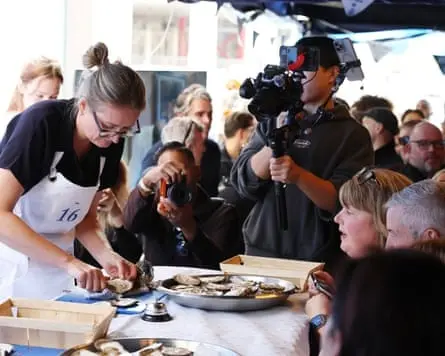
Beneath the fluttering bunting of an uncharacteristically bright Mayfair afternoon, the air hummed with a distinctly feverish, high-stakes energy. On the terrace of Bentley’s—a century-old institution that typically caters to bankers and tourists casually working their way through seafood platters and champagne—two hundred spectators crammed into a temporary tent. They had gathered to bear witness to what is arguably the poshest, yet most adrenaline-fueled, sport in England: the Speed Shucking Oyster Open.
The competition was more than a mere culinary exhibition; it was a grueling test of speed, precision, and nerve. Sixteen of the country’s finest shuckers battled through intense preliminary heats before culminating in a white-knuckle grand final. Their mission: to pry open dozens of giant native oysters against the ticking clock without damaging the delicate bivalve inside or maiming their own hands. Presiding over the sensory evaluations was actor, documentarian, and renowned foodie Stanley Tucci, whose presence added a layer of Hollywood glamour to an already theatrical British tradition.
When the oyster shells had settled and the judges had tallied their deductions for broken shards and rogue grit, the crown went to Fredrik Linifors of the Notting Hill Fish Shop. With an expressionless demeanor and a preternaturally steady hand, Linifors out-shucked the competition to secure the title. He will now go on to represent England at the World Oyster Opening Championship in Galway, Ireland.
Yet, beneath the champagne toasts, celebrity sightings, and theatrical displays of knife-work, the event cast a sharp spotlight on broader socio-economic and environmental issues. From the perils of the trade and the rich historical tapestry of oyster consumption in the British Isles to the alarming impact of sewage pollution on English coastal waters, the Mayfair showdown proved that the humble oyster is at the center of a much larger, and often contentious, modern narrative.
Detailed Chronology: The Road to the Mayfair Finals
The Contenders and the Setup
The atmosphere on the Bentley’s terrace shifted dramatically from its usual Friday afternoon languor. Bunting hung overhead as 16 elite competitors, drawn from restaurants and seafood bars across England, prepared their stations. The rules of engagement were deceptively simple: open a set number of giant native oysters as fast as humanly possible, present them cleanly on a bed of ice, and present them to a panel of expert judges.
In the first round, shuckers raced to open 12 giant native oysters. Speed, however, was only half the battle. Once opened, the bivalves were meticulously inspected. Points were aggressively deducted for structural failures—crushed shells, lacerated oyster meat, or stray grains of grit that could ruin the diner’s experience.
For the grand final, the stakes were doubled. The remaining top contenders had to power through 30 giant native oysters under the exact same unforgiving conditions, all while hundreds of onlookers watched their every twitch and slice.
The Philosophy of Speed
Among the competitors was Quincy Coulter Young of Rocks Oysters, widely recognized as one of the fastest shuckers in the country. For Young, the secret to survival and speed in this niche vocation boils down to psychology and repetition.
"The secret is not being scared of stabbing yourself in the hand," Young remarked coolly between heats. Tracing the origins of his craft, he noted that his expertise is the result of lifelong immersion. "It’s the only job I’ve ever had. I hope I am good at it, as oyster shucking isn’t exactly a transferable skill. My uncle was the head chef for Wright Brothers seafood bar in Borough Market, so he taught me from a very young age."
The Crown Goes to Notting Hill
As the final round reached its crescendo, the crowd watched in breathless silence. Standing apart from the animated chatter was Fredrik Linifors of the Notting Hill Fish Shop. While other competitors wore expressions of intense strain, Linifors was an image of absolute stoicism. With a completely expressionless face and a frighteningly steady hand, he effortlessly prised open shell after shell, maintaining a rhythmic cadence that left his opponents in the dust.
When the timers stopped and the judges completed their forensic examination of the platters, Linifors was declared the undisputed champion. His reward: a ticket to Galway, Ireland, where he will carry the hopes of the nation into the World Oyster Opening Championship.
Stanley Tucci’s Accidental Tasting
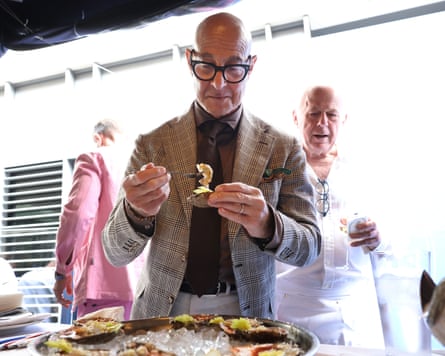
Adding a comedic and star-studded touch to the proceedings was actor Stanley Tucci. Seated at the judges’ table, Tucci cuts a dashing figure, though he confessed to a slight misunderstanding regarding his duties for the afternoon.

"I thought this was going to be a wine tasting," Tucci joked, holding a massive goblet of white wine, "but I am glad there’s food."
Rather than adopting the traditional, devil-may-care approach of swallowing the oyster whole in a single fluid motion, Tucci approached the delicacy with visible trepidation. He delicately used a fork to taste the shucked oysters, evaluating their texture, salinity, and quality with the discernment of a seasoned culinary traveller.
Supporting Context & Metrics: History, Economics, and Peril
A Two-Thousand-Year British Legacy
The modern fascination with oyster shucking sits atop a deep, centuries-old historical foundation. English people have been consuming oysters for more than two millennia. The Roman conquerors, famously obsessed with the flat, elliptical mollusks found along British coasts, prized the native oyster as an elite delicacy.
However, the socio-economic status of the oyster has fluctuated wildly throughout history. By the 19th century, oysters were so unimaginably cheap and plentiful that they served as a primary, working-class source of protein—famously immortalized by Charles Dickens in The Pickwick Papers.
Today, the pendulum has swung entirely in the opposite direction. Oysters are once again viewed as an upscale luxury, frequently served by smiling, suited oystermen in opulent establishments. Bentley’s, the Mayfair host venue, is a prime example of this resurgence, currently shucking and serving an astonishing 10,000 oysters every single week.
The Physical Toll: Blood, Sweat, and Biceps
While the setting is luxurious, the job itself is intensely physical and surprisingly perilous. Richard Corrigan, the celebrated Irish chef who purchased Bentley’s in 2005 and oversaw the day’s events, points out that a great shucker requires a specific alchemy of traits.
"You don’t find oyster shuckers; you make oyster shuckers, and they need to have a smiley face and a warm heart and strong hands," Corrigan explains. "It’s a completely social job. And it’s great for the biceps; don’t go to the gym, come to Bentley’s and open oysters for me!"
Yet, the glamour fades quickly when faced with the reality of the shucking knife. Both the jagged edges of the oyster shells and the razor-sharp blades used to breach them present a constant, bloody hazard.
"It’s likely you could absolutely rip your bloody hand off," Corrigan warns bluntly, speaking from personal experience. Recounting the opening week of Bentley’s 22 years ago, he recalled finishing a grueling shift with his hand wrapped in heavy hospital bandages. "After a day of opening oysters, I was shattered and the knife slipped."
Official Statements: The Environmental Reality of the Modern Oyster
Beyond the theater of competition and the celebration of gastronomy, the event served as an urgent reminder of the precarious health of the marine environment. Oysters are biological powerhouses; as filter feeders, they ingest vast quantities of water, filtering out toxins and serving as critical indicators of ecosystem health.
"A native oyster is a great sign of how well our coastal waters are doing," notes Corrigan.
However, this biological filtering capacity has become a double-edged sword in modern Britain. Due to widespread environmental degradation—specifically the controversial practice by English water companies discharging untreated sewage through overflow pipes directly into the sea—bivalve beds have become vulnerable to severe contamination.
This ecological crisis has forced top-tier restaurateurs to fundamentally alter their supply chains. Out of an abundance of caution and a commitment to food safety, Bentley’s has drastically shifted where it sources its signature product.
"We get our oysters from Loch Ryan in Scotland, the west coast of Ireland, and Jersey," Corrigan revealed, highlighting a stark geographic retreat. "We moved away from the Mersea, Colchester area [and] the south coast of England."
Presented with a large, round native oyster during the event, Corrigan offered a masterclass in sensory appreciation. "Just chew this oyster," he urged. "You’re tasting a bit of sea. This is Mother Nature."
Tasting one himself, he closed his eyes, visibly moved. "Jesus. A very mineral flavour, and you see this is not about how clever a chef is or a cook is, but about the sacrosanct respect we have for nature."
Future Outlook: Raising Standards and Protecting the Waters
As Fredrik Linifors prepares to pack his bags for Galway to compete on the global stage, the organizers of the Speed Shucking Oyster Open hope the event’s legacy will ripple outward through the British culinary scene.
Richard Corrigan remains steadfast in his belief that competitions of this caliber do more than simply entertain crowds—they elevate the entire industry. He hopes the fierce, public display of craftsmanship will inspire restaurants across the UK to approach shellfish with greater reverence and ambition.
"I hope this gets restaurants to be more confident about putting oysters on the menu," Corrigan stated.
More importantly, he views the spotlight on oyster provenance as an unexpected form of environmental activism. Knowing precisely where Britain’s waters meet "Blue Flag" environmental standards—and crucially, where they fall dangerously short—is the key to preserving the native oyster population for generations to come.
"Knowing what part of Britain, where the waters are blue flag and where they’re not blue flag, that is where the best place is to get oysters from, you know," Corrigan concluded. "This is what it’s about. This is as good as any environmental contest."
As the crowds dispersed from the Mayfair tent, leaving behind heaps of iridescent shells and empty champagne flutes, the message was clear: the future of the British oyster depends not just on the speed of the shucker’s knife, but on the collective will to clean up the waters from which they came.



