

Executive Overview
In an era defined by rapid digital transformation and tightening institutional budgets, the preservation of scientific knowledge often hangs in a delicate balance. For nearly two decades, the Biodiversity Heritage Library (BHL) stood as a colossal monument to open-access science, backed primarily by the institutional fortitude of the Smithsonian Institution. However, when that foundational support unexpectedly dissolved, the world’s largest open-access digital library for biodiversity literature faced an existential crisis. Without immediate intervention, 64 million pages of irreplaceable natural history archives, historic illustrations, and foundational scientific literature threatened to vanish behind paywalls or fade into digital obsolescence.
What followed was a masterclass in global solidarity. Through the collaborative efforts of an international community spanning 46 countries, the BHL did not merely survive; it successfully navigated a high-stakes transition to an independent, globally governed model. Following a successful public fundraising campaign that raised over $113,000, and the monumental relocation of core technical infrastructure to the Field Museum in Chicago, the BHL has emerged as a resilient, decentralized collective. Yet, as the formal transition period concludes, the digital ark faces its next great trial: moving from emergency rescue to sustainable, long-term operation.
This comprehensive report examines the dramatic arc of the BHL’s transition, the metrics of its community-driven rescue, the mechanics of its new global infrastructure, and the ongoing campaign to ensure that humanity’s collective knowledge of the natural world remains free, open, and accessible to all.
Detailed Chronology: From Existential Threat to Independence
The survival of the Biodiversity Heritage Library is a modern saga of operational reinvention executed under immense time pressure. To understand the magnitude of the library’s current standing, one must retrace the critical timeline of events that reshaped its organizational DNA between 2025 and 2026.
The Looming Precipice: Early 2025
For nearly twenty years, the BHL operated under the secure administrative umbrella of the Smithsonian Institution. While the library functioned as a cooperative consortium of natural history and botanical libraries worldwide, its core technical and administrative heartbeat relied heavily on Smithsonian resources.
The crisis struck unexpectedly when the library faced the sudden loss of this primary institutional support. The implications were catastrophic. The library’s staff, essential public services, complex technical systems, global partnerships, governing framework, and operational funding were simultaneously thrown into uncertainty. The central question facing the leadership was stark: How does a digital repository housing tens of millions of pages of biodiversity literature re-establish itself as an independent, globally governed entity without experiencing a catastrophic collapse in service?
The Turning Point: October 17, 2025
Recognizing that institutional safety nets could no longer be taken for granted, BHL leadership made the decision to take the fight public. On October 17, 2025, the organization launched an urgent public fundraising initiative designed to fund its operational transition.
This launch marked the beginning of a frantic, high-stakes race against the clock. The goal was not merely to raise capital, but to demonstrate broad, international grassroots support that could prove the library’s value to prospective institutional partners and governing bodies. The initiative resonated instantly across borders, drawing contributions from individuals, researchers, educators, and nature enthusiasts across 46 countries.
The Final Sprint: November – December 2025
As the deadline for independence approached, BHL initiated its targeted #GiveBHLWings campaign during the final seven weeks of 2025. The campaign acted as a rallying cry for the global scientific and conservation communities. During this short window alone, supporters contributed an astounding $51,000, driving the total funds raised past the critical threshold needed to secure the immediate future of the staff and technical architecture.
The Dawn of Independence: January 1, 2026
January 1, 2026, marked a monumental milestone in digital library history. On this date, the BHL officially transitioned away from its historic dependency, stepping into a newly minted independent status. Because the global community had rallied so fiercely behind the initiative, essential staff were retained, public services experienced zero interruption, and the vast digital stacks containing over 64 million pages of historical literature remained freely accessible online.
Completing the Technical Migration: June – July 2026
While the administrative transition officially took effect at the start of the year, the complex mechanics of migrating a digital empire required several more months of intensive labor. By the end of June 2026, the formal transition period concluded.
The final, and perhaps most technically perilous, piece of the puzzle fell into place in July 2026: the physical and digital relocation of BHL’s servers and core technical infrastructure from the Smithsonian Institution to the Field Museum in Chicago. This migration symbolized more than just a change of physical address; it cemented the BHL’s new identity as a distributed, partner-supported model, anchored by a robust administrative and technical foundation designed to weather the challenges of the 21st century.
Supporting Context & Metrics: The Scale of the Achievement
To fully appreciate what was saved, one must examine the sheer volume and global utility of the resources housed within the Biodiversity Heritage Library. The BHL is not merely a collection of scanned books; it is the foundational memory of modern biological science.

The Treasure Trove of Natural History
Spanning centuries of scientific exploration, the BHL preserves the written records of humanity’s encounters with the natural world. Within its digital vaults lie:
- Over 64 million pages of digitized biodiversity literature, field notes, taxonomic monographs, and expedition journals.
- Historic scientific illustrations—such as rare plates documenting avian development, botanical specimens, and marine life—that serve as both artistic masterpieces and critical historical data points for modern conservation biologists tracking ecological shifts.
- Core taxonomic literature that establishes the scientific nomenclature for millions of species, serving as the legal and historical bedrock of global biodiversity research.
The Economics of the Rescue
The financial metrics of the transition highlight both the generosity of the global community and the lean efficiency with which the BHL operates:
- Total Funds Raised: Over USD $113,000 contributed by supporters globally.
- Geographic Reach: Donations poured in from 46 countries, illustrating that the value of biodiversity literature transcends national boundaries.
- Campaign Velocity: USD $51,000 of the total was secured during the intensive seven-week
#GiveBHLWingscampaign leading up to the January 1, 2026 deadline. - Fiscal Sponsorship: To ensure complete transparency and fiscal accountability, all donations are securely processed through the BHL’s fiscal sponsor, the Council on Library and Information Resources (CLIR).
Official Statements and Leadership Perspectives
The successful navigation of this existential crisis was guided by a dedicated team of international professionals who understood that the closure of BHL would represent an irreversible loss for global science.
Nicole Kearney, BHL Communications Director, Manager of BHL Australia, and Chair of the BHL Persistent Identifier Working Group, captured the emotional and operational essence of the transition in statements released throughout the campaign. Kearney, whose professional life is dedicated to open access, persistent identifiers, and the conservation of biodiversity, emphasized that the survival of the library was a testament to collective action.
"Last year, our community gave BHL wings," Kearney noted, reflecting on the outpouring of international support. "For 20 years, BHL has opened biodiversity literature to the world. It exists because of a global community committed to open access, shared infrastructure, and the belief that biodiversity knowledge should be available to everyone. Last year, that community saved BHL. Now we’re asking you to help us keep flying."
Leadership from partner institutions—including the newly minted technical home at the Field Museum in Chicago—echoed these sentiments. The transition to a distributed, partner-supported governance model represents a paradigm shift in how global digital commons are maintained. Rather than relying on the benevolence of a single mega-institution, the BHL now draws its strength from a diversified network of museums, botanical gardens, libraries, and research institutions worldwide. This decentralized architecture ensures that no single political or institutional shift can ever again threaten the existence of the entire library.
Future Outlook: The Imperative of Sustainable Support
While the emergency rescue of 2025 and the infrastructural migration of 2026 secured the immediate survival of the Biodiversity Heritage Library, the leadership is unequivocal on one point: survival is not the same as sustainability.
As the formal transition dust settles, the BHL faces the ongoing challenge of maintaining operations in a complex, digitally demanding environment.
Why Monthly Support Matters
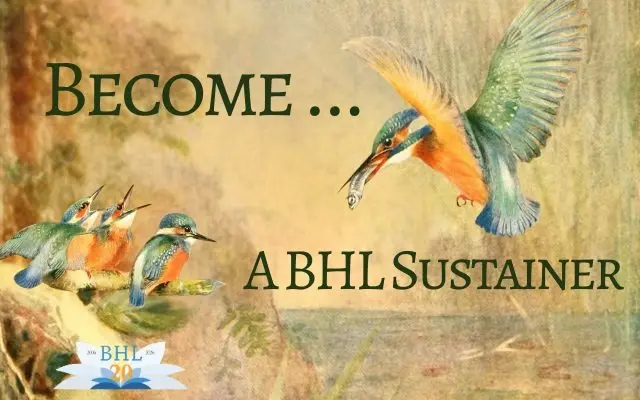
Like the fragile, exquisitely illustrated baby kingfishers and developing eggs found within its historic collections, the BHL requires dependable, ongoing nourishment to thrive. Modernizing technical infrastructure, improving search discoverability algorithms, expanding and connecting disparate global collections, and retaining top-tier technical and curatorial staff require predictable, recurring revenue.
This is the genesis of the BHL Sustainers initiative. While major gifts, wire transfers, bequests, and legacy endowments remain vital pillars of long-term financial health, monthly contributions provide the steady operational current required to keep the servers humming and the pages turning for researchers around the globe.
A Call to Action for the Global Community
The BHL belongs to everyone because its contents are used by everyone. Its pages are routinely consulted by:
- Taxonomists and Conservation Biologists tracking endangered species and describing new discoveries.
- Historians and Philosophers of Science tracing the evolution of ecological thought from Darwin to the modern era.
- Artists, Writers, and Educators drawing inspiration from centuries of botanical and zoological illustration.
- Amateur Naturalists and Citizen Scientists fostering a deeper love and understanding of the natural world.
The call to action is clear. Contributions of any size—processed in more than 135 currencies to accommodate the global user base—can be set up on a recurring monthly basis through the official BHL donation portal managed by the Council on Library and Information Resources (CLIR).
For twenty years, the Biodiversity Heritage Library has kept the flame of open-access natural history burning brightly. Through unprecedented international cooperation, the global community proved that it values this digital ark enough to catch it as it fell. Now, the collective challenge is to ensure that the BHL does not merely glide through temporary reprieves, but soars permanently into the future, keeping the natural history of our planet open, free, and accessible to every citizen of the world.



