Executive Overview
For more than 70 years, Dr. Sylvia Earle has stood at the absolute vanguard of marine science, exploration, and environmental advocacy. Affectionately dubbed "Her Deepness" by the scientific community and the media alike, Earle’s career spans an era of unprecedented transformation in human understanding—and exploitation—of the global ocean. From the infancy of underwater self-contained underwater breathing apparatus (SCUBA) technology to the modern age of industrialized overfishing, climate change, and widespread coral bleaching, Earle has borne witness to the shifting ecology of our blue planet from a uniquely intimate perspective.
In a recent, expansive interview on The World, host Carolyn Beeler sat down with the legendary oceanographer to reflect on her extraordinary life, her unyielding passion for marine ecosystems, and the profound, often alarming ways the world’s oceans have transformed during her lifetime. This article provides an in-depth examination of Earle’s pioneering legacy, contextualizing her achievements within the broader sweep of marine history, public policy, and the urgent contemporary race to protect what remains of the Earth’s life support system.
Detailed Chronology: A Life Spent in the Deep
To understand the scope of Sylvia Earle’s contributions to marine science, one must trace a timeline that defies conventional definitions of a career. Her trajectory is not merely a sequence of professional appointments, but rather a relentless series of boundary-pushing expeditions that reshaped what was thought possible for human endurance and scientific inquiry underwater.
The Formative Years and Early SCUBA Innovation (1950s–1960s)
Born in Gibbstown, New Jersey, in 1935, Earle relocated to Florida with her family as a child, where her lifelong fascination with the natural world took root along the Gulf Coast. Long before the widespread adoption of underwater breathing apparatuses for civilian use, Earle was already cataloging marine life with the fervor of a seasoned naturalist.
When modern SCUBA technology became commercially available in the early 1950s, Earle was among the very first individuals—and certainly one of the few women—to harness the equipment for rigorous scientific observation. At a time when traditional marine biology relied heavily on hauled-up dredge nets and preserved museum specimens, Earle insisted on observing organisms in their native habitats. This methodology revolutionized how researchers perceived behavioral ecology, habitat interaction, and the complex interdependence of reef systems.
Breaking Records and Smashing Glass Ceilings (1970–1990s)
As her academic credentials solidified—culminating in a Ph.D. from Duke University—Earle’s exploits beneath the waves began to capture global attention.
- The Tektite II Project (1970): Earle served as the leader of an all-female team of aquanauts during the prestigious Tektite II program, living and working for two weeks in a habitat fifty feet below the surface of the Lameshur Bay in the U.S. Virgin Islands. This mission proved conclusively that female scientists could endure and excel in saturation diving environments just as effectively as their male counterparts, though media coverage at the time frustratingly fixated on domestic details rather than the rigorous scientific data being gathered.
- The Deep Jim Atmospheric Dive (1979): Pushing the limits of human descent, Earle achieved a legendary milestone by descending 1,250 feet (381 meters) below the surface off the coast of Oahu, Hawaii. Encased in an armored, one-atmosphere JIM suit, she walked untethered along the seafloor. To this day, the feat stands as the women’s record for the deepest untethered sea walk, remaining an iconic moment in deep-sea exploration history.
- NOAA Chief Scientist (1990–1992): Breaking yet another barrier, Earle was appointed as the first female chief scientist of the National Oceanic and Atmospheric Administration (NOAA) under President George H.W. Bush. In this high-profile administrative role, she provided critical scientific oversight on environmental policy, marine sanctuaries, and the management of coastal fisheries, establishing a bridge between rigorous academic research and federal regulatory frameworks.
Supporting Context & Metrics: The Degradation of the Global Ocean
During her conversation with Carolyn Beeler on The World, Earle emphasized a sobering reality: the ocean she explored as a young researcher in the 1950s is fundamentally different from the ocean of today. While human technology has advanced exponentially, allowing us to map the ocean floor with sonar and explore hydrothermal vents via unmanned submersibles, the ecological health of marine environments has plummeted.
The Metrics of Decline
Marine scientists and international bodies have quantified the scale of anthropogenic impact over the decades of Earle’s career. The data underscores the urgency of her message:
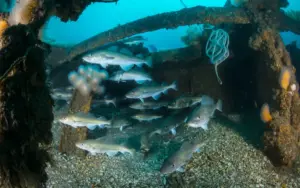
- Industrial Fishing and Biomass Reduction: According to assessments by the Food and Agriculture Organization (FAO), historical industrial fishing practices have depleted populations of large predatory fish—such as tuna, sharks, and cod—by an estimated 90% since the mid-20th century. Earle often notes that when she began diving, the seas were teeming with an abundance of marine life that younger generations now view as an impossibility rather than a historical baseline.
- Coral Reef Degradation: Global climate change has driven unprecedented ocean warming events. Coral reefs, which cover less than 0.1% of the ocean floor but support at least 25% of all marine species, have suffered catastrophic mass-bleaching events. Scientific consensus indicates that over 50% of the world’s coral reefs have been severely degraded or destroyed over the past several decades.
- Ocean Acidification: As the ocean absorbs roughly 30% of anthropogenic carbon dioxide emissions, its average pH has dropped by approximately 0.1 units—representing a 30% increase in acidity. This chemical shift impairs the ability of calcifying organisms, including oysters, clams, and microscopic pteropods, to build and maintain their shells and skeletons, threatening the base of the marine food web.
- Plastic Pollution: Microplastics and macro-plastics now contaminate every known marine ecosystem, from sunlit surface waters to the deepest abyssal trenches, including the Mariana Trench. Millions of tons of plastic waste enter the marine environment annually, resulting in the entanglement and ingestion-related mortality of countless marine mammals, sea turtles, and seabirds.
Official Statements and Perspectives
The dialogue between Carolyn Beeler and Sylvia Earle bridges historical reflection with contemporary environmental philosophy. In her interviews, Earle consistently rejects fatalism, arguing that humanity possesses both the knowledge and the technological capability to reverse course—if we choose to act with sufficient urgency.
"We are at the most critical juncture in human history," Earle has frequently remarked. "The next ten years will determine the next ten thousand. What we do—or fail to do—right now will dictate whether the ocean remains a living, life-sustaining system or a degraded, acidic soup of our own making."
In her discussion on The World, Earle pivoted away from pure doom-mongering to spotlight the concept of "Mission Blue"—an initiative she founded to establish a global network of marine protected areas known as "Hope Spots." These areas are championed not merely as conservation zones, but as vital ecological savings accounts designed to give battered marine habitats the breathing room required to regenerate.
Environmental policy experts who study Earle’s impact note that her ability to translate complex oceanographic data into accessible, poetic language has been her greatest gift to the conservation movement. Unlike bureaucrats or detached academics, Earle speaks of fish as individuals, of coral reefs as ancient cities, and of the ocean as the literal blue heart of the planet.
Future Outlook: The Race to Save the Blue Heart of the Planet
As we look toward the mid-21st century, the roadmap laid out by Sylvia Earle offers a clear, albeit challenging, path forward for marine conservation. The future of the global ocean hinges on several critical developments:
1. Scaling Up Marine Protected Areas (MPAs)
The international community has increasingly rallied around the "30×30" initiative—a global target to protect 30% of the world’s land and ocean by 2030. Earle’s Hope Spots project serves as a grassroots complement to this diplomatic goal, identifying critical marine ecosystems that require immediate, stringent safeguards against industrial trawling, deep-sea mining, and coastal pollution.
2. Halting Deep-Sea Mining Before It Begins
One of the most pressing contemporary battles highlighted by oceanographers is the looming threat of commercial deep-sea mining. Corporations are eyeing mineral-rich polymetallic nodules on the abyssal plains of the Clarion-Clipperton Zone in the Pacific Ocean. Earle and a coalition of marine scientists have been vocal opponents of this nascent industry, warning that dredging the deep sea will permanently destroy fragile, slow-growing ecosystems and disrupt carbon sequestration processes that are vital for planetary climate stability.
3. Fostering Ocean Literacy Among Younger Generations
Earle remains an indefatigable educator. Through books, documentaries (such as Netflix’s Mission Blue), lectures, and mentorship programs, she continues to inspire a new generation of marine scientists, policymakers, and activists. She stresses that society cannot protect what it does not understand, and cannot love what it does not know.
Conclusion
Sylvia Earle’s seventy-year crusade beneath the surface is a testament to the power of relentless curiosity married to profound moral conviction. As the ocean faces unprecedented stressors from a changing climate and human expansion, her voice remains a beacon of clarity and urgency. The conversation captured by Carolyn Beeler on The World serves as both a historical archive of a remarkable life and a clarion call to action for humanity: the ocean is failing, but it is not yet lost. The choices made in the coming years will decide whether future generations inherit a vibrant, living blue planet or a silent, sterile abyss.