

Executive Overview
On September 8, 2026, the Japan Art Association announced the laureates for the esteemed Praemium Imperiale, one of the global arts community’s highest and most revered accolades. Among this year’s distinguished class of international cultural icons is the renowned Polish-American architect Daniel Libeskind, co-founder of Studio Libeskind. Celebrated globally for his ability to translate profound historical narratives, cultural memory, and philosophical inquiry into striking, emotionally resonant built environments, Libeskind has been honored in the architecture category.
The Praemium Imperiale, established in 1988 under the patronage of the Japanese Imperial Family, recognizes exceptional, lifetime contributions to the arts across fields that transcend national and ethnic boundaries. Alongside Libeskind, the 2026 laureates comprise a powerhouse of creative luminaries: Cate Blanchett for theater and film, Jenny Holzer for painting, Andy Goldsworthy for sculpture, and Herbert Blomstedt for music. Each laureate will receive an honorarium of 15 million yen, a testimonial letter, and a commemorative medal presented by the Japan Art Association during a formal ceremony in Tokyo on October 28, 2026.
This latest recognition underscores a career defined by architectural disruption, theoretical rigor, and a fearless willingness to confront history. From his masterwork at the Jewish Museum in Berlin to the monumental scope of the World Trade Center Master Plan in New York City, Libeskind’s portfolio stands as a testament to the idea that architecture is not merely shelter, but a dynamic medium for cultural dialogue, mourning, healing, and renewal.
Detailed Chronology: From Virtuoso Musician to Master Architect
Daniel Libeskind’s journey to the pinnacle of architectural achievement is as unconventional as the geometries that define his buildings. Born in Łódź, Poland, in 1946 to Holocaust survivors, Libeskind immigrated with his family to Israel as a youth, where he displayed prodigious talent as a virtuoso musician, mastering the accordion before moving to the United States in 1959. Music remains a foundational anchor in his creative DNA; he frequently speaks of architectural composition through the lens of musical rhythm, counterpoint, and harmony.
However, before translating sound into stone and steel, Libeskind pursued formal training in the visual arts and architecture. He earned his architectural degree from the Cooper Union for the Advancement of Science and Art in New York in 1970, followed by a postgraduate degree in history and theory of architecture from the University of Essex in England in 1972. Eschewing the conventional corporate drafting table early in his career, Libeskind immersed himself in architectural theory, education, and academia, serving as the head of the Department of Architecture at the Cranbrook Academy of Art in Michigan during the late 1980s.
The defining inflection point of his career arrived in 1989, when his radical design entry won the international competition for the Jewish Museum in Berlin. Completed in 2001, the museum’s jagged, zinc-clad zigzag form—pierced by subterranean "voids" symbolizing the erasure of Jewish life during the Holocaust—sent shockwaves through the architectural establishment. It instantly established Libeskind as a pioneer of deconstructivism, though his work uniquely prioritized human emotional response and historical trauma over formalist acrobatics alone.
Following the international acclaim of the Jewish Museum, Libeskind relocated his practice to Berlin and later established Studio Libeskind in New York City. In 2003, his trajectory shifted to the global stage once more when his master plan, Memory Foundations, was selected for the rebuilding of the World Trade Center site in Lower Manhattan. Balancing the solemnity of the 9/11 memorial with commercial viability and urban connectivity, Libeskind cemented his status as an architect capable of navigating complex socio-political landscapes. Over the subsequent decades, his firm expanded into a global practice, delivering iconic civic, cultural, and residential projects across Europe, North America, and Asia.
Supporting Context & Metrics: The Philosophy and Oeuvre of Studio Libeskind
The Japan Art Association’s citation highlights Libeskind’s unique capacity to evoke cultural memory through architecture that is both emotionally charged and fiercely original. Unlike architects who rely strictly on digital modeling tools, Libeskind has remained steadfastly committed to the physicality of hand-drawn design, viewing the initial sketch as a direct extension of thought. This tactile approach informs buildings that challenge orthogonal norms, utilizing sharp angles, slashing lines, and dynamic spatial sequences to disrupt complacency and provoke deep reflection.
Major Milestones in the Libeskind Portfolio
- The Jewish Museum (Berlin, Germany, 2001): A watershed project that redefined museum architecture, utilizing spatial disorientation and raw architectural expression to communicate historical loss.
- The World Trade Center Master Plan (Memory Foundations, New York City, USA): A visionary urban recovery project anchoring the reborn financial district around the footprints of the Twin Towers.
- The Military History Museum (Dresden, Germany, 2011): A bold, wedge-shaped glass and steel insertion slicing through a neoclassical 19th-century armory, symbolizing the intersection of militarism and democracy.
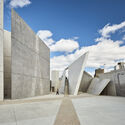
- The National Holocaust Monument (Ottawa, Canada, 2017): A powerful public sculpture and contemplative space comprising six concrete triangular volumes arranged around a central gathering place.
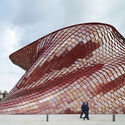
- The Vanke Pavilion (Milan Expo, Italy, 2015): A serpentine structure clad in self-cleaning red ceramic panels, exploring themes of sustainable urban farming and community.
Beyond cultural institutions, Studio Libeskind has left an indelible mark on urban skylines through high-density residential towers, concert halls, university buildings, and mixed-use complexes. Notable recent endeavors include Reflections at Keppel Bay in Singapore—a series of undulating, ribbon-like residential towers—and ongoing commissions such as the Albert Einstein Discovery Center in Ulm, Germany, which honors the physicist’s revolutionary theories through dynamic, curving geometries.
Official Statements and Global Recognition
The announcement of the 2026 Praemium Imperiale laureates was broadcast simultaneously across major cultural capitals—Paris, Rome, Berlin, New York, London, and Tokyo. The international prestige of the prize lies in its interdisciplinary scope, bridging visual arts, performance, and the built environment under the shared banner of enriching the global human experience.
In its official appraisal, the Japan Art Association praised Libeskind for his "lifelong engagement with music, philosophy, and literature," noting how these disparate disciplines converge in spatial designs that refuse to treat architecture as a neutral backdrop. Instead, Libeskind’s buildings are active participants in urban and psychological landscapes.
The Praemium Imperiale adds to an already illustrious roster of international honors bestowed upon Libeskind. His previous accolades include the Goethe Medal, the Hiroshima Art Prize, the Dresden Peace Prize, and the European Civil Rights Prize of the Sinti and Roma. These awards collectively reflect not only his architectural brilliance but also his moral clarity as an artist willing to address the darkest chapters of human history through built form.

Future Outlook: Contemporary Innovations and Ongoing Urban Transformations
Even as he receives one of the global arts community’s highest honors, Daniel Libeskind shows no signs of slowing down. Studio Libeskind continues to push the boundaries of urban density, sustainability, and adaptive reuse through a series of high-profile international commissions that bridge the gap between historic preservation and futuristic design.
Key Active Projects and Redevelopments
- Daechi Ssangyong 1 Redevelopment (Seoul, South Korea): In collaboration with HJ Design Partners and SAMOO Architects & Engineers, Studio Libeskind is spearheading a massive residential transformation in Gangnam-gu. The project replaces an aging 630-unit complex with six striking, high-density residential towers soaring up to 49 stories, introducing nearly 1,000 modern, sustainable homes to Seoul’s dense urban fabric.
- Issy-les-Moulineaux Station Transformation (Paris, France): Winning a competitive tender to reshape the transport hub adjacent to the forthcoming Line 15 station of the Grand Paris Express, Studio Libeskind is designing a 20,000-square-meter mixed-use complex. The project integrates bio-sourced construction materials and a sweeping living green wall, exemplifying the firm’s commitment to ecological urbanism.
- Boerentoren Renovation (Antwerp, Belgium): Demonstrating mastery in adaptive reuse, the firm is currently transforming the historic Boerentoren—an Art Deco skyscraper and one of Europe’s earliest high-rises—into a dynamic new cultural center in the heart of Antwerp. This delicate intervention balances historical reverence with contemporary programmatic needs.
As these projects move from drawing board to realization, they reinforce the core ethos that has guided Daniel Libeskind for decades: that architecture must dare to ask difficult questions, embrace the complexities of human history, and imagine futures that are as imaginative as they are humane. The 2026 Praemium Imperiale serves as both a celebration of a legendary career and an anticipation of the transformative spaces yet to come.



