


Executive Overview
As the international community prepares for the upcoming COP31 United Nations climate summit in Antalya, Turkey, global climate governance finds itself at a profound crossroads. Gathered in the Fijian city of Nadi for the traditional pre-COP preparatory meeting, high-ranking ministers, national delegates, and civil society advocates convened against a backdrop of compounding geopolitical turmoil, historical energy insecurity, and an increasingly hostile international political landscape.
At the heart of the summit lay a stark warning from Murat Kurum, Turkey’s climate change minister and the COP31 president-designate. In an uncompromising assessment, Kurum argued that wealthy industrialized nations must allocate significantly more financial capital to combat the climate crisis than the 5% of gross domestic product (GDP) recently pledged by NATO members for military defense. Insisting that "the climate issue is the security issue itself," Kurum emphasized that proactive climate investments are vastly more cost-effective than managing catastrophic fallout post-disaster.
Yet, even as host nations championed ambitious renewable energy targets—such as surging global electricity generation to 35% by 2035—deep divisions emerged over direct commitments to phase out fossil fuels. Kurum hedged on whether COP31 would successfully replicate previous historic agreements to "transition away from fossil fuels," asserting that the global economy is already moving and that fossil fuel dependence can be tackled indirectly. This cautious stance, paired with ongoing investments in fossil fuel developments by both Australia (acting as COP31’s "president of negotiations") and Turkey, drew sharp criticism from climate advocates and vulnerable island nations. With the United Nations Environment Programme (UNEP) warning that global heating under current optimal scenarios will reach at least 1.8°C—overshooting the critical 1.5°C Paris Agreement threshold—the stakes for the upcoming summit in Antalya could not be higher.
Detailed Chronology: The Road to Nadi and the Pacific Awakening
The journey toward COP31 took a deliberate and symbolic turn when Australia, assuming its novel role as "president of negotiations," pushed to hold the pre-COP preparatory summit in the heart of the Pacific Ocean. By hosting the event in Nadi, Fiji, organizers sought to center the narrative on the frontline communities facing the most immediate and existential threats from a warming planet.
However, the geopolitical realities of 2026 cast a long shadow over the proceedings. Compounded by ongoing international conflicts, a protracted global energy crisis, and the return of an unpredictable, climate-denying United States administration, only 13 national leaders accepted Australian Prime Minister Anthony Albanese’s invitation. The vast majority of attending heads of government hailed from Pacific island states. Despite the low turnout of leaders, the summit drew approximately 30 national ministers—including representatives from major industrial economies like India and European nations—alongside delegations from major greenhouse gas emitters China and Saudi Arabia, international agency heads, and nearly 4,000 delegates.
The Human Face of the Crisis: A Journey to Tuvalu
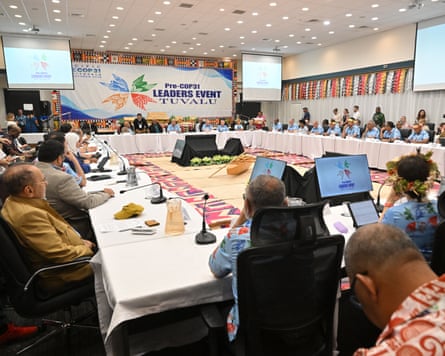
On the Tuesday of the summit, a high-level delegation flew north to Tuvalu, a low-lying atoll nation of roughly 10,000 residents whose very survival is imperiled by rising seas. Most of Tuvalu’s landmass sits a mere two meters above sea level, making it exceptionally vulnerable to coastal erosion, saltwater intrusion, and increasingly violent storm surges.

Delegates were given a firsthand look at a 20-hectare (49-acre) land reclamation project designed to buy the island nation precious time. More striking than the engineering feats, however, were the human stories shared by residents. In a poignant and widely circulated address, 13-year-old Melelusi Sokotia told visiting dignitaries that the aspirations of her generation—dreams of becoming teachers, doctors, and builders—were routinely overshadowed by a single, terrifying question: Can we grow safely here in Tuvalu?
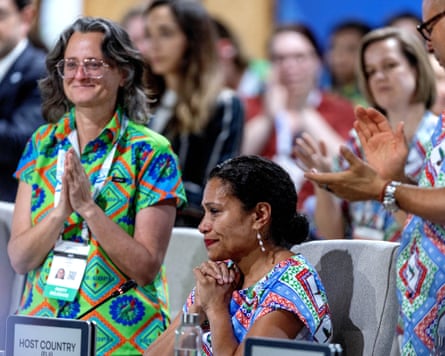
The emotional resonance of the Pacific’s plight carried back to Nadi, culminating in the summit’s closing address on Thursday. Fiji’s climate minister, Lynda Tabuya, broke down in tears as she delivered a passionate plea to the global delegation, earning a sustained standing ovation.
"This pre-COP draws to a close tonight," Tabuya told the assembly, her voice breaking with emotion. "Our responsibility does not." She urged delegates to remember the faces of the people they met and to carry a piece of the Pacific’s urgency with them back to their home capitals as they draft the binding texts for Antalya.
Supporting Context & Metrics: The Mathematics of Catastrophe
As governments gear up for the November summit in Antalya, they do so against a mountain of sobering scientific data that underscores the failure of current global commitments. Approximately 190 national governments will arrive in Turkey carrying the weight of a damning United Nations Environment Programme assessment. The report warns that even under the most optimistic emissions-reduction scenarios currently on the table, global heating is on track to reach at least 1.8°C—safely sailing past the aspirational 1.5°C ceiling established under the landmark Paris Agreement.
Scientists have repeatedly emphasized that every fraction of a degree of avoided warming translates directly into millions of human lives saved and trillions of dollars in averted economic devastation. Yet, the financial architecture designed to support the nations least responsible for—yet most vulnerable to—the climate crisis remains radically underfunded.
During the summit, Australian Climate Change Minister Chris Bowen laid bare the stark inequities of international climate finance. Bowen revealed that a meager 0.2% of global climate finance is currently directed toward helping small island developing states (SIDS) adapt to accelerating environmental breakdown.

"The countries that need it the most get it the least," Bowen stated bluntly. "That has got to change. It’s a key priority of COP31."
The Defense vs. Climate Funding Paradox
The financial debate took a radical turn when Turkish Climate Change Minister Murat Kurum directly challenged the economic priorities of Western and industrialized democracies. Pointing to recent commitments made by NATO member states to ramp up defense spending to 5% of GDP by 2035—driven by heightened geopolitical anxieties and regional warfare—Kurum argued that these nations are fundamentally misallocating their resources by ignoring the root security threat of the 21st century.
When asked by journalists if wealthy nations should spend as much on climate mitigation and adaptation as they do on military defense, Kurum did not hesitate: "Much more."
"The climate issue is the security issue itself," Kurum explained through an interpreter. "If you don’t spend one unit of money prior to the disasters, then you are left in a position where you have to spend 10 units of money after the disaster. It’s cheaper pre-disaster."
Despite these rhetorical flourishes, both host nations—Australia and Turkey—faced intense accusations of hypocrisy throughout the Nadi summit. Civil society groups and vulnerable nation blocs severely criticized both governments for continuing to approve and embrace new coal and gas development projects domestically, while remaining conspicuously silent on aggressive fossil fuel phaseout timelines ahead of the pre-COP.
Official Statements and Policy Debates
The tension between long-term transition goals and short-term fossil fuel extraction defined much of the diplomatic maneuvering in Fiji. While both Australia and Turkey endorsed a multi-country statement backing a global "transition away from fossil fuels"—borrowing the historic phrasing first agreed upon at COP28 in Dubai three years prior—their underlying strategies diverged significantly from the demands of climate activists and progressive island coalitions.
The Electrification Target vs. The Supply Dilemma
To address power generation, Kurum and Bowen rallied support for a specific, measurable target: achieving a global benchmark where 35% of all energy required to run homes, businesses, factories, and vehicles comes directly from electricity by 2035. At present, electrified energy accounts for roughly 21% globally. Bowen argued that the most effective way to eliminate fossil fuel reliance is not to artificially restrict the supply of hydrocarbons, but to scale up renewable energy generation so rapidly that fossil fuel power plants simply become economically obsolete.
However, this supply-side agnosticism infuriated advocates of the Fossil Fuel Non-Proliferation Treaty. Tzeporah Berman, chair of the initiative, pushed back hard against the logic of expanding extraction while scaling renewables.
"Pacific leaders have been clear: you cannot phase something out by building more of it," Berman asserted. "This means no new projects."
The Diplomatic Stalemate Over Hydrocarbons
Kurum’s comments regarding the terminology of the upcoming Antalya text signaled a potential diplomatic retreat. Suggesting that the world is "already in a transition," Kurum questioned whether pushing for explicit language on phasing out fossil fuels in the COP31 agreement would be a productive use of negotiating capital, noting his skepticism that deeper consensus could be forged among recalcitrant petrostates.
This reluctance mirrors bitter battles fought at COP30 in Brazil, where oil-producing giants like Saudi Arabia and Russia fiercely blocked any totalizing text naming fossil fuels directly as the primary driver of global heating. Frustrated by what they perceive as a systemic deadlock within official UN frameworks, a coalition of progressive nations met separately in Colombia earlier this year to map out alternative pathways to bypass petrostate obstructionism. These nations are scheduled to convene again next July in Tuvalu, vowing to force the fossil fuel phaseout issue onto the official agenda in Antalya.
Future Outlook: The Road to Antalya
As the delegates packed their bags and departed Nadi, the geopolitical landscape leading into COP31 in Antalya, Turkey, remains fraught with friction. The conference is shaping up to be a historic battleground between the economic and security imperatives of industrialized superpowers and the existential survival demands of the Global South.
The core challenges facing the COP31 presidency are formidable:
- Bridging the Finance Gap: Turning rhetoric into reality by dramatically scaling up adaptation funds for small island developing states currently receiving a negligible fraction of global capital.
- Reconciling Security Budgets: Convincing NATO and other wealthy economies to reevaluate their security paradigms, treating climate finance not as foreign aid, but as an indispensable component of global defense and risk management.
- The Fossil Fuel Deadlock: Overcoming resistance from major oil and coal exporters to secure binding, actionable language on supply reduction, rather than relying solely on indirect electrification metrics.
For leaders like Tuvalu’s Melelusi Sokotia and Fiji’s Lynda Tabuya, the stakes are measured not in GDP percentages or diplomatic compromises, but in the physical survival of their homes, cultures, and futures. Whether the international community meeting in Antalya can rise to meet this existential test remains the defining question of our era.



