Executive Overview
The convergence of record-breaking heatwaves, unprecedented moorland fires, and piercing national emergency alerts has forced the British public to confront the harsh realities of the climate crisis with visceral intensity. For Prime Minister Andy Burnham, this climate-induced summer of discontent has presented an immediate, high-stakes political test.
While swift emergency responses—including Cobra meetings, drought relief for farmers, and the controversial deployment of screeching emergency alerts directly to mobile phones—demonstrate a government keenly aware of visible threats, a deep-seated contradiction remains at the heart of Downing Street’s agenda. Even as suburban fences burn and ash blankets gardens across the UK, Burnham’s administration continues to entertain the prospect of new North Sea oil and gas drilling, alongside consultations to ease stringent zero-emission vehicle (Zev) targets for automotive manufacturers.
This piece examines the fragile balancing act defining Burnham’s premiership: navigating the immediate political and socio-economic pressures of blue-collar industrial heartlands, managing fears of a resurgent right-wing populist backlash, and attempting to reconcile populist pragmatism with the existential demands of a rapidly warming planet.
Detailed Chronology: A Summer of Fire and False Alarms
The Peak District Wake-Up Call
The atmosphere across the usually soggy Peak District shifted radically this summer. Weeks of relentless sunshine baked the traditionally verdant valleys into a dangerously dry, crispy landscape resembling a tinderbox.
On a Friday evening, the silence was shattered by a harsh, discordant shriek blaring simultaneously from every mobile device in the household. Initially mistaken for a localized fire threat—given the ominous plumes of smoke billowing from persistent moorland blazes across the region—the alert turned out to be a nationwide warning regarding extreme wildfire risks and a plea to refrain from using barbecues. While ultimately a warning rather than an immediate evacuation order, the shrill alarm served as an unmistakable cultural and psychological turning point.
Escalating Crises and Rapid Government Intervention
As the summer progressed, the weather-induced chaos intensified across England and Wales:
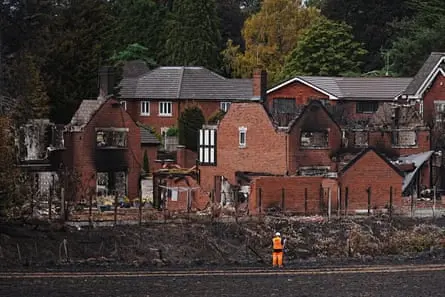
- Mid-August 2026: Footage circulated widely of aggressive wildfires leaping over suburban fences and forcing farmers to turn terrified livestock loose as surrounding hedgerows erupted in flames.
- The Cobra Response: Pressured intensely by Green Party representatives and local MPs, Prime Minister Andy Burnham convened an emergency Cobra meeting specifically targeted at organizing a cohesive national strategy for combating wildfires.
- Agricultural Relief: Recognizing the catastrophic impact of prolonged droughts on food security and rural livelihoods, the government swiftly announced targeted financial and logistical support for drought-hit farmers.
- The Nationwide Mobile Alert: The high-water mark of government public messaging arrived via the emergency phone alert system, which lit up millions of devices simultaneously, sparking widespread anxiety among motorists and urban residents alike.
Despite these reactive measures, public skepticism remains high. Observers note that while Burnham was quick to visit victims of the devastating Stourbridge wildfires in the West Midlands, his public engagement with local Labour MPs warning against fossil fuel expansion has been notably muted.
Supporting Context & Metrics: The Anatomy of a Pragmatic Retreat
To understand Andy Burnham’s cautious navigation of environmental policy, one must examine the socio-economic pressures inherited from previous administrations and magnified by global geopolitical instability.
The Automotive Sector and the Zev Mandate
At the core of the government’s current environmental policy review is the Zero Emission Vehicle (Zev) mandate. Under the existing framework, automotive manufacturers face steep financial penalties if they fail to meet progressively aggressive annual quotas for electric vehicle (EV) sales as a percentage of their total market output.

However, amidst a persistent cost-of-living squeeze, consumers have been reluctant or financially unable to purchase high-priced new EVs at the scale required by the legislation. Faced with the choice of absorbing crippling government fines or shutting down traditional petrol and diesel production lines, manufacturers have warned that rigid targets risk precipitating plant closures across Britain’s remaining industrial heartlands.
Lessons from Greater Manchester
This tension is familiar to those who observed Burnham’s tenure as Mayor of Greater Manchester, most notably his swift recalibration of the deeply unpopular Clean Air Zone charging scheme for drivers. Burnham has consistently demonstrated an instinct to protect blue-collar jobs, local trade unions, and industrial manufacturing bases whenever green mandates threaten to alienate working-class communities.
While the prime minister remains largely insulated from expensive fossil fuel lobbyists, he is acutely sensitive to:
- The Aberdeen Workforce: Trade unions fiercely defending the employment interests of North Sea oil rig workers.
- Manufacturing Hubs: Car manufacturers lobbying aggressively for relaxed timelines to prevent factory mothballing.
- The Populist Threat: The constant political hazard of far-right and populist entities weaponizing economic pain—such as rising gas bills—against "woke" net-zero policies.
Geopolitical Pressures and Energy Security
Compounding domestic industrial anxieties are international supply chain vulnerabilities. Ongoing conflicts, including disruptions stemming from U.S. military actions involving Iran, threaten to drive European gas prices skyward heading into the autumn months.
Faced with the specter of another winter energy crisis, even prominent green energy entrepreneurs—such as Dale Vince and Greg Jackson—have argued that domestic extraction from projects like the Rosebank and Jackdaw oil and gas fields may serve as a pragmatic, cleaner alternative to international dependency, potentially mitigating the public backlash against net-zero transitions.
Official Statements and Political Reactions
The government’s official stance has increasingly relied on the language of "pragmatism," walking a tightrope between ecological urgency and economic appeasement.
- Prime Minister Andy Burnham: Emphasizing his commitment to protecting vulnerable communities affected by extreme weather, Burnham stated during his visit to Stourbridge: "We must stand shoulder to shoulder with those who have lost their homes and livelihoods to these unprecedented fires, while ensuring our economic transition leaves no community behind." However, Downing Street has faced mounting criticism for failing to explicitly connect these localized disasters to macro-level fossil fuel policies.
- Cat Eccles, Labour MP for Stourbridge: Expressing deep concern over ongoing extraction proposals, Eccles noted in public communications that constituents are increasingly questioning the coherence of pursuing new fossil fuel projects during the hottest summer on record. "A lot of people have contacted me… asking how we can reconcile these tragedies with ongoing discussions about new oil and gas licenses," she remarked.
- John Harris, Political Commentator: Writing in The Guardian, critics have sharply questioned the administration’s trajectory, noting: "Andy Burnham has barely acknowledged the climate crisis. If only Britain’s workers had that luxury." Analysts argue that treating climate policy as a secondary luxury to be managed only when it aligns with short-term employment goals fundamentally misunderstands the systemic threat posed by global heating.
Future Outlook: The Test Ahead
As the unnaturally hot summer months inevitably give way to what meteorological models predict will be an exceptionally wet and volatile autumn, Andy Burnham faces a defining leadership crucible.
The fundamental question surrounding his premiership is whether he can rise above transactional politics. The Labour Party did not propel Burnham into high office merely for naked pragmatism or reactionary firefighting; voters expected the institutional courage to confront complex, uncomfortable truths, paired with the emotional intelligence required to guide the nation through an inevitable economic and ecological transformation.
If Downing Street continues down a path of short-term appeasement—focussing primarily on cleaning up the debris of climate catastrophes while greenlighting the very extraction projects that exacerbate them—the administration risks losing both its moral authority and its long-term viability. The sirens heard across the Peak District this August were more than a false alarm; they were an audition for a government that must decide whether it wishes to lead the future or merely manage the decline.