

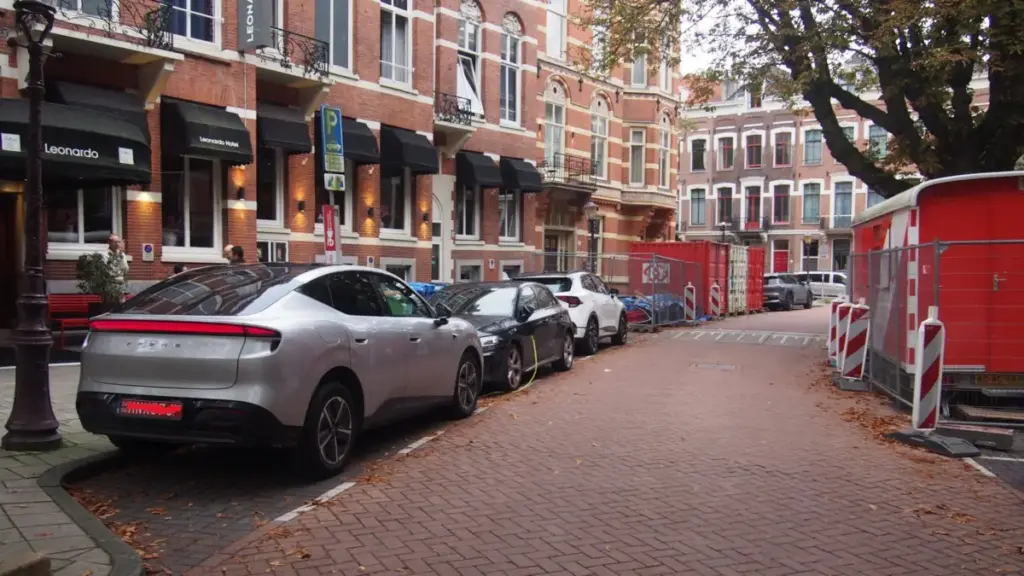
Executive Overview
The global race for autonomous driving supremacy is entering a critical new phase, shifting away from rigid, rules-based programming toward sophisticated artificial intelligence capable of true behavioral anticipation. In a quiet, clandestine test drive conducted on the challenging, historical streets of Amsterdam, XPENG provided an exclusive look at its cutting-edge autonomous technology.
As the first independent journalist outside of XPENG’s internal testing ecosystem to experience the L03 prototype running XNGP with VLA 2.0 (Vision-Language Action), this evaluation offered a rare comparative window into the future of intelligent mobility. Immediately following the XPENG test, a Tesla Model 3 running Full Self-Driving (FSD) was evaluated over the exact same route.
While FSD has made significant inroads in select Western markets, the Netherlands recently became one of the first European jurisdictions to permit rigorous testing under complex urban conditions. XPENG’s deployment of the L03 prototype in Amsterdam ahead of its official European release next year represents a major strategic milestone. Operating without the safety nets of pre-mapped geofencing or cloud-reliant lag, VLA 2.0 demonstrated a distinctly human-like capability to anticipate traffic flows, navigate notoriously chaotic urban infrastructure, and interact safely with pedestrians and cyclists.
This report—Part 1 of a two-part series—examines the mechanics, performance characteristics, and cabin experience of the XPENG L03 operating under VLA 2.0 in one of Europe’s most demanding driving environments.
Detailed Chronology: From Berlin to the Canals of Amsterdam
The opportunity to evaluate VLA 2.0 side-by-side with Tesla’s FSD materialized rapidly. While taxiing to the terminal gate on a return flight from IFA Berlin, an encrypted notification flashed across the screen: XPENG was quietly organizing a back-to-back testing session in Amsterdam. Without hesitation, travel arrangements were secured for the following morning.
A Low-Profile Operation in the Rain
Unlike major international press events characterized by official welcome committees, professional film crews, and heavily branded vehicles, XPENG opted for strict operational discretion. Requests were made to avoid corporate automotive attire, prompting a shift from an official XPENG commemorative jacket (retained from the brand’s million-vehicle celebration event) to a low-profile Wu-Tang hoodie.
The testing took place under typical Dutch weather conditions: a chilly morning marked by intermittent rain, slick pavement, and unpredictable wind gusts. The rendezvous occurred outside a boutique hotel, where the XPENG team and a collaborating Dutch content creator gathered. Because the vehicles were strictly protected pre-production prototypes, no internal telemetry cameras or microphones had been permanently installed; temporary action cameras were hastily mounted to capture in-cabin footage.
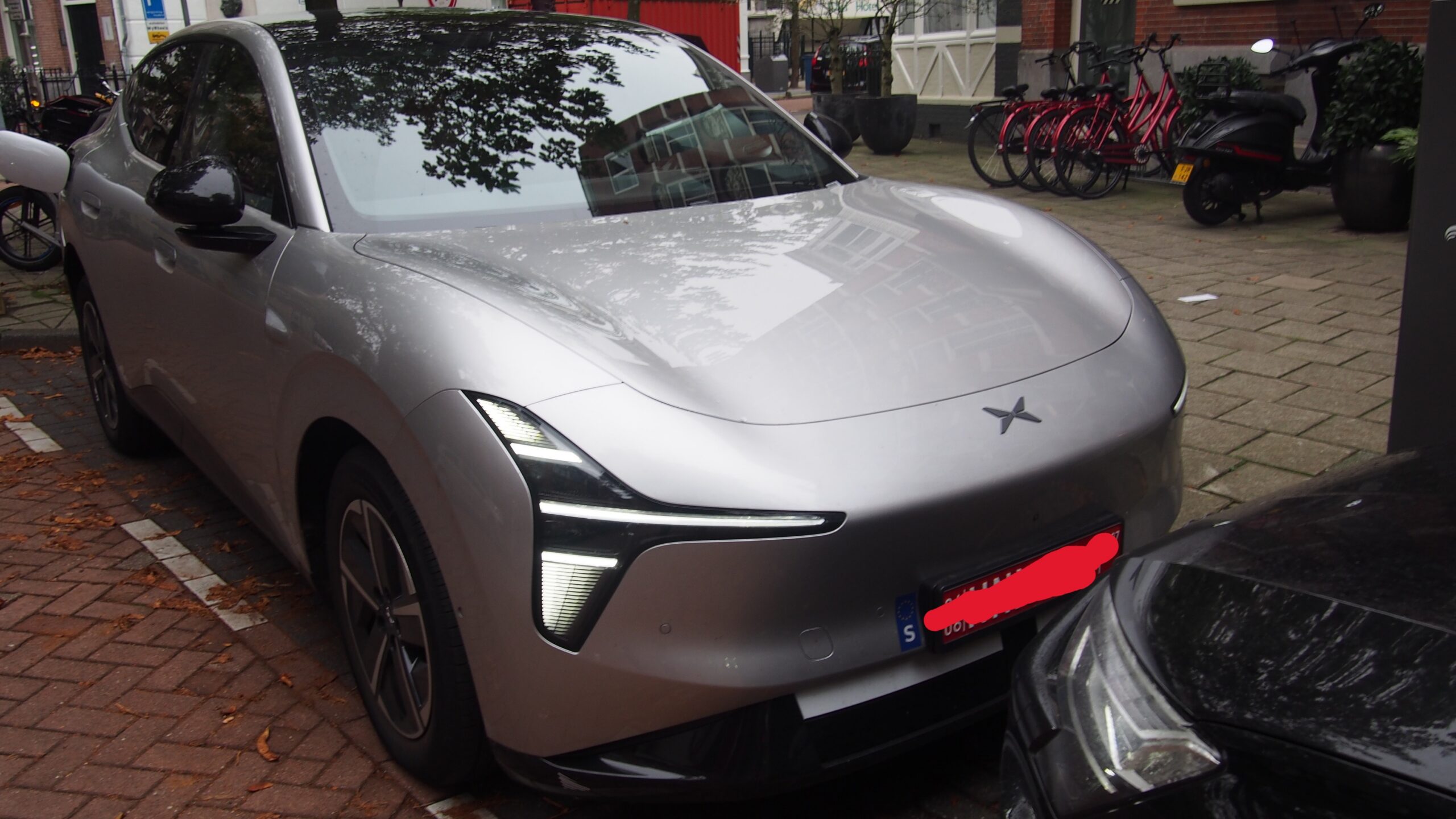
The Vehicle: XPENG L03 Prototype
The test vehicle itself—the XPENG L03—was far from a polished press car. Retaining subtle remnants of camouflage and bearing the slight wear and tear of active engineering trials, it blended seamlessly into Amsterdam’s dense traffic. Despite its unassuming exterior, the vehicle occasionally turned heads; one curious local pedestrian approached the car while parked, inquiring about its specifications and striking design.
Due to strict prototype insurance regulations and corporate testing protocols, human journalists were restricted to the passenger seat. Longwen, a senior representative from XPENG’s Munich technical office, piloted both the L03 and the comparative Tesla Model 3, expertly fielding real-time queries regarding the software architecture and dynamic decision-making trees.
Amsterdam’s Urban Crucible
Amsterdam presents a uniquely punishing environment for autonomous driving systems. Unlike grid-patterned North American cities or wide European boulevards, Amsterdam’s layout evolved centuries before the invention of the automobile. The resulting infrastructure is defined by:

- Narrow, Canal-Adjacent Roadways: Roads hugging historical waterways frequently lack modern shoulders or clear lane demarcations.
- Active Construction Zones: Ongoing urban renewal projects routinely reduce multi-lane roads down to tight, single-file bottlenecks.
- The Vulnerable Road User Matrix: Pedestrians—frequently distracted tourists—wander unpredictably into active lanes. More critically, cyclists hold absolute legal priority, routinely weaving across traffic, ignoring standard signaling conventions, and emerging silently from blind spots.
- Inclement Weather Complications: Intermittent rain forces pedestrians under umbrellas and hoods, sharply diminishing their environmental awareness and elevating the risk profile for automated navigation.
Supporting Context & Metrics: VLA 2.0 Architecture vs. Traditional Systems
To fully understand why VLA 2.0 handled Amsterdam’s chaotic roads with poise, it is necessary to examine the foundational technological shift underway at XPENG.
Anticipate and Act: The Core Philosophy of VLA 2.0
Traditional advanced driver-assistance systems (ADAS) rely heavily on hard-coded rules, high-definition mapping data, and manual data labeling. When faced with an edge case—such as an unmarked construction zone or a swarm of cyclists cutting across a tram line—rules-based systems often hesitate, disengage, or trigger abrupt emergency maneuvers.
VLA 2.0 discards this rigid framework in favor of end-to-end AI architecture. During the Amsterdam evaluation, the most striking characteristic of the system was its ability to anticipate and act:
- Predictive Trajectory Analysis: Rather than reacting to an obstacle the moment it enters a sensor cone, VLA 2.0 continuously models the kinetic intent of surrounding actors. It identifies a cyclist’s speed, vector, and head orientation before they execute a turn, allowing the L03 to adjust its speed proactively rather than relying on panic stops.
- Polite Yet Assertive Navigation: When negotiating tight construction zones where workers and heavy machinery occupied the margins, the L03 maintained generous safety buffers. It did not aggressively lurch back into a lane upon spotting a temporary opening; instead, it waited until a clean, unobstructed path was confirmed.
- Micro-Input Flexibility (Co-Driving): The system demonstrated exceptional cooperative capability. Drivers could gently intervene via steering wheel controls or accelerator pedals to adjust speed or clear obstacles without triggering a system disengagement. The car continuously learns from these driver corrections, dynamically adapting to regional micro-preferences in real time.
Onboard Processing Power vs. Cloud Latency
A major engineering differentiator observed during the test was response latency. When initializing routes or passing through complex waypoints, the L03 reacted instantaneously. There was no perceptible pause or computational lag requiring cloud-based recalculation. This responsiveness is driven by massive onboard AI processing power housed directly within the vehicle—surpassing legacy hardware suites and enabling instantaneous decision-making at the edge.
Ride Comfort and Mechanical Harmony
Amsterdam’s cobblestone-laden streets, persistent speed bumps, and unexpected potholes put vehicle suspension and dampening to the test. The L03 integrated predictive road-scanning capabilities, gently deceleration ahead of severe surface anomalies proportional to their size.

Combined with an intelligently tuned suspension setup that balanced structural feedback with cabin isolation, the L03 provided a significantly smoother and more refined ride quality than the comparative Tesla Model 3.
Official Statements & Technical Insights
While formal product launch timelines point toward a broader European rollout in 2027, engineering leads accompanying the test provided vital context regarding the localization process.
"A system can be technically flawless in a structured testing ground like Munich or Beijing, but Amsterdam demands an entirely different tier of contextual awareness," noted Longwen during the debrief. "Because VLA 2.0 is not bound by rigid rules-based logic, it absorbs local driving customs much like a human expat learning the unwritten laws of a foreign city."
Key architectural highlights shared by the engineering team include:
- Native Multi-Modal Learning: The Vision-Language Action framework unifies visual perception with language-based reasoning models, enabling the vehicle to interpret complex environmental cues—such as hand gestures from construction workers or temporary emergency signage—in real time.
- Conversational Cabin Integration: While the test vehicle utilized standard touch and physical control interfaces (including a practical steering column shifter stalk that eased manual parking maneuvers), XPENG’s upcoming voice-control architecture boasts onboard computational capability exceeding Tesla’s HW4 suite. This conversational interface will soon allow occupants to govern advanced intelligent driving features entirely through natural speech.
Future Outlook: The Road to 2027
The performance of the XPENG L03 prototype in Amsterdam signals a profound evolution in global automated driving development. By successfully navigating narrow canal roads, erratic bicycle traffic, and sudden construction bottlenecks without triggering a single horn blast or hostile reaction from local road users, VLA 2.0 proved its mettle in one of the world’s most difficult operational design domains.

The primary hurdle remaining for XPENG is not technological capability, but psychological comfort. Autonomous systems that operate with high assertiveness can occasionally startle uninitiated passengers who prefer overly cautious, robot-like deceleration profiles. Introducing customizable assertiveness settings—similar to adaptive cruise control distance sliders—may bridge this gap as European consumers grow accustomed to AI-driven transit.
As XPENG continues to ingest regional driving data and refine its end-to-end neural networks ahead of its commercial European debut, traditional Western automakers and autonomous competitors face an increasingly formidable challenger.
Stay tuned for Part 2, where we step into the Tesla Model 3 running FSD over the exact same Amsterdam route for a definitive head-to-head comparison.



