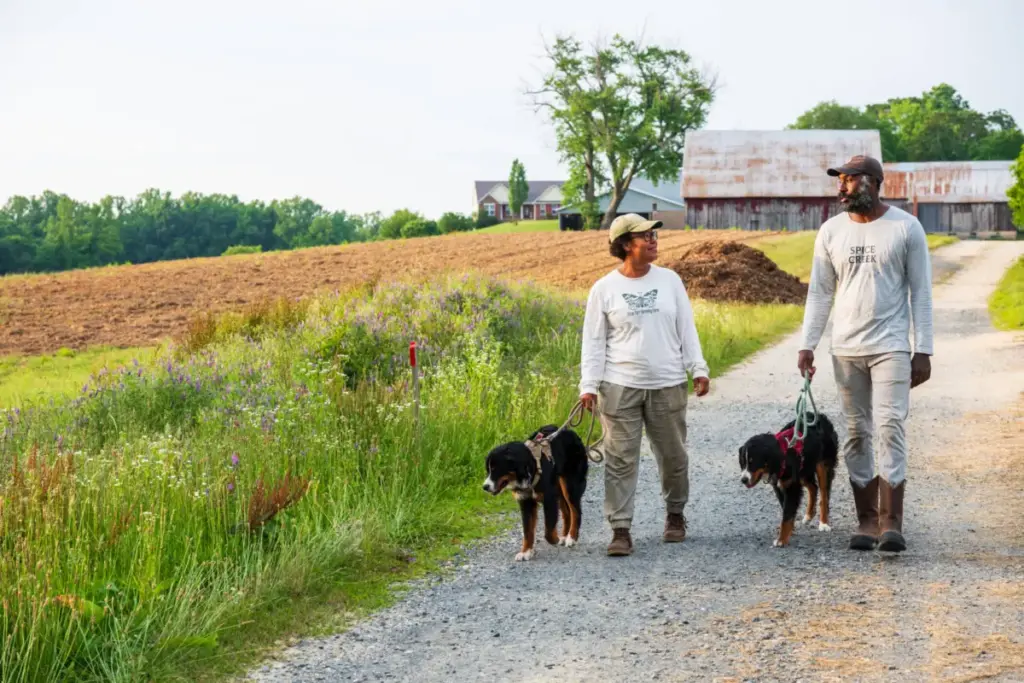
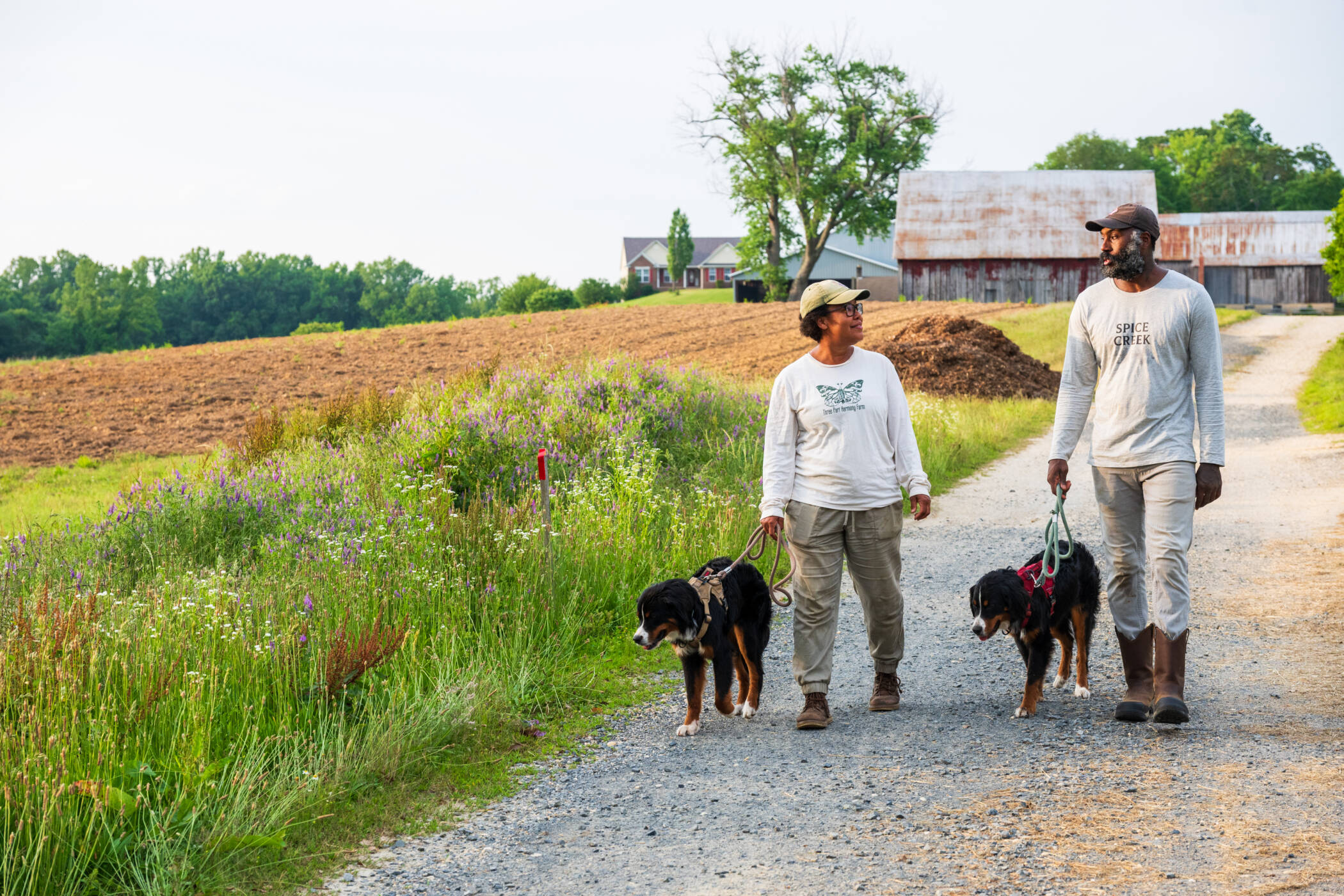
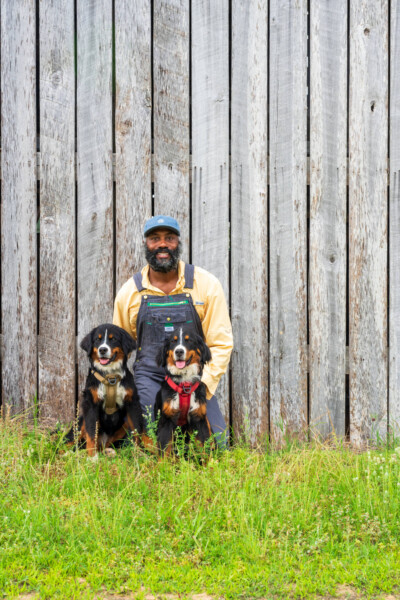
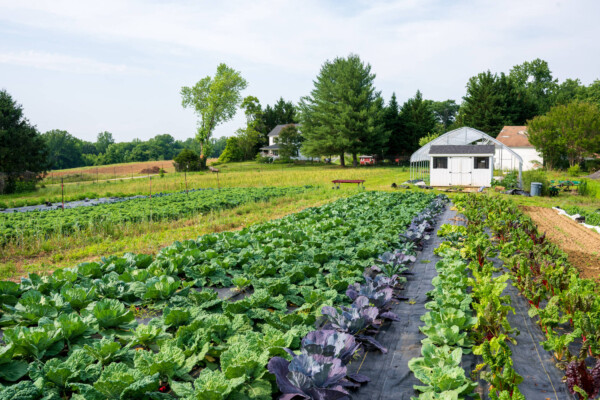
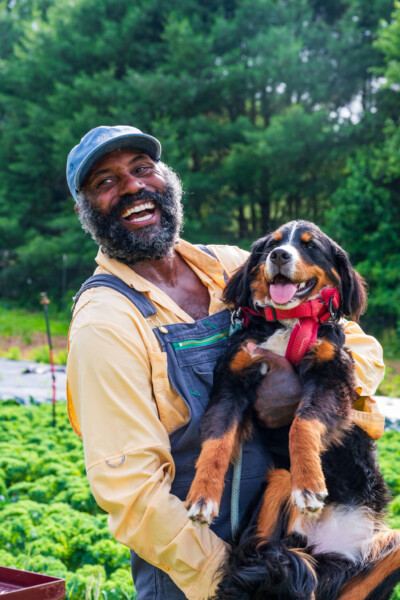
On a steamy, sun-drenched early summer day at Spice Creek Farm in Brandywine, Maryland, tomato plants stretch aggressively skyward, heavy with the promise of a bountiful harvest. D’Real Graham, tending the land alongside his life partner and co-farmer Gail Taylor, meticulously establishes a wire trellis designed to train the vigorous vines and keep the ripening fruit clear of the damp earth. Nearby, robust peppers and squash bulk up under the humid mid-Atlantic sun, while immaculately maintained rows of kale and Swiss chard sit at the absolute peak of their productivity. As Graham drives sturdy wooden posts deep into the rich earth, their two Bernese Mountain dogs, Ruby and Ivy, playfully nip at the nutrient-dense leafy greens framing the pathway.
For Taylor, who spent more than a decade successfully cultivating food on a modest 2-acre urban farm in Washington, D.C., 2025 marks a transformative milestone: the first full growing season on an expansive, rural canvas. Spanning 24 acres in Prince George’s County—roughly 25 miles southeast of the nation’s capital—Spice Creek Farm is far more than a commercial agricultural enterprise. It is the physical manifestation of an ambitious, deeply intentional blueprint for an equitable, community-based regional food system.
The couple’s groundbreaking work has not gone unnoticed. Their rapid progress and unwavering dedication to social and environmental stewardship earned them a finalist spot for the inaugural U.S. Good Farmer Award, a joint initiative by the Rodale Institute and the Davines Group designed to celebrate outstanding farmers pioneering regenerative organic practices. Today, with technical mentorship from the Rodale Institute’s elite consulting team, Taylor and Graham are systematically scaling up their operations, laying down deep roots, and actively spearheading the formation of a burgeoning Black Agrarian Corridor across Southern Maryland.
Detailed Chronology: From Policy Desks to Rural Acreage
Unlikely Beginnings and the Pivot to Agriculture
Gail Taylor and D’Real Graham arrived at agriculture through entirely distinct paths, each driven by a fundamental desire to create tangible, positive impacts in human lives. Taylor’s journey began far from the farm. Growing up near Albany, New York, she pursued a rigorous academic course of study, earning a degree in U.S. foreign policy and Latin America from Syracuse University, followed by immersive fieldwork in Guatemala and Chile.
However, disillusionment with traditional policy work eventually set in. In 2005, seeking a hands-on vocation where she could directly benefit her community, Taylor began volunteering at Deep Roots Farm, a sprawling 200-acre regenerative organic farm in Upper Marlboro, Maryland. Her dedication quickly caught the eye of proprietor Gale Livingstone, who hired her for the following growing season.
"I was looking for a change from policy work, and farming felt to me like I was having a positive impact for people," Taylor reflects.
As her responsibilities expanded, so did her vision for local food access. However, the grueling daily commute from her home in Washington, D.C., out to the rural Maryland farm proved unsustainable. By 2011, Taylor crafted an innovative business model: a hyper-local, backyard Community Supported Agriculture (CSA) subscription service centered in the District. Three local homeowners generously offered their residential yards for cultivation, and Taylor installed a greenhouse in her own backyard to propagate vegetable seedlings. Every Thursday, she mounted her bicycle, pedaled between the yards to harvest the produce, and organized the fresh yields directly onto her front porch for her six foundational CSA members.
Legislative Breakthrough: Changing D.C. Tax Law
Buoyant from this initial success, Taylor sought to scale up by transforming an unused two-acre plot near Catholic University into a permanent urban farm. She immediately hit a systemic roadblock: Washington, D.C., lacked municipal tax policies exempting agricultural land from commercial property taxes—a common incentive found in rural agricultural counties nationwide.
Refusing to be deterred, Taylor partnered with pro bono law students from American University to draft and champion legislative reform. Her relentless advocacy culminated in the passage of the landmark 2014 D.C. Urban Farming and Food Security Act. This critical legislation overhauled municipal tax codes and empowered the city to lease public and vacant lands to urban growers. Armed with this legal victory, Taylor launched Three Part Harmony Farm on the site in 2015. By 2024, the urban plot’s meticulously managed sixty-four 3-by-100-foot beds were yielding an astonishing 7,000 pounds of fresh, organic produce annually.
Graham’s Awakening and the Partnership Formed
Meanwhile, D’Real Graham was navigating his own professional evolution. Raised in Michigan with a natural calling toward education, Graham moved to Washington, D.C., to accept a position with an educational nonprofit. Seeking an authentic escape from rigid office culture, he also gravitated toward Deep Roots Farm as a volunteer.
Transitioning from white-collar administration to manual agricultural labor presented steep learning curves.
"At first, Farmer Gale only trusted me to weed," Graham recalls with a smile. "But I came to it humbly and was willing to learn."
His tenacity paid off swiftly. By the conclusion of his inaugural season, Graham was trusted with driving the farm’s delivery van and managing its high-volume vendor stands across three weekly farmers markets.
It was at Deep Roots Farm that Graham and Taylor’s paths crossed, forging a personal and professional partnership. In 2019, Graham officially joined the team at Three Part Harmony Farm. Together, the duo began searching for a larger land base to drastically expand production and operationalize their long-held vision for a regional agricultural hub.
Securing Spice Creek Farm
In 2022, Taylor and Graham took their first major step into rural agriculture by leasing a 24-acre parcel in Brandywine, Maryland—historic land previously operated as a tobacco farm by generations of the locally prominent Baden family. Recognizing the historic weight and vast potential of the property, the couple entered into a strategic lease-to-purchase agreement in December 2023, backed by Dirt Capital Partners, a premier investment firm dedicated to funding regenerative organic agriculture projects.
Supporting Context & Metrics
Healing Degraded Land: Remediation and History
The 24-acre Spice Creek Farm property arrived with layers of complex history and physical challenges. In researching the land’s deep roots, Graham uncovered a sobering reality: at one point prior to the Civil War, 110 enslaved individuals had been forced to labor on the very soil the couple now farms. Bordered along one edge by Spice Creek—a vital artery feeding into the Patuxent River and ultimately the Chesapeake Bay watershed—the landscape demanded deep ecological healing.
Decades of conventional farming practices, dominated by intensive corn and soybean production, had taken a heavy toll. The relentless transit of massive tractors had severely compacted the subsoil, while chemical inputs and synthetic herbicides had decimated natural microbial life.
Soil Regeneration: In the summer of 2022, the farmers hauled in seven massive truckloads of high-grade organic compost. Graham spent three intensive days operating a rented skid steer to spread the amendments evenly across the primary production fields.
Infrastructure Investment: Following comprehensive soil remediation, the couple erected perimeter deer fencing, hand-dug their initial crop beds, installed water lines for efficient drip irrigation, built a dedicated post-harvest wash station, and erected a functional seedling greenhouse.
Diverse Cultivation: Beyond staple vegetables like potatoes, watermarks, eggplants, and tomatillos, the farm has embraced culturally significant and experimental crops. Plans for upcoming seasons include cultivating cotton and cowpeas—crops explicitly chosen to help their local community reconnect with agricultural history and traditional textiles.
Collaborative Farming and the Black Agrarian Corridor
Rather than operating in isolation, Spice Creek Farm functions as an anchor for a broader cooperative network. Taylor and Graham maintain active, collaborative relationships with roughly a half-dozen neighboring farms across Southern Maryland.
Rather than engaging in cutthroat market competition, these producers coordinate planting schedules and crop rotations to supply the region efficiently. This mutual aid model forms the bedrock of their vision for a Black Agrarian Corridor—a cooperative network designed to build generational wealth, foster peer support, and ensure long-term regional food sovereignty.
Official Statements & Expert Guidance
The transition from a two-acre urban footprint to a sprawling 24-acre rural operation involves immense logistical hurdles. To navigate this scaling phase, Taylor and Graham partnered directly with Kegan Hilaire, the Rodale Institute’s small farms and diversified vegetable consultant.
"When farmers begin to scale up, they need to balance their short-term needs for infrastructure and equipment to keep up with their growth, while staying focused on their long-term plans," explains Hilaire. "A walk-behind tractor can get you started, for example, but it’s not going to be enough when you’re working 20 acres. You also need simple infrastructure for post-harvest preparation and storage that can handle the volume you’re harvesting now, while you save for a bigger cooler and processing space."
Hilaire’s advisory scope spans every facet of organic farm management, ranging from weed management protocols and cover crop integration to bureaucratic navigating of organic certification and inspector preparation. Furthermore, the Rodale Institute consulting team assists transitioning farms in securing critical financial grants, accessing capital, and building robust regional market networks.
D’Real Graham emphasizes the spiritual and philosophical core that guides their daily operations:
"We aspire to be land stewards as much as farmers. We wake up every day with the goals of building the soil and producing food that’s good for people."
Gail Taylor echoes this sentiment, looking toward the horizon of mentorship:
"We want to get to the point where we can nurture the next wave of beginning farmers."
Future Outlook & Farm Facts
As Spice Creek Farm looks toward the remainder of 2025 and beyond, the operation faces both unique opportunities and systemic headwinds. Recent contractions in federal funding and agricultural grants for small-scale, organic producers have placed immense financial pressure on operations that started without substantial capital reserves. Additionally, finding reliable agricultural labor remains a persistent challenge within modern farming.
To combat labor retention issues, Taylor and Graham are spearheading an innovative housing initiative on the property. Currently, their sole farmhand resides with them in the property’s roadside brick house. However, future plans involve completely renovating a historic white cabin on the interior of the acreage to serve as a permanent private residence for the couple, converting the brick house entirely into dedicated employee housing to attract passionate agricultural workers.
Core Objectives for the Future:
Multi-Farm CSA Expansion: Replicating Taylor’s previous urban model on a regional scale, uniting roughly a dozen diverse local food producers to supply hundreds of CSA members with hyper-local, ethically sourced goods.
Educational Workshops: Developing hands-on consumer workshops focused on organic nutrition, ecological land restoration, and agricultural literacy.
Agritourism & Agrobiodiversity: Introducing pasture-raised poultry—guarded by their trained Bernese Mountain dogs, Ruby and Ivy—alongside heritage goats utilized for targeted, chemical-free pasture clearing.
Spice Creek Farm At-a-Glance
Location: Brandywine, Prince George’s County, Maryland
Total Land Area: 24 acres
Active Vegetable Production: 3 acres (rapidly expanding)
Current CSA Membership: 150 households
Production Window: 48 weeks of continuous food production annually
Through sheer grit, legislative advocacy, and a steadfast commitment to regenerative organic agriculture, Gail Taylor and D’Real Graham are proving that farming can be a powerful catalyst for community healing, environmental restoration, and social justice.