Executive Overview
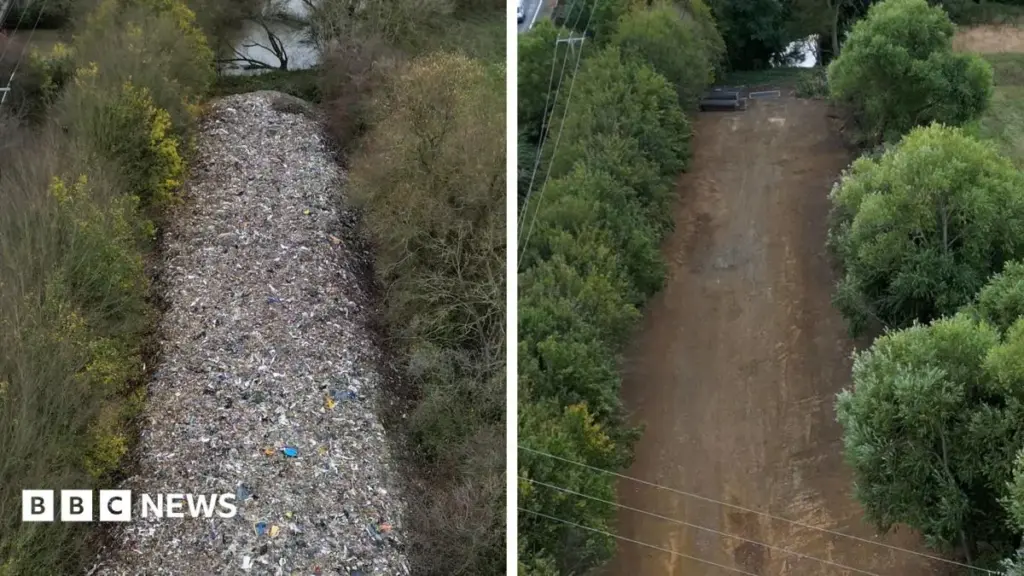
The clearance of one of England’s largest and most notorious illegal waste dumps—located in Kidlington, Oxfordshire—has finally been completed, leaving taxpayers saddled with a staggering £6 million clean-up bill. The site, situated between the picturesque River Cherwell and the bustling A34, became a blight on the local landscape after approximately 22,000 tonnes of domestic and commercial refuse were illegally dumped there.
Kidlington is not an isolated incident. It represents just one of nearly 30 sprawling "supersites" first brought to light by a landmark BBC investigation. While the government has vowed to aggressively recoup clearance costs for Kidlington and seven other major dump sites directly from the criminals responsible, recent data reveals a stark and deeply concerning discrepancy between the cost of environmental destruction and the state’s ability to recover funds.
Figures obtained via an Environmental Information Regulations (EIR) request reveal that over the past five years, the Environment Agency has managed to claw back a meager £7.3 million from convicted waste criminals using Proceeds of Crime Act (Poca) confiscation orders. This figure stands in sharp contrast to the broader economic reality: the Environment Agency estimates that waste crime costs the UK economy an eye-watering £1 billion annually.
With approximately 20% of England’s waste now believed to be illegally managed, critics, rural landowners, and local government officials have heavily criticized the state’s financial recovery rates. They argue that current penalties and asset seizures act as little more than a "cost of doing business" for sophisticated criminal syndicates, failing entirely to provide an effective deterrent. As the government rolls out a high-profile nationwide crackdown—deploying frontline officers, drones, and targeted action plans—this report examines the anatomy of England’s waste crime crisis, the financial metrics underpinning it, and the uphill battle to restore justice to rural and urban communities alike.
Detailed Chronology and the Anatomy of a "Supersite"
The Rise and Fall of the Kidlington Dump
The crisis at Kidlington began to unfold when industrial quantities of mixed domestic and commercial waste started arriving at the site between the River Cherwell and the A34. Over a sustained period, criminal networks transformed the tract of land into a toxic, sprawling monument to regulatory evasion. By the time authorities fully grasped the scale of the operation, roughly 22,000 tonnes of rubbish had been accumulated.
The environmental implications were immediate and severe. Large-scale illegal tips of this nature frequently leach hazardous liquids into local water tables, pose extreme fire hazards due to the spontaneous combustion of compacted refuse, and attract vermin while destroying local ecosystems.
As investigations deepened, law enforcement agencies moved in. Four men were arrested in connection with the Kidlington illegal waste tip. While all four have since been released under investigation, the physical legacy of their alleged actions remained: a massive, mountainous pile of trash requiring state intervention. Because the private landowners of such sites are traditionally expected to foot the bill—costs that routinely bankrupt individuals or small businesses—the government was forced to step in. Under exceptional circumstances, public funds were utilized to clear the Kidlington site, culminating in a final bill of £6 million for the British taxpayer.
The Broader Landscape of Waste Crime
Kidlington is merely the tip of a much larger, subterranean iceberg. The site is one of nearly 30 identified "supersites"—massive illegal dumping grounds that dwarf traditional fly-tipping incidents. These operations are rarely the work of disorganized opportunists; rather, they are increasingly orchestrated by organized crime syndicates who view waste management as a low-risk, high-reward enterprise.
Under the previous framework, these sites were allowed to fester for years, caught in a bureaucratic quagmire between local authorities, the Environment Agency, and cash-strapped landowners. The physical clearance of these locations requires specialized heavy machinery, hazardous material handling, and months of labor, explaining why a single site like Kidlington demands millions in public expenditure.
Recognizing the untenable nature of the status quo, the government’s recently unveiled Waste Crime Action Plan outlines a shift in policy. Under this framework, the Environment Agency is authorized to intervene on an exceptional basis to clear sites that present an immediate and catastrophic risk to public health and the environment. Prime Minister Andy Burnham announced a nationwide expansion of this initiative, identifying three additional supersites slated for immediate state-led clearance pending rigorous assessments. In total, six supersites have been officially earmarked for public-funded remediation. However, dozens of other illegal supersites remain scattered across the English countryside, their futures shrouded in uncertainty, leaving local communities to wonder when—or if—relief will arrive.
Supporting Context & Metrics: The Numbers Behind the Crisis
Poca Confiscation Orders: A Drop in the Ocean
To understand the systemic failure to hold waste criminals financially accountable, one must examine the data regarding the Proceeds of Crime Act (Poca) confiscation orders. Figures released to the BBC via the Environmental Information Regulations paint a sobering picture of asset recovery between January 2021 and March 2026.
Over this five-year window, the Environment Agency secured just 66 confiscation orders relating to larger illegal waste sites. The cumulative total of these orders stands at £7.3 million. When measured against the Environment Agency’s own assessment that waste crime drains £1 billion from the economy every single year, the recovered sum represents less than 0.75% of a single year’s estimated economic damage.
Furthermore, even these modest recovery figures are plagued by delays and shortfalls:
- Outstanding Balances: Of the 66 orders issued, 14 have yet to be fully paid.
- Unrecovered Funds: This leaves approximately £1.4 million stranded in unpaid judgments.
- Jurisdictional Limits: These figures exclusively cover major illegal sites managed by the Environment Agency and intentionally exclude smaller, localized fly-tipping offences handled independently by municipal local authorities.
When questioned about these outstanding balances, the Environment Agency defended its record, stating that some of the unpaid orders remain within the statutory six-month payment grace period permitted for legal settlements. Agency representatives added that failure to pay constitutes a matter for the criminal courts and that additional funds could potentially be seized should investigators uncover hidden assets belonging to the offenders.
The Scale of the Underground Waste Economy
The stark reality is that illegal waste management has evolved into a multi-million-pound shadow industry. The government estimates that a staggering 20% of all waste in England is currently managed outside the bounds of legitimate regulatory frameworks.
Criminal enterprises undercut legitimate waste disposal companies by offering unnaturally low rates to commercial businesses desperate to avoid steep landfill taxes and regulatory compliance costs. Once the cash changes hands, the waste is dumped on rented agricultural land, abandoned industrial estates, or hidden behind hastily erected perimeter fencing.
Because the profit margins generated by these illicit schemes are astronomical—often running into the millions of pounds per operation—standard judicial fines are frequently absorbed by criminals as a routine, manageable business expense. Without aggressive asset stripping, property seizures, and lengthy custodial sentences, the financial incentive to engage in waste crime remains entirely intact.
Official Statements and Stakeholder Reactions
Government Resolve vs. Rural Frustration
The launch of the government’s renewed crackdown has sparked intense debate among policymakers, enforcement agencies, and rural communities bearing the brunt of the crisis.
Environment Secretary Dame Angela Eagle struck a defiant tone when outlining the administration’s new strategy:
"After years of waste crime being allowed to fester, we are taking decisive action. By putting more officers on the frontline and using drones to catch offenders in the act, we’re putting the criminal gangs on notice that there is nowhere left to hide."
Despite these assurances, skepticism remains high among those on the front lines. The disconnect between government rhetoric and grassroots reality is particularly acute in rural areas, where landowners and parish councils are frequently left to deal with the environmental wreckage and financial fallout of illegal dumping.
Charlie Coats, chairman of Highnam Parish Council in Gloucestershire—home to a notorious supersite in the countryside of Over that remains uncleared—did not mince words when assessing the government’s track record. Speaking to the BBC, Coats dismissed the total amount recovered via Poca orders as "derisory."
"It acts as absolutely no deterrent whatsoever because the income that they can derive from this dwarfs anything by way of any fine," Coats stated, calling on the Environment Agency to take immediate action on the Over site before further environmental degradation occurs.
The Voice of Rural Landowners
The Country Land and Business Association (CLA), which represents approximately 28,000 farmers, landowners, and rural businesses across England and Wales, has been one of the most vocal critics of current enforcement policies. Because criminals frequently target isolated rural acreage—often using fraudulent identities or coercing vulnerable landowners—rural members are regularly left holding the bag for exorbitant clean-up costs if the perpetrators evade justice.
Gavin Lane, president of the CLA, argued that the current judicial approach lacks the teeth necessary to alter criminal behavior. Urging a fundamental overhaul of enforcement mechanisms, Lane asserted:
"The punishment has to be real: seize their vehicles, recover the money they owe, and make waste crime a losing business."
Lane’s sentiment echoes a broader frustration shared by local authorities and environmental campaigners who argue that until the state proves capable of systematically dismantling the financial networks of waste syndicates, remediation efforts will remain a game of fiscal catch-up funded entirely by ordinary taxpayers.
Future Outlook: Can the Tide Be Turned?
The Road Ahead for England’s Environment
As England grapples with the fallout of the Kidlington clearance and faces the daunting task of assessing and remediating the remaining supersites, the overarching question remains: is the government’s new Waste Crime Action Plan enough to turn the tide?
The integration of advanced technology—such as thermal-imaging drones, real-time vehicle tracking, and increased frontline intelligence-sharing between police forces and the Environment Agency—represents a positive step forward. Catching perpetrators in the act and shutting down illegal operations before they reach "supersite" status is undeniably more cost-effective than cleaning up tens of thousands of tonnes of compacted refuse after the fact.
However, structural vulnerabilities persist within the legal and regulatory framework:
- Asset Recovery Reform: Unless the Crown Prosecution Service and the Environment Agency can dramatically accelerate and expand Poca confiscation procedures—closing loopholes that allow offenders to shield assets overseas or under nominee names—the financial deterrent will remain weak.
- Landowner Protections: Rural advocates continue to push for greater financial insulation for private landowners who fall victim to rogue operators, ensuring that innocent parties are never again bankrupted by criminal environmental dumping.
- Capacity and Resources: While frontline officer numbers are slated to rise, the sheer volume of illegally managed waste—estimated at one-fifth of the nation’s total output—will require sustained, multi-year funding commitments that transcend political cycles.
For communities like Kidlington, the nightmare of the Cherwell-A34 dump has finally reached its physical conclusion, though at a punishing cost of £6 million to the public purse. For dozens of other communities living in the shadow of uncleared supersites from Gloucestershire to the wider English countryside, the wait for justice—and a clean environment—continues. Whether the state’s newly declared war on waste criminals will deliver genuine deterrence or simply manage the symptoms of an escalating crisis will depend entirely on its willingness to permanently strip offenders of their ill-gotten gains.