

Executive Overview
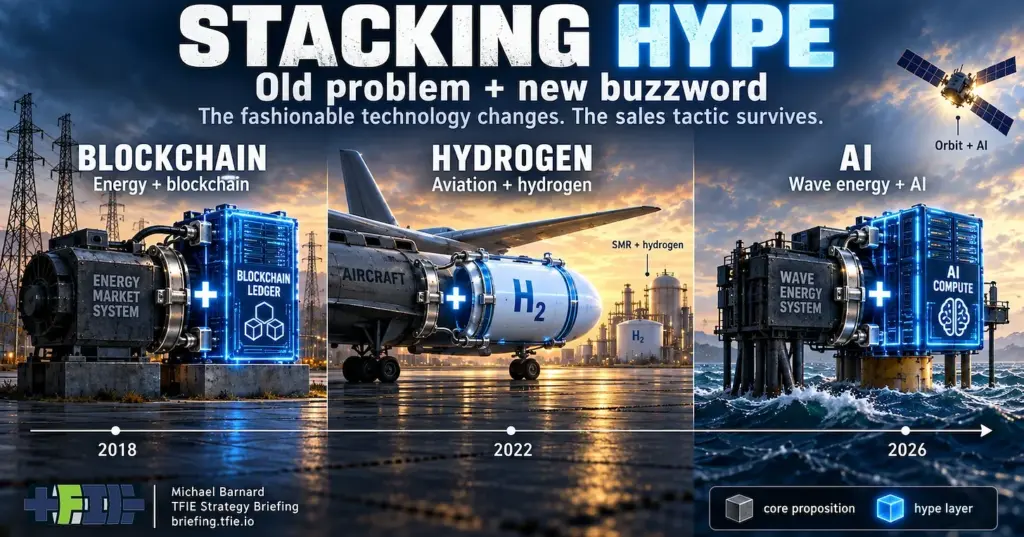
From the speculative frenzy of blockchain to the grandiose promises of green hydrogen and, most recently, the gold rush of artificial intelligence (AI), a familiar playbook defines the modern technology ecosystem. The commercialization tactic is remarkably consistent: attach a fresh, highly fashionable narrative to an unresolved engineering proposition before the underlying system has ever proven its foundational economics.
This cyclical phenomenon relies on a simple psychological and financial mechanism. When an emerging sector—such as AI—captures global imagination and commands staggering valuations, it becomes a powerful vehicle for reinvention. Struggling or inherently bottlenecked hard-tech industries quickly co-opt the current buzzword to reframe their value propositions. Wave energy companies suddenly become offshore AI infrastructure providers. Aerospace startups promise supersonic hydrogen travel before solving basic cryogenic constraints. Solar-car manufacturers pivot to generative design and advanced driver assistance systems while still struggling to establish basic manufacturing tooling.
The core danger of this "hype-layering" strategy lies in how it distorts risk. In sound engineering and prudent financial portfolio management, diversification reduces exposure by holding independent assets whose outcomes are imperfectly correlated. However, in technology development, stacking unproven systems together does the exact opposite.
When a product requires multiple uncertain subsystems to succeed simultaneously, failure probabilities multiply. Each newly added technology—whether it is high-availability computing placed on an ocean wave platform or pressurized hydrogen storage in a deep mine shaft—adds a fresh dependency. Instead of removing a material constraint, these layers introduce new failure modes, shifting the burden of proof further into an ever-receding future. This investigative analysis examines how startups leverage prevailing technology trends, explores the empirical outcomes of past hypes, and establishes a rigorous due diligence framework to separate genuine technological integration from superficial narrative masking.
Detailed Chronology: From Blockchain to Hydrogen and AI
To understand the current wave of tech-layering, one must trace the evolution of the narrative modifiers that have dominated the venture capital and startup landscapes over the past decade.
The Blockchain Era and Distributed Electricity
Years before generative AI dominated pitch decks, the tech sector was transfixed by distributed ledger technology. Blockchain was routinely invoked as a silver bullet for nearly every friction point in legacy industries. In the energy sector, startups promised blockchain-powered electricity trading, decentralized renewable energy certificates, and peer-to-peer microgrid markets.
The underlying reality was that physical meters, centralized utilities, complex regulatory frameworks, and electrical network physics still performed 100% of the essential work. Blockchain layers added cryptographic complexity and marketing appeal, but they did little to lower the cost of generation, smooth out intermittent supply, or resolve transmission constraints. Unsurprisingly, as the hype cycle faded, the vast majority of these decentralized energy marketplaces quietly vanished without fundamentally altering power distribution.
The Hydrogen Horizon
As blockchain lost its luster, green hydrogen stepped into the spotlight as the ultimate catch-all narrative. Touted as the fuel of a decarbonized future, hydrogen was bolted onto virtually every heavy-industry concept imaginable. Companies proposed hydrogen supersonic passenger jets, hydrogen-powered regional aviation (eVTOLs), and underground energy storage facilities.
A prime example of this pattern is Destinus, which initially captured public attention with grand plans for liquid-hydrogen supersonic passenger aviation. The concept combined an already extraordinarily difficult commercial aircraft development cycle with the immense engineering hurdles of cryogenic fuel storage, novel propulsion systems, and widespread fueling infrastructure.
However, Destinus did not simply collapse; instead, it underwent a pragmatic strategic pivot. By detaching its underlying capabilities—such as autonomy, high-speed flight aerodynamics, propulsion, and advanced manufacturing—from the impossible economic stack of commercial passenger hydrogen flight, the company found a viable market in defense and missile systems. In April 2026, Destinus formalized this transition by agreeing to form a strategic missile joint venture with Rheinmetall. This outcome did not validate hydrogen supersonic travel; rather, it proved that core technical capabilities can succeed only when stripped of unviable commercial narratives.
Similarly, Gravitricity attempted to couple its original, relatively straightforward deep-mine gravity storage concept with "H2FlexiStore," an underground hydrogen storage initiative. While both concepts involved subterranean engineering, they required entirely different equipment, regulatory pathways, customer bases, and safety protocols. Managing two capital-intensive, high-risk development programs simultaneously strained finite resources, culminating in the company entering voluntary liquidation in October 2025.
The AI Imperative
Today, AI performs the same narrative function with unprecedented efficiency. Because terrestrial data centers face genuine, severe constraints regarding electricity supply, land acquisition, cooling capacity, and grid interconnection queues, almost any proposition that promises an alternative power source or a novel location for compute suddenly sounds revolutionary.
Startups are now pitching wave-powered ocean data centers and orbital computing infrastructure. While these concepts sound visionary, they risk repeating the exact structural errors of their predecessors: masking fundamental economic and operational hurdles behind the shiny veneer of a generational technology trend.
Supporting Context & Metrics: Case Studies in Layered Hype
A rigorous examination of recent high-profile ventures reveals how marketing momentum frequently outruns engineering reality.
Ocean-Powered Computing: The Panthalassa Model
Consider Panthalassa, which raised $140 million to construct autonomous ocean platforms designed to generate electricity from marine waves and utilize it directly for onboard AI inference computing.
On paper, this proposition solves a genuine, historic problem for wave energy: transmission. Historically, wave energy developers struggled with the immense costs and physical degradation of transmitting electricity back to shore via subsea cables and marine grid connections. By placing a high-value electrical load directly beside the generator, the need for subsea transmission cables is ostensibly eliminated. With its newly acquired capital, Panthalassa plans to complete a pilot manufacturing facility and deploy its Ocean-3 systems.
However, moving the compute load offshore does not magically erase the fundamental physical challenges of marine energy. Equipment must still endure the brutal marine environment—saltwater corrosion, biological fouling, relentless wave fatigue, and severe storm forces—while generating electricity cheaply enough to justify the capital expenditure. Furthermore, adding high-value AI servers, complex power conditioning hardware, and sensitive satellite communication arrays directly into this corrosive, high-vibration environment introduces extreme maintenance complexities. The true economic benchmark is not whether the system avoids a subsea cable, but whether offshore AI compute can compete on a total cost of ownership basis with terrestrial data centers powered by cheap renewables, grid electricity, and localized battery storage.
The Aptera Saga: Two Decades of Solar-Automotive Optimism
Few companies illustrate the persistence of hype-layering better than Aptera. The company’s core premise—body-integrated solar cells on an ultra-aerodynamic three-wheeled vehicle—is physically functional. Under ideal, hyper-specific environmental conditions (such as an unsheltered Southwestern ranch driveway under blistering sunlight), solar body panels can indeed trickle useful energy into a vehicle battery.
Yet, the harder commercial reality remains the brutal economics of automotive manufacturing at scale. Aptera’s public securities filings indicate that the company still requires $40 to $45 million simply to complete tooling and validation for low-volume production, followed by an additional $140 to $160 million to ramp its existing facility toward a target of approximately 20,000 vehicles per year. This financial hurdle comes after more than two decades of perpetual promises to investors, marked by multiple corporate iterations, asset liquidations, buybacks, and internal legal disputes over intellectual property.
To maintain investor interest, Aptera consistently layered new technological buzzwords onto its core vehicle concept: AI-assisted generative design, additive manufacturing, advanced driver assistance systems, and proprietary in-wheel motors. The company’s prolonged pursuit of in-wheel motors—despite widely understood industry concerns regarding unsprung weight and high-speed suspension dynamics—served primarily as a press-cycle generator to attract retail investors.

Despite delivering zero production vehicles to paying customers over twenty years, Aptera successfully accumulated roughly 50,000 vehicle reservations backed by refundable $100 deposits, leaving about $4.1 million in unearned reservation fees on its balance sheet. Even larger sums were extracted from equity investors through crowdfunding campaigns offering priority delivery slots. Throughout this protracted timeline, credulous coverage from mainstream publications and financial news wires repeatedly amplified company announcements, demonstrating how effectively a compelling narrative can shield a troubled business model from accountability.
Official Statements and Industry Insights
Industry analysts and strategic observers emphasize that the core issue is not whether technologies like AI, hydrogen, solar, or nuclear are legitimate—they plainly are. The critical distinction lies in systems integration economics.
According to deep-dive analyses from structural technology briefing publications, the fundamental diligence question is straightforward: When does adding another technology remove a material constraint, and when does it simply add another dependency before customer value can be delivered?
When traditional infrastructure projects are evaluated, successful integrations typically address measurable operational bottlenecks. For example, pairing heat pumps with thermal storage or electric vehicles with managed charging directly optimizes energy use and reduces peak grid strain. Each component performs an identifiable, complementary job.
In contrast, hype-layering operates by taking an inherently difficult, unresolved baseline proposition and binding it to an equally immature or expensive secondary technology. The resulting narrative expands the imagined total addressable market long before the integrated system becomes cheaper, simpler, or more reliable. Every additional layer multiplies the failure points:
- Hydrogen aviation requires breakthroughs in airframe design, cryogenic fuel tanks, specialized airport fueling infrastructure, and stringent regulatory certification.
- Offshore marine AI requires concurrent breakthroughs in wave-energy survivability, autonomous maritime robotics, and high-availability, low-maintenance edge data centers.
- Vehicle-integrated solar requires specific weather conditions, optimal outdoor parking habits, and favorable consumer utility models to justify its manufacturing overhead.
Startup risk is fundamentally different from financial portfolio diversification. While an investor holding uncorrelated assets reduces overall portfolio volatility, an engineered product requiring multiple uncertain subsystems to function simultaneously multiplies risk. Customer value cannot be realized until the entire, unbroken chain operates flawlessly.
Future Outlook: A Rigorous Due Diligence Framework
As long as financial markets reward visionary storytelling and media outlets prioritize novelty over iterative engineering, the incentives for hype-layering will persist. Founders naturally gravitate toward narratives that secure meetings and capital, investors seek exposure to secular megatrends, and governments favor projects aligned with geopolitical or industrial strategies.
To navigate this landscape, investors, analysts, and policymakers must move past the superficial allure of narrative modifiers and apply a rigorous due diligence framework based on three foundational questions:
- What specific material constraint does the added technology actually remove?
(Does it solve a genuine bottleneck, or does it merely reframe the problem in the language of a current market trend?) - How much operational cost or engineering burden is permanently eliminated by this integration?
(Does the complexity reduction outweigh the added capital expenditure and maintenance overhead?) - Is the complete, multi-layered system demonstrably more competitive than simpler, mundane alternatives?
(How does the integrated stack compare against established terrestrial or conventional benchmarks?)
When these questions yield clear, measurable, and positive answers, technological integration is genuinely productive. When the answers remain vague, future-dependent, or heavily reliant on speculative market projections, the new technology layer is likely doing far more work in the financing pitch deck than it is in the physical product. Ultimately, the market will continue to separate durable engineering innovation from transient marketing maneuvers, rewarding only those companies that can survive the transition from compelling narrative to undeniable economic reality.



