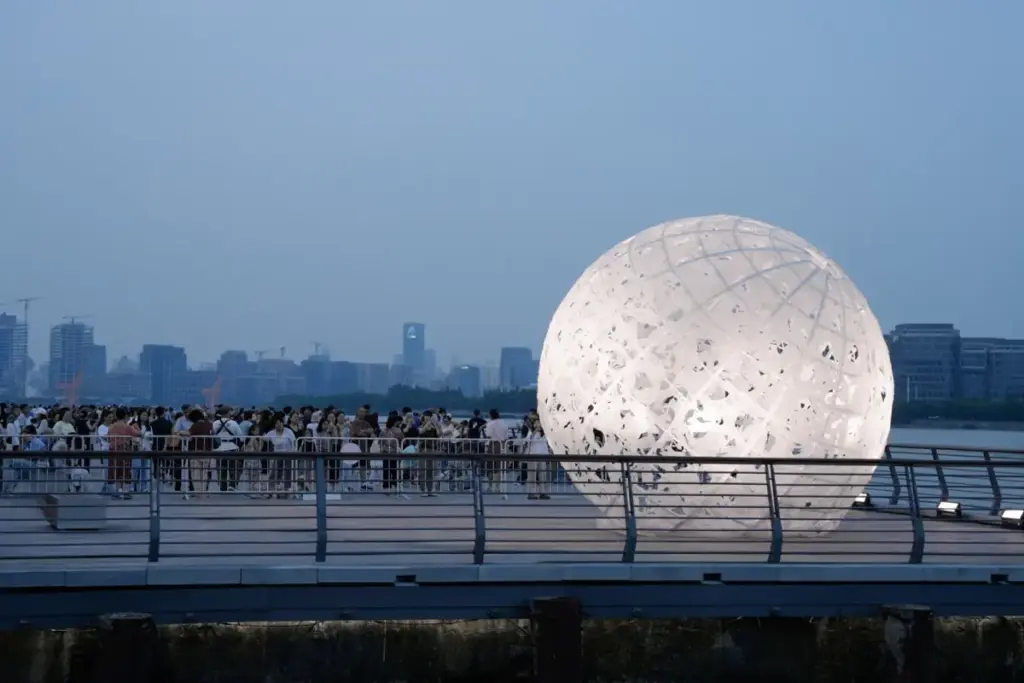
Urban public spaces serve as the modern canvas for cultural discourse, bridging the gap between historical heritage and contemporary civic life. In the heart of Shanghai, along the bustling cultural corridor of the West Bund, a striking new installation has captured the public imagination. Invited by the prestigious Power Station of Art (PSA), the innovative SHISUO Design Office has unveiled its latest architectural and artistic triumph: "The Full Moon."
Curated by Han Shuang, this temporary yet monumental public art installation was designed to celebrate the traditional Mid-Autumn Festival, transforming an ordinary urban plaza into a theatre of light, shadow, and mythological resonance. Merging cutting-edge digital fabrication techniques with intangible cultural heritage, SHISUO Design Office collaborated with Shi Qinling—a celebrated master and inheritor of traditional Shanghai-style paper-cutting (Jianzhi)—to craft an immersive experience that reinterprets ancient folklore for the twenty-first-century metropolis.
At its core, "The Full Moon" is more than a seasonal display; it is a profound exploration of scale, material transparency, and communal engagement. Drawing inspiration from classical Chinese iconography, the installation centers on two deeply entrenched cultural symbols: the moon and the jade rabbit. While the celestial sphere of the full moon represents the cyclical nature of time, wholeness, and cosmic harmony, the rabbit embodies the pulsating vitality, growth, and enduring resilience of all living beings.
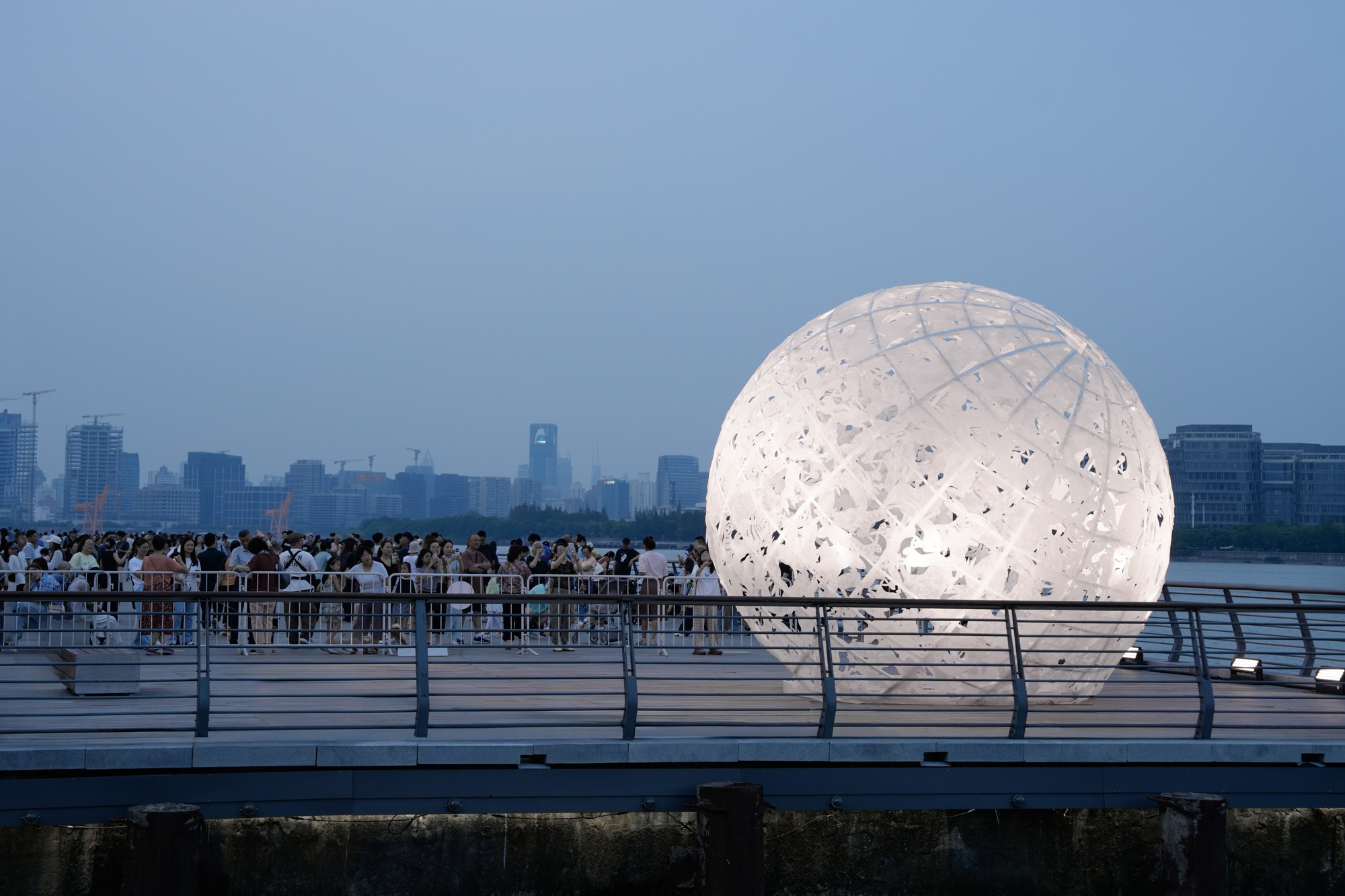
Captured vividly through the lens of architectural photographer Jianyuan Ye, the installation drew massive crowds throughout its exhibition run at the West Bund, solidifying its place as a landmark achievement in contemporary urban intervention. This report offers an exhaustive investigation into the genesis, design methodology, cultural integration, and urban impact of "The Full Moon," shedding light on how temporary architecture can permanently alter our perception of public space.
Detailed Chronology
The realization of "The Full Moon" was an intricate dance between conceptual design, material experimentation, and collaborative craftsmanship. The project’s timeline traces an inspiring path from an institutional invitation to a towering civic landmark.
Phase I: Commission and Conceptualization (Early Planning Stages)
The genesis of the project began when the Power Station of Art (PSA)—China’s premier contemporary art museum, housed in a converted historical power plant along the Huangpu River—issued a formal brief to SHISUO Design Office. The museum sought an installation that would honor the forthcoming Mid-Autumn Festival not merely through nostalgic pastiche, but by injecting contemporary design thinking into traditional folklore.
SHISUO Design Office accepted the challenge, assembling a multidisciplinary team led by principal architects and urban designers. The early ideation sessions focused heavily on the spatial duality of the moon: its physical absence and presence, its shifting phases, and its psychological weight in human culture. The team quickly realized that to make a stationary object dynamic, they needed to harness natural environmental elements—specifically sunlight by day and artificial illumination by night—to animate the structure.
Phase II: The Cross-Disciplinary Collaboration (Heritage Meets Modernism)
A pivotal turning point in the timeline occurred when SHISUO partnered with Shi Qinling, an esteemed inheritor of Shanghai-style paper-cutting. While traditional paper-cutting is typically practiced on a micro-scale using delicate sheets of red paper, translating this intricate folk art into a three-dimensional architectural installation required a radical rethinking of structural integrity and scale.
Over several months, SHISUO’s designers worked hand-in-hand with Shi Qinling to digitize traditional paper-cutting motifs. They analyzed how intricate negative spaces could be structurally maintained when scaled up to monumental proportions. The traditional imagery of the jade rabbit (Yutu) was deconstructed and re-imagined, shifting from flat folk art into complex, multi-layered geometric patterns that could wrap around a curved architectural surface.
Phase III: Material Prototyping and Fabrication
Moving from digital models to physical reality required rigorous testing of modern materials. The design team selected crackle-textured acrylic panels as the primary medium for the installation. These specialized panels offered a unique set of optical properties: they possessed the structural rigidity necessary to withstand outdoor wind loads while retaining the ability to diffuse light in ethereal, unpredictable ways.
The crackle texture on the acrylic was specifically engineered to mimic the cratered surface of the moon when viewed from a distance, while up close, it fractured light into crystalline refractions that evoked the delicate, hand-carved incisions of paper-cutting. Fabrication took place in specialized workshops across Shanghai, where CNC (Computer Numerical Control) routers precisely carved the intricate rabbit patterns and lunar motifs into the massive acrylic sheets.
Phase IV: Installation and Public Unveiling at the West Bund
Assembling "The Full Moon" on-site at the West Bund required precise logistical coordination. Given the temporary nature of the exhibition and the heavy foot traffic anticipated along the riverfront, the structural framing was designed for rapid deployment and absolute safety.
Upon its official unveiling, the installation instantly became a focal point of Shanghai’s cultural calendar. Crowds gathered from dusk until dawn to interact with the structure. By day, the installation functioned as a monumental sculpture reflecting the expansive skies of the Huangpu River; by night, internal lighting transformed it into a glowing beacon, casting intricate shadows of running rabbits and lunar phases across the paved grounds of the West Bund.
Supporting Context & Metrics
To fully appreciate the architectural weight of "The Full Moon," one must examine the socio-cultural and spatial metrics that governed its design and execution.
Cultural Metaphor and Universal Symbolism
The rabbit holds a fascinating position in global folklore, but within East Asian mythology, it occupies a uniquely sacred space. In classical Chinese tradition, the jade rabbit resides on the moon alongside Chang’e, pounding the elixir of immortality. SHISUO Design Office leveraged this narrative not as a literal storytelling device, but as an architectural metaphor.
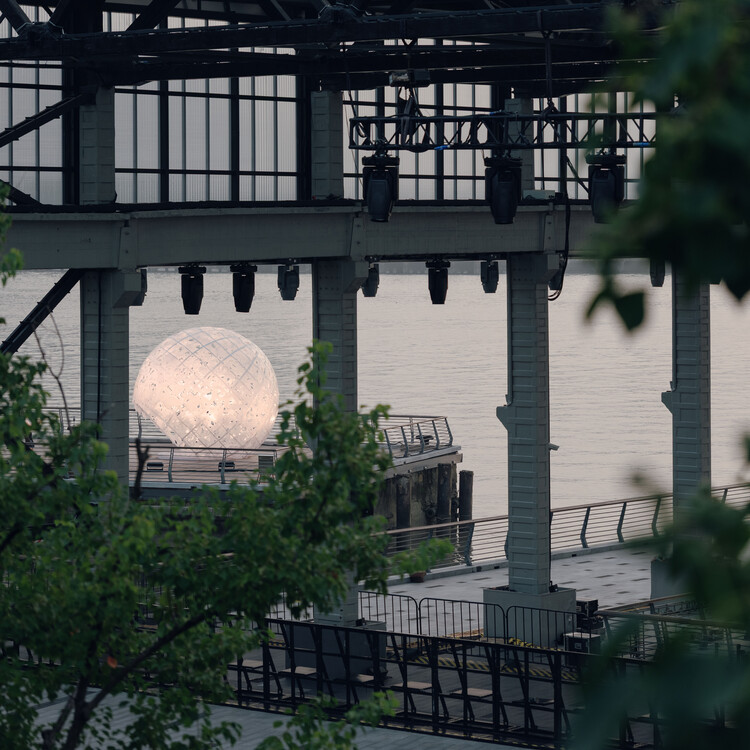
The Moon as a Spatial Anchor: Geometrically, a sphere or circular form creates an immediate focal point in an orthogonal urban landscape. By introducing a massive, curvaceous form into the rigid industrial context of the West Bund, the architects created a deliberate visual tension.
The Rabbit as a Symbol of Vitality: In the installation, the rabbit motifs are integrated into the skin of the structure using crackle-textured acrylic panels. These panels are not merely decorative; they serve as light filters that break down the monolithic scale of the installation into intimate, human-scale moments of discovery.
Architectural and Material Specifications
Primary Structural Medium: High-durability, crackle-textured acrylic panels designed for weather resistance and optimal light diffusion.
Collaborative Heritage Element: Integration of Shanghai-style paper-cutting (Jianzhi), scaled from micro-craftsmanship to macro-architecture.
Site Context: The West Bund, Shanghai, positioned adjacent to the Power Station of Art (PSA)—a landscape defined by heavy industrial heritage, massive brick volumes, and expansive open plazas.
Lighting Dynamics: Dual-state operation utilizing natural daylight refraction during daytime hours and programmable internal LED arrays to simulate varying lunar phases after sunset.
Audience Engagement: Designed for high-capacity public interaction, accommodating thousands of daily visitors with a 360-degree walkable perimeter that alters the visual perception of the "moon" from every viewing angle.
Official Statements
The intersection of architecture, heritage, and public art often generates profound dialogue among creators and institutions. Below are perspectives gathered from the core creative forces behind "The Full Moon."
SHISUO Design Office on the Architectural Intent:
"Architecture is rarely just about buildings; it is about staging human emotions and collective memories within a shared environment. With ‘The Full Moon,’ our goal was to strip away the complexities of modern urban anxiety and replace them with a primal, universal shape. By merging the celestial imagery of the moon with the intimate craft of paper-cutting, we wanted to give citizens a physical anchor—a place where they could pause, reflect, and reconnect with traditional folklore in a hyper-modern setting."
Curator Han Shuang on the Cultural Resonance of the Exhibition:
"The collaboration between contemporary spatial designers and intangible cultural heritage inheritors represents a vital evolution in how we preserve our traditions. Culture cannot survive in a museum glass case alone; it must breathe, scale up, and engage with the public in real-time. The immense crowds at the West Bund proved that people are hungry for public art that speaks to their cultural identity while offering a breathtaking visual experience."
Master Paper-Cutter Shi Qinling on Translating Tradition:
"Traditional paper-cutting is an art of subtraction—every cut matters, and there is no room for error. Scaling this delicate craft up to architectural proportions meant redefining how negative space interacts with light and air. Seeing the intricate patterns of the jade rabbit come alive through modern acrylic panels and structural lighting was a testament to the fact that ancient traditions possess limitless elasticity when placed in visionary hands."
Future Outlook: The Legacy of Temporary Public Architecture
As cities across the globe densify, the pressure on open urban spaces intensifies. Projects like SHISUO Design Office’s "The Full Moon" offer a compelling blueprint for the future of urban design. They demonstrate that temporary public art installations are not fleeting novelties, but essential catalysts for community building, cultural education, and urban revitalization.
The Rise of Experiential Placemaking
The success of "The Full Moon" at the West Bund underscores a broader shift in urban planning toward experiential placemaking. Traditional monuments of the past were built out of heavy stone and designed to stand in austere permanence, often alienating the everyday citizen. In contrast, contemporary temporary installations prioritize engagement, emotional resonance, and spatial fluidity. They invite touch, exploration, and photography, turning passive observers into active participants.
Sustainability and Material Innovation
Looking ahead, the methodologies pioneered in this project—particularly the use of recyclable, high-performance polymers like crackle-textured acrylics—point toward more sustainable futures for temporary architecture. By engineering installations that can be easily dismantled, transported, or repurposed without leaving permanent scars on the urban fabric, architects can deliver high-impact cultural experiences while respecting ecological boundaries.
Bridging the Generation Gap in Cultural Heritage
Perhaps the most enduring legacy of "The Full Moon" lies in its treatment of intangible cultural heritage. By translating Shanghai-style paper-cutting into a monumental public art piece, SHISUO Design Office and Shi Qinling successfully engaged younger generations who might otherwise remain disconnected from traditional folk arts. The installation proved that when heritage is re-contextualized through modern spatial design, it transcends generational divides and sparks renewed civic pride.
In conclusion, "The Full Moon" stands as a luminous milestone in contemporary architecture and urban public art. By weaving together folklore, material innovation, and collaborative craftsmanship, SHISUO Design Office has not only illuminated the Shanghai skyline during a festive season, but has also cast a visionary light on how our cities can honor the past while boldly embracing the future.