

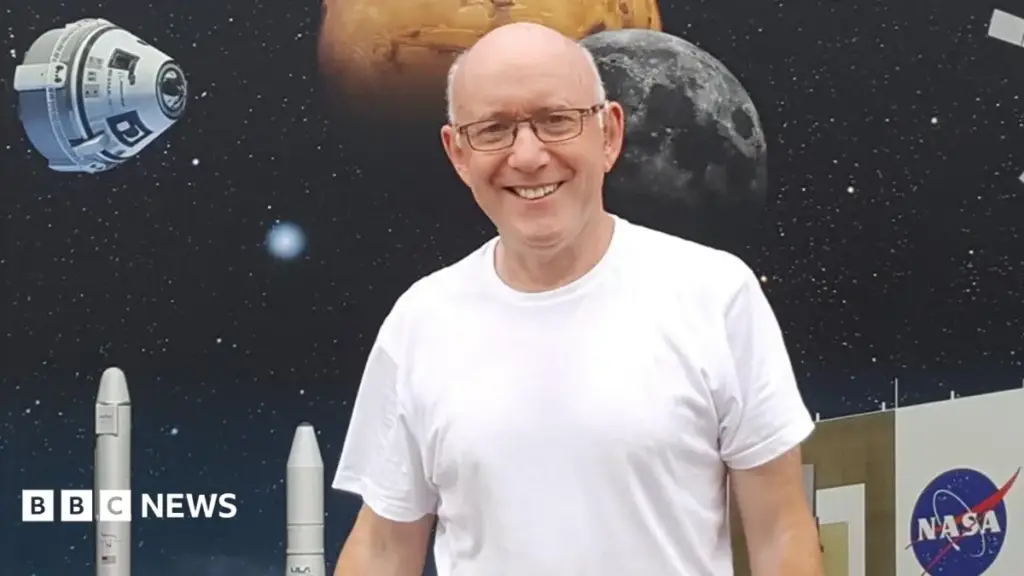
By Georgie Docker | North West Bureau
Executive Overview
Nearly 54 years after the roaring engines of Saturn V tore through the Florida sky, the legacy of mankind’s final voyage to the lunar surface continues to resonate. Long before commercial space tourism became a billionaire’s playground, NASA orchestrated a singular, unprecedented diplomatic and scientific outreach initiative: the International Youth Science Tour.
Among the 80 hand-picked youths from across the globe was a 16-year-old schoolboy from Frenchwood, Preston. Dermot Gethings, fueled by the Cold War space race, youthful ingenuity, and a self-taught passion for the cosmos, found himself swept into the beating heart of America’s space program. From accidentally stepping on Neil Armstrong’s foot outside a Florida motel to breaking bread with political heavyweights at the White House, Gethings’ journey culminated in an astonishing responsibility: becoming the custodian of the United Kingdom’s Apollo 17 Goodwill Moon Rock.
As a new 30-minute documentary, The Custodian of the Goodwill Moon Rock, prepares to chronicle his extraordinary teenage odyssey, this article examines the convergence of grassroots scientific enthusiasm, Cold War diplomacy, and the enduring legacy of humanity’s last footprints in the lunar dust.

Detailed Chronology: From Preston Skies to the Kennedy Space Center
The Genesis of an Astronomer
Dermot Gethings’ trajectory toward the stars began not in a high-tech laboratory, but beneath the rural and suburban night skies of Lancashire. Growing up in an era dominated by the technological anxieties and triumphs of the Cold War Space Race, Gethings was typical of his generation in his consumption of science fiction, Thunderbirds, and grainy televised rocket launches. However, his intellectual curiosity surpassed passive observation.
The definitive "trigger moment" occurred when Gethings was just 10 years old, catching his first unobstructed view of the Milky Way.
"It hit me straight away—that was where I wanted to be," Gethings recalls. "And I took a deep interest in space."
Refusing to wait for formal institutional instruction, Gethings immersed himself in astrophysical literature. By age 16, he had independently mastered the curriculum, successfully earning an O-Level in Astronomy through self-directed home study. His ambition extended beyond personal achievement; he founded an astronomy club at his alma mater, St John Fisher’s School in Preston. He coordinated public exhibitions, delivered lectures to peers and younger students, and positioned himself as an enthusiastic ambassador for amateur astronomy in the North West of England.

The Letter That Changed Everything
Fate intervened when the Lancashire Evening Post published a feature detailing Gethings’ astronomical exhibitions and school club activities. Months later, in late 1972, a missive arrived bearing the seal of the United States Embassy in London.
The letter invited Gethings—along with a shortlist of 16 exceptional British students—to undergo a rigorous interview process. The prize was extraordinarily high: a single representative would be chosen by NASA for an all-expenses-paid, 19-day immersive delegation to witness the launch of Apollo 17.
Out of hundreds of potential candidates across the UK, Gethings was selected. When the formal confirmation letter arrived, it marked the beginning of an experience that would redefine his life. In December 1972, stepping onto his very first commercial airplane flight at Manchester Airport, the Lancashire teenager embarked on a trans-Atlantic journey that would span a dozen states, introduce him to the architects of the Apollo program, and place him at ground zero of human history.
A Fateful Collision with the First Man on the Moon
Upon arriving in Florida ahead of the December 7, 1972 launch, Gethings joined international peers at a local motel. It was here that he experienced one of the most charmingly disarming anecdotes in space exploration folklore.

Stepping out of his motel room on launch day, Gethings rushed forward and inadvertently collided with a tall gentleman, stepping squarely onto the man’s foot. Mortified, the 16-year-old braced himself to apologize to an annoyed stranger. Instead, he looked up to find Neil Armstrong—the first man to walk on the Moon—smiling down at him.
"I stood on his foot by accident and I was really embarrassed," Gethings recounts. "I looked up and the man smiling down at me was Neil Armstrong!"
Rather than dismissing the clumsy teenager, Armstrong engaged him in casual conversation as they walked downstairs together. When Armstrong learned of Gethings’ participation in the international youth delegation, he invited his wife to take a commemorative photograph. Gethings handed over his camera, shook hands with the legendary astronaut beside his car, and received a signed photograph of the student delegates that remains one of his most treasured possessions.
The Launch: Fire, Sound, and Fury
In the pre-dawn hours of December 7, 1972, Gethings took his place in the VIP viewing box at the Kennedy Space Center. Sitting mere inches from Neil Armstrong, he was positioned just three miles (5 km) away from Launch Complex 39A, where Apollo 17—the final crewed lunar landing mission—sat poised atop the colossal Saturn V rocket.

At 00:33 local time, the engines ignited. The sensory onslaught that followed transcended mere sound; it was a physical confrontation with raw thermodynamic energy.
"My heart was pumping in my chest," Gethings recalls. "And when the vehicle cleared the tower suddenly you got punched in the chest by a shockwave. The ground beneath your feet was like an earthquake and the stands were rattling. And then you got hit by this incredibly painful crackling staccato snapping sound against the skin on your face."
Within minutes, the thunderous beast transformed into a silent, brilliant star ascending into the celestial sphere—leaving an indelible mark on every spectator present.
Supporting Context & Metrics: The International Youth Science Tour & Apollo 17
To fully appreciate the scale of Gethings’ experience, one must examine the geopolitical and scientific landscape of late 1972.

| Metric / Fact | Detail |
|---|---|
| Mission Identifier | Apollo 17 (The final crewed mission to the Moon) |
| Launch Date | December 7, 1972 (00:33 EST) |
| Mission Commander | Eugene Cernan |
| Lunar Module Pilot | Harrison Schmitt (The first and only geologist on the Moon) |
| Command Module Pilot | Ronald Evans |
| Youth Tour Scope | 80 students globally (NASA’s first and only International Youth Science Tour) |
| Gethings’ Delegation Role | UK Student Representative & Custodian of the UK Goodwill Moon Rock |
| Presentation Date | July 1973 (Presented to Prime Minister Edward Heath at 10 Downing Street) |
The Goodwill Moon Rock
Following the successful completion of Apollo 17—during which Commander Eugene Cernan and Lunar Module Pilot Harrison Schmitt spent over 74 hours on the lunar surface (including three extensive Extravehicular Activities)—NASA recovered 110.4 kilograms of lunar material.
As part of a diplomatic legacy project commissioned by President Richard Nixon, small fragments of lunar basalt collected during the mission were encased in commemorative plaques featuring the flags of participating nations. These "Goodwill Moon Rocks" were distributed to 135 foreign nations and the 50 US states.
Uniquely, the 80 international students who participated in NASA’s Youth Science Tour were designated custodians of specialized educational fragments representing their respective nations. Gethings found himself entrusted with bringing the United Kingdom’s fragment back across the Atlantic.
Upon his return, Gethings formally presented the Apollo 17 Goodwill Moon Rock to Prime Minister Edward Heath at 10 Downing Street in July 1973, alongside US Ambassador Walter Annenberg and Brigadier General James McDivitt. Today, that historic fragment is preserved and displayed for the public at the Natural History Museum in London, serving as an enduring symbol of international scientific cooperation.

Official Statements and Retrospective Reflection
The impact of Gethings’ teenage encounter with the pinnacle of human engineering has guided his entire professional and personal life. Now 70 years old, he serves as the vice-chair of the Preston & District Astronomical Society, a Fellow of the Royal Astronomical Society, and a frequent collaborator with the Jeremiah Horrocks Institute at the University of Central Lancashire (UCLan).
Reflecting on his journey ahead of the documentary screening, Gethings emphasizes the profound sense of privilege that accompanied his youth:
"Space had been a passion all my life. To be brought over there to see places and meet people that you have only ever read about or seen on TV—it was the stuff of dreams. I knew what a privilege it was—even at the time. It will just be fantastic to see that journey on the big screen."
The documentary, titled The Custodian of the Goodwill Moon Rock, was directed and produced by UCLan graduate Sarah Bullough. The 30-minute film bridges archival footage of the 1972 Apollo launch with modern-day reflections from Gethings, capturing the transition from an awestruck Lancashire schoolboy to a seasoned science communicator.

Future Outlook: Inspiring the Next Generation
As space agencies worldwide—including NASA, the European Space Agency (ESA), and private commercial spaceflight enterprises—turn their sights back toward the Moon through the Artemis program, the historical bridge built by missions like Apollo 17 becomes increasingly relevant.
Dermot Gethings’ life work embodies the vital importance of grassroots scientific engagement. Through his ongoing public lectures, educational outreach programs with the Jeremiah Horrocks Institute, and local society meetings in Preston, Gethings continues to ignite the same spark in modern youth that he felt looking up at the Milky Way over half a century ago.
The Custodian of the Goodwill Moon Rock premiered at the University of Central Lancashire’s Preston Campus on Wednesday, October 14, serving as both a historical preservation of a golden age of exploration and a timely reminder of what human curiosity can achieve when governments and dreamers align their sights upon the stars.



