

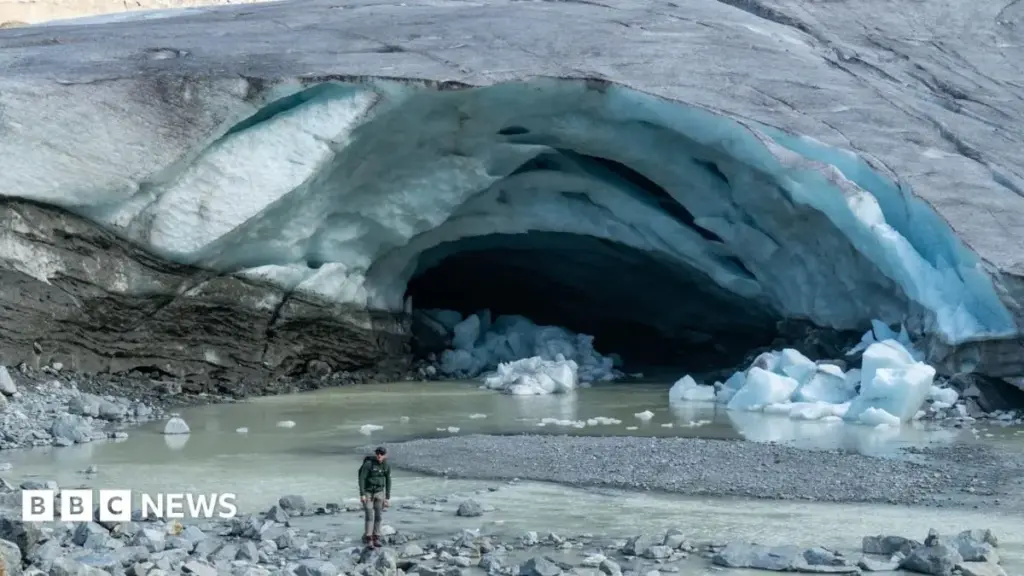
BERN, SWITZERLAND — Switzerland’s iconic Alpine landscape is undergoing an irreversible and terrifying transformation. Newly released data from Glacier Monitoring Switzerland (GLAMOS) reveals that the nation’s glaciers have suffered a near-record loss of ice over the past twelve months, driven by relentless, intense summer heatwaves. More than 5% of the country’s remaining glacial mass has vanished in a single year—a phenomenon that glaciologists describe as both "extraordinary" and deeply alarming.
While the retreat of Alpine ice has been documented for decades, the current velocity of the melt has outpaced even the most pessimistic computer models. Scientists warn that this acceleration is no longer an anomaly, but a tragic new normal. The consequences extend far beyond the jagged peaks of the Swiss Alps, threatening regional water security, escalating natural hazard risks across Europe, and serving as a glaring indicator of a rapidly destabilizing global climate system.
Executive Overview
The scale of the 2026 melt season has shocked the scientific community. Until recently, glaciologists operating in the European Alps considered an annual ice volume loss of 2% to be an "extreme" event—a threshold that triggered emergency responses and widespread media attention. However, the latest figures show an estimated 5.5% disappearance of the remaining ice reserves in just one year.
This staggering loss compounds decades of incremental decline, but the concentration of damage within a single twelve-month period underscores the compounding vulnerability of the cryosphere. The primary drivers are clear: greenhouse gas emissions, primarily from fossil fuel combustion, have pushed global temperatures past the threshold where seasonal winter snowfall can replenish what is lost during increasingly prolonged and punishing summers.
The implications of this crisis are multi-dimensional:
- Water Security: Critical river basins that supply agricultural irrigation, municipal drinking water, and hydroelectric power are facing severe long-term deficits.
- Geological Instability: As the permafrost thaws and glaciers recede, entire mountain slopes are losing their structural integrity, dramatically increasing the frequency of catastrophic rockfalls and landslides.
- Downstream Hazards: Accelerated melting and structural failures in high-altitude environments elevate the risk of sudden glacial lake outburst floods (GLOFs) and debris flows, endangering communities both within Europe and globally.
Detailed Chronology of the 2026 Melt Season
To understand how a 5.5% annual loss materialized, scientists must look back at the sequence of meteorological conditions that defined the 2025–2026 hydrological year across Switzerland.
Winter Accumulation Deficits
The crisis began long before the summer sun beat down on the peaks. The winter of 2025–2026 was characterized by below-average snowfall across the majority of the Swiss Alps, coupled with unseasonably warm atmospheric currents that swept in from the Mediterranean and North Africa. In many regions, precipitation fell as rain rather than snow even at medium-to-high altitudes, denying glaciers their critical winter protective blanket.
Without this thick layer of reflective white snow—often referred to by glaciologists as "glacier food"—the underlying glacial ice was left exposed prematurely. Fresh snow acts as a shield, reflecting incoming solar radiation back into the atmosphere (a high albedo effect). When that shield is absent or thin, the darker, exposed ice absorbs solar energy at an exponentially higher rate, kicking off a destructive feedback loop of premature melting.
The Summer Heatwave Paradigm
By late June, a succession of severe European heatwaves locked high-pressure atmospheric systems over Central Europe. Temperatures in Alpine valleys regularly shattered historical records, but the most profound anomalies were recorded at high-altitude monitoring stations.
Unlike previous decades, when extreme heat was typically confined to July and August, the 2026 heat season extended from late spring through early autumn. Freezing levels—the altitude at which the air temperature drops to 0°C—routinely surged above 4,000 meters, well past the summits of many famous Swiss peaks. This meant that even at night, when temperatures historically dropped to allow temporary refreezing, the ice continued to liquefy around the clock.
The Late-Summer Collapse
By August 2026, the cumulative toll of the heatwaves became visually apparent even to casual observers. Rivers fed by glacial meltwater ran high early in the season, only to experience severe low-flow conditions later as the ice reservoirs became depleted.
At the end of the hydrological year in September, field surveys conducted by GLAMOS confirmed the worst-case scenarios: entire sections of well-documented glaciers had simply ceased to exist, breaking apart into isolated stagnant ice patches or disappearing entirely beneath newly exposed rock and debris.
Supporting Context & Metrics: The Science of Accelerated Decay
The metrics gathered by glaciologists in 2026 tell a story of systemic ecological failure. To contextualize the current crisis, researchers look at both historical benchmarks and localized micro-climate indicators at extreme elevations.
High-Elevation Anomalies
Historically, glaciers situated above 3,000 to 3,500 meters were considered relatively safe from extreme melting because ambient temperatures at those heights rarely sustained prolonged positive readings. However, the 2026 data shattered these assumptions.
Researchers visiting measurement sites at 3,500 meters above sea level discovered an absolute absence of snow cover at the close of summer. In a stable climate, these high-altitude accumulation zones should retain several meters of compacted winter snow. Instead, scientists measured up to four meters of pure ice loss directly at the highest points of major glaciers.
Normal Alpine Glacier Balance (Historical Baseline):
[Winter Snowfall Accumulation] -> [Compaction into Firn] -> [Conversion to Ice] -> [Flow to Lower Elevation Ablation Zone]

2026 Crisis Dynamics:
[Sub-par Winter Snow] -> [Early Melt / Zero Snowpack] -> [Direct Solar Radiation on Ice] -> [Unchecked 5.5% Annual Mass Loss]
As glaciologist Dr. Fabien Maussion notes, the physics of glaciers dictate that they must gain mass at the top to sustain their flow downstream. "In its simplest form, what we see right now is that we took an ice cube out of the fridge and it’s just melting in front of our eyes," Maussion explains. When no snow survives the summer to replenish the lower ablation zones, the glacier starves, thins, and eventually fragments.
The Fate of Minor Glaciers
While massive ice bodies like the Aletsch Glacier capture international media headlines, the true indicator of ecological tipping points can be seen in Switzerland’s smaller glaciers.
Minor formations, such as the Plattalva Glacier in eastern Switzerland, have already vanished entirely. Dozens of other sub-square-kilometer glaciers across the Swiss Alps are now classified as "dead ice"—masses that no longer possess the dynamic movement required to feed themselves and are merely lingering in place as they evaporate and melt away.
Official Statements and Expert Perspectives
The psychological and professional toll on the scientists monitoring this environmental collapse is profound. Speaking at the release of the annual assessment, leading figures in the European cryosphere community expressed deep distress.
"It’s really just disastrous," said Dr. Matthias Huss, director of Glacier Monitoring Switzerland (GLAMOS). "We are watching decades of geological history unravel in the span of a single human career. What used to be considered a worst-case scenario for the end of the 21st century is now happening before our eyes today."
Experts emphasize that the phenomenon is inextricably linked to anthropogenic climate change. The global concentration of carbon dioxide and methane has created an atmospheric trap that dictates persistent, multi-week heat domes over the European continent.
Furthermore, researchers point out the interconnected nature of global cryospheric collapse. The mechanisms driving the loss of Swiss glaciers—atmospheric warming, reduced albedo, and permafrost degradation—are identical to those destabilizing the ice sheets of Greenland, the Antarctic Peninsula, and the Himalayas.
Broader Impacts: Cascading Risks for Europe and Beyond
The disappearance of Switzerland’s glaciers is not merely a scenic loss for tourism and mountaineering; it triggers a cascade of physical, economic, and geopolitical risks.
1. Water Resource Vulnerability
Switzerland is often described as the "water tower of Europe." Its alpine watersheds feed major international river systems, including the Rhine and the Rhône, which support millions of people downstream in Germany, France, and the Netherlands.
During dry summer months, glacial meltwater acts as a crucial buffer, maintaining river levels and supplying water for agricultural irrigation, industrial cooling, and inland navigation. As the glaciers shrink to a fraction of their former size, this natural reservoir is disappearing. Without adequate water management and new infrastructure, European agriculture and energy sectors face severe shortages in future dry years.
2. Geotechnical Instability and Landslides
The melting of glaciers directly impacts the structural integrity of surrounding mountain walls. For millennia, massive bodies of ice have acted as buttresses, physically supporting steep rock faces. As the ice retreats and the underlying permafrost thaws, millions of tons of rock are left unsupported.
This dynamic has dramatically increased the frequency of rockfalls and catastrophic slope failures across the Alps. Similar mechanisms were observed internationally—most notably in Nepal this past August, where a massive collapse of bedrock and glacial ice triggered catastrophic flash flooding. While complex multi-factor events, scientists confirm that long-term glacier thinning and permafrost degradation fundamentally heighten these baseline risks globally.
Future Outlook: Can the Alps Be Saved?
As the world processes the sobering data from the 2026 melt season, the central question remains: Is there still time to save what is left of the Alpine cryosphere?
Glaciological models project that even under aggressive global decarbonization scenarios—where net-zero emissions are achieved by mid-century—Switzerland will likely lose the vast majority of its remaining glacial ice by the year 2100. Smaller glaciers will disappear entirely within the next decade, while larger formations like the Aletsch will fragment into isolated ice remnants.
However, scientists stress that the difference between aggressive climate action and business-as-usual is not binary; it is a matter of degree. Halting emissions will not restore the glaciers lost in 2026, but it could preserve a fraction of the high-altitude ice, stabilizing sea-level rise and mitigating the most extreme disruptions to European water cycles.
Dr. Huss and his colleagues continue to monitor the remnants of Switzerland’s frozen heritage, documenting a tragedy foretold by science but largely ignored by policy for decades. As the ice continues to weep down the granite faces of the Alps, it serves as a silent, relentless witness to humanity’s failure to heed the warnings of a changing world.



