In the global effort to combat climate change, organic waste diversion has emerged as one of the most accessible and high-impact strategies available to municipalities. Landfills are currently the third-largest source of human-related methane emissions in the United States, and organic matter—primarily food scraps—is the chief culprit. In response, municipal curbside organics collection (frequently referred to as the "green bin" program) has expanded at an unprecedented rate. According to data from BioCycle, the number of U.S. households with access to curbside food waste collection surged by 49 percent between 2021 and 2023, expanding from 10 million to nearly 15 million households.
Yet, infrastructure expansion tells only half the story. While municipalities have successfully deployed millions of heavy-duty collection carts to suburban curbsides and urban alleyways, actual citizen participation remains stubbornly low in many jurisdictions. While some pioneering cities boast near-universal compliance, others struggle with participation rates well below 30 percent.
An unused organics cart represents a significant sunk capital cost for local governments and a failure to meet environmental mandates. Investigative analysis reveals that the primary bottleneck to sustained citizen compliance is not a lack of ecological awareness, but rather a visceral, domestic obstacle: the "yuck factor."
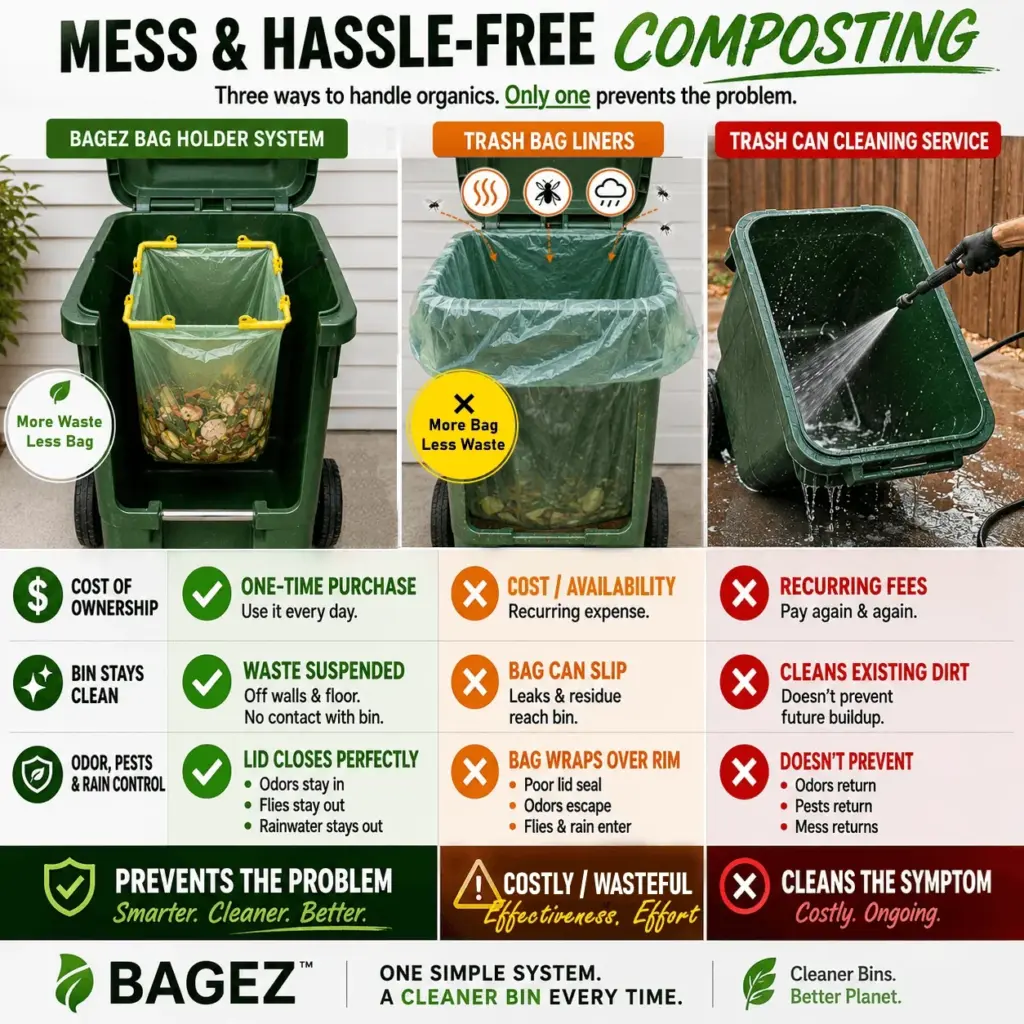
Without effective containment, curbside organic bins rapidly become breeding grounds for insects, sources of foul odors, and targets for wildlife. This report investigates the mechanics of household waste habits, the systemic costs of bin maintenance, and how targeted engineering solutions—such as the BagEZ suspended bag frame—are bridging the gap between municipal policy and daily household compliance.
Detailed Chronology of the Curbside Organics Expansion
The trajectory of municipal solid waste (MSW) management over the past four decades has occurred in distinct waves. The first wave, starting in the late 1980s, established the dual-stream recycling model for paper, glass, and metals. The second wave, beginning in the 2000s, transitioned many municipalities to single-stream recycling to simplify citizen sorting. Today, waste management is in the midst of its third and most challenging transformation: the mandatory separation of organic fractions.
During this period, state and provincial governments began recognizing that voluntary composting programs were insufficient to meet greenhouse gas reduction targets. Landmark legislation, such as California’s Senate Bill 1383 (passed in 2016 with implementation starting in 2022), mandated a 75 percent reduction in organic waste disposal by 2025. This triggered a massive capital investment phase, with municipalities purchasing specialized collection vehicles and rolling out millions of green, brown, and grey organic carts to residents.
The Access Boom (2021–2023)
The physical infrastructure of organics collection scaled rapidly. BioCycle’s nationwide surveys documented a massive leap in household access, driven by new municipal rollouts in the Northeast, the West Coast, and major metropolitan areas like New York City. By the end of 2023, nearly 15 million American households had a dedicated cart for food scraps sitting outside their homes.
The Participation Crisis (2024–Present)
As the novelty of the new carts wore off, municipalities began encountering the "participation cliff." While initial rollout periods showed high engagement, waste audits revealed that a substantial portion of households stopped using their organic carts within three to six months. Investigative surveys conducted by municipal waste departments consistently point to a single, recurring theme: the unpleasant realities of maintaining a large, outdoor container filled with decomposing food waste.
Supporting Context & Metrics: The Cost of the Unused Bin
To understand why the failure of green bin programs is so consequential, one must look at the underlying environmental and thermodynamic metrics of landfills.
The Methane Equation
According to estimates by the U.S. Environmental Protection Agency (EPA), food waste constitutes approximately 24 percent of municipal solid waste sent to landfills. Because landfills are highly compacted, anaerobic environments, buried organic material decomposes without oxygen, producing methane ($CH_4$)—a greenhouse gas with a global warming potential 28 to 36 times greater than carbon dioxide ($CO_2$) over a 100-year timescale. The EPA estimates that food waste alone is responsible for a staggering 58 percent of all fugitive methane emissions released from municipal landfills.
Waste Category in Landfills
Percentage of Total Landfill Volume
Share of Fugitive Methane Emissions
Food Waste
24%
58%
All Other Waste Materials
76%
42%
The Scale of Household Waste
A common misconception among municipal planners is that households require massive volume capacity for food waste. The MITRE-Gallup study—the largest and most comprehensive survey of U.S. household food waste behavior to date—analyzed the habits of nearly 10,000 households. The findings revealed that the average household generates approximately 6.2 cups of edible food waste per week. When adding non-edible scraps such as fruit peels, vegetable cores, coffee grounds, and bones, the total rises to roughly 8.8 cups per week (approximately 0.55 gallons).
This data reveals a stark design mismatch: municipalities routinely distribute 35-gallon to 64-gallon wheeled carts to households that generate barely half a gallon of food waste per week. When this small volume of organic material is thrown loose into a giant plastic cart, it smears against the walls, pools at the bottom, and creates an oversized surface area for rot, odor, and insect infestation.
Behavioral Interventions: The Essex County Case Study
The connection between bin cleanliness, containment tools, and participation rates was clearly demonstrated in a year-long pilot project conducted by the Essex County Council in the United Kingdom.
In the 2023–2024 fiscal year, the council launched the Food Recycling Project, targeting more than 375,000 households. The intervention was simple but highly targeted: alongside educational leaflets, the council provided households with a free roll of compostable bin liners and an informational sticker for their general waste bin.
The results were immediate and statistically significant:
Tonnage Increase: Overall food recycling tonnage rose by an average of 21 percent compared to a control group during the first three months.
Target Outperformance: The growth rate more than doubled the council’s initial 10 percent projection.
Key Takeaway: Providing residents with a physical tool to contain the mess (the liners) was a far more effective driver of compliance than educational messaging alone.
However, the Essex County project also highlighted a financial limitation: continuous, publicly-funded distribution of free compostable liners is a subsidy that most municipal budgets cannot sustain long-term. Consequently, the burden of sourcing and paying for containment solutions falls back on the consumer.
The Science of the "Yuck Factor": Why Bins Fail
To understand why households abandon their green bins, it is necessary to examine the physical and biological processes that occur inside a standard plastic waste cart.
Condensation and Leachate Accumulation
Fresh food waste is highly hydrous; fruits, vegetables, and cooked meats consist of 70 to 90 percent water. As cellular structures break down during decomposition, this intracellular water is released.
When food waste is placed in a standard bag and tossed into a green bin, the bag typically rests flat against the cold plastic bottom and walls of the cart. This contact prevents air circulation. The temperature differential between the warm, decomposing waste and the exterior air causes moisture to condense on the outside of the bag and the inner walls of the bin.
This liquid—known in waste management as leachate—collects at the bottom of the bin, forming a dark, nutrient-rich, foul-smelling pool. This pool is incredibly difficult to clean without tipping the bin over and hosing it out, a chore that most suburban residents find highly objectionable.
Vector Attraction: Flies, Maggots, and Rodents
The pools of stagnant leachate and exposed food residue on bin walls release volatile organic compounds (VOCs) that serve as powerful chemical cues for pests.
Diptera (Flies): Female flies are drawn to the moist, nutrient-rich environment of the bin to lay eggs. In warm weather, these eggs hatch into larvae (maggots) within 24 hours, leading to severe infestations inside the cart.
Mammalian Pests: Raccoons, rats, and mice rely almost entirely on their highly developed sense of smell to locate food sources. A dirty bin radiating food odors acts as an active attractant, leading to tipped carts, chewed lids, and property damage.
Engineering a Solution: The BagEZ Suspended Bag System
Recognizing that bin hygiene is the primary barrier to organics recycling, Canadian designer and founder of BagEZ, Sean Rana, engineered a simple, mechanical solution designed to address the root causes of the "yuck factor."
AERATION DYNAMICS: STANDARD BIN VS. BAGEZ SYSTEM

Standard Bin (No Airflow)             BagEZ System (Suspended)
┌─────────────────────────┐          ┌─────────────────────────┐
│  │                   │  │          │  │  | |  Airflow  | |│  │
│  │   ┌───────────┐   │  │          │  │ ┌┼───────────┼┐ │  │
│  │   │ Wet Waste │   │  │          │  │ ││   BagEZ   ││ │  │
│  │   │    Bag    │   │  │          │  │ ││ Suspended ││ │  │
│  │   └───────────┘   │  │          │  │ ││   Bag     ││ │  │
│  └─── Contact Area ──┘  │          │  │ └┼───────────┼┘ │  │
│  [Leachate Pools/Rot]   │          │  │  | | Air Space | |  │
└─────────────────────────┘          └─────────────────────────┘
The Suspension Mechanism
BagEZ is a heavy-duty, folding stainless steel frame equipped with high-tension clips. The device mounts directly onto the rim of any standard municipal curbside cart, hanging securely just beneath the lid.
By pulling the rim of a standard compostable or paper bag through the frame and securing it with the integrated clips, the bag is suspended in mid-air inside the cart.
This suspended geometry completely alters the physical environment inside the bin:
Zero Cart Contact: The bag containing the food scraps never touches the bottom or sides of the plastic cart.
360-Degree Air Circulation: Air is allowed to circulate entirely around the bag—underneath, above, and along all four sides.
Evaporative Drying: Because air moves freely, condensation on the exterior of the bag evaporates rather than pooling at the bottom of the cart. The interior of the municipal bin remains completely dry and free of leachate.
Right-Sizing the Consumables
One of the most significant economic benefits of the BagEZ system is that it decouples the size of the bag from the size of the bin.
Normally, to line a 35-gallon municipal cart, a homeowner must purchase specialized, heavy-duty 35-gallon compostable liners, which are expensive and prone to tearing under their own weight.
Because the BagEZ frame holds the bag suspended from the top rim, users can mount standard, readily available 13-gallon (49-liter) kitchen-sized compostable bags or paper bags.
As established by the MITRE-Gallup study, a 13-gallon capacity is more than double the weekly volume generated by the average family, making it the ideal, cost-effective size for weekly collection cycles.
Advanced Odor and Pest Control Strategies
Maintaining a completely dry, suspended bag system allows homeowners to utilize simple, low-cost pest and odor-control techniques that are ineffective in wet, dirty bins:
Baking Soda ($NaHCO_3$): In a dry bin, a small sprinkle of baking soda inside the suspended bag effectively neutralizes acidic food odors. In a wet bin, baking soda quickly dissolves in the leachate pool and loses its neutralizing capacity.
Diatomaceous Earth (DE): Many ecologically conscious homeowners use food-grade diatomaceous earth to prevent fly larvae. DE works by absorbing lipids from the waxy outer layer of insects’ exoskeletons, causing them to dehydrate. However, DE is instantly neutralized by moisture. In a dry bin maintained by a suspended bag system, a light dusting of DE remains active and highly effective.
Olfactory Deterrents: Because the exterior of the bin remains clean and odorless, simple deterrents—such as a small cloth sachet filled with cloves and peppermint oil tied to the handle—are highly effective at keeping rodents and raccoons away.
Official Statements and Industry Perspectives
The Inventor’s Perspective
Sean Rana, founder of BagEZ, developed the product out of personal frustration with municipal waste guidelines.
"When our city introduced mandatory organics collection, we wanted to do the right thing," Rana explains. "But within a few weeks, the bin became an absolute nightmare. It was coated in slime, smelled terrible, and hosing it out on the driveway felt like a step backward for water conservation. I realized that if a committed environmentalist like myself was tempted to quit, the average busy household had no chance. We designed BagEZ to remove the friction. If you keep the bag suspended and the bin dry, you remove 90 percent of the reasons why people abandon the program."
The Municipal Challenge
Solid waste managers across North America agree that behavioral compliance is the hardest metric to shift. While cities can easily purchase cleaner, quieter natural-gas collection trucks, they cannot easily force a resident to clean a maggot-infested cart.
"Contamination and participation are our two greatest hurdles," says one West Coast municipal waste coordinator. "If residents find the organic bin too disgusting to use, they either put their food waste back into the regular trash—which defeats the purpose of our diversion targets—or they throw it into the recycling bin, contaminating high-value paper and plastic streams. Simple tools that make household compliance cleaner and easier are critical to the financial viability of our composting infrastructure."
Future Outlook: Scaling Diversion Through Better Design
The future of municipal solid waste management is undeniably circular. As landfill capacities decline and state-level organic landfill bans expand, the pressure on municipal curbside programs will continue to grow.
However, achieving high diversion rates requires recognizing that municipal infrastructure must be paired with user-friendly household tools.
Over the next decade, we can expect several key trends to shape the organics recycling landscape:
Strict Local Enforcement: Cities will increasingly transition from voluntary organics programs to mandatory enforcement, using camera-equipped collection trucks to identify and fine households that repeatedly put food waste in general trash carts.
Standardization of Compostable Bioplastics: The packaging industry is rapidly working to standardize certified BPI (Biodegradable Products Institute) compostable plastics. As these bags become cheaper and more durable, household adoption will rise.
Micro-Level Behavioral Design: Waste management planners are shifting their focus from "macro-infrastructure" (such as building multi-million dollar anaerobic digestion plants) to "micro-infrastructure" (improving the daily sorting experience inside the home).
Ultimately, the success of the global effort to reduce landfill methane emissions does not depend on grand policy declarations. Instead, it hinges on the weekly habits of millions of ordinary households.
By addressing the practical realities of waste storage—and replacing the dreaded chore of hosing out dirty bins with clean, mechanical suspension systems like BagEZ—municipalities can finally turn their environmental targets into a daily, sustainable reality.