


Executive Overview
The global automotive landscape is undergoing a tectonic shift, driven by the meteoric rise of Chinese electric vehicle (EV) manufacturers. While media attention has traditionally fixated on trade battles in Europe and North America, a more dynamic and transformative revolution is quietly unfolding closer to China’s doorstep: Southeast Asia.
Recent data released by energy think tank Ember reveals that China’s EV export juggernaut shattered records yet again, shipping a staggering $9.2 billion worth of electric vehicles overseas in May alone. This represents a robust 49% increase year-over-year, narrowly eclipsing the previous monthly watermark of $9.1 billion set just a month prior in April. To put this explosive growth into perspective, China’s monthly EV export valuations sat below the $1 billion threshold as recently as 2020.
At the heart of this export boom is the Association of Southeast Asian Nations (ASEAN) region. Propelled by aggressive government policies, ballooning consumer demand, and spiking traditional fuel costs stemming from geopolitical instability in the Middle East, Southeast Asia has transitioned from a secondary market into a primary growth engine for global electro-mobility. With Chinese automakers deploying capital, infrastructure, and hyper-competitive pricing models across the region, the electrification of ASEAN transport is no longer a distant projection—it is happening at a blistering, unprecedented pace.
Detailed Chronology: The Road to Record-Breaking Numbers
To fully grasp how Southeast Asia became the epicenter of China’s latest export wave, one must examine the systematic alignment of manufacturing scale, regional policy changes, and macroeconomic pressures that culminated in May’s record-shattering performance.
1. The Scaling of Production and Early 2024 Foundations
By the end of the first quarter of 2026, Chinese EV giants—led by companies like BYD, SAIC, and Geely—had achieved manufacturing efficiencies and economies of scale that domestic markets alone could no longer absorb. Factories across mainland China were pumping out passenger electric vehicles at a rate that necessitated aggressive international expansion. In April, this strategy bore fruit with a then-record $9.1 billion in overseas shipments, establishing a high baseline for the spring shipping season.
2. March 2026: Cambodia Opens the Floodgates
Recognizing the economic and environmental imperatives of moving away from fossil fuels, regional governments began dismantling trade barriers. In late March, Cambodia implemented a decisive policy shift by cutting customs duties on battery electric vehicles (BEVs) down to a flat 0%. Simultaneously, the Cambodian government slashed tariffs on plug-in hybrid electric vehicles (PHEVs) from a prohibitive 35% down to just 7%. This policy immediately triggered a surge in vehicle logistics, with Chinese automakers positioning affordable models directly into the Cambodian marketplace.
3. May 2026: The Inflection Point
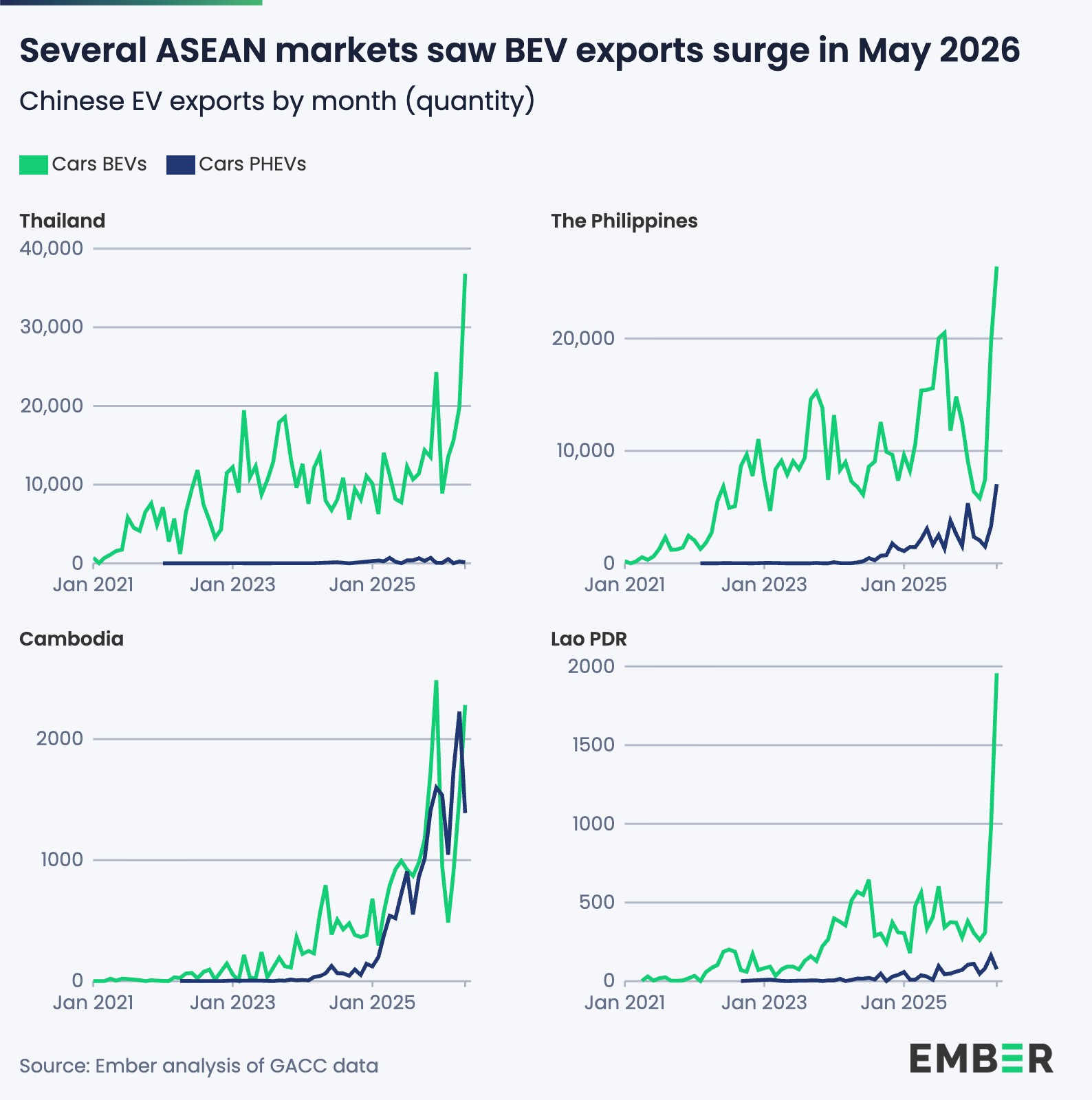
May proved to be a watershed month for cross-border trade between China and ASEAN nations. China exported approximately 448,000 electric passenger vehicles in total during the month, comprising roughly 279,000 pure battery electric vehicles (BEVs) and 169,000 plug-in hybrid electric vehicles (PHEVs).
Within this global volume, cumulative Chinese EV exports to ASEAN member states vaulted to an all-time monthly high of $1.2 billion. The distribution across the bloc underscored widespread regional adoption:
- Thailand maintained its status as the regional titan, importing upwards of 36,000 Chinese EVs in May alone, anchored by robust local dealership networks and manufacturing investments.
- The Philippines closely followed, registering imports exceeding 33,000 vehicles as urban centers sought sustainable solutions to chronic traffic congestion and air pollution.
- Cambodia and Laos both logged unprecedented monthly import volumes, aided by fresh financial incentives, targeted tax breaks, and expanding public charging grids.
4. Mid-2026: Laos Changes the Game with ICE Restrictions
As May’s import figures broke records, Laos introduced one of the most aggressive regulatory maneuvers seen in the region. To curb its heavy economic dependence on imported fossil fuels, the Laotian government enacted a temporary ban on imports of traditional internal combustion engine (ICE) vehicles, effective through the end of 2026.
Furthermore, Laos slashed EV registration and service fees while instituting a mandatory fleet transition mandate: all commercial transportation companies operating within the country must ensure that at least 10% of their operational fleets consist of electric vehicles by December 31, 2026.
Supporting Context & Metrics: The Numbers Behind the Boom
The numbers defining the 2026 EV surge tell a compelling story of macroeconomic transformation, industrial dominance, and shifting consumer behavior.
| Metric Category | Data Point / Value | Trend / Context |
|---|---|---|
| Total China EV Exports (May) | $9.2 billion | Up 49% year-over-year; breaks April’s record of $9.1 billion. |
| Total Passenger EVs Shipped (May) | ~448,000 units | Comprises ~279,000 BEVs and ~169,000 PHEVs. |
| ASEAN Region Imports (May) | $1.2 billion | Record monthly valuation driven by government electrification pushes. |
| Thailand Imports (May) | >36,000 units | Leading ASEAN nation in total volume uptake. |
| Philippines Imports (May) | >33,000 units | Rapidly accelerating urban adoption and fleet replenishment. |
| Historical Baseline (2020) | <$1 billion / month | Illustrates the exponential scaling of Chinese manufacturing over six years. |
The Macroeconomic Catalyst: Middle Eastern Conflict and Fuel Prices
While policy incentives have opened the door for EVs in Southeast Asia, external macroeconomic shocks have kicked the transition into overdrive. The protracted geopolitical conflict in the Middle East has injected severe volatility into global crude oil markets, driving up local gasoline and diesel prices across importing nations in Asia.
For emerging and developing economies in ASEAN, exposure to fossil fuel price fluctuations represents a constant drain on foreign exchange reserves. The spike in traditional energy costs has fundamentally altered consumer psychology and corporate calculus, rendering the high upfront cost of electric vehicles secondary to the promise of predictable, insulated operating costs.
Official Statements and Industry Insights
Energy analysts and institutional researchers tracking the global transition have emphasized that the events unfolding in Southeast Asia are structurally altering international trade routes.
Lam Pham, Energy Analyst for Asia at Ember:

"The current energy crisis has reinforced the value of electrification as a pathway to greater energy security, reduced fuel import exposure, and long-term transport cost savings. What we are seeing in Southeast Asia is not just a passing trend, but a structural reassessment of national energy independence."
Pham’s analysis points to a growing consensus among policymakers: transitioning away from oil is no longer strictly an environmental objective, but an urgent matter of national security and economic resilience.
Euan Graham, Senior Electricity and Data Analyst at Ember:
"Southeast Asia is fast becoming one of the most dynamic destinations for electric vehicles, and China is supplying that demand at scale and speed. The sheer velocity at which Chinese manufacturers can adapt to regional preferences and regulatory shifts is staggering."
Graham highlights the distinct advantage held by Chinese automakers, who have avoided the complacency sometimes observed legacy Western automotive hubs. By offering everything from ultra-budget city cars to sophisticated multi-row family SUVs, Chinese original equipment manufacturers (OEMs) have effectively captured every tier of the ASEAN auto market.

Future Outlook: What Lies Ahead for the ASEAN EV Landscape
As the second half of 2026 unfolds, the trajectory of electric vehicle adoption in Southeast Asia points toward even deeper market integration and industrial localization.
From Importers to Manufacturers
A critical phase of the region’s evolution will involve transitioning from being mere destination markets for finished Chinese vehicles to becoming localized production hubs. Major Chinese players like BYD, Great Wall Motor, and Changan have already invested billions of dollars in establishing manufacturing and assembly plants in countries like Thailand, Indonesia, and Malaysia. These domestic production facilities will allow automakers to bypass potential regional trade friction, lower logistics costs, and seamlessly comply with local content requirements.
Infrastructure and Policy Maturation
The sustainability of this growth curve will depend heavily on the continued deployment of public and commercial charging infrastructure. Governments in Cambodia, Laos, Thailand, and the Philippines are increasingly partnering with private energy firms to build out fast-charging corridors along major commercial shipping and passenger highways. With Laos enforcing its ICE import ban through the remainder of the year and neighboring nations contemplating similar measures to curb emissions, the pressure on legacy automakers to pivot or exit the region will intensify.
The Global Ripple Effect
Ultimately, the rapid electrification of Southeast Asia serves as a vital blueprint for the rest of the developing world. While legacy automakers in the US and Europe grapple with slowing domestic adoption curves and debate the pace of their EV transitions, China and its ASEAN neighbors are proving that affordable technology, coupled with decisive government backing and acute energy vulnerabilities, can turn the dream of mass electrification into an immediate, unstoppable reality.



