By Global Logistics & Clean Energy Correspondent
Published: Special Infrastructure & Transportation Report
Executive Overview
As the global cost of lithium-ion and advanced chemistries continues its historic downward trajectory, a foundational consensus has emerged across the transportation sector: the future of freight is electric. From heavy-duty long-haul semi-trucks to domestic container ships and freight locomotives, the pressure to phase out fossil fuels is intensifying. However, a crucial variable is frequently overlooked in global decarbonization models.
While battery prices are dropping on a global scale, the physical infrastructure of freight does not start from a blank slate.
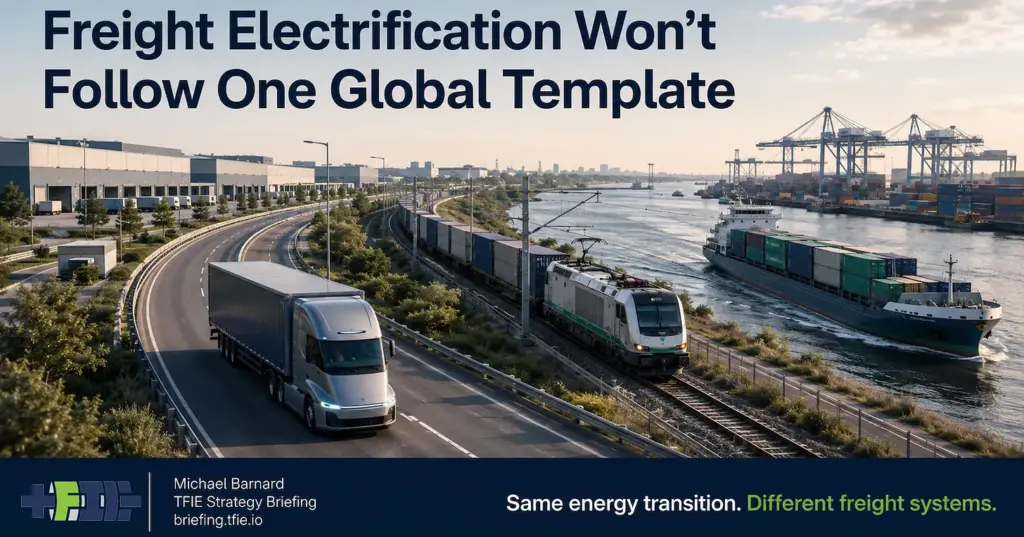
Nations inherit vastly different legacies of road networks, rail grids, and inland waterways. China, India, Europe, and the United States move domestic cargo through starkly contrasting modal splits. Because these geographical and infrastructural footprints are deeply entrenched, falling battery costs will not trigger a uniform, one-size-fits-all electrification pathway. Instead, every major economic powerhouse is charting a distinct course dictated by its historical infrastructure, regulatory frameworks, and geopolitical imperatives.
To understand how the logistics sector will transition through the 2030s, one must look beyond the battery pack and examine the underlying anatomy of regional freight networks. Battery costs are global; freight geography is local.
Supporting Context & Metrics: The Modal Split Blueprint
The foundation of any heavy transport decarbonization strategy begins with the "modal split"—the proportion of domestic cargo carried by road, rail, and water. A comparative analysis of global freight reveals significant structural divergences:
- China: Approximately 44% road, 20% rail, and 36% domestic water. China’s unique geographic layout allows it to leverage massive coastal and river waterways alongside a balanced mix of heavy trucking and rail corridors.
- European Union (EU-27): Approximately 54% road, 12% rail, and 34% internal water freight (derived from harmonized multi-mode datasets). Europe relies heavily on road networks for flexible distribution, supported by vital internal riverways and a dense, albeit under-utilized, rail grid.
- India: Approximately 69% road, 23% rail, and 8% water. Based on NITI Aayog modeling baselines, India’s freight ecosystem is overwhelmingly dependent on road transport, though it possesses a rapidly modernizing, heavily electrified rail backbone.
- United States: Approximately 53% road, 36% rail, and 10% water (reconstructed comparative metrics with lower statistical confidence). The U.S. stands out for its high reliance on private freight rail for long-distance, dense cargo hauling.
These structural variations dictate where electricity must enter the economic bloodstream. China can simultaneously scale a massive electric truck fleet while expanding heavy rail and water volumes. India can target road electrification while aggressively moving freight onto an almost entirely electrified broad-gauge railway. Europe must tackle the dual challenge of reviving its rail share while electrifying stubborn road routes. Meanwhile, the United States faces a unique dilemma: managing a commercially dominant, diesel-powered freight rail network while facing rapid disruption from battery-electric trucking.
Regional Breakdown: How Four Superpowers Are Electrifying Freight
1. China: Industrial Scale and Heavy Truck Swapping
China is currently setting the global pace in the deployment of electric heavy-duty commercial vehicles. During the first half of 2026, sales of "new energy" heavy trucks in China surged to approximately 140,000 units—representing a staggering 78.6% increase year-over-year.
While the term "new energy" encompasses both battery-electric vehicles (BEVs) and fuel-cell options, the sheer volume represents true industrial-scale adoption. Beijing’s policy targets aim for new-energy heavy trucks to capture roughly 40% of annual heavy-truck sales by 2030. To support this growth, state and private enterprises are aggressively constructing megawatt-scale charging and automated battery-swapping infrastructure along major national logistics corridors, bypassing the grid constraints that plague static charging stations.
2. India: Betting on Dedicated Freight Corridors
Rather than attempting to electrify millions of fragmented road miles all at once, India is focusing on systemic rail modernization. The nation has completed approximately 2,800 kilometers of Dedicated Freight Corridors (DFCs). By early 2026, these high-capacity arteries were handling roughly 480 specialized freight trains per day.
Electrification alone does not automatically shift cargo from highways to steel tracks, but dedicated infrastructure changes the equation. By offering heavier axle loads, higher operational speeds, and reliable, scheduled transit times, India is transforming its already-electrified railway network into a highly competitive, low-carbon alternative to long-haul trucking.

3. Europe: The Multi-Pronged Challenge
Europe serves as a vital cautionary tale against assuming that the mere existence of infrastructure automatically guarantees modal share. The EU boasts more than 200,000 kilometers of rail lines with a substantial electrified percentage. Yet, despite this clean rail infrastructure, road transport actually gained approximately 3.3 percentage points of inland freight share between 2014 and 2024, driven by the flexibility of door-to-door trucking.
On the road front, electrically chargeable trucks weighing over 3.5 tonnes reached 4.2% of total EU registrations in 2025. Consequently, Europe is forced to execute a complex balancing act: it must simultaneously improve the performance, interoperability, and utilization of its existing electric rail network while rapidly deploying mega-chargers to decarbonize the road freight that remains indispensable to its economy.
4. The United States: The Long-Duration Rail vs. Road Battle
The United States represents a slower-moving, highly entrenched market where freight rail has historically retained massive structural advantages in train length, labor productivity, and the long-distance hauling of bulk, dense commodities.
However, the rapid advancement of battery-electric trucking is fundamentally altering the energy and operating-cost calculus. According to detailed modeling from the National Renewable Energy Laboratory (NREL), zero-emission heavy-duty trucks are fully capable of reaching total-cost-of-ownership (TCO) parity—or better—across critical market segments by 2035, driven by ongoing declines in battery chemistry costs.
Crucially, American freight rail operators cannot afford to stand still. Battery-electric and hybrid locomotive options are entering development, meaning any long-term U.S. freight forecast must account for technological improvements across both rails and roads simultaneously.
Expert Insights and Official Perspectives
Industry analysts and institutional researchers point out that the transition cannot be understood through simple cost-per-kilowatt-hour metrics.
"Falling battery costs are universal, but the friction of logistics is entirely local," notes a senior infrastructure strategist tracking global supply chains. "You cannot drop a European rail electrification model into the American Midwest, nor can you replicate China’s state-backed battery-swapping highway corridors inside the regulatory framework of the United States or India."
According to recent economic briefings from specialized logistics intelligence firms, capital allocation decisions through the late 2020s will depend heavily on how regional grid operators handle localized peak loads. Heavy-duty truck charging hubs require power allocations equivalent to small towns. Without proactive grid modernization, charging infrastructure bottlenecks could stall the transition in regions with privatized or fragmented utility markets—such as the U.S.—while state-directed economies like China can co-locate grid upgrades directly with national highway planning.
Future Outlook: The 2030s and Beyond
As the world moves toward the 2030 horizon, the overarching trajectory of global freight is clear: fossil fuels are systematically retreating from road, rail, and domestic water transport, making way for electrons delivered via wires, high-power chargers, and advanced battery packs.
Yet, the defining question of the next decade will not be whether freight electrifies, but how much freight stays on each specific mode, and how much capital infrastructure must be built to support inherited systems.
- In China: The focus will remain on scaling domestic battery-electric and hydrogen heavy trucks while maintaining high-volume rail and water corridors.
- In India: The test will be whether expanding DFC networks can successfully peel high-value cargo away from an increasingly electrified road sector.
- In Europe: Policymakers must reconcile the paradox of possessing world-class electric rail while watching road freight volumes expand.
- In the United States: A fierce commercial competition is unfolding between private Class I railroads exploring alternative propulsion and rapidly maturing zero-emission trucking fleets achieving cost parity.
Ultimately, batteries are a global commodity, but logistics is dictated by geography. The nations that successfully harmonize their inherited networks with falling battery costs will dominate the low-carbon global economy of the mid-21st century.