


Executive Overview
As Canada races toward its ambitious net-zero commitments, the national discourse has largely centered on giga-scale infrastructure projects. Mega-transmission lines, utility-scale wind farms, and colossal hydroelectric facilities dominate headlines and command billions in capital. Yet, this high-level view obscures a fundamental reality: a substantial portion of the nation’s energy transition will happen not in remote wilderness corridors, but inside neighborhoods, commercial districts, and apartment complexes.
It will look like rows of heat pumps quietly humming outside suburban homes, deep envelope retrofits, rooftop solar arrays, and an expanding web of electric vehicles tethered to community-scale microgrids.
According to comprehensive modeling from Corporate Knights’ Climate Dollars analysis, achieving deep decarbonization across Canada will require an estimated $2.17 trillion in capital investment through 2050—averaging roughly $86 billion annually. While roughly 58% of this capital will pour into upgrading the overarching electricity supply system, an impressive 42% must be deployed directly into energy-using technologies: residential and commercial buildings, industrial applications, and personal and commercial transportation fleets.
This staggering capital requirement is often perceived as an intimidating hurdle. However, it simultaneously represents the single largest opportunity for community-owned economic development that Canada has seen in generations. The primary constraint is not a shortage of national capital; rather, it is a structural challenge of deployment. The central questions facing policymakers, investors, and local leaders are straightforward yet profound: Who will own the physical assets that this $2 trillion buys? Who will finance them, who will execute the labor, and where will the long-term economic returns flow?
While community finance cannot—and should not—fund the entirety of the national transition, it is uniquely suited for a vital subset of these assets. By prioritizing community groups, cooperatives, Indigenous nations, non-profits, and localized institutions, Canada can pivot from an extractive fossil-fuel economy that exports wealth to a generative clean-energy model that builds lasting local equity.
Detailed Chronology & Structural Evolution: From Fossil Fuels to Distributed Assets
To understand the mechanics of the clean-energy transition, one must first examine the structural shift occurring in Canada’s energy architecture. For over a century, the nation’s energy framework has operated on a centralized model of extraction, refinement, and consumption.
The Century of Extractive Fuel Consumption
Historically, Canadian communities have acted as passive consumers of energy. Every year, Canadians spend approximately $235 billion on energy, with a staggering $179 billion directed toward natural gas and petroleum products alone.
Consider the personal transportation sector: Canadian households spend upwards of $41 billion annually on fuel for personal vehicles. When factoring in light- and medium-commercial trucks—such as delivery vans, tradespeople’s trucks, and local service fleets that anchor municipal economies—that annual expenditure swells to roughly $65 billion. For a standard mid-sized community of 50,000 residents, this translates to an annual energy bleed of approximately $83 million.
In every practical sense, this economic mechanism is entirely consumptive: a liter of gasoline is purchased, burned, and permanently depleted, necessitating another purchase the following day. Income is systematically turned into ephemeral fuel.
The Rise of Distributed Clean Energy
The clean-energy transition dismantles this linear model. Wind and solar resources harvest power across vast geographical areas, fundamentally decentralizing generation. Buildings evolve from static consumer endpoints into active energy assets, while electric vehicles double as mobile storage units. Tied together via advanced batteries, localized chargers, and smart microgrids, this network requires a financial architecture that mirrors its physical decentralization.

In the low-carbon scenario modeled by Corporate Knights, as personal and commercial vehicle fleets electrify, the comparable annual energy bill drops precipitously from $65 billion to roughly $19 billion. While this transition mandates significant upfront capital investment—procuring electric vehicles, erecting charging infrastructure, and hardening local distribution networks—the economic payoff is transformative. Investments in solar panels, battery banks, and building envelopes create long-lasting capital assets that deliver value for decades.
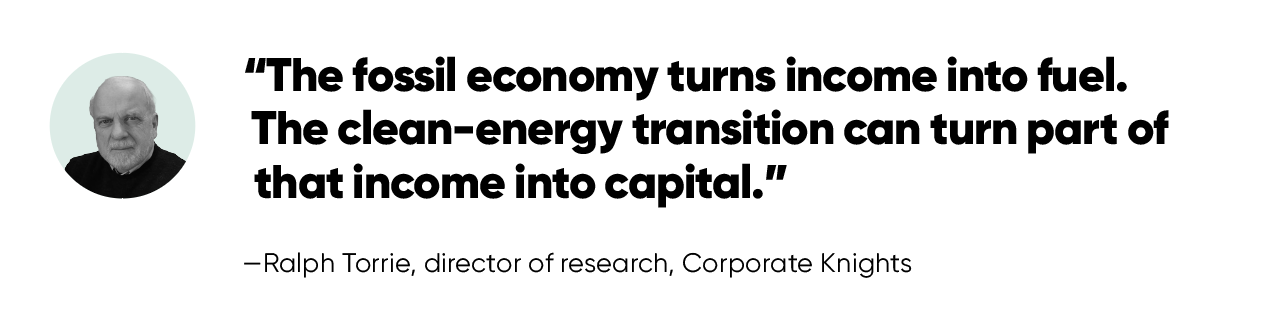
Instead of turning local income into transient fuel, the clean-energy transition turns that same income into permanent community wealth.
Supporting Context & Metrics: The $1.2 Trillion Opportunity
While the total price tag for net-zero by 2050 stands at $2.17 trillion, Corporate Knights modeling identifies more than $1.2 trillion of that investment falling squarely into asset classes where some degree of local or community participation is entirely feasible.
Where Local Capital Operates
This $1.2 trillion universe encompasses four primary asset categories:
- Wind and Solar Generation: Distributed renewables sited within or adjacent to municipal boundaries.
- Building Decarbonization: Residential and commercial energy-efficiency retrofits, heat pump installations, and structural upgrades.
- Vehicle-to-Grid (V2G) Infrastructure: Charging networks and bidirectional power management systems.
- Electricity Distribution: Localized grid enhancements and smart-grid integration.
It is important to clarify that this figure does not project a wholesale shift into community bonds or cooperative share-offerings. Standard utility distribution will largely remain on regulated corporate and municipal balance sheets, utility-scale wind projects will continue to rely on conventional project finance, and private homeowners will leverage traditional mortgages, HELOCs, and commercial loans.
However, the $1.2 trillion metric illustrates the expansive addressable market in which community finance can—and should—play a catalytic role.
Overcoming Transaction Costs Through Aggregation
Traditional financial institutions are brilliantly optimized for large, standardized, centralized transactions. Yet, the distributed energy transition presents the exact opposite profile: thousands or millions of small, heterogeneous projects characterized by distinct owners, varied building typologies, disparate technologies, and hyper-local environmental conditions.
To a centralized bank, this diversity appears as an insurmountable transaction cost. Financing a single residential energy retrofit is notoriously inefficient. However, by aggregating 20, 50, or 500 retrofits under a single financial umbrella, institutions can effectively diversify risk and slash transaction costs. The same principle applies seamlessly to affordable housing portfolios, multi-family apartment chargers, rooftop solar arrays, and municipal vehicle fleets. In this context, the unit of finance does not need to mirror the unit of technology.
The Scale of Building Decarbonization
The scale of this challenge is vividly apparent in Canada’s built environment. Decarbonizing the nation’s residential housing stock requires an estimated $183 billion in incremental capital through 2050. Commercial buildings demand an additional $191 billion, bringing the total building decarbonization tally to approximately $374 billion.
Physically, there is no single $374-billion construction project. There are millions of distinct projects: detached houses, urban apartment complexes, rural schools, community centers, health clinics, retail shops, and office warehouses.
Crucially, these assets cannot be retrofitted remotely. A heat pump in Regina must be specified and installed by a local technician; a building envelope in Sudbury cannot be insulated from New York. While certain technologies will inevitably be imported, the heavy lifting of construction, electrical contracting, project management, and ongoing maintenance must occur precisely where the buildings stand. This reality transforms the transition into an engine of local economic vitality—provided that local actors share in the equity and operational ownership.
Official Perspectives & Expert Insights
As the financial framework for Canada’s energy transition takes shape, leading researchers and energy economists emphasize that the success of community-led finance depends heavily on alignment, policy support, and structural design.
Ralph Torrie, Director of Research at Corporate Knights and author of the underlying Climate Dollars analysis, underscores the necessity of matching physical decentralization with financial innovation:
"An energy system that is becoming more distributed physically needs a financial architecture capable of being distributed as well. Canada does not suffer from a simple shortage of capital. The challenge is getting capital into the right assets, at the right scale, and through structures capable of financing a highly distributed transition. Community finance is one essential tool for doing that."
Financial analysts point out that community finance functions best when four essential criteria align:
- An Investable Asset: A tangible project with clear operational metrics.
- A Credible Issuer: A trusted local entity, cooperative, municipality, or Indigenous nation.
- A Dependable Repayment Stream: Predictable cash flows generated by energy savings or service fees.
- A Meaningful Ownership Opportunity: Structures that allow residents to participate directly as financial stakeholders rather than mere consumers.
Furthermore, sociological and economic research into renewable energy deployment repeatedly demonstrates that community ownership dramatically alters public perception. Projects characterized by meaningful local or Indigenous equity stakes consistently report higher rates of public acceptance and perceptions of procedural fairness. While community ownership does not eliminate legitimate community-level debates over local development, it fundamentally shifts the psychological paradigm: citizens experience the energy transition not as an imposition happening to them, but as a collective enterprise they are actively building.
Future Outlook: Building Wealth, Not Just Infrastructure
Looking ahead to 2050, the trajectory of Canada’s clean-energy transition hinges on a critical philosophical and economic pivot: Will the trillions of dollars deployed simply replace fossil-fuel dependency with corporate-owned clean-energy dependency, or will it actively foster community wealth?
Community finance must be understood as a robust complement to conventional institutional capital, rather than a utopian substitute. An Indigenous or municipal ownership stake may represent only 10%, 20%, or 50% of a major wind project’s total financing structure. Community capital can serve as high-impact equity, provide subordinated tranches, or successfully aggregate smaller neighborhood initiatives, allowing major commercial banks, provincial utilities, and pension funds to finance the balance.
The overarching objective is not to keep every single dollar strictly localized—global supply chains for specialized hardware, advanced software, and specialized expertise will always interact with regional projects. Rather, the goal is to capture a vastly superior share of the long-term value created by the transition within the very communities where the physical assets reside.
For over a century, Canadian communities have operated as temporary nodes in a massive, centralized resource pipeline, purchasing a continuous, unrecoverable stream of fossil fuels. The emerging clean-energy system offers a historic structural divergence. By marrying decentralized physical assets with localized financial architecture, Canada can ensure that every dollar invested in a rooftop solar array, a retrofitted apartment building, or a community microgrid does more than merely reduce carbon emissions—it builds enduring generational wealth for the people who call those communities home.



