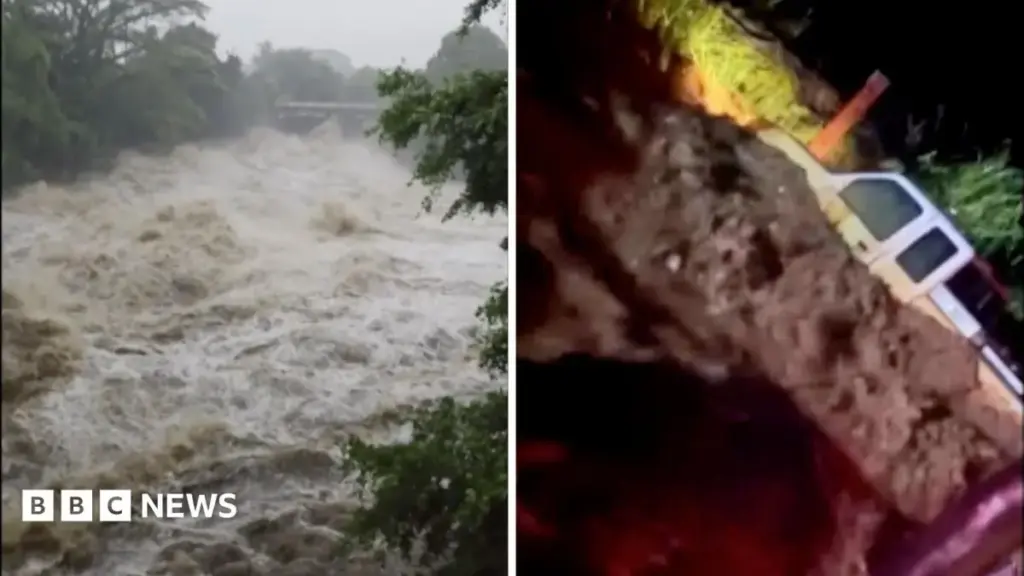
HONOLULU — In the wake of what was supposed to be a glancing blow from a downgraded tropical system, Hawaii is once again grappling with the terrifying vulnerability of its isolated island communities to the escalating fury of extreme weather. Hurricane Lala, which skirted the Big Island over the weekend as a Category 1 storm, has left a devastating trail of destruction in its wake. Torrential downpours triggered catastrophic flash floods and violent mudslides, sweeping away residential homes, knocking out critical infrastructure, and resulting in at least one confirmed fatality.
As first responders continue to navigate impassable roads and treacherous terrain, state and federal officials are racing to assess the full scale of the disaster. With more than 200,000 households plunged into darkness and vital lifelines severely compromised, the state’s emergency management systems have been pushed to their absolute limits.
This comprehensive report examines the unfolding crisis, detailing the sequence of events, the immediate humanitarian and infrastructural impact, official responses from local and federal authorities, and what climatologists predict as the storm charts a westward course across the Pacific.
Executive Overview
Over the weekend, Hurricane Lala approached the Hawaiian archipelago, carrying fears of widespread destruction. While the storm’s eye ultimately skirted the coastline of the Big Island rather than making a direct landfall, its sprawling outer bands delivered an unprecedented deluge of rain and hurricane-force wind gusts. The combination of saturated volcanic soils, steep topography, and unrelenting precipitation proved catastrophic.
According to preliminary assessments released by county and state emergency officials, approximately 100 homes on the Big Island were completely swept off their foundations by fast-moving rivers of mud and debris. The human toll has begun to mount, with local authorities confirming one fatality resulting from a massive mudslide that engulfed a residential property in the early hours of Sunday morning.
The economic and infrastructural fallout is staggering. More than 200,000 households—representing a significant portion of the island’s population—found themselves without electrical power as transmission lines snapped and substations were submerged or battered by flying debris. Major thoroughfares have been fractured, bridges compromised, and entire neighborhoods isolated from emergency services.
Governor Josh Green has issued an emergency proclamation, mobilizing the Hawaii National Guard to assist with search-and-rescue operations, debris clearance, and the distribution of emergency rations. As the tropical storm slowly tracks westward away from the islands, the focus has shifted from immediate survival to a long, arduous recovery process that will likely cost hundreds of millions of dollars.
Detailed Chronology: The Unfolding Crisis
To understand the suddenness and severity of the disaster, emergency management experts have reconstructed the timeline of Hurricane Lala’s approach and its devastating aftermath over the course of the 72-hour crisis period.
Friday: The Approach and Early Warnings
By Friday afternoon, meteorologists at the Central Pacific Hurricane Center (CPHC) elevated warnings as Hurricane Lala maintained its Category 1 status, packing sustained winds of up to 85 miles per hour. Although computer models indicated that the center of the storm would pass just south and west of the Big Island, forecasters repeatedly emphasized that the storm’s asymmetry meant the most severe weather—heavy rainfall and gale-force wind bands—would impact the eastern and southern slopes of the island.
Local authorities in Hilo, Kona, and surrounding districts immediately activated emergency operations centers. Shelters were opened, and residents in low-lying coastal areas and known flood zones were urged to evacuate. However, few anticipated the sheer volume of rainfall that would accumulate in the higher elevations of Mauna Loa and Kīlauea.
Saturday: The Deluge Begins
By Saturday morning, the outer rainbands of Hurricane Lala slammed into the windward slopes of the Big Island. Rainfall rates quickly exceeded three to four inches per hour in localized areas. The volcanic soil, already damp from previous seasonal rains, rapidly reached saturation point.
Throughout the day, weather stations recorded staggering rainfall totals, with some mountainous gauges registering over 15 inches in a 24-hour window. Small streams transformed into raging torrents within minutes. Culverts backed up, and roadways began to wash away. Despite repeated warnings, several motorists and residents found themselves trapped as rising waters cut off escape routes.
Sunday: Cataclysmic Flooding and Mudslides
The situation deteriorated rapidly during the pre-dawn hours of Sunday. Saturated hillsides, unable to hold their own weight, let go in a series of massive, fast-moving mudslides. Unlike slow-moving earthflows, these debris flows acted like concrete avalanches, picking up boulders, trees, and entire residential structures in their path.
It was during this period that the storm claimed its first confirmed victim, a resident in a rural community south of Hilo who was caught inside a home swept away by a sudden wall of mud.
Simultaneously, wind gusts exceeding 70 mph battered electrical infrastructure, snapping utility poles and ripping transformers from their mounts. By Sunday afternoon, the grid had suffered a near-total collapse on large sections of the island, leaving over 200,000 households in the dark. Communication towers lost primary and backup power, plunging some rural districts into a temporary information blackout.
Monday: Assessment and Rescue Operations
As daylight broke on Monday, Hurricane Lala began to pull away, its center tracking steadily westward into the open Pacific. Rain began to taper off, giving way to oppressive humidity and clearing skies. The true extent of the devastation became glaringly apparent.
Helicopter search-and-rescue teams from the U.S. Coast Guard and the Hawaii National Guard took to the skies to locate stranded hikers and residents marooned on rooftops or cut off by washed-out bridges. Ground crews equipped with heavy machinery began the grueling task of clearing debris from Highway 11 and other critical arteries to allow emergency aid to reach isolated communities.
Supporting Context & Metrics
The destruction wrought by Hurricane Lala is not an isolated meteorological event; it is part of a growing pattern of intensifying extreme weather events linked to shifting climatic conditions in the Central Pacific basin. To grasp the magnitude of the disaster, it is essential to analyze the statistical and environmental metrics surrounding the storm.
Meteorological Profile
- Storm Classification: Category 1 Hurricane at closest approach, later downgraded to a severe tropical storm.
- Maximum Sustained Winds: 85 mph (peak intensity prior to skirt).
- Rainfall Accumulation: Peak measurements exceeded 18 inches over a 48-hour period in the windward uplands of the Big Island.
- Geographical Impact Area: The Big Island of Hawaii bore the brunt of the storm, though high surf advisories and coastal flooding affected Maui and Oahu.
Infrastructural and Social Metrics
- Displaced Structures: Approximately 100 residential homes completely destroyed or swept off their foundations.
- Power Outages: Peak figures exceeded 200,000 households without electricity across the Big Island and parts of Maui County.
- Casualties: One confirmed fatality, with several individuals treated for injuries ranging from lacerations and fractures to hypothermia and shock.
- Emergency Shelters: Over a dozen emergency shelters activated, housing upwards of 1,500 displaced residents at the peak of the crisis.
The Geography of Vulnerability
The Big Island’s unique topography played a critical role in the severity of the flooding. The presence of massive shield volcanoes—Mauna Kea and Mauna Loa—creates a meteorological phenomenon known as orographic lift. As moisture-laden air from the Pacific is forced upward by the steep mountain slopes, it cools rapidly, condensing into torrential rainfall. When a slow-moving or passing tropical system feeds continuous moisture into this system, the resulting downpours dwarf those seen in flatter continental regions. Furthermore, the island’s young, porous volcanic soils, while effective at draining normal rainfall, quickly become unstable when subjected to sustained, multi-inch-per-hour deluge conditions, triggering catastrophic landslides.
Official Statements and Government Response
In the wake of the disaster, local, state, and federal leaders have mobilized a coordinated response to address immediate humanitarian needs and begin planning for long-term recovery.
Governor Josh Green’s Emergency Declaration
Hawaii Governor Josh Green addressed the public during an emergency press conference in Honolulu on Monday morning, expressing profound sorrow for the loss of life and pledging the full resources of the state government to the recovery effort.
"We are heartbroken by the tragic loss of life on the Big Island and the unimaginable devastation experienced by families who have watched their homes swept away in a matter of minutes," Governor Green stated. "Hurricane Lala has tested our resilience, but it has not broken our spirit. Our immediate priority is the safety and well-being of every resident—ensuring that those who are stranded receive medical care, food, and water, and that our power grid is restored as safely and rapidly as possible."
The Governor confirmed that he had formally requested an expedited Major Disaster Declaration from the White House to unlock federal assistance funds from the Federal Emergency Management Agency (FEMA).
County Officials and Emergency Management
Hawaii County Mayor Mitch Roth praised the tireless efforts of local first responders, utility workers, and community volunteers who stepped up during the height of the storm.
"Our first responders have faced conditions that can only be described as apocalyptic," Mayor Roth said in a statement from the Hilo Emergency Operations Center. "From navigating waist-deep floodwaters to cutting through debris-choked roads in the dead of night, their bravery has saved countless lives. We ask for patience from our community as we work around the clock to clear pathways and restore essential services."
Utility and Infrastructure Updates
Hawaiian Electric issued a technical briefing detailing the immense challenges facing repair crews. The utility noted that hundreds of downed power lines, compromised utility poles, and flooded substations will require extensive rebuilding rather than simple repairs.
"This is not a routine blackout," a Hawaiian Electric spokesperson explained. "In many areas, the ground beneath our transmission towers has completely washed away. We are working alongside state forestry and transportation departments to stabilize the earth before our lineworkers can safely re-energize the grid."
Future Outlook: Meteorological Trajectory and Long-Term Recovery
As the immediate rescue phase transitions into recovery, meteorologists, urban planners, and environmental scientists are casting their gaze toward the future—both immediate and long-term.
Immediate Weather Forecast
According to the latest advisories from the Central Pacific Hurricane Center, the remnants of what was Hurricane Lala are currently tracking in a westward direction, moving further out into the open waters of the Pacific. While the storm poses no further direct threat to the Hawaiian Islands, lingering moisture trailing behind the system may still produce scattered rain showers and elevated surf conditions along western-facing shores over the next 24 to 48 hours. Small craft advisories and high surf warnings remain in effect for parts of the archipelago.
The Long Road to Recovery
For the residents of the Big Island, however, the end of the storm marks only the beginning of a grueling recovery process. Rebuilding 100 homes swept off their foundations will require not just construction materials, but complex geotechnical evaluations to determine which parcels of land remain safe for habitation. State geologists have already begun inspecting mudslide zones to assess the risk of secondary slides should future seasonal storms strike the island.
Economically, the tourism sector—a vital pillar of Hawaii’s economy—faces temporary disruptions as infrastructure repairs are carried out. State tourism officials are working to reassure prospective visitors that while the Big Island sustained significant damage in specific localized pockets, major airports and tourist infrastructure remain operational.
Climate Change and Island Resilience
In the broader scientific community, Hurricane Lala has sparked renewed discussions regarding climate change adaptation in the Pacific. Climatologists point out that while hurricanes are not historically uncommon in Hawaii, warming sea surface temperatures and shifting atmospheric circulation patterns are increasing the frequency of high-intensity storms and erratic storm tracks in the Central Pacific basin.
Urban planners are calling for a paradigm shift in how Hawaii approaches coastal and hillside zoning. Proposals are already being drafted in the state legislature to re-evaluate floodplain boundaries, mandate stricter building codes for properties situated on sloping terrain, and invest in hardened, decentralized microgrids capable of withstanding extreme weather events without collapsing entirely.
As the sun sets over a battered but resilient landscape, the people of Hawaii are once again demonstrating the deep-rooted cultural principle of kuleana—a shared responsibility to care for one another and the land. While the scars left by Hurricane Lala will take years to heal, the collective resolve of the island communities remains unshaken.