As the global race to decarbonize energy grids accelerates, offshore wind power has emerged as one of our most promising tools in the fight against climate change. With vast swaths of untapped potential across the world’s coastlines, clean energy developers are preparing for a massive multi-decade boom. However, this rapid expansion brings a critical dilemma: while offshore wind farms are vital for reducing carbon emissions, constructing industrial-scale energy installations in delicate marine ecosystems poses significant environmental risks.
To ensure that the clean energy transition does not come at the expense of ocean health, scientists, conservationists, and industry experts are charting a new path forward. Drawing from insights across Mongabay’s extensive investigative series on marine wind energy, a consensus has emerged: offshore wind farms must be developed responsibly to work with nature, rather than against it. From advanced marine spatial planning and noise-mitigation technologies to ecosystem restoration and circular economy innovations, ten key strategies are paving the way for a truly nature-positive energy transition.
Detailed Chronology: The Evolution of Marine Wind and Environmental Oversight
The integration of environmental accountability into offshore wind development has not happened overnight. It is the result of decades of trial, error, and mounting scientific data regarding how industrial structures interact with marine and avian wildlife.
Early Phase (Late 1990s – 2010s): The dawn of modern offshore wind focused primarily on engineering feasibility and energy yield. Early projects in the North Sea and off the coast of Europe prioritized finding high-wind zones with stable seabeds. Little was known about the long-term ecological consequences of pile-driving noise or how turbine bases would alter local benthic (seabed) communities.
The Research Awakening (2015 – 2022): As hundreds of turbines went up, marine biologists began publishing landmark studies on the ecological footprints of these structures. Researchers discovered a dual reality: while the construction phase caused acute stress to marine life via noise and physical disruption, the operational phase often saw turbine foundations acting as de facto marine reserves, sheltering fish and encouraging shellfish growth.
Policy and Spatial Integration (2023 – Present): Armed with empirical data, governments and international coalitions began shifting regulatory frameworks. Countries like France and the Netherlands pioneered "non-price criteria" in wind farm auctions, rewarding developers who incorporated biodiversity protection into their bids. Today, the focus has shifted toward proactive ecological design—seeding structures with marine life during construction rather than relying solely on post-construction mitigation.
Supporting Context & Metrics: The Scale of the Challenge and Opportunity
Scaling up offshore wind requires balancing monumental energy demands with fragile marine habitats. To understand the gravity of this balancing act, experts look to several core metrics and structural considerations:
Carbon and Material Intensity: Renewable energy infrastructure is not entirely carbon-neutral in its infancy. Steel and concrete—the primary components of traditional fixed-bottom turbine foundations—are among the most carbon-intensive materials produced globally. Recent lifecycle assessments published in the Journal of Cleaner Production emphasize that minimizing material use and transitioning to "green" or low-carbon steel is critical to reducing the initial carbon footprint of wind projects.
Acoustic Impacts: Traditional pile-driving methods generate intense underwater noise that can travel vast distances, disrupting marine mammal communication, disorienting fish, and causing physical trauma. Implementing modern mitigation tools—such as bubble curtains, sound dampeners, and high-pressure water jetting—has become a regulatory necessity in advanced markets.
Avian and Bat Vulnerabilities: Above the water, rotating turbine blades pose collision risks for migratory birds and bats. Because mitigation strategies like blade painting yield mixed results, regulatory frameworks increasingly rely on conservation compensation schemes, where developers fund off-site habitat protections to offset unavoidable wildlife impacts.
The Temporal Gap in Science: Many ecological impacts of large-scale offshore wind remain poorly understood due to a historical lack of long-term studies. Recent research in the ICES Journal of Marine Science stresses that environmental monitoring must span a minimum of three to five years, continuing across the entire lifespan of a wind farm to accurately map cumulative ecosystem changes.
The Ten Pillars of Nature-Inclusive Offshore Wind Design
To reconcile clean energy generation with marine conservation, experts interviewed by Mongabay have outlined ten actionable, science-backed strategies for sustainable offshore wind development.
1. Marine Spatial Planning During Site Selection
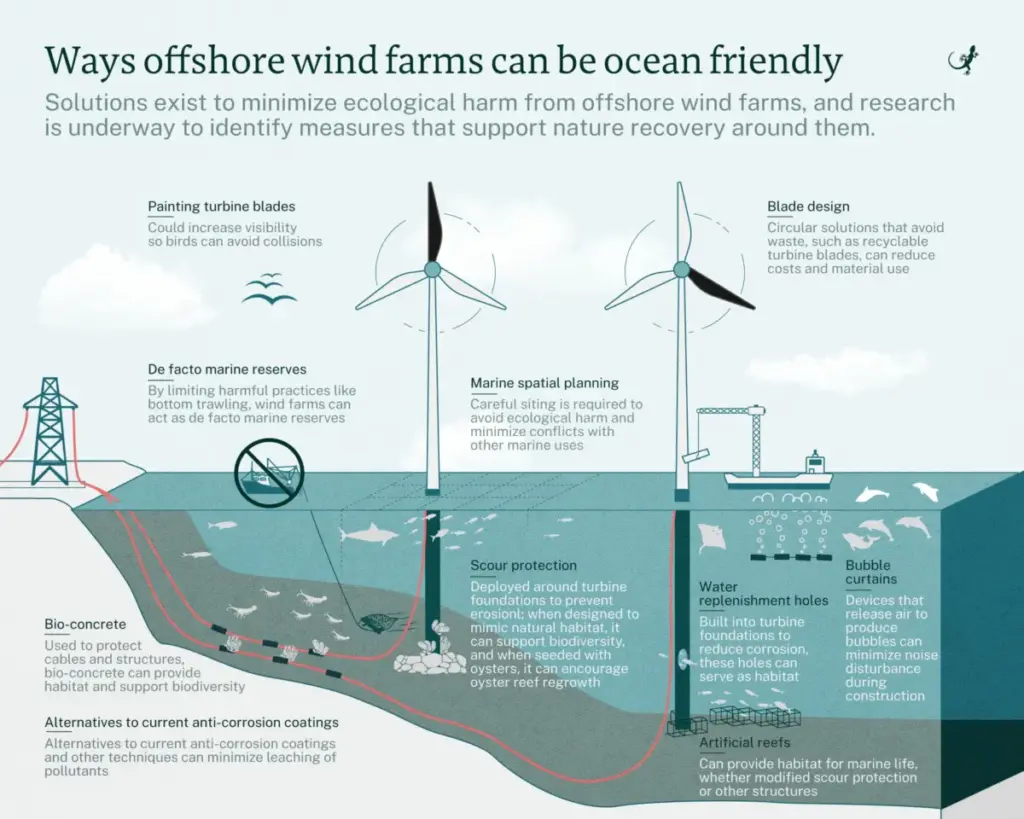
The most effective way to mitigate negative environmental impacts is to avoid sensitive ecosystems altogether through rigorous marine spatial planning.
"That’s step one," Marjolein Kelder, senior project manager at The Rich North Sea, a Netherlands-based nonprofit, told Mongabay. "Don’t put wind farms in your ecologically most valuable areas or in bird migration corridors."
Advanced spatial planning ensures the preservation of critical habitats, protects the livelihoods of coastal communities, and minimizes resource conflicts with shipping lanes and commercial fisheries. Furthermore, researchers are continuously developing high-resolution "sensitivity maps" for vulnerable species, such as seabirds and bats, to guide developers away from high-risk zones.
2. Nature-Friendly Structures
Far from acting as pure industrial intrusions, offshore wind farms can double as refuges for marine life. By intentionally modifying turbine foundations, developers can transform sterile infrastructure into thriving artificial habitats. Strategies include installing specialized steel habitat cages (such as "biohuts" used in floating wind projects), creating artificial reefs out of scour-protection rocks, and building intentional water replenishment holes into turbine foundations to encourage healthy water exchange and marine community growth.
3. Proactive Habitat Restoration
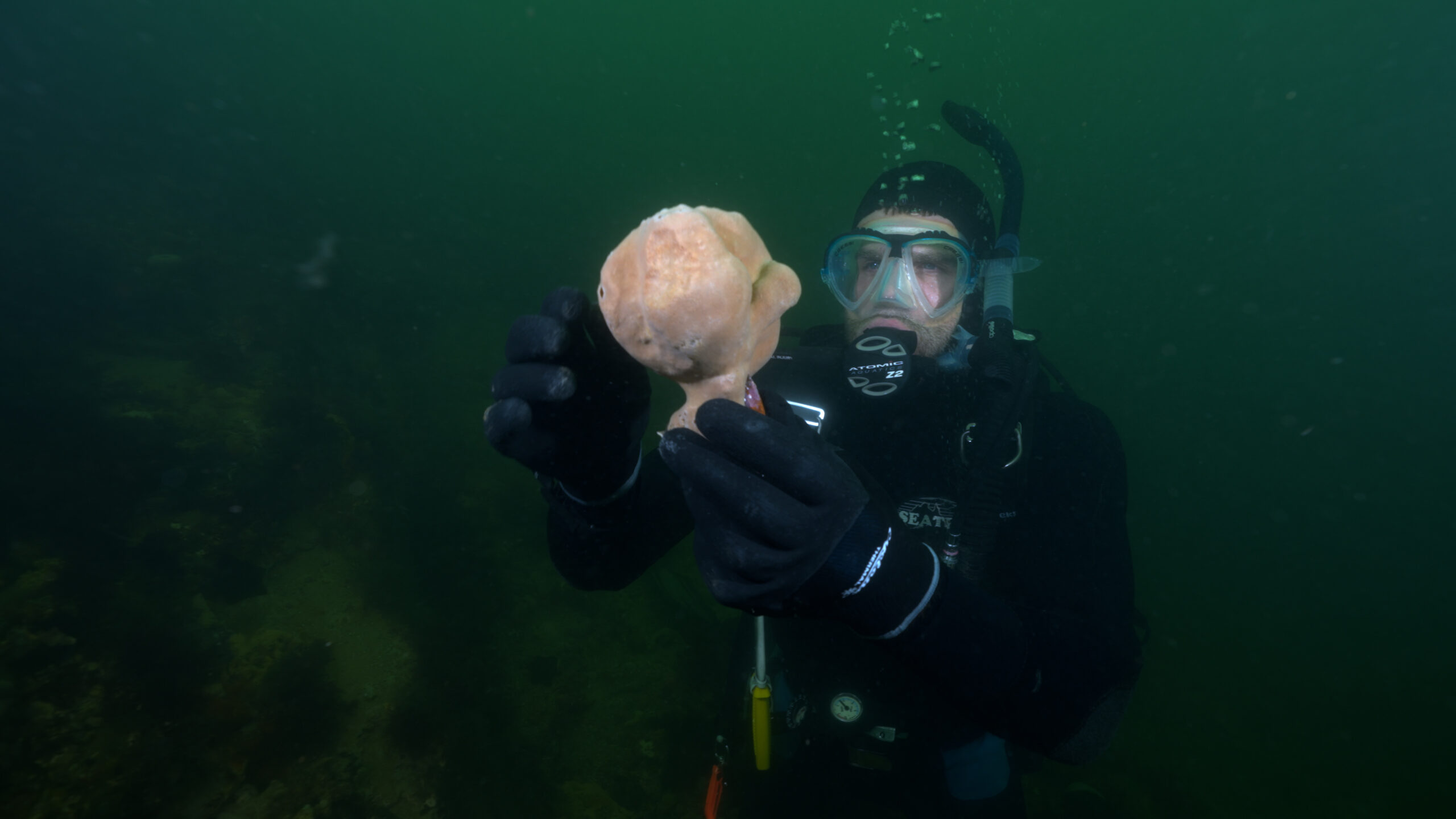
Rather than simply allowing nature to colonize wind farms by chance, forward-thinking projects are actively seeding infrastructure to restore depleted marine populations. Pilot projects in the North Sea are currently testing the viability of seeding oyster larvae and sea sponges directly onto the rock armor surrounding turbine bases.
"Seeding substrates with marine life makes sense," Chris Gillies, a marine biologist and founder of Offshore Biotechnologies, a consultancy based in Australia, told Mongabay. "Where these pilots need to go is start to work in with construction as opposed to post construction."
4. Advanced Noise Reduction Techniques
Construction noise remains one of the most immediate threats to marine ecosystems. Moving away from traditional, concussive pile-driving methods is becoming an industry standard. Innovations such as high-pressure water jetting allow monopile foundations to sink smoothly into the seabed. Additionally, deployment of bubble curtains—systems that release compressed air from the seafloor to create a sound-absorbing barrier—and gas-filled balloon dampeners successfully insulate surrounding waters from damaging acoustic shockwaves.
5. Leveraging Non-Price Criteria in Government Auctions
Market forces alone will not save biodiversity; policy must step in to bridge the gap. Experts advocate for the inclusion of "non-price criteria" in government-led wind farm auctions and permitting processes. By evaluating bids based on environmental stewardship, innovation in nature-inclusive design, and social responsibility alongside cost, governments can incentivize developers to go above and beyond baseline regulations.
"We see this as a key lever to accelerate innovation around nature inclusive design," Louise Combret, renewable energy policy associate at The Nature Conservancy, told Mongabay.
6. Circular Economy and Innovative Engineering
Applying circular economy principles to offshore wind helps slash material waste and optimize environmental footprints. The industry is seeing the introduction of recyclable turbine blades and advanced materials designed to extend structural lifespans.
Moreover, engineering breakthroughs—such as new fixed foundation designs that eliminate the heavy "transition piece" connecting the tower to the monopile—significantly reduce steel consumption, lowering both financial and carbon costs. Retaining scour protection stones after decommissioning further prevents localized habitat destruction.
7. Utilizing "Green" Materials
Because the manufacturing of steel and concrete drives a significant portion of a wind farm’s lifetime emissions, switching to low-carbon, "green" steel alternatives is imperative. Combined with structural optimization—selecting foundation types that inherently require fewer raw materials—developers can dramatically shrink the embodied carbon of future energy installations.
8. Warding Off Avian and Bat Collisions
Mitigating wildlife mortality in the skies requires multi-layered precautions. While visual deterrents like high-contrast blade painting are being tested, developers are also expected to implement operational curtailment during peak migration windows. When unavoidable wildlife losses occur, conservation compensation models—wherein project developers fund dedicated habitat restoration elsewhere—help balance the ecological ledger.
9. Rigorous, Long-Term Monitoring
To build a truly sustainable industry, guesswork must be replaced with empirical data. Scientists are calling for mandatory, standardized environmental monitoring protocols that last a minimum of three to five years, extending across the entire operational lifecycle of every wind farm.
"If you really want to understand how these structures might influence ecosystems, including fish, then these studies need to be done over much longer periods," Anthony Bicknell, a senior research fellow at the University of Exeter in the U.K., told Mongabay.
10. Navigating the Frontier of Floating Wind
As the industry moves into deeper waters, floating wind turbines represent the next technological frontier. By eliminating fixed-bottom foundations, these systems drastically reduce noise pollution and seafloor disturbance during installation. However, they introduce unique challenges, including the risk of marine mammals, sea turtles, and sharks becoming entangled in loose anchor lines and subsea cables. Mitigating these risks requires smart micro-siting away from migration paths, specialized cable configurations, and continuous underwater monitoring technologies.
Future Outlook: A Harmonized Energy and Ocean Strategy
The trajectory of global energy policy makes one thing abundantly clear: offshore wind will play a dominant role in powering human civilization through the 21st century and beyond. The question is no longer whether we will build these colossal marine energy farms, but how we will build them.
By bridging the gap between heavy engineering and ecological science, the offshore wind sector has a unique window of opportunity. Through smart marine spatial planning, proactive habitat restoration, strict noise regulations, and circular economy design, the industry can transcend the false dichotomy of climate action versus biodiversity protection. Ultimately, these ten pillars prove that with foresight, innovation, and political will, offshore wind can be as beneficial for the health of our oceans as it is for the stability of our global climate.