

Executive Overview
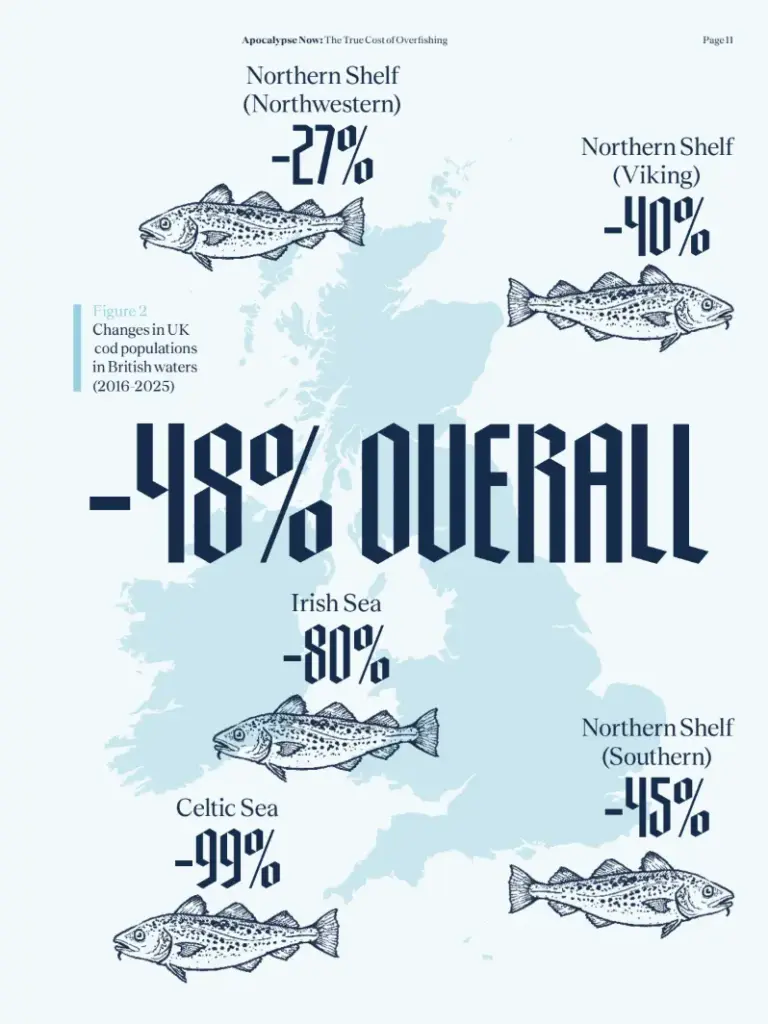
The quintessential British tradition of fish and chips faces an existential threat. According to a landmark study released in September 2026 by the ocean conservation charity the Blue Marine Foundation, United Kingdom cod stocks have plummeted by an alarming 48 percent over the past decade. The report accuses successive governments of systematically ignoring the overwhelming scientific consensus regarding rapidly declining marine populations, allowing relentless overfishing to drive vital fish stocks to the absolute brink of total collapse.
While the nationwide 48 percent decline is staggering in its own right, regional figures paint an even more catastrophic picture. In the Celtic Sea—home to one of the five distinct cod populations supporting UK waters—the total weight of mature, spawning-capable cod has experienced a near-total wipeout, suffering a catastrophic 98 percent drop over the last ten years.
This investigative report examines the data behind the Blue Marine Foundation’s findings, explores the structural failures in fisheries management, assesses the ecological and economic ramifications for the British fishing industry and the beloved culinary staple, and evaluates what steps—if any—can reverse this marine emergency.
Detailed Chronology: A Decade of Decline
To understand how UK cod populations reached this tipping point, one must examine the trajectory of marine policies and scientific warnings over the last ten years.
- The Mid-2010s (Post-EU Reform Realities): Following reforms to the European Union’s Common Fisheries Policy (CFP), hopes were high that legally binding commitments to end overfishing by 2015 or 2020 would restore North Atlantic and domestic fish stocks. However, environmental watchdogs noted persistent discrepancies between scientific advice on Total Allowable Catches (TACs) and the political compromises struck during annual quota negotiations.
- The Post-Brexit Transition (2020–2021): With the UK leaving the European Union, the government promised a "bright new future" for British fisheries, claiming that taking back control of maritime borders would lead to sustainable, science-based management. Conservationists warned at the time that sovereign control alone would not automatically safeguard fish if quota allocations continued to prioritize short-term economic yields over long-term stock resilience.
- The Mid-2020s Acceleration (2022–2025): Independent marine assessments began flagging acute recruitment failures—meaning fewer juvenile fish were surviving to adulthood. Despite warnings from marine biologists that warming sea temperatures driven by climate change were compounding the pressures of industrial extraction, industrial fishing fleets continued to target vulnerable cod aggregations.
- September 2026: The Blue Marine Foundation publishes its definitive report, Apocalypse Now: The True Cost of Overfishing, exposing that overall UK cod stocks had halved over the preceding decade, culminating in the shocking revelation that Celtic Sea cod had depleted by 98 percent.
Supporting Context & Metrics: The Numbers Behind the Crisis
The data compiled by the Blue Marine Foundation and highlighted in national investigations—including reports by the Daily Mail—illustrates a systemic failure in marine resource management.
1. The 48 Percent National Collapse
Across all major UK fishing grounds, the aggregate biomass (total weight) of cod has dropped by nearly half in just ten years. This metric does not merely reflect the number of individual fish swimming in the sea, but their overall mass, which directly correlates with reproductive capacity. Younger, smaller fish produce significantly fewer eggs than mature, larger adults, meaning the reproductive engine of the population has been severely hobbled.
2. The Celtic Sea Catastrophe (98 Percent Decline)
Perhaps the most damning statistic in the 2026 report centers on the Celtic Sea cod stock. Once a thriving fishery supporting regional fleets off the southwest coast of England, Wales, and Ireland, this specific population has suffered a 98 percent reduction in mature fish biomass. Marine biologists characterize this as a functional collapse, where the population is so depleted that genetic diversity is threatened and natural recovery becomes nearly impossible without total, multi-year fishing moratoria.
3. Ignoring the Science
Under the UK Fisheries Act, authorities are legally mandated to fish at Maximum Sustainable Yield (MSY) and take ecosystem-based approaches to conservation. Yet, the Blue Marine Foundation’s report documents a recurring pattern where government-set fishing quotas consistently exceed the scientific advice issued by bodies such as the International Council for the Exploration of the Sea (ICES). When decision-makers consistently prioritize short-term commercial lobbying over scientific limits, long-term ecological degradation is the inevitable result.
Official Statements and Stakeholder Reactions
The release of the report has ignited a fierce political and environmental debate across the United Kingdom.
Charles Clover, co-founder of the Blue Marine Foundation, did not mince words when discussing the findings:
"We are witnessing the slow-motion dismantling of our marine ecosystems. For years, successive governments have had the science laid out plainly on their desks, and for years, they have chosen political expediency and short-term appeasement of the fishing lobby over the survival of our fish stocks. Cod is being pushed to the point of total collapse. If urgent, radical action is not taken immediately, we will witness the permanent disappearance of wild cod from British waters."
Environmental lawyers and marine scientists have echoed these sentiments, pointing out that failing to curb overfishing violates both domestic legal obligations under the Fisheries Act and international biodiversity commitments.

Conversely, representatives from commercial fishing organizations have defended their operations, arguing that UK fishers face some of the strictest regulations and monitoring in the world. Industry advocates contend that blaming domestic fleets alone ignores wider international dynamics, such as shared stocks fished by European Union and Norwegian vessels in adjacent waters, as well as the profound impacts of climate-induced marine heatwaves shifting fish distributions northward.
Future Outlook: Can the Great British Fish and Supper Be Saved?
The cultural implications of a cod-free Britain are profound. Fish and chip shops—a cornerstone of British culinary heritage, numbering in the thousands across coastal towns and urban high streets alike—are already feeling the squeeze. Surging wholesale prices, driven by shrinking domestic quotas and expensive imports from Iceland and Norway, are forcing independent chip shops to either absorb crushing overhead costs or pass them on to consumers, threatening the accessibility of the nation’s favorite working-class meal.
To prevent the total erasure of wild UK cod and secure a sustainable future for the seafood industry, marine experts argue that a paradigm shift is required:
- Enforcing Science-Based Quotas: The government must legally bind itself to never exceed the catch limits recommended by independent marine scientists, removing political interference from quota-setting processes.
- Emergency Closures for Depleted Stocks: Immediate, strictly enforced fishing bans must be enacted in severely depleted zones like the Celtic Sea to give remaining populations a chance to spawn and rebuild.
- Modernizing Fleet Management: Incentivizing low-impact, sustainable fishing methods—such as hook-and-line or creeling—while phasing out destructive industrial practices like bottom-trawling that wreck seabed habitats and capture juvenile fish indiscriminately.
- Climate Resilience Integration: Fisheries management must account for rapidly warming ocean temperatures, protecting deep-water thermal refuges where cod can seek cooler waters during marine heatwaves.
Time is running out. Unless policymakers heed the urgent warnings of marine conservationists and break the cycle of political inaction, the iconic Friday night fish and supper may soon become a historical memory, relegated to old menus and folklore as our seas are left empty.



