

Executive Overview
For two decades, the Biodiversity Heritage Library (BHL) has served as a digital ark, preserving millions of pages of scientific literature, field notes, and historical archives. As the BHL celebrates its landmark 20th anniversary, the initiative continues to do more than simply archive fragile paper; it is actively rewriting the historical record. By transforming obscure handwritten manuscripts into searchable, open-access digital assets, institutions worldwide are unearthing the hidden voices of historical figures who were systematically marginalized or overlooked by traditional historiography—particularly women in the natural sciences.
A prime illustration of this archival renaissance is unfolding at the Academy of Natural Sciences of Drexel University in Philadelphia. During a recent project to digitize and transcribe 83 historical scientist notebooks and field journals for the BHL, library staff encountered an archival record listed simply as A notebook containing an entomological essay by Carrie Aaron, attributed vaguely to "Mrs. Aaron."
Thanks to cross-departmental detective work, modern web-linking standards, and comprehensive student-led digitization initiatives, this anonymous entry has been transformed into a fully realized digital profile for Carrie Baily Aaron (1860–1940s). The project not only established a dedicated BHL Creator ID and Wikidata identifier for Aaron but also unlocked a treasure trove of correspondence housed within the American Entomological Society (AES) collection.
Aaron’s recovered writings reveal a brilliant, sharp-witted entomological essayist who brilliantly described dragonflies as "the hawks of the minuter insect world," critiqued the gender imbalances of elite scientific societies at the turn of the 20th century, and left behind tantalizing clues regarding forgotten female pioneers of marine biology. This comprehensive report explores the chronology of Aaron’s rediscovery, the mechanics of modern archival enrichment, the institutional collaborations making these breakthroughs possible, and the broader implications for historical equity in biodiversity research.
Detailed Chronology: From "Mrs. Aaron" to a Recognized Scientific Voice
1. The Archival Oversight and Correction
The rediscovery of Carrie Aaron began in the cataloging department of the Academy of Natural Sciences of Drexel University. While working to prepare 83 rare scientific notebooks for the BHL’s Field Journal Fixup collection, the Cataloging and Digital Resources Librarian confronted a common barrier in historical research: inadequate metadata.
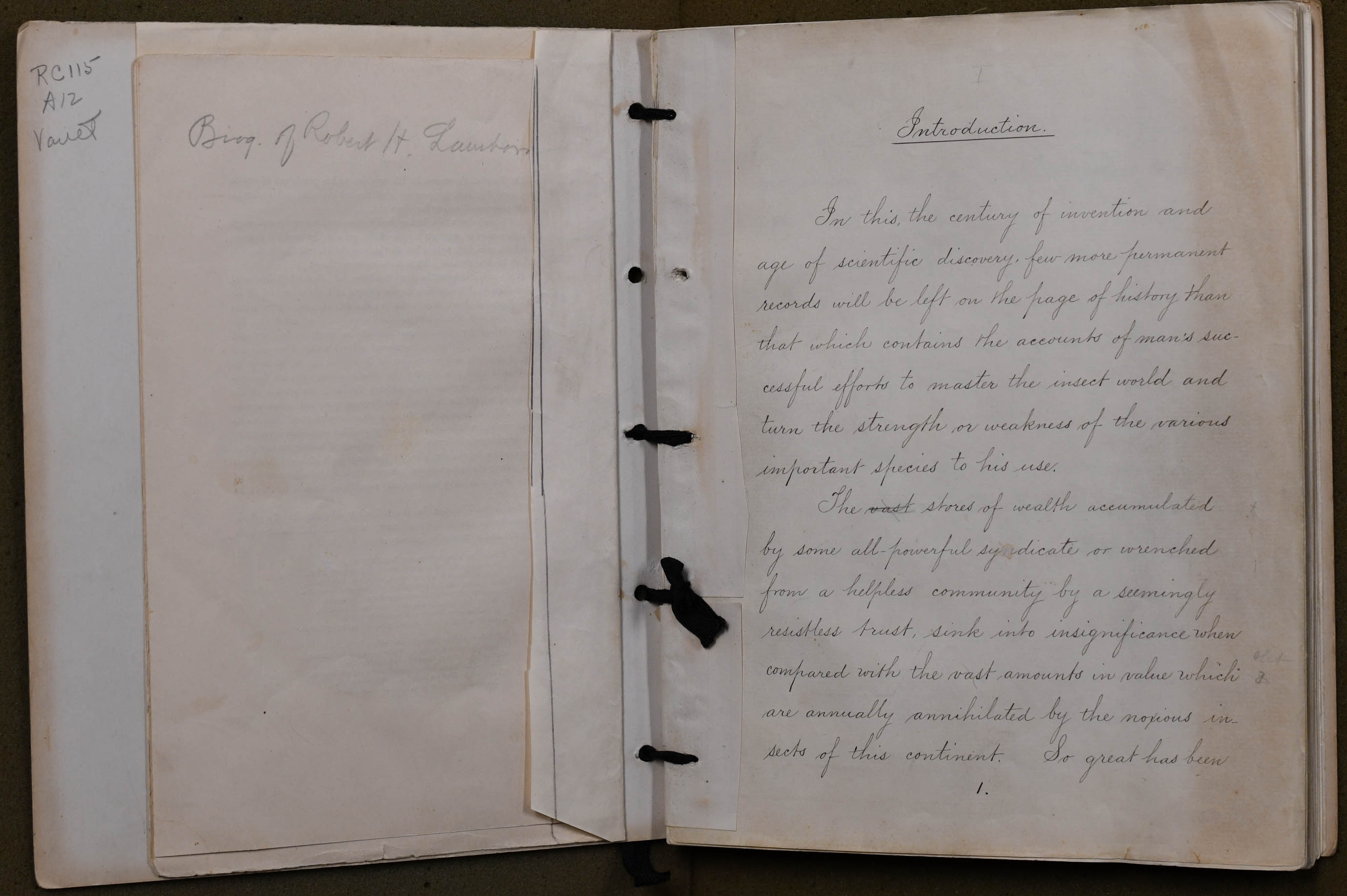
The original finding aid cataloged a meticulously handwritten 19th-century notebook simply under the authorship of "Mrs. Aaron," stripping the author of her distinct identity and flattening her into a marital honorific. This practice, historically standard in archival processing, has historically created immense hurdles for researchers attempting to map the contributions of women to science.
Fortunately, Academy Archivist Jessica Lydon identified the discrepancy and supplied vital biographical details. This intervention enabled the library team to create a dedicated BHL Creator ID for Carrie Aaron, seamlessly linking it to her official Wikidata identifier (Q125503946). Though seemingly an administrative minutiae, this digital bridge permanently anchors Aaron’s individual agency into the global web of linked open data, ensuring she can never again be easily rendered anonymous.
2. The Mosquito Eradication Essay (1889–1901)
The centerpiece of Aaron’s rediscovered corpus is her detailed manuscript notebook, which compiles research spanning from 1889 to 1901. Contextual research appended to her updated catalog record reveals that Aaron authored the piece as an entry into a high-profile essay competition organized by Robert Henry Lamborn.
Lamborn, a wealthy industrialist involved in building the Lake Superior Railroad, had suffered immensely from the relentless onslaught of mosquitoes during his engineering expeditions. Driven by personal torment, he offered substantial financial prizes for the three most comprehensive, scientifically sound essays proposing methods to eradicate or mitigate the mosquito pest.
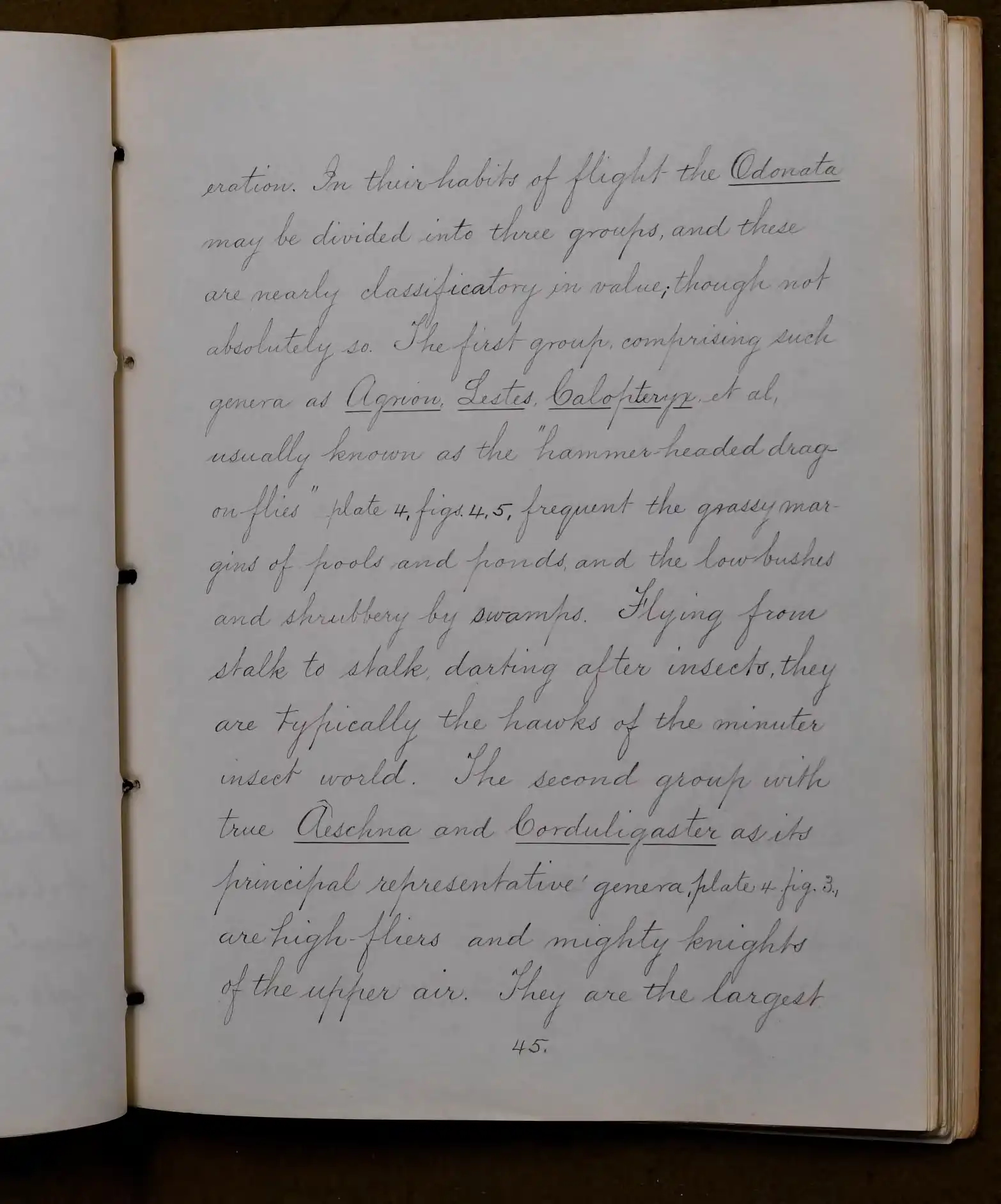
In her biographical notice honoring Lamborn—preserved within her BHL-digitized papers—Aaron documented this exact origin story, noting how Lamborn’s field miseries catalyzed an international quest for dipterous solutions. Aaron’s own submission, titled "The Dipterous Enemies of Man," demonstrated a formidable grasp of entomology. Within its neatly penned pages, she analyzed various biological vectors for population control, famously dubbing hammer-headed dragonflies "the hawks of the minuter insect world" for their ferocious predatory prowess against smaller airborne insects.
Intriguingly, Aaron and her contemporary researchers displayed a hands-on, fearless approach to empirical study. Her notes document an experimental attempt to inoculate themselves with what was then believed to be poisonous fluid extracted from mosquitoes. The experiment proved unsuccessful, a failure Aaron dryly attributed "to the inferiority of the needle as an injector, compared with the delicate hypopharynx" of the insect itself. Her essay was eventually selected for publication alongside competing submissions in the compilation volume Dragon Flies vs. Mosquitoes: Can the Mosquito Pest be Mitigated? (1890).
3. Disillusionment with Elite Societies (1900)
Tucked inside Aaron’s archival notebook is a piece of correspondence that illuminates the barriers faced by female intellectuals during the Victorian and Edwardian eras. The document is a letter dated May 18, 1889, from prominent entomologist Henry Skinner, congratulating Aaron on her prize-winning essay and assuring her that her scientific reputation would "now be well established."
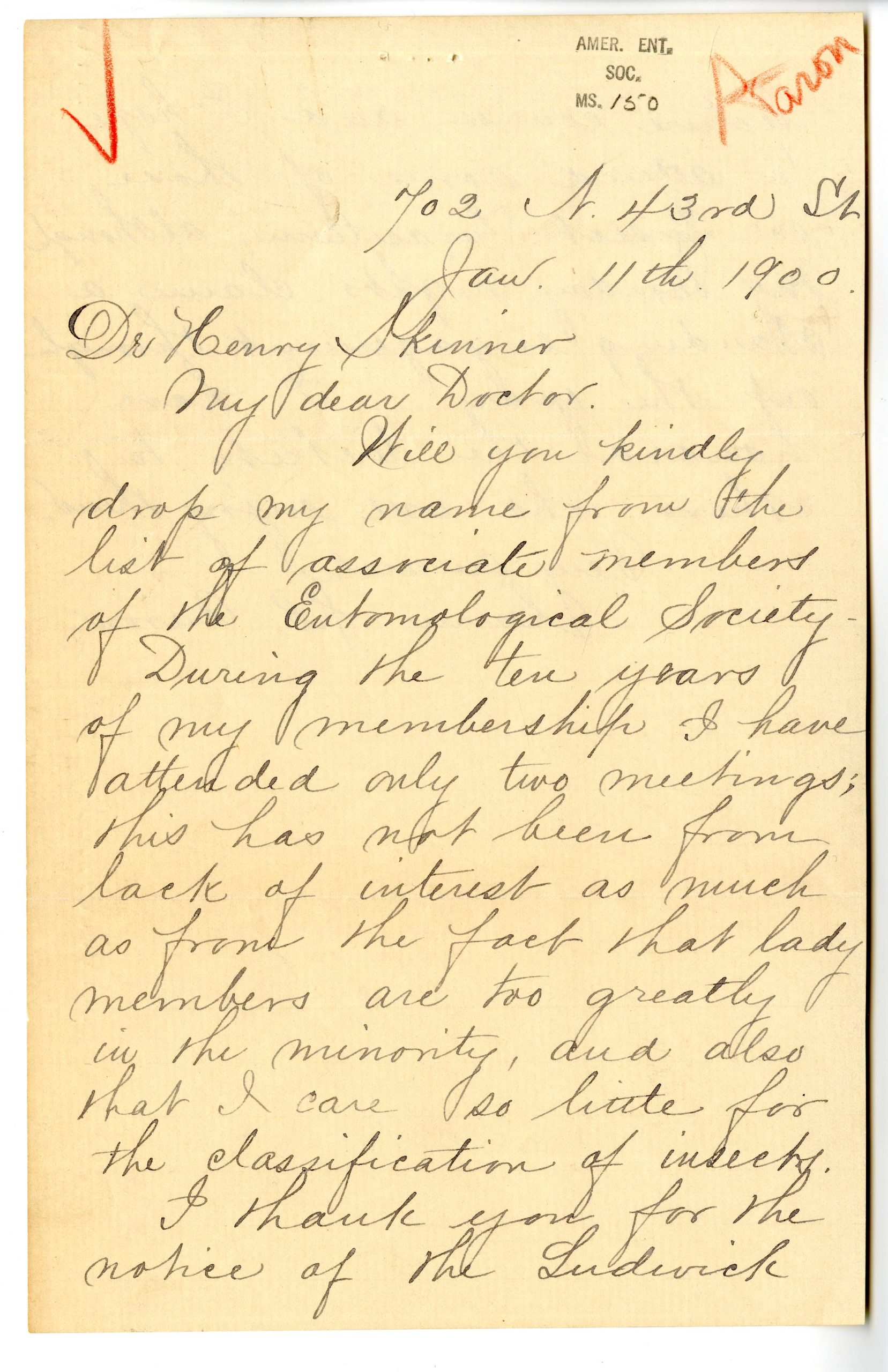
Yet, a decade later, Aaron’s relationship with the maledominated scientific establishment had soured. On January 11, 1900, Aaron penned a remarkably candid letter to Skinner formally requesting that her name be stricken from the associate membership roster of the American Entomological Society (AES). She explained her resignation with biting clarity:
"During the ten years of my membership I have attended only two meetings; this has not been from lack of interest as much as from the fact that lady members are too greatly in the minority, and also that I care so little for the classification of insects."
Despite her frustrations with institutional gatekeeping and dry taxonomical debates, Aaron maintained a deep personal bond with Skinner. The Academy’s archives preserve subsequent correspondence confirming a "more than thirty year sympathetic friendship," culminating in a warm reflective letter written by Aaron in 1923.
4. California Travels and the Mystery of the Marine Curator (1926)
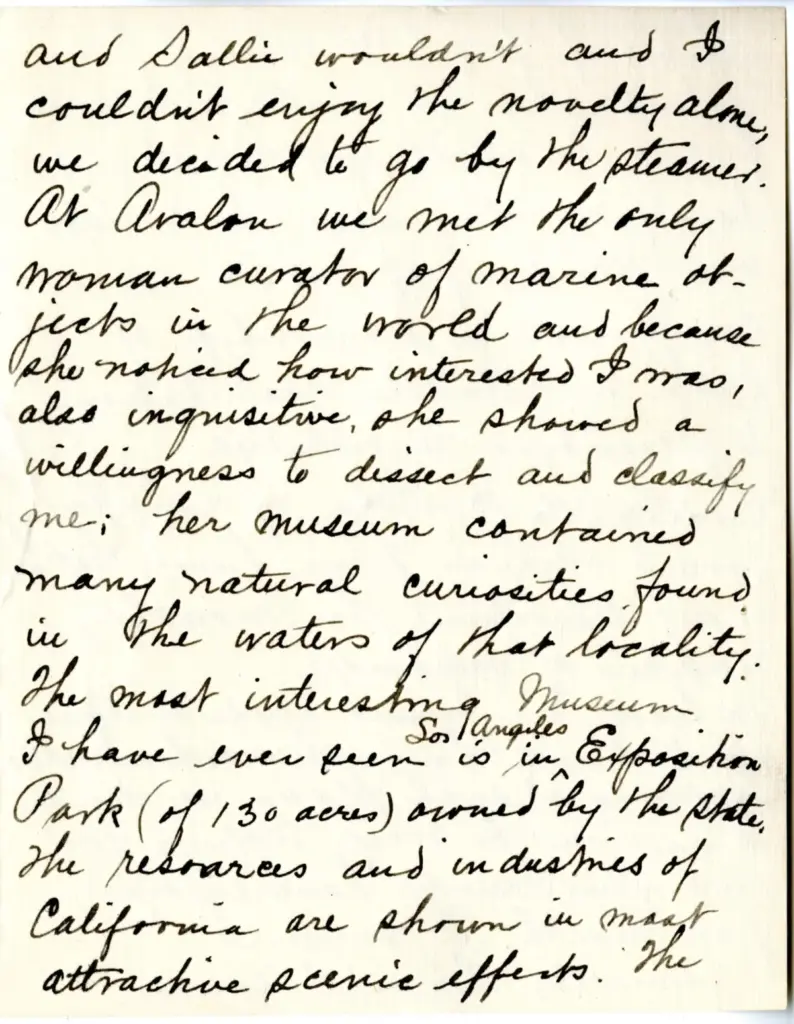
Thanks to a parallel digitization project funded by Dr. William Day and the American Entomological Society—executed by archival intern Will Le—researchers gained laptop access to Aaron’s broader correspondence via PA Photos and Documents. Among these documents is a March 8, 1926, letter detailing Aaron’s travels to Southern California, a region she described rapturously as "the land of perpetual bloom and uninterrupted sounds of birds and insects."
During her time in Santa Monica and Avalon, Aaron encountered a remarkable kindred spirit whose identity remains an active historical mystery. Aaron wrote:
"At Avalon we met the only woman curator of marine objects in the world and because she noticed how interested I was, also inquisitive, she shared a willingness to dissect and classify me; her museum contained many natural curiosities found in the waters of that locality."
Furthermore, Aaron expressed profound admiration for the state-owned museum at Exposition Park in Los Angeles, marveling at its fossil displays of prehistoric fauna and lamenting that her declining health prevented her from helping the Academy of Natural Sciences acquire similar paleolithic treasures.
Presently, library staff at the Academy are treating Aaron’s cryptic mention of "the only woman curator of marine objects in the world" as a compelling new historical investigation, seeking to identify the trailblazing female marine scientist who operated out of Avalon nearly a century ago.
Supporting Context & Metrics
The revival of Carrie Aaron’s scientific legacy is not an isolated incident; it is symptomatic of a broader, systemic shift within GLAM (Galleries, Libraries, Archives, and Museums) institutions leveraging digital infrastructure to correct historical imbalances.
| Metric / Milestone | Detail | Impact |
|---|---|---|
| BHL Anniversary Milestone | 20 Years of Continuous Operation | Democratized access to over 60 million pages of biodiversity literature. |
| Academy Digitization Scope | 83 Rare Notebooks & Journals | Processed, digitized, and transcribed for global public access via BHL. |
| AES Correspondence Project | Complete Collection Digitization | Spearheaded by intern Will Le, bringing archival letters to PA Photos and Documents. |
| Persistent Identifiers Created | BHL Creator ID & Wikidata (Q125503946) | Ensures permanent discoverability and prevents anonymous archiving ("Mrs. Aaron"). |
The convergence of student internships, specialized philanthropic funding (such as grants provided by Dr. William Day and the AES), and international syndication platforms like the Biodiversity Heritage Library demonstrates how modest investments yield exponential returns in historical scholarship.
Official Statements & Institutional Perspectives
The institutional commitment to uncovering and democratizing these narratives is reflected in commentary from the library professionals managing these collections:
- On the Power of Digital Discovery: Library staff note that working with primary sources transformed passive catalogers into active historians. "I don’t consider myself a historian, but it’s difficult to resist historical research when presented with easily accessible primary sources and when given the tools to link subjects across different platforms."
- On the Importance of Global Collaboration: The integration of the Academy’s archives into the Biodiversity Heritage Library underscores the necessity of open-access frameworks. Without cross-platform linking—from local finding aids to Wikidata and the BHL—voices like Carrie Aaron’s would remain trapped in physical boxes in Philadelphia, inaccessible to researchers around the globe.
- On the BHL at 20 Campaign: Emphasizing the core mission of the 20-year-old initiative, BHL representatives stress that digital preservation is fundamentally an act of social equity: "For 20 years, BHL has helped uncover the people and stories hidden within biodiversity literature and archives, making them freely available for new generations to discover. Your support helps us continue digitizing, connecting, and sharing collections like Carrie Aaron’s notebook—and ensures that more overlooked voices and histories can be found."
Future Outlook
The rediscovery of Carrie Aaron opens up several dynamic avenues for future historical research and digital library development at the Academy of Natural Sciences and the broader Biodiversity Heritage Library network:
- Solving the Curatorial Mystery: Archivists and independent researchers are actively cross-referencing California historical directories from the 1920s to identify the anonymous female marine curator in Avalon who fascinated Aaron during her coastal travels.
- Expanding the Field Journal Fixup Initiative: Buoyed by the success of digitizing Aaron’s notebook and the AES correspondence collection, the Academy plans to pursue additional grant funding to process thousands of additional uncatalogued manuscripts, ensuring that other women scientists hidden behind historical marital titles are restored to the historical record.
- Enhancing Linked Open Data Integration: Moving forward, digital resource librarians plan to aggressively integrate Wikidata property statements across all legacy manuscript metadata, ensuring machine-readable connectivity that prevents future anonymous or misattributed catalog entries.
- Deepening Student and Intern Pipelines: By integrating academic interns like Will Le into core archival workflows, institutions ensure that the next generation of information professionals gains hands-on experience in ethical description, transcription, and digital curation.
As the Biodiversity Heritage Library enters its third decade, the story of Carrie Aaron stands as a testament to what can be achieved when rigorous archival standards meet open-access technology. By turning the page on anonymous attribution, the library community is ensuring that the historical record reflects the true, diverse tapestry of those who studied, documented, and fiercely loved the natural world.



