Executive Overview
In the world of rare-book acquisition, the discovery of a historically significant text is always a momentous occasion. However, when that text bridges the gap between Enlightenment-era exploration and modern biological nomenclature—while maintaining a deeply personal historical tie to the institution acquiring it—the find becomes an extraordinary event.
This is the narrative of a recent acquisition by the Field Museum’s Marie Louise Rosenthal Library: a rare, three-volume zoological masterpiece published between 1778 and 1783 by the German geographer, zoologist, and mathematician Eberhard August Wilhelm von Zimmermann. Titled Geographische Geschichte des Menschen, und der allgemein verbreiteten vierfüßigen Thiere, nebst einer hieher gehörigen Zoologischen Weltcharte, this monumental work features a fold-out map widely recognized as the first world map of zoological geography.
As part of the ongoing celebration of the Biodiversity Heritage Library’s (BHL) 20th anniversary—specifically highlighting treasures contributed by the BHL community—this article explores the fascinating intersection of 18th-century exploration, 20th-century bureaucratic nomenclature rulings, and modern digital preservation. Through a meticulous examination of archival records, historical correspondence, and shifting scientific standards, we trace how a disputed text was redeemed, how it reshaped our understanding of global mammalian distributions, and how it is now freely accessible to researchers worldwide through the BHL.
Detailed Chronology: From Enlightenment Discovery to Modern Digitization
To fully appreciate the significance of Zimmermann’s work and its journey into the digital age, we must traverse a timeline spanning nearly two and a half centuries.
1777: The Prototypical Latin Edition
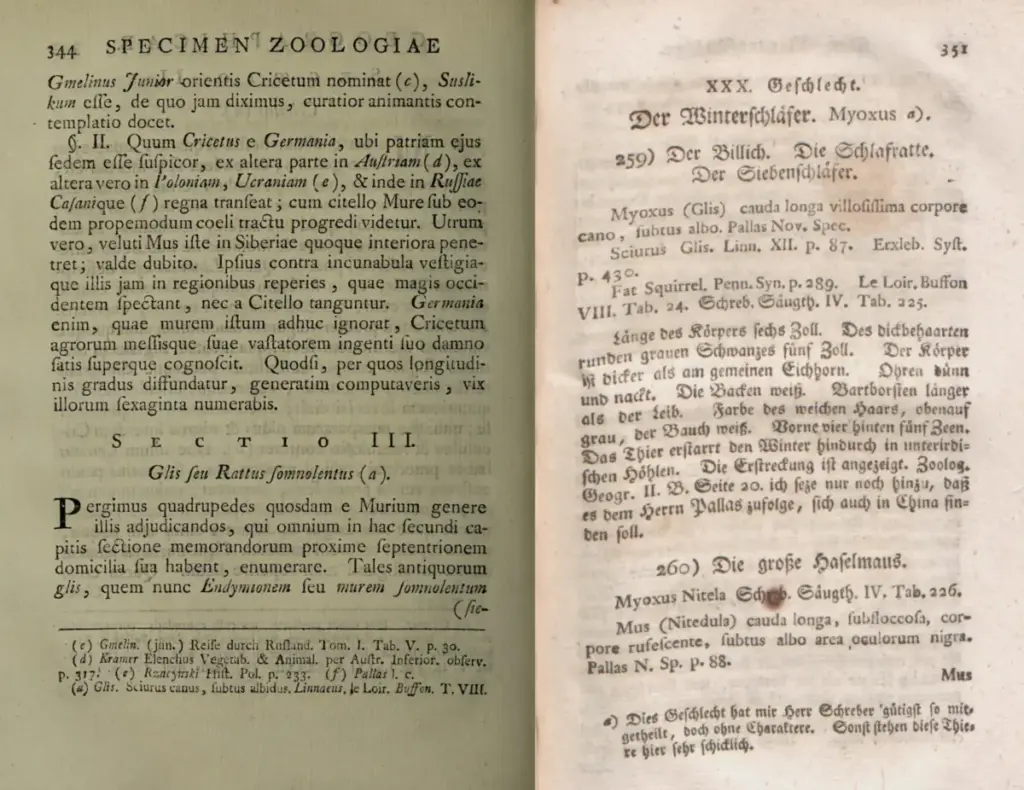
Eberhard August Wilhelm von Zimmermann first attempted to map the global distribution of quadrupeds in his 1777 Latin publication, Specimen zoologiae geographicae, quadrupedum domicilia et migrationes sistens. While ambitious, this early work suffered from a fatal flaw in the eyes of future taxonomists: Zimmermann failed to consistently apply the burgeoning system of binomial nomenclature established by Carl Linnaeus. Instead, he relied on a hodgepodge of generic terms, descriptive phrases, and common names. For instance, where modern science demands a strict two-part Latin name, Zimmermann referred to a species of dormouse using the descriptive phrase Glis seu Rattus somnolentus.
1778–1783: The Definitive German Revision
Recognizing the limitations of his earlier Latin text, Zimmermann significantly overhauled, expanded, and refined his research. Published in three comprehensive volumes between 1778 and 1783, Geographische Geschichte des Menschen, und der allgemein verbreiteten vierfüßigen Thiere represented a monumental leap forward. Crucially, this German edition formally adopted and standardized binomial nomenclature. Within its pages, Zimmermann introduced several binomial names that remain valid and are still attributed to him today, including:

- Cervus muntjak (the muntjac deer)
- Canis zerda (now recognized as Vulpes zerda, the fennec fox)
- Lutra minima (now known as Chironectes minimus, the water opossum)
Furthermore, the work included an updated and vastly improved fold-out map: the Tabula Mundi Geographico Zoologica sistens Quadrupedes hucusque notos sedibus suis adscriptos edidit. This map incorporated cutting-edge geographical data from contemporary maritime expeditions, most notably the voyages of Captain James Cook and his crew aboard the HMS Endeavour.
1954: The International Commission on Zoological Nomenclature (ICZN) Intervenes
The status of Zimmermann’s 1777 and 1778–1783 publications became a subject of intense debate among 20th-century zoologists. The core controversy centered on whether the 1777 Latin edition met the rigorous legal standards required for "nomenclatorial purposes" under the rules of zoological nomenclature.
The matter was brought before the International Commission on Zoological Nomenclature (ICZN). In Opinion 257, published in 1954, the Commission officially rejected the 1777 Specimen zoologiae geographicae for failing to satisfy Article 25 of the Règles internationales de la nomenclature zoologique. Consequently, the 1777 text was placed on the "Official Index of Rejected and Invalid Works in Zoological Nomenclature."
Conversely, the Commission verified that Zimmermann’s 1778–1783 German edition did successfully apply binomial nomenclature. As a result, Geographische Geschichte was triumphantly added to the "Official List of Works Approved as Available for Zoological Nomenclature."
March of the Present Era: Acquisition and Digital Redemption
In March, staff at the Field Museum’s Marie Louise Rosenthal Library identified a pristine copy of Zimmermann’s three-volume German edition available for purchase through a rare book fund. Following a rigorous evaluation process—assessing its historical value, scientific significance, institutional rarity, and digital availability—staff recognized that while the 1777 edition was already accessible via the Biodiversity Heritage Library, the definitive 1778–1783 edition was absent from the BHL corpus.
The acquisition was secured, and through the collaborative preservation efforts of the BHL community, Geographische Geschichte des Menschen has now been fully digitized and integrated into the global digital library.

Supporting Context & Metrics: Mapping the World and Refining Taxonomy
The scientific weight of Zimmermann’s Geographische Geschichte rests on two primary pillars: its revolutionary approach to zoological cartography and its codification of mammalian taxonomy.
The Evolution of the Tabula Mundi Geographico Zoologica
Zimmermann’s fold-out map is celebrated by cartographic historians as the first true world map of zoological geography. While the 1777 edition featured an early iteration, the 1783 map found in Geographische Geschichte reflects a quantum leap in geographic literacy, heavily informed by the discoveries of Captain James Cook.
- Pacific Discoveries: The map reflects Cook’s charting of the Sandwich Islands (modern-day Hawaii).
- North American Coastline: It provides a significantly more accurate and complete rendering of the western coast of North America.
- African Exploration: The Seychelles are explicitly named just east of mainland Africa—a nod to the French colonial settlement established there only thirteen years prior.
On this map, Zimmermann plotted the names of quadrupeds directly over their respective geographic ranges. His labeling convention varied wildly based on convenience: using genera alone, full binomials, or colloquial common names. For example:
- Castor (beaver) and Bison blanket northern North America.
- Tigris (tiger) prowls the landscapes of Asia.
- Kanguro (kangaroo) is boldly marked across New Holland (Australia), documenting an animal only recently introduced to European science by botanist Daniel Solander aboard Cook’s HMS Endeavour.
Taxonomic Comparison: Dormice as a Case Study
The shift from Zimmermann’s 1777 methodology to his 1783 standard highlights the maturation of 18th-century taxonomy.
| Edition | Publication Year | Taxon Example | Nomenclatorial Style | Modern Status |
|---|---|---|---|---|
| Specimen | 1777 | Fat Dormouse | Glis seu Rattus somnolentus (Descriptive phrase) | Invalid for nomenclature (Rejected by ICZN Opinion 257) |
| Geographische Geschichte | 1780 (Vol. 2) | Fat Dormouse | Myoxus glis (Binomial format) | Valid baseline; species currently recognized as Glis glis (Linnaeus, 1766) |
This evolution underscores why the 1954 ICZN ruling was so vital: it separated preliminary, non-compliant natural history essays from rigorously structured scientific literature that could safely serve as the foundation for modern zoological nomenclature.
Official Statements and Institutional Collaboration: The Field Museum’s Hidden Hand
One of the most compelling revelations surrounding the 1954 ICZN ruling is that it was not merely an abstract bureaucratic decision made in a vacuum; it was directly shaped by the expertise and advocacy of scientists at the Field Museum of Natural History in Chicago.

The Osgood-Hershkovitz Advocacy
When the ICZN deliberated on the validity of Zimmermann’s works, the Secretary of the Commission, Francis Hemming, engaged in extensive correspondence with prominent mammalogists. Archival records reveal that Hemming consulted directly with Wilfred H. Osgood, a towering figure in American mammalogy and a curator at the Field Museum, who vigorously advocated for the formal recognition of Zimmermann’s Geographische Geschichte.
To bolster his case, Hemming also sought the counsel of Philip Hershkovitz, then serving as the Field Museum’s Curator of Mammals. Hershkovitz fully supported Osgood’s position, confirming that the German edition’s consistent application of binomial nomenclature and its monumental contributions to biogeography warranted its protection and inclusion on the official approved lists.
This behind-the-scenes institutional involvement transforms the Field Museum’s recent acquisition from a simple library purchase into a homecoming of sorts. The museum’s historical staff laid the very groundwork that legitimized the book’s place in scientific history, and today, the Rosenthal Library proudly houses the physical manifestation of that legacy.
Future Outlook: The Living Scientific Record
The story of Eberhard August Wilhelm von Zimmermann’s Geographische Geschichte offers a profound lesson on the longevity and malleability of the scientific record. As demonstrated by the 1954 ICZN ruling—which occurred nearly 170 years after the ink on the final volume dried—historical texts are never truly static. They are continually re-evaluated, contested, and re-contextualized by new generations of researchers.
Today, thanks to the collaborative preservation efforts of the Biodiversity Heritage Library and the dedication of institutions like the Field Museum, both the rejected 1777 Latin prototype and the triumphant 1778–1783 German masterwork are available side by side in the digital commons. Researchers in evolutionary biology, historical cartography, and the philosophy of science can now examine the raw materials of 18th-century zoology with unprecedented clarity.
As BHL marks its 20th anniversary, this case study stands as a shining testament to the core mission of open-access digital heritage: rescuing rare, historically vital literature from obscurity and placing it directly into the hands of a global audience—ensuring that the foundational texts of our natural world continue to inspire, educate, and provoke discovery for centuries to come.