In response to mounting scientific evidence linking artificial garden feeding stations to the transmission of lethal avian diseases, the Royal Society for the Protection of Birds (RSPB) has introduced a transformative nationwide guidance framework. Centered on the core mandate to "Feed Seasonally, Feed Safely," this initiative marks a pivotal shift in modern ornithological conservation. No longer is year-round supplementary feeding viewed as an unmitigated good; contemporary research underscores that poorly managed backyard feeding stations can inadvertently act as vectors for highly contagious pathogens, most notably trichomonosis.
To safeguard vulnerable populations of blue tits, greenfinches, and other iconic garden visitors, conservationists are urging a fundamental rethinking of how humans interact with local wildlife. Rather than relying exclusively on artificial seed mix and high-fat blocks—which require stringent hygiene protocols and strict temporal limitations—homeowners are being encouraged to transform their garden borders into self-sustaining ecosystems. By integrating native flora, seed-bearing perennials, and berry-producing trees, gardeners can provide a natural, continuous, and disease-resilient food web. This report details the scientific imperatives behind the RSPB’s new directive and explores 26 exceptional plants designed to turn any backyard into a haven for avian wildlife.

Detailed Chronology: The Path to Modern Feeding Guidance
The evolution of backyard bird feeding policy has been shaped by decades of ecological observation, epidemiological research, and shifting environmental pressures. Understanding the path that led to the RSPB’s 2024 guidance reveals why seasonal and hygienic interventions have become so urgent.
- Early 20th Century – The Rise of Backyard Feeding: Supplementary feeding gained popularity as a benevolent hobby, particularly during harsh winter months when natural foraging resources dwindled. At this stage, little was understood about the long-term ecological consequences of concentrating wild birds around artificial food sources.
- The 2000s – Emergence of Trichomonosis: A dramatic decline in greenfinch populations across the United Kingdom signaled a biological crisis. Pathologists identified Trichomonas gallinae, a microscopic parasite responsible for trichomonosis, jumping from game birds and pigeons into suburban songbird populations. High-density garden feeders were rapidly identified as primary transmission hubs.
- The 2010s – Growing Calls for Biosecurity: Conservation organizations began issuing preliminary warnings regarding feeder hygiene, recommending regular cleaning routines. However, guidance remained generalized, often failing to address the risks of continuous, year-round feeding during spring and summer breeding seasons.
- Early 2024 – The "Feed Seasonally, Feed Safely" Framework: Backed by comprehensive epidemiological studies, the RSPB formally released its updated guidelines. This landmark policy established clear temporal boundaries for supplementary feeding (restricting high-fat items between May and October) and outlined rigorous cleaning protocols to mitigate pathogen spread.
- Present Day – Habitat Integration: The conservation paradigm has expanded beyond mere feeder management. The modern focus emphasizes structural planting—transforming garden borders into natural feeding grounds that reduce reliance on artificial stations altogether.
Supporting Context & Metrics: The Science of Disease and Foraging
The necessity for the RSPB’s revised guidance is rooted in hard ecological data. Trichomonas gallinae is a protozoan parasite that causes lesions in the upper digestive tract of infected birds, making it difficult or impossible for them to swallow. Because garden feeders force multiple species into close physical proximity, contaminated food and water bowls transform into contagion hotbeds. Studies show that finch species feeding on flat surfaces or crowded platforms are disproportionately affected.

To combat this, the "Feed Seasonally, Feed Safely" initiative establishes strict operational boundaries:
- The Summer Restriction Window (May 1 to October 31): During these months, natural food sources—such as caterpillars, flying insects, and early seed sets—abound. Offering large quantities of high-energy suet, fatballs, or mealworms during this period is not only unnecessary but encourages unnaturally high bird densities at artificial sites, accelerating disease transmission. Peanuts and seeds should be strictly reserved for late autumn and winter.
- Rigorous Biosecurity Protocols: When feeders are deployed, they must be moved regularly to prevent the accumulation of toxic droppings and spilt food. Flat-surface feeders, such as traditional wooden bird tables, are strongly discouraged due to the ease with which they become soiled. Cleaning requires dedicated protective gear—including rubber gloves—and the restriction of washing brushes exclusively to avian maintenance to prevent cross-contamination.
Official Statements and Conservation Insights
Conservation scientists and horticulturists have been vocal about the paradigm shift required in domestic gardening.

"Our research demonstrates clearly that while the public has a profound and admirable desire to help garden wildlife, continuous and unmonitored feeding can inadvertently cause harm," noted an RSPB avian health researcher. "By shifting our focus toward seasonal moderation and rigorous hygiene—while simultaneously planting wildlife-friendly flora—we can support bird populations safely and sustainably."
Experts emphasize that nature-led gardening offers a superior alternative to artificial feeding stations during the warmer months. As leading horticulturists point out, planting perennial borders that naturally cycle through flowering, seeding, and decaying stages provides a dynamic menu that aligns perfectly with avian nutritional requirements across all four seasons.

The 26 Best Plants for Feeding Garden Birds
To help gardeners embrace this habitat-first approach, the following curated list details 26 outstanding plants, grasses, climbers, and trees that provide essential natural food sources, shelter, and beauty.
1. Sunflower (Helianthus annuus)
Dwarf varieties like ‘Choco Sun’ offer stunning summer displays without requiring staking. Left standing into autumn, their heavy seedheads become an irresistible feast for blue tits and greenfinches. Note: Ensure you select pollen-producing varieties rather than sterile, pollenless cultivars.

- Type: Annual | Wildlife rating: 4/5 | Beauty rating: 4/5
2. Ornamental Millet (Pennisetum glaucum ‘Purple Baron’)
Standing at 90cm with deep purple foliage and feathery summer spikes, this grass provides striking architectural contrast in borders. Once flowering concludes, seed-eating birds descend in flocks to harvest the grain.
- Type: Annual | Wildlife rating: 3/5 | Beauty rating: 3/5
3. Cornflower (Centaurea cyanus)
Compact cultivars like ‘Polka Dot Mixed’ thrive effortlessly in pots and borders, producing blue, pink, and purple blooms. Their flowers attract vital pollinating insects for insectivorous birds, while their mature seeds are a favorite of goldfinches.

- Type: Annual | Wildlife rating: 3/5 | Beauty rating: 4/5
4. Teasel (Dipsacus fullonum)
This statuesque biennial produces bristly, cylindrical flowerheads in mid-to-late summer. When dried, their seed-laden architecture remains a beacon for goldfinches equipped with narrow, pointed beaks.
- Type: Biennial | Wildlife rating: 3/5 | Beauty rating: 3/5
5. Knapweed (Centaurea nigra)
A true champion of wildlife gardening, knapweed features thistle-like purple blooms that pull in heavy numbers of bees and pollinators. These insects attract dunnocks, while goldfinches feast on the half-ripe seeds.

- Type: Perennial | Wildlife rating: 5/5 | Beauty rating: 5/5
6. Field Scabious (Knautia arvensis)
Reaching up to 1.5 meters, this wildflower produces delicate blue heads that feed pollinators and host moth caterpillars. Post-flowering, its seedheads are heavily foraged by sparrows and finches.
- Type: Perennial | Wildlife rating: 4/5 | **Beauty rating:*** 4/5
7. Michaelmas Daisy (Symphyotrichum novi-belgii)
Delivering vibrant pink, purple, and blue hues when most summer blooms have faded, Michaelmas daisies provide essential late-season nectar and produce abundant seed crops for goldfinches.

- Type: Perennial | Wildlife rating: 4/5 | Beauty rating: 5/5
8. Self-Heal (Prunella vulgaris)
An underrated, low-growing perennial that thrives in lawns and borders alike. Its violet flower clusters attract pollinators, and its spent seed spikes provide reliable sustenance for house sparrows and dunnocks.
- Type: Perennial | Wildlife rating: 4/5 | Beauty rating: 3/5
9. Coneflower (Rudbeckia fulgida)
Offering radiant golden blooms with dark centers from July through October, coneflowers provide open, accessible seedheads that finches and sparrows can easily harvest.

- Type: Perennial | Wildlife rating: 3/5 | Beauty rating: 5/5
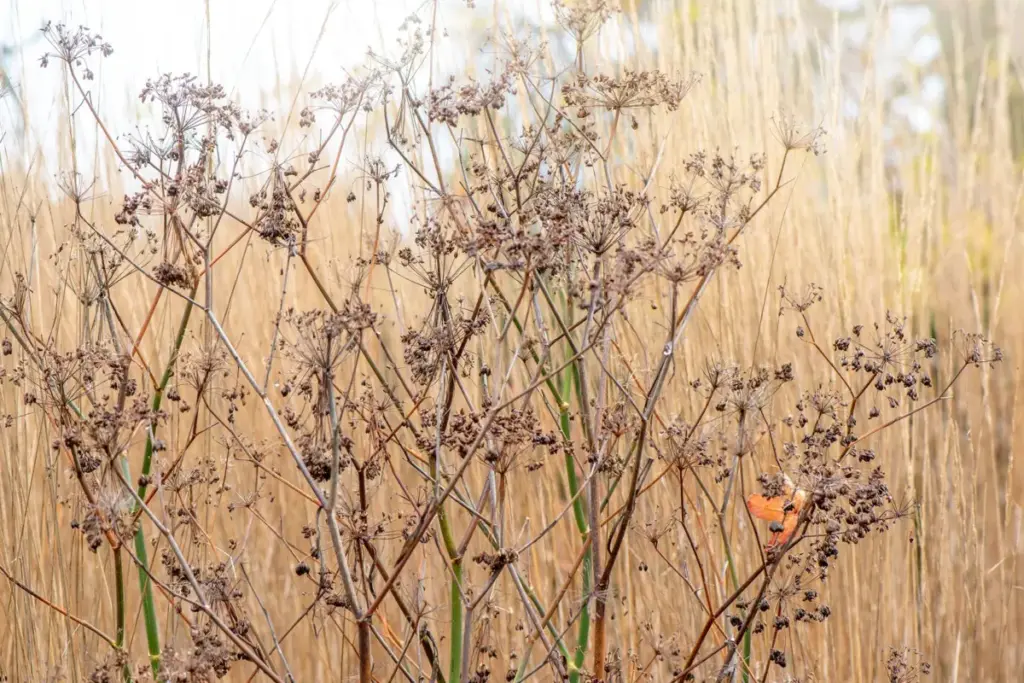
10. Fennel (Foeniculum vulgare)
With feathery foliage and towering umbels, fennel naturally attracts aphids and small garden insects. Insectivores like blue tits make short work of the pests, while the drying seed umbels provide rich sustenance later in the year.
- Type: Perennial | Wildlife rating: 4/5 | Beauty rating: 4/5
11. Verbena (Verbena bonariensis)
Tall, slender stems topped with purple clusters allow sparrows and finches to practice their acrobatic balancing skills while plucking autumn seeds.

- Type: Perennial | Wildlife rating: 4/5 | Beauty rating: 5/5
12. Chicory (Cichorium intybus)
Wild chicory features pale blue, cornflower-like blooms that endure through summer droughts. Its architectural seed heads are a noted favorite among local finch populations.
- Type: Perennial | Wildlife rating: 4/5 | Beauty rating: 5/5
13. Firethorn (Pyracantha spp.)
An exceptional multi-season shrub, firethorn offers spring blossoms for insectivores, dense spiny cover for nesting safety, and an explosion of vibrant red and orange berries for thrushes and winter migrants.

- Type: Evergreen shrub | Wildlife rating: 4/5 | Beauty rating: 4/5
14. Wild Honeysuckle (Lonicera periclymenum)
Supporting dozens of moth caterpillars that feed developing nestlings, honeysuckle also yields sweet-scented night blooms and red autumn berries relished by robins, blackcaps, and thrushes.
- Type: Semi-evergreen climber | Wildlife rating: 5/5 | Beauty rating: 5/5
15. Ivy (Hedera helix)
Far more than a simple climber, mature ivy supports late-season hoverflies and bees in autumn, followed by calorie-dense winter berries that sustain thrushes and wood pigeons when all else fails.

- Type: Evergreen climber | Wildlife rating: 5/5 | Beauty rating: 3/5
16. Mistletoe (Viscum album)
This hemiparasitic shrub produces iconic white berries that give mistle thrushes their name. Overwintering blackcaps also depend heavily on its sticky fruit during harsh months.
- Type: Evergreen shrub | Wildlife rating: 3/5 | Beauty rating: 3/5
17. Lavender (Lavandula angustifolia)
While typically pruned after summer flowering, leaving a few non-sterile English lavender plants to go to seed creates an exceptional autumn buffet for local sparrows and finches.

- Type: Evergreen shrub | Wildlife rating: 4/5 | Beauty rating: 5/5
18. Elder (Sambucus nigra)
Elder delivers fragrant spring blossom sprays followed by heavy clusters of dark berries in autumn. Starlings, warblers, and thrushes gorge on the fruit to fuel migration and winter survival.
- Type: Deciduous shrub | Wildlife rating: 4/5 | Beauty rating: 4/5
19. Guelder Rose (Viburnum opulus)
A native hedge staple producing lace-cap white flowers and translucent red berries. Ensure you select berry-producing species rather than sterile garden hybrids like ‘Roseum’ to feed bullfinches and thrushes.

- Type: Deciduous shrub | Wildlife rating: 4/5 | Beauty rating: 4/5
20. Oregon Grape (Mahonia aquifolium)
Flowering in late winter and early spring, mahonia provides vital early nectar for blue tits, followed by blue-black berries that perfectly time their ripening for juvenile blackbirds.
- Type: Evergreen shrub | **Wildlife rating:* 4/5 | Beauty rating:** 3/5
21. Hawthorn (Crataegus monogyna)
Supporting over 500 invertebrate species on its foliage alone, hawthorn is an ecological powerhouse. Its autumn haws feed fieldfares, redwings, and finches across the British Isles.

- Type: Deciduous tree | Wildlife rating: 5/5 | Beauty rating: 4/5
22. Crab Apple (Malus)
From spring aphids and caterpillars to autumn fruits favored by waxwings and thrushes, crab apple trees provide reliable, multi-seasonal sustenance—even attracting amber-listed bullfinches to spring buds.
- Type: Deciduous tree | Wildlife rating: 5/5 | Beauty rating: 5/5
23. Hazel (Corylus avellana)
Essential for spring caterpillars that feed tit chicks, hazel trees also draw jays, nuthatches, and great-spotted woodpeckers in autumn to harvest and cache nutritious hazelnuts.

- Type: Deciduous tree | Wildlife rating: 5/5 | Beauty rating: 4/5
24. Holly (Ilex aquifolium)
Glossy winter berries provide critical calories for thrushes. To secure a berry crop, plant female cultivars (such as ‘Argentea Marginata’) alongside a compatible male pollinator like ‘Silver Queen’.
- Type: Evergreen tree | Wildlife rating: 4/5 | Beauty rating: 4/5
25. Silver Birch (Betula pendula)
A graceful native tree hosting numerous moth larvae. In winter, goldfinches and siskins flock to its drooping catkins to extract tiny winged seeds, while woodpeckers frequently nest in its aging trunks.

- Type: Deciduous tree | Wildlife rating: 5/5 | Beauty rating: 5/5
26. Rowan (Sorbus aucuparia)
Displaying brilliant autumn foliage, rowan trees support over 150 insect species. Their bright red berries are the absolute favorite of waxwings—which can consume twice their body weight daily—alongside starlings and fieldfares.
- Type: Deciduous tree | Wildlife rating: 5/5 | Beauty rating: 4/5
Future Outlook: Sustainable Habitats for Generations to Come
The RSPB’s guidance represents a critical maturation in humanity’s relationship with urban wildlife. As suburban development places increasing pressure on natural landscapes, backyard gardens can no longer be viewed merely as aesthetic extensions of the home; they must function as vital ecological corridors.

By embracing the "Feed Seasonally, Feed Safely" framework—exercising restraint during the sensitive spring and summer breeding months, maintaining pristine hygiene standards when supplementary feeding is necessary, and anchoring garden design in native, biodiversity-rich flora—homeowners can actively combat the spread of avian disease. Cultivating plants such as sunflowers, teasels, hawthorns, and rowans ensures that backyard birds receive safe, natural nutrition. Ultimately, this holistic approach promises healthier avian populations, resilient local ecosystems, and a deeper, more sustainable connection to the natural world right outside our windows.