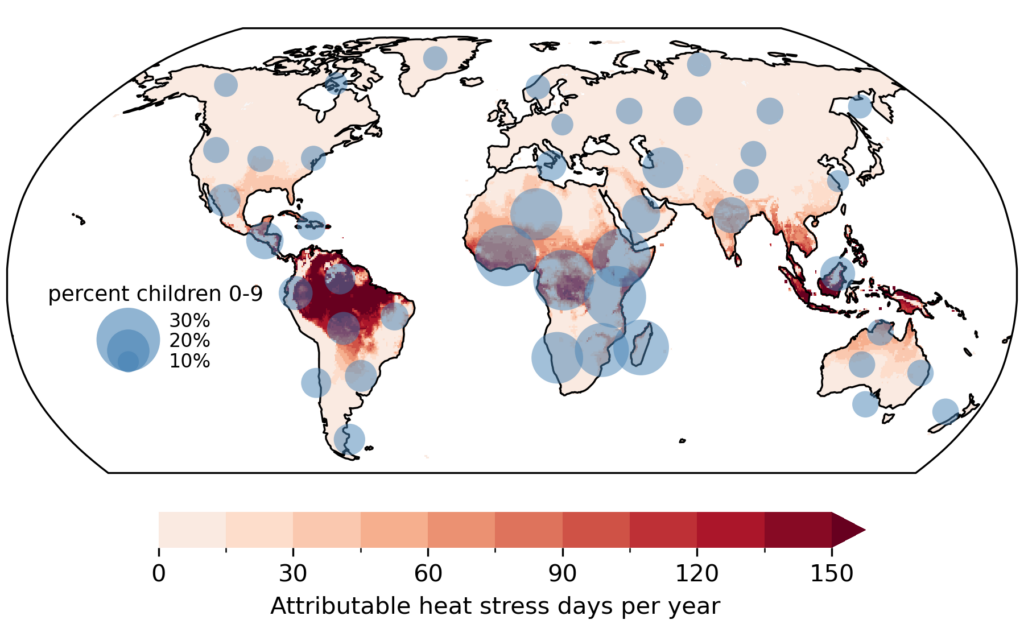
More than 40% of children under the age of 10 worldwide—representing approximately 583 million young lives—are already enduring at least 20 additional "heat-stress days" every year solely due to human-induced climate change. This troubling finding comes from a study published in Science Advances, which integrates state-of-the-art climate models with global demographic data to map age-specific exposures to extreme humid heat.
The study demonstrates that children up to nine years old currently face greater additional exposure to dangerous, humid heat than any other demographic age group on Earth. This disparity is predominantly driven by geography and demographic trends: regions enduring the sharpest increases in climate-driven extreme heat—specifically West Africa, South Asia, and Southeast Asia—are precisely those experiencing rapid population growth with the highest proportion of young children.
As global temperatures continue to rise, the research warns that children will consistently remain the most exposed cohort. Beyond the physiological risks posed by extreme heat, the study raises profound ethical questions regarding intergenerational equity and climate justice. Lead researcher Rosa Pietroiusti emphasizes that the children suffering the most acute environmental burdens reside in developing nations that have contributed the absolute least to historical greenhouse gas emissions.
Detailed Chronology of Climate-Exposure Research
To fully understand the significance of the latest findings published in Science Advances, it is essential to trace the evolving trajectory of academic research into generational climate exposure over recent years.
       2021 STUDY                            2025 STUDY                            2026 STUDY
┌──────────────────────────┐          ┌──────────────────────────┐          ┌──────────────────────────┐
│  Establishes that youth  │          │ Finds >50% of kids born  │          │ Pietroiusti et al. in    │
│  born in the 21st        │ ───────► │ in 2020 (~62M) will face │ ───────► │ Science Advances maps    │
│  century face more       │          │ unprecedented lifetime   │          │ current/future humid     │
│  extremes than parents.  │          │ heatwaves even at 1.5°C. │          │ heat stress by age cohort│
└──────────────────────────┘          └──────────────────────────┘          └──────────────────────────┘
The Foundational 2021 Generational Exposure Study
In 2021, a landmark study established a empirical framework proving that individuals born in the 21st century would experience vastly more extreme weather events over their lifetimes than their parents or grandparents. The analysis shifted the scientific dialogue from generic global temperature averages to the tangible, lived experiences of specific age cohorts.
The 2025 Cohort Assessment
Four years later, scientists building on the 2021 research focused specifically on infants born at the turn of the decade. Their findings revealed that more than half of all children born in 2020—approximately 62 million individuals—would face "unprecedented lifetime exposure" to severe heatwaves, even under an optimistic scenario where global warming is successfully capped at 1.5°C above pre-industrial levels.
The 2026 Empirical Attribution Study
Building directly upon these foundation works, the 2026 study led by Rosa Pietroiusti at Vrije Universiteit Brussel moves from long-term lifetime projections to present-day empirical reality. By evaluating present-day climate conditions (represented by 2023 levels of warming at 1.3°C above pre-industrial baselines), the team proved that children are already living through significantly more climate-attributed days of dangerous humid heat than older generations.
Supporting Context & Metrics
The Science of Humid Heat and the WBGT Index
Extreme heat poses a severe threat to human biology, but its lethality increases exponentially when paired with high atmospheric humidity. Under normal conditions, the human body thermoregulates through sweat evaporation. However, as relative humidity rises, ambient air becomes saturated, drastically reducing the efficiency of evaporative cooling and leading to heat accumulation within the body.
To capture this risk, the study utilized the indoor Wet-Bulb Globe Temperature (WBGT) metric—a standard measurement evaluating thermal stress by combining air temperature and humidity.
Heat-Stress Day Definition: Any day recording an indoor WBGT exceeding 28°C, recognized by medical and meteorological standards as the threshold for "moderate heat stress."
Attributable Days Calculation: Researchers modeled present-day temperature patterns (at 1.3°C warming) against a counterfactual pre-industrial climate lacking human-caused emissions. The difference between these two scenarios yields the number of extra, climate-change-driven heat-stress days.
Demographic Asymmetry and Geographic Disparities
The study highlights a distinct geographical and demographic disparity between the Global South and Global North. Tropical, low-latitude regions carry the vast majority of climate-attributed heat days while simultaneously housing the youngest demographic profiles.
Region / Country
Average Annual Heat-Stress Days (WBGT > 28°C)
Anthropogenic Climate Change Contribution
Primary Demographic Characteristics
Côte d’Ivoire
112 days / year
~50% (~56 extra days)
Young population, high birth rates, low latitude
Germany
0.1 days / year
~100% (virtually all attributable)
Aging population, low fertility rates, mid-to-high latitude
West Africa
High overall exposure
Substantial increase over baseline
Rapid population growth, highest proportion of under-10s
South & SE Asia
High overall exposure
Substantial increase over baseline
Massive overall child population exposed to tropical humidity
In Côte d’Ivoire, residents experience 112 heat-stress days annually, roughly half of which exist purely due to fossil-fuel-driven warming. Conversely, Germany averages just 0.1 heat-stress days per year under the WBGT indoor metric.
Lead author Rosa Pietroiusti notes that while the European metric appears low, the study intentionally focuses on humid heat thresholds rarely triggered in northern latitudes. Furthermore, the global scale of the climate models does not capture the localized "urban heat island" effect, which can significantly amplify local heat in dense European cities.
Future Warming Trajectories (SSP2 Scenario)
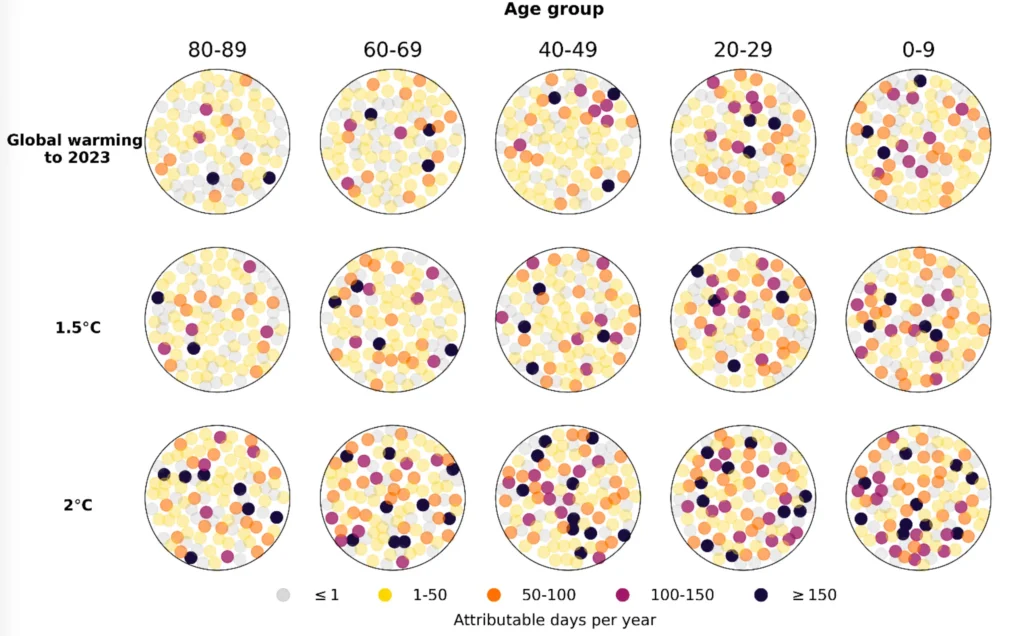
Using the Shared Socioeconomic Pathway 2 (SSP2)—a middle-of-the-road demographic trajectory where global population peaks above 9 billion in the late 21st century—the study projected future exposure across three warming levels:
Percentage of Demographics Facing ≥100 Extra Heat-Stress Days/Year:

  CHILDREN UNDER 10
  Present (1.3°C) [███░░░░░░░] 11%
  1.5°C Warming   [████░░░░░░] 13%
  2.0°C Warming   [███████░░░] 23%

  ADULTS AGED 60-69
  Present (1.3°C) [█░░░░░░░░░] 6%
  1.5°C Warming   [██░░░░░░░░] 9%
  2.0°C Warming   [█████░░░░░] 17%
Present-Day Climate (1.3°C): 11% of children under 10 (583 million) face $ge$20 attributable heat-stress days, and 11% face $ge$100 extra heat days per year. By contrast, only 6% of adults aged 60–69 face $ge$100 extra heat days.
At 1.5°C Warming: 13% of children under 10 will experience $ge$100 attributable heat-stress days annually, compared to 9% of older adults.
At 2.0°C Warming: Nearly a quarter—23%—of all children under 10 worldwide will endure $ge$100 extra heat-stress days each year, compared to 17% of adults aged 60–69.
Official Statements & Expert Analysis
The publication of Pietroiusti et al.’s research has sparked key discussions across climate science, public health, and ethics. Experts inside and outside the research team offer complementary and contrasting insights regarding vulnerability metrics, physiological adaptation, and data reporting gaps.
Lead Author Insights: Climate Justice and Data Representation
Speaking to Carbon Brief, lead author Rosa Pietroiusti underscored the profound climate justice implications embedded in the study’s data:
"The findings should inform discussions about climate justice… children in developing countries have contributed the least to historical greenhouse gas emissions."
Pietroiusti also highlighted critical data collection deficits in international humanitarian tracking. Historical databases such as EM-DAT frequently underreport African heatwaves due to a lack of formal institutional reporting and media coverage.
"Studies like this, which start from the climate data, can start to fill some of these gaps… A really important step forward in the research community would be to link up climate science and health science experts to do research on what metrics are really most representative of, for example, health impacts and educational impacts that children will be suffering."
   ┌─────────────────────────────────────────────────────────────────────────┐
   │                         THE DATA GAP IN HEAT REPORTING                  │
   ├─────────────────────────────────────────────────────────────────────────┤
   │ Historic Disaster Databases (e.g., EM-DAT)                              │
   │ ──► Rely on formal reporting and media coverage                         │
   │ ──► Consequence: Severe underrepresentation of heatwaves in Africa      │
   │                                                                         │
   │ Pietroiusti et al. Top-Down Scientific Approach                         │
   │ ──► Relies directly on physical climate models & demographic grids       │
   │ ──► Consequence: Bypasses media bias; uncovers hidden tropical risks   │
   └─────────────────────────────────────────────────────────────────────────┘
Critical Counterpoint: Elderly Vulnerability and Mid-Latitude Acclimatization
Dr. Qinqin Kong, a postdoctoral researcher in medicine and health policy at Stanford University who was not involved in the study, commended the research’s methodology while offering a nuance regarding relative biological and social risk:
"The paper provides timely quantitative evidence for discussions of climate justice, children’s rights, and intergenerational equity. However, it may overstate the contrast between children and the elderly and underestimate the relative burden of older adults.
The elderly may also be more vulnerable due to their social circumstances. Children often benefit from parental supervision and caregiving, whereas many older adults live alone, have limited mobility, and face barriers to accessing cooling or emergency assistance during heat events."
Dr. Kong further noted that populations living in mid-latitude regions across Europe and North America remain uniquely unadapted to rising heat levels:
"Europe shows substantially stronger relative risk of heat mortality likely due to less heat-acclimatised populations, lower air conditioning prevalence, and urban designs that don’t favour heat dissipation."
Adaptation and Resilience Nuances
Dr. Daniel Vecellio, a researcher at the University of Nebraska who was also unaffiliated with the paper, acknowledged that while children are historically an "understudied cohort," there remain physiological and behavioral reasons for cautious optimism:
"Children are typically pretty good behavioural adapters to extreme heat, and people who are chronically exposed to extreme heat will have a better chance at better acclimatisation."
Future Outlook & Policy Implications
The findings of Pietroiusti et al. highlight an urgent need to rethink climate adaptation, public policy, and public health infrastructure worldwide.
┌─────────────────────────────────────────────────────────────────────────────┐
│                          KEY STRATEGIC IMPLICATIONS                         │
├─────────────────────────────────────────────────────────────────────────────┤
│ 1. Tailored Health Metrics                                                  │
│    Development of child-specific heat metrics combining climate modeling    │
│    with pediatric health and educational outcome data.                      │
│                                                                             │
│ 2. Climate Justice & Financing                                              │
│    Targeted Loss and Damage funding directed toward pediatric climate       │
│    resilience in sub-Saharan Africa, South Asia, and Southeast Asia.        │
│                                                                             │
│ 3. Physical & Social Adaptation                                             │
│    Retrofitting schools, childcare facilities, and urban areas in high-risk  │
│    tropical zones with passive cooling and reliable ventilation.            │
└─────────────────────────────────────────────────────────────────────────────┘
1. Re-engineering Public Health Metrics for Children
Standard environmental metrics like the 28°C indoor WBGT threshold were originally developed using adult physiological baselines. As highlighted by the study’s authors, future research must build dedicated metrics that track how humid heat affects early childhood physiology, cognitive development, and educational attendance. School closures and thermal stress in non-air-conditioned classrooms pose a direct threat to human capital formation in developing nations.
2. Operationalizing Climate Justice in Global Finance
With over 583 million young children already subject to tens of additional dangerous heat days per year, international climate negotiations must incorporate pediatric risk into funding allocations. Developing nations in West Africa and Asia require targeted international funding to build heat-resilient communities, upgrade healthcare systems, and install sustainable cooling systems.
3. Urban Planning and Infrastructure Adaptation
To mitigate the combined threats of humid heat and urban heat island effects, policy responses must emphasize localized adaptation strategies. In tropical, rapidly growing urban centers, civil planners must prioritize passive building cooling, expanded green canopy cover, and protected outdoor spaces. Simultaneously, developed mid-latitude regions must prepare their aging populations and historically unacclimated infrastructure for increasingly intense, novel heat extremes.
The findings in Science Advances make it clear that climate change is no longer a distant threat for future generations to navigate. For hundreds of millions of children around the globe, dangerous, climate-driven heat stress is already an inescapable daily reality.