

By Abraham Utama
BBC Indonesia
Executive Overview
High above the tropical canopy of Indonesia’s westernmost territory, nestled within the jagged contours of the Sudirman mountain range, an ancient environmental milestone is approaching its final, tragic chapter. For centuries, the soaring peaks of Papua—situated just a stone’s throw from the equator on the world’s second-largest island—have defied their tropical latitude, bearing crowns of pristine "eternal snow." These high-altitude glaciers have served as an invaluable barometer of the Earth’s climatic shifts, while simultaneously functioning as the sacred, beating heart of indigenous cosmology for the region’s traditional inhabitants.
Today, that chronicle of ice is nearly extinguished.
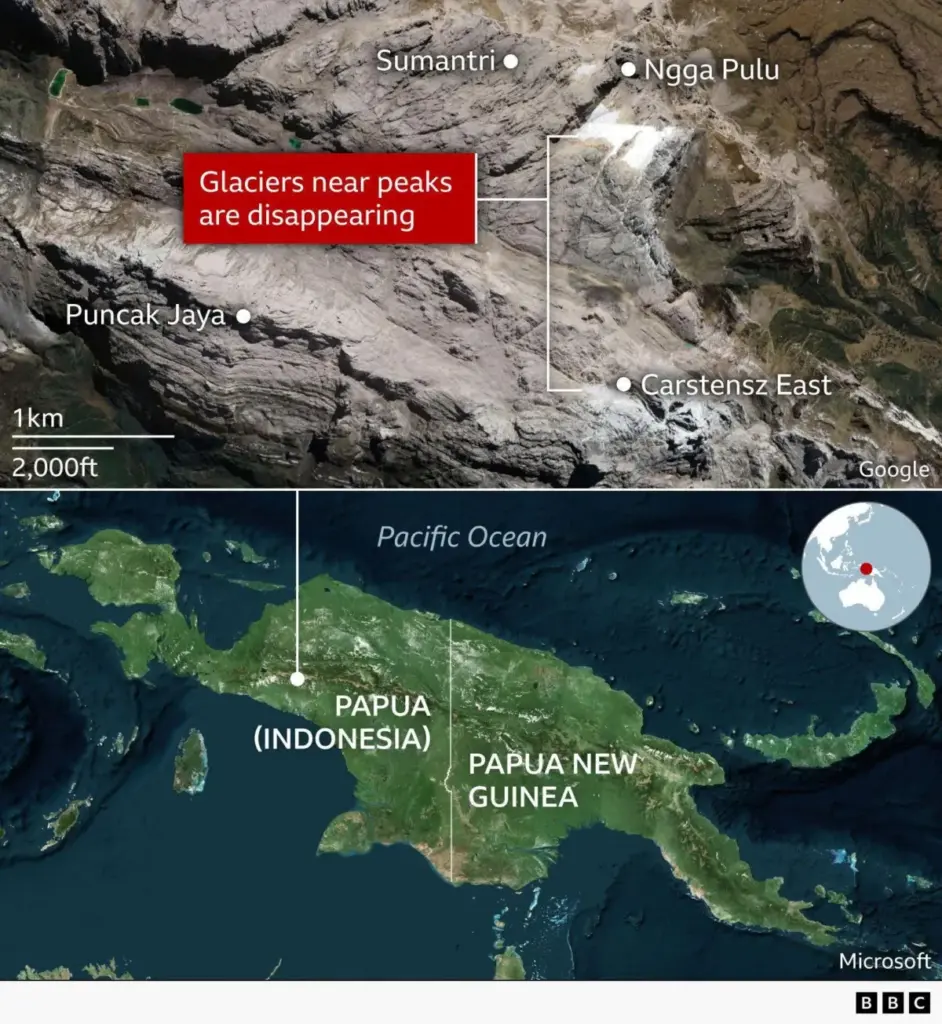
A century ago, permanent ice and thick blankets of snow coated all four of the major crests along a rugged 300-kilometer (190-mile) stretch of the Sudirman Range. Now, only desperate, isolated fragments cling to the slopes surrounding Puncak Jaya, more commonly known as the Carstensz Pyramid. Scientific projections indicate these last remnants will completely vanish within the next one to two years.
Once spanning nearly 1,900 hectares (4,700 acres) in the late 19th century, glacial coverage around Puncak Jaya has collapsed to roughly 16 hectares (40 acres). Entire glacial systems, forged over millennia, have dissolved within the span of a single human lifetime. As the equatorial ice evaporates into the warming atmosphere, it carries away an irreplaceable repository of planetary history and delivers a devastating blow to the cultural identity of the Indigenous communities who revere the mountains as their spiritual sanctuary.
Detailed Chronology: The Rapid Retreat of the Sudirman Range
The history of the Sudirman Range’s glaciation is a tale of rapid, unprecedented decline driven by accelerating global temperature anomalies. Understanding the pace of this loss requires looking back at historical photographic records and modern scientific expeditions.

The Turn of the 20th Century: A Robust Tropical Glacial System
At the dawn of the 1900s, the high peaks of New Guinea—specifically the Sudirman Range—were formidable alpine environments. Glaciers descended deeply into mountain valleys, shielded by extreme elevations and localized climatic phenomena. Spanning roughly 1,900 hectares, these ice fields represented a rare geographic anomaly: massive, permanent tropical glaciers situated merely 450 kilometers (280 miles) south of the equator.
The Mid-20th Century: Documenting the Decline
The first clear visual warnings of the glaciers’ vulnerability emerged in the 1930s. Photographic expeditions, notably those captured during early mountaineering and scientific surveys in 1936, documented expansive white snowfields cradling Puncak Jaya and its neighboring peaks, including Sumantri, Ngga Pulu, and Carstensz East. Even then, subtle recessions had begun, though the scale of the ice pack remained vast and visually dominant.
The Early 2000s to 2025: The 95% Collapse
As the 21st century unfolded, the rate of glacial retreat shifted from a steady trickle to a catastrophic freefall. According to data compiled by contemporary researchers and mapping initiatives like Danish explorer Klaus Thymann’s Project Pressure, the glaciated area plummeted by a staggering 95% between the early 2000s and 2025.
In March, Czech glacier ecologist Marie Šabacká traveled to Puncak Jaya to join what she acknowledged as a race against time—an effort to be among the final scientists to physically sample and study Papua’s dying ice before it vanishes forever. Her journey underscored a grim reality: the ice is retreating faster than the scientific community can document its secrets.
Supporting Context & Metrics: Climate Science and Unique Ecosystems
The disappearance of Papua’s glaciers is not merely a localized curiosity; it is a profound indicator of systemic, human-induced planetary warming.
The Mechanics of Equatorial Melting
Glaciers survive on high mountains through a delicate balance of snowfall accumulation and melting. However, as global greenhouse gas emissions—stemming from the large-scale burning of fossil fuels such as coal, oil, and gas—warm the atmosphere, the freezing level creeps steadily higher up the mountainsides.

In equatorial regions, this margin is razor-thin. Because the Sudirman Range sits so close to the equator, permanent ice can only endure at extreme elevations under a severely restricted range of climatic conditions. When temperatures edge upward, even by fractions of a degree, the precipitation regime flips: rain replaces snow. This transition simultaneously starves the glacier of fresh ice accumulation and accelerates the melting of existing ice packs through warm rainfall.
Furthermore, regional climatic phenomena like El Niño events act as force multipliers, sharply spiking temperatures and exacerbating dry spells that strip away protective cloud cover, exposing the ice to intense, direct tropical solar radiation.
An Irreplaceable Climate Archive
Beyond their physical beauty, the glaciers of Papua hold critical scientific value. Ice cores extracted from the slopes of Puncak Jaya preserve a high-resolution, multi-millennial archive of atmospheric conditions.
Scientists rely on these cores to reconstruct historical climate shifts, monsoonal patterns, and the behavioral history of the Western Pacific Warm Pool—the planet’s warmest body of ocean water, which directly influences global weather systems. Because Papua’s tropical glaciers are isolated by thousands of kilometers from other major glacial networks in the Andes and the Himalayas, their loss destroys a unique data set. Once this ice is gone, the climatic history locked within its frozen layers is erased permanently.
Official Statements and Expert Perspectives
The impending extinction of the ice has drawn alarm from researchers and environmental advocates worldwide, who emphasize both the scientific tragedy and the ethical injustice of the crisis.
-
Marie Šabacká, Glacier Ecologist:
Reflecting on the stark realities observed during her expedition to Puncak Jaya, Šabacká highlighted the profound global irony of the situation:
"There is a profound unfairness in this. The tropical glaciers in Papua are unique because they are separated from other glacier systems by thousands of kilometers. They represent the last remaining tropical ice between the Andes and Himalayas. This archive is disappearing before scientists have had time to fully study it… Glaciers are incredible indicators of climate change. When people hear that something described as ‘eternal’ is disappearing, it triggers a reaction."
-
Klaus Thymann, Founder of Project Pressure:
Utilizing advanced 3D drone mapping and historical comparative photography, Thymann and his research team have meticulously charted the demise of the ice fields. Summarizing the empirical data, Thymann stated:"From the early 2000s to 2025, the glaciated area has receded by 95%. There’s almost no ice left. Those are the facts."
The Human Cost: A Spiritual Anchor Shaken
For the Indigenous peoples of Papua, the loss of the glaciers extends far beyond the realm of physical science or climate metrics. At least five distinct Indigenous groups maintain deep, multi-generational spiritual bonds with Puncak Jaya and its surrounding peaks.
Sacred Geographies and Cultural Foundations
To the Moni people, the mountain is known as Mbainggela, a sacred site watched over by ancestral spirits. To the Amungme people, the towering range is revered as Nemangkawi, translating to the "White Arrow."
For the Amungme, Nemangkawi is not merely a geological formation; it is a moral compass and an existential anchor. Elfrida Natkime, a young Amungme community member and advocate, explains the deep cultural significance tied to the peak:

"Parents and grandparents prayed their children would have hearts like the White Arrow, never straying from the proper path. It symbolises honesty, purity, and moral integrity."
Adolfina Kum, an Amungme environmental activist, draws a striking parallel to contextualize the magnitude of the loss for outsiders:
"How would Muslims feel if Mecca were destroyed? How would Catholics feel if Rome or the Vatican were destroyed? For the Amungme people, that is what it feels like when Nemangkawi is destroyed."
Kum expands on the broader psychological and cultural toll, noting that the degradation of the mountain ecosystem threatens to unravel the community’s traditional foundations:
"I often describe it as pulling out the roots of a tree. Once the roots are removed, the tree loses its foundation. Communities lose an important source of strength when sacred mountains, forests, or ancestral places are disturbed."
The Double-Edged Sword of Industrial Development
The environmental crisis unfolding on the peaks is compounded by decades of heavy industrial activity in the valleys below. During the latter half of the 20th century, the discovery of massive gold and copper deposits transformed the region. The establishment and expansion of major extractive operations—such as the Grasberg mine, operated by Freeport—fundamentally restructured the landscape.

While industrial development brought infrastructure, roads, education, and employment opportunities that integrated local communities into the modern cash economy, it simultaneously introduced severe ecological degradation. Entire mountain faces have been excavated, valleys altered, and ancestral access restricted, leaving Indigenous residents grappling with a complicated legacy of economic benefit weighed against environmental destruction.
Reflecting on this duality, Elfrida Natkime shares a poignant sentiment felt by many in her community:
"Every time I see the mountains, I feel amazed, but I also feel sadness. Since the company came, I have seen the exploitation. But the development has also provided a livelihood for many people."
Future Outlook: Documenting the End of an Era
As the final patches of ice on Puncak Jaya enter their terminal months, scientists, conservationists, and Indigenous leaders find themselves bearing witness to a milestone that future generations will only know through digital archives and historical accounts.
The disappearance of Papua’s eternal snow serves as an unambiguous warning shot from the frontlines of global climate change. It demonstrates that no ecosystem—regardless of how majestic, remote, or culturally sacred—is immune to the warming pressures exerted by industrial carbon emissions.
For the Amungme, Moni, and neighboring Indigenous nations, the melting of Nemangkawi marks the painful erosion of a foundational spiritual landmark. For the global scientific community, it represents the permanent closure of an invaluable climatic library. While advanced 3D modeling and photographic preservation can map the ghost of the glaciers, they cannot replace the living ice, leaving behind a stark landscape defined by the echoes of what was once eternal.



