

Executive Overview
In a historic and harrowing turn of events for European heavy industry, Volkswagen Group has formally initiated one of the most aggressive restructuring campaigns in automotive history. Faced with mounting financial pressure, sluggish domestic demand, and an existential threat from agile, fast-moving Chinese electric vehicle (EV) competitors, VW’s supervisory board has unanimously approved its sweeping Future Plan 2030.
The radical blueprint portends sweeping structural contraction: Volkswagen is preparing to eliminate an additional 50,000 jobs worldwide. Combined with previously announced reductions across the VW Group—spanning Volkswagen, luxury marque Audi, sports-car icon Porsche, and software subsidiary Cariad—the total planned workforce reduction reaches a staggering 100,000 positions. Given that the conglomerate employs approximately 650,000 people globally, this shake-up equates to erasing nearly 15% of its total workforce.
Beyond the human cost, the company’s manufacturing footprint faces an unprecedented reckoning. Volkswagen has flagged four major German facilities—Emden, Zwickau, Hanover, and Audi’s Neckarsulm factory—whose long-term futures hang in the balance. With no vehicle replacements currently allocated after their current production cycles end between 2031 and 2034, these iconic plants face the very real prospect of shuttering vehicle production entirely.
To stem the bleeding, VW plans to slash its global model lineup by half, reduce vehicle configurations and options by 75%, and radically streamline its software and electrical architectures. As Europe’s largest automaker grapples with structural overcapacity exceeding 500,000 vehicles annually across the continent, Future Plan 2030 represents a high-stakes gamble to rescue profit margins, protect long-term viability, and reclaim technological parity in a rapidly shifting global market.
Detailed Chronology of the Crisis
The unfolding crisis at Volkswagen did not happen overnight; it is the culmination of years of delayed software developments, strategic missteps during the early transition to electromobility, and a failure to anticipate the hyper-competitive pricing strategies of Chinese EV manufacturers.
The Buildup: Software Snags and Strategic Miscalculations
For years, Volkswagen prided itself on being a global volume titan, trading blows with Toyota for the crown of the world’s largest automaker. However, as the global automotive industry lured toward a software-defined, electric future, VW stumbled. Its dedicated software arm, Cariad, ran into catastrophic delays and architectural bottlenecks, forcing repeated pushbacks of critical next-generation EV platforms.
At the same time, traditional legacy operations in Germany remained bloated. High labor costs, rigid regulatory frameworks, and expensive energy inputs made European manufacturing increasingly uncompetitive. While legacy plants hummed along producing internal combustion engine (ICE) vehicles, Chinese automakers like BYD, Geely, and a host of digitally native EV startups perfected low-cost manufacturing ecosystems, advanced battery supply chains, and ultra-responsive consumer tech features—outpacing German engineering speed by years.
The Turning Point: Supervisory Board Approval
The breaking point arrived on a pivotal Thursday, when Volkswagen’s supervisory board convened to vote on the parameters of Future Plan 2030. Recognizing that incremental cost-cutting would no longer suffice, the board voted unanimously to back the radical overhaul.
Instead of spreading capital thinly across dozens of niche projects and high-overhead factories, the board opted for a severe, centralized contraction. The plan immediately put labor unions and local state governments on high alert, as it signaled the end of Germany’s post-war consensus on impenetrable job security and untouchable domestic factory footprints.
The Timeline of Factory Uncertainty
The schedule facing Volkswagen’s German plants reveals a slow-motion existential threat. The sites in question—Emden, Zwickau, Hanover, and Neckarsulm—have staggered timelines where their existing vehicle allocations expire between 2031 and 2034:
- Zwickau: Volkswagen’s crown jewel of the early EV transition, which famously became the company’s first major plant to completely phase out combustion engines in favor of ID-series production.
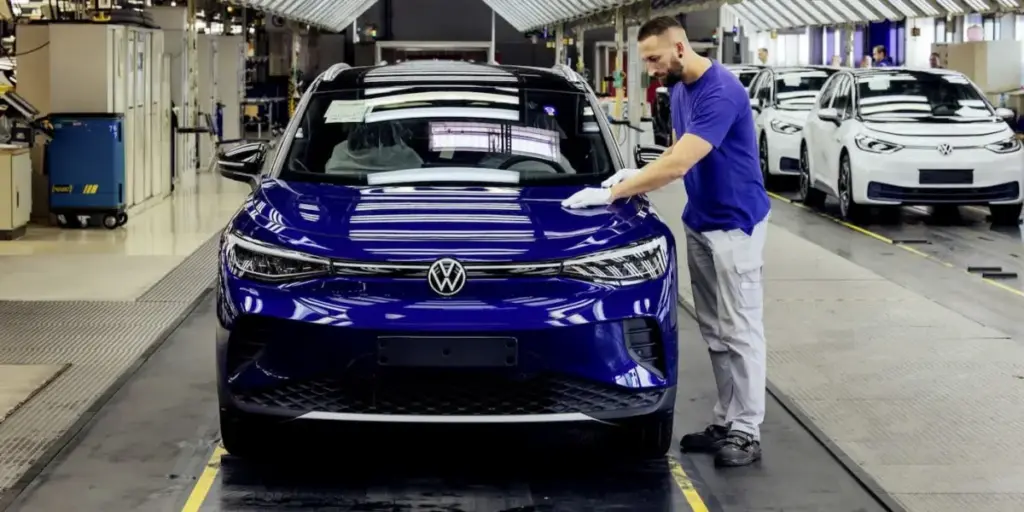
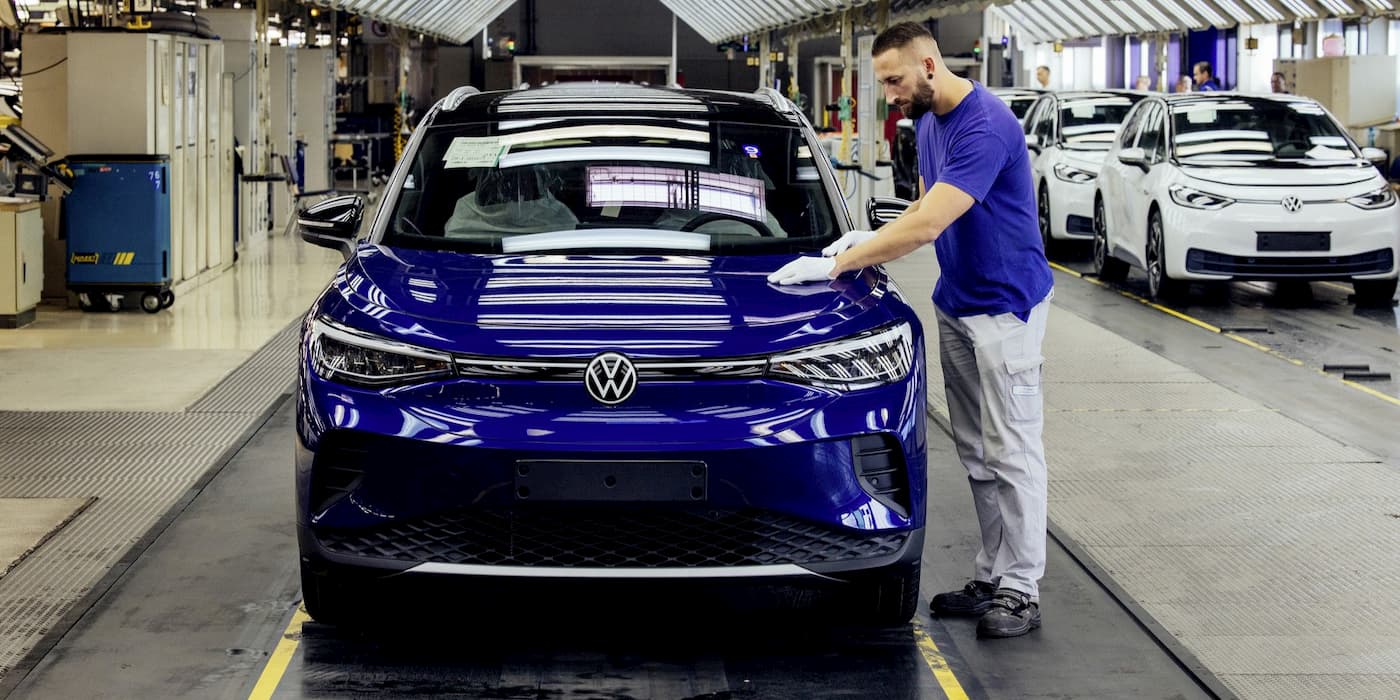
- Emden: The production hub for core electric volume models like the ID.4 crossover and the sleek ID.7 sedan.
- Hanover: The historic home of Volkswagen Commercial Vehicles, currently tasked with building the nostalgic yet high-tech ID. Buzz and ID. Buzz Cargo.
- Neckarsulm: Audi’s prestigious facility, which splits its capacity between the high-performance e-tron GT electric sports car and various internal combustion and plug-in hybrid models.
Because Volkswagen has not lined up successor vehicles for these locations once their current production runs terminate, the company faces an agonizing choice: pivot these plants to entirely non-automotive industrial uses, or shutter them completely. Management has stated that a definitive European production strategy mapping out plant capacities will be finalized by the end of June 2027.
Supporting Context & Metrics
To understand the magnitude of Volkswagen’s predicament, one must analyze the raw financial and operational metrics underpinning Future Plan 2030. The numbers paint a vivid picture of systemic overcapacity and urgent modernization needs.

The Overcapacity Crisis in Europe
Volkswagen has openly admitted that its European manufacturing infrastructure is severely oversized relative to real-world consumer demand. Across its domestic and regional plants, the company possesses the physical capacity to build more than 500,000 vehicles per year above what consumers are actively purchasing. In a low-margin, high-fixed-cost industry, carrying half a million units of idle or unprofitable capacity is a financial hemorrhage.
Workforce Reductions: By the Numbers
- Total Global Workforce: ~650,000 employees.
- Previous Planned Cuts: ~50,000 roles across Volkswagen, Audi, Porsche, and Cariad.
- New Restructuring Cuts: An additional ~50,000 management and operational roles.
- Total Combined Impact: ~100,000 positions eliminated, representing 15% of the total global workforce.
Capital Expenditure and Financial Targets
Despite downsizing its physical footprint and workforce, Volkswagen is pouring massive amounts of capital into its technological transformation. The automaker plans to deploy €135 billion ($157 billion) in capital expenditures and research and development (R&D) between 2027 and 2031.
Through this massive capital injection, management has staked its reputation on hitting rigorous financial targets by 2030:
- Annual Sales Volume: Target of 9 million vehicles globally (prioritizing high-margin profitability over pure volume chasing).
- Operating Margin: Target of 9%.
- Operating Profit: Projected at approximately €31 billion ($36 billion).
Product Portfolio Simplification
To achieve these margins, Volkswagen is drastically pruning its bloat:
- Model Lineup Reduction: The total number of global models will be slashed by roughly 50% by 2035.
- Variant & Option Stripping: Equipment choices, trim packages, and add-on options will be cut by 75%, moving away from complex bespoke customisation toward simplified, standardized factory builds.
- Business Portfolio: Non-core operations, subsidiaries, and peripheral investments will be shrunk by approximately one-third, with assets either sold off or thoroughly reorganized.
Official Statements and Stakeholder Reactions
A corporate restructuring of this magnitude cannot occur without fierce pushback from labor representatives, who hold immense power in German corporate governance through co-determination laws.
The Labor Perspective: Daniela Cavallo
Daniela Cavallo, Volkswagen’s chief employee representative and a powerful voice on the supervisory board, initially resisted any talk of factory closures or mass layoffs. However, recognizing the existential realities facing the company in the global marketplace, labor leadership ultimately chose a pragmatic path, endorsing Future Plan 2030 while drawing a hard line in the sand regarding worker exploitation.

"The Future Plan is a necessity to lead our Group successfully into the next decade — without placing the burden of that transformation solely on employees," Cavallo stated following the board’s approval. "In doing so, Volkswagen once again affirms that job security and economic viability carry equal weight as shared corporate goals."
Cavallo’s stance underscores a tense compromise: labor unions accepted the inevitability of structural shrinkage, but extracted assurances that management would pursue alternative employment pathways, retraining initiatives, and negotiated early-retirement packages rather than arbitrary, unmitigated mass layoffs.
Management’s Strategic Defense
Executive leadership has defended the severe measures as the only responsible path forward to prevent a slow, managed decline of the entire corporate empire. With legacy costs weighing down balance sheets and Chinese competitors aggressively undercutting European pricing in export markets, VW executives argue that shedding operational weight is non-negotiable. The goal is to transition Volkswagen from a lumbering bureaucratic giant into a lean, software-driven mobility provider capable of weathering the storms of the 2030s and beyond.
Future Outlook: Can Volkswagen Reclaim Its Crown?
The road ahead for Volkswagen is fraught with monumental challenges. As the company marches toward its 2030 financial milestones, several critical hurdles will determine whether Future Plan 2030 succeeds or merely manages a slow corporate retreat.
1. The Chinese Competitive Threat
Domestically and globally, Chinese EV manufacturers have established an insurmountable lead in battery supply chain cost-efficiency and in-cabin digital user experiences. Volkswagen’s attempt to simplify its software, electronic architectures, and driver-assistance systems is a direct reaction to this deficit. If VW’s upcoming platform overhauls fail to match the technological allure and price points of its Asian rivals, cutting models and factory options will simply result in lower sales volumes rather than higher margins.
2. The Social and Political Fallout in Germany
Germany’s industrial heartland is deeply intertwined with Volkswagen. The potential closure or repurposing of plants in Emden, Zwickau, Hanover, and Neckarsulm carries heavy political ramifications. Regional state governments, which hold minority stakes in the automaker (such as Lower Saxony), will face intense pressure to intervene, protect local jobs, and prevent the hollowing out of industrial towns. How Volkswagen manages the transition of these four facilities over the next few years will test the limits of Germany’s social market economy.

3. The Execution of the EV Transition
Zwickau and Emden are ground zero for Volkswagen’s electric ambitions. Scaling back or altering production at these facilities risks creating supply bottlenecks or signaling a tactical retreat from aggressive EV adoption just as global markets are slowly maturing. Balancing profitability with strict European Union carbon emission reduction targets will require a delicate tightrope walk from executive leadership.
Conclusion
Volkswagen’s Future Plan 2030 marks the definitive end of an era for European automotive manufacturing. By shedding 100,000 jobs, placing four major domestic plants on notice, and halving its model lineup, VW is performing radical surgery on itself. Whether this aggressive pruning will yield a leaner, more profitable titan capable of dominating the next generation of mobility—or whether it will trigger a protracted identity crisis—remains the defining question for the world’s automotive landscape in the decade ahead.



