

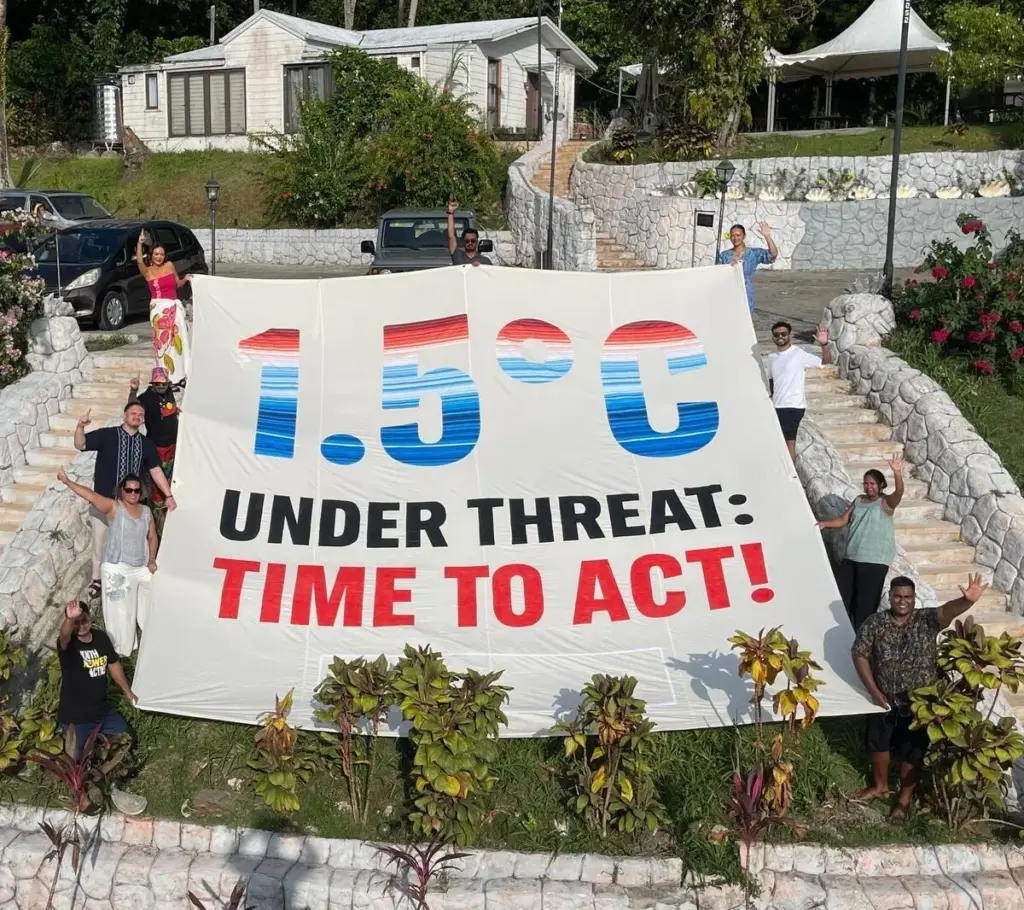
NEW YORK — As global leaders converge in New York for the United Nations General Assembly (UNGA), the diplomatic spotlight has turned intensely toward the High-Level Event on Climate Action and the Just Transition. This pivotal summit represents the final major climate initiative of outgoing UN Secretary-General António Guterres, who has anchored his decade-long legacy in the existential fight against global heating.
Yet, the gathering takes place against a grim backdrop. Just weeks prior, the United Nations Environment Programme (UNEP) issued a sobering scientific consensus: humanity has officially failed to hold global warming to the aspirational Paris Agreement threshold of 1.5°C, entering a dangerous "overshoot, peak, and decline" trajectory.
Against this fracture in planetary stability, environmental organizations, led by Greenpeace International, are issuing an uncompromising ultimatum to world governments. With critical milestones looming—including the upcoming COP31 climate summit in Türkiye and COP17 biodiversity conference in Armenia—environmental advocates are demanding that world leaders move past rhetorical diplomacy and enforce the hard commitments agreed upon at COP28 in Dubai. These include phasing out fossil fuels, halting forest destruction by 2030, and compelling the world’s wealthiest polluters to finance the global green transition.
Executive Overview
The convergence of escalating climate disasters, record-shattering fossil fuel corporate profits, and the UNEP’s acknowledgment of the 1.5°C overshoot has transformed the UNGA climate events into a crucible for international environmental policy.
At the heart of the debate is a profound systemic disconnect: while climate-fueled catastrophes—ranging from unprecedented wildfires to economic-crushing droughts—devastate vulnerable communities worldwide, major oil and gas conglomerates continue to post historic windfalls. Greenpeace delegates in New York argue that the financial architecture of the global economy remains profoundly misaligned with ecological survival.
The primary demands brought forward by Greenpeace leadership during the UNGA high-level events crystallize into three core pillars:
- Accelerated Fossil Fuel Phase-Out: Moving beyond vague transition promises to legally binding national roadmaps that fast-track renewable energy integration.
- Ecosystem Defense: Treating the 2030 deforestation targets as absolute biophysical boundaries rather than aspirational goals, supported by the Brazil COP30 Presidency’s Forest Roadmap.
- Climate Justice and Polluter Accountability: Implementing permanent windfall and carbon taxes on major energy firms to alleviate "fossilflation" for working families and fund international climate finance for the Global South.
Detailed Chronology: The Escalating Crisis and Diplomatic Milestones
To understand the urgency of the current New York climate events, one must trace the diplomatic and environmental milestones that have defined the past several years of international climate governance.
The Legacy of COP28 and the 2030 Horizon
In late 2023, COP28 in Dubai concluded with a historic, albeit contested, agreement explicitly calling on nations to transition away from fossil fuels in energy systems. For the first time in the history of UN climate negotiations, the explicit driver of global heating was named in a final text, alongside a parallel commitment to halt and reverse deforestation by the end of the decade.
However, the months following COP28 have revealed a dangerous implementation gap. While nations draft high-level climate strategies, actual capital investments by major economies continue to subsidize fossil fuel extraction, and global carbon emissions have stubbornly refused to peak at the scale required.
The September UNEP Warning: Crossing the 1.5°C Threshold
The atmospheric reality caught up with political hesitancy in September, when UNEP released a definitive assessment warning that the world is no longer on a direct path to limit global warming to 1.5°C. Instead, scientists mapped out an "overshoot, peak, and decline" scenario.
This scientific reality check sent shockwaves through the diplomatic community. An overshoot means that global temperatures will temporarily—and potentially catastrophically—exceed the 1.5°C guardrail before technological and ecological interventions can theoretically pull them back down. Environmental scientists have repeatedly warned that an overshoot risks triggering irreversible tipping points, such as the collapse of the Amazon rainforest, the melting of Arctic permafrost, and the destabilization of major ocean currents.
The UNGA High-Level Event and Outgoing Leadership
As Secretary-General Guterres prepares to step down, his final climate initiative in New York is designed to prevent the international community from normalizing this climate overshoot. The High-Level Event on Climate Action and the Just Transition aims to forge emergency coalitions among progressive states, sub-national governments, and civil society actors, bypassing the diplomatic gridlock that often plagues formal COP plenaries.
Supporting Context & Metrics: Profits, Disasters, and the Cost of Delay
The economic framework underpinning the current climate crisis is characterized by deep asymmetries. While communities bear the human and financial toll of ecological collapse, the fossil fuel industry enjoys unprecedented financial health.
The Economics of Extraction and "Fossilflation"
Greenpeace’s analysis highlights how ordinary citizens are bearing the brunt of a dual economic and ecological crisis. Rebecca Newsom, Global Political Lead at Greenpeace International, coins the term "fossilflation" to describe how geopolitical conflicts—such as the ongoing hostilities involving Iran—immediately enrich oil conglomerates while driving up costs for consumers at the petrol pump, grocery checkout, and through soaring insurance premiums driven by climate-related property destruction.
Recent financial disclosures from multinational oil and gas majors demonstrate that profits have routinely broken historical records during periods of international instability. These windfalls, activists argue, represent an untapped pool of public wealth that should be redirected toward climate mitigation and adaptation.
The Deforestation Emergency
The ecological integrity of the planet’s remaining major carbon sinks is deteriorating at an alarming rate. The year has seen unprecedented wildfires tear through boreal and tropical forests alike, turning vital carbon absorbers into massive carbon emitters.
According to biodiversity experts, the destruction of high-integrity forests not only accelerates global heating but annihilates the habitats of countless endangered species, directly undermining the Kunming-Montreal Global Biodiversity Framework’s targets.
Official Statements: Perspectives from Greenpeace Leadership
At the UNGA briefings, senior Greenpeace representatives laid out a scathing critique of global political inertia while offering concrete pathways for immediate intervention.
Jasper Inventor: Ending the Culture of Delay
Jasper Inventor, Deputy Programme Director, Greenpeace International, did not mince words when addressing the disconnect between political rhetoric and scientific reality:
"We are overshooting our climate limits while fossil fuel companies are overflowing with profits. As those most responsible for the climate crisis continue to cash in, this year’s repeated disasters pose a clear question: will politicians finally end the industry’s destruction? Talk is cheap, but life is priceless and our climate stability is disintegrating the longer we delay."
Inventor emphasized that the solutions do not lie in ideological division or geopolitical fragmentation, but in unified, aggressive state intervention:
"The answer is not found in discord or division, but urgent collective action for our mutual benefit. Governments must develop and implement national roadmaps that accelerate a fast, fair and funded just transition into renewable energy and ensure we hold fossil fuel polluters and forest destroyers to account for the destruction they’ve caused."
An Lambrechts: Treating 2030 Targets as Hard Boundaries
Highlighting the intersection of climate change and biodiversity loss, An Lambrechts, Biodiversity Policy Expert, Greenpeace International, stressed that forest conservation is non-negotiable for maintaining the 1.5°C limit:
"The devastating wildfires this year must finally compel us to act with the urgency we need to protect high integrity forests and end forest destruction by 2030, as agreed at COP28 and as part of the Kunming-Montreal Global Biodiversity Framework. These 2030 targets are not only aspirational, they represent a hard climate and biodiversity boundary. But as forest and ecosystem loss continue on our rapidly heating planet, these wildfires risk becoming a testament to our collective failure to act."
Lambrechts pointed to emerging diplomatic opportunities, specifically endorsing the momentum generated by the Brazil COP30 Presidency:
"The Brazil COP30 Presidency’s Forest Roadmap creates the momentum for solutions to be put in place. What’s required is clear government action and deliverables to end and reverse forest destruction by 2030. A future world of 1.5°C hinges on defending forests now and in the future."
Rebecca Newsom: The Demand for Polluter Accountability
Focusing on the economic injustice of the current system, Rebecca Newsom, Global Political Lead, Greenpeace International, emphasized that public fatigue has reached a breaking point, evidenced by a massive global petition drive:
"We are united with one simple demand: make the wealthiest polluters pay for the damage they cause. People are fed up with paying for a crisis they didn’t create, hit by fossilflation at the pump, the checkout, on insurance and in the climate damage communities are confronted with."
Demonstrating the scale of public mobilization, Greenpeace recently delivered a petition boasting over 2 million signatures to the United Nations General Assembly, demanding that governments implement "Make Polluters Pay" frameworks. Newsom elaborated on the fiscal mechanisms required:
"Fossil fuel profits are soaring off the back of the war on Iran. Permanently increasing taxes on them and shifting fiscal incentives towards renewables should be obvious for any government serious about a just transition and ensuring Global South countries get the public international climate finance they’re owed. The money is there, it just needs to be put into the right hands."
Future Outlook: The Road to COP31 and Beyond
As the New York climate events draw to a close, attention pivots immediately to the complex diplomatic road ahead. The international community faces a narrow window to translate the demands voiced at UNGA into binding commitments at upcoming global summits.
The Strategic Importance of COP17 and COP31
- COP17 (Biodiversity): Scheduled to take place in Armenia, the upcoming biodiversity conference will test whether nations can mobilize financial resources to protect critical ecosystems and halt species extinction in alignment with the Kunming-Montreal framework.
- COP31 (Climate): Set to be hosted by Türkiye, the conference will serve as a critical checkpoint for national climate action plans (Nationally Determined Contributions, or NDCs). Under the Paris Agreement timeline, countries are expected to submit enhanced emissions-reduction targets that reflect the reality of the 1.5°C overshoot.
The Test of Political Will
The ultimate success of Secretary-General Guterres’s parting climate legacy will not be measured by the eloquence of speeches delivered in New York conference halls, but by whether national governments possess the political courage to confront entrenched corporate interests.
As Greenpeace and millions of global citizens have made clear through petitions, protests, and policy papers, the capital, technology, and scientific blueprints required for a just transition already exist. What remains missing is the political mandate to break free from fossil fuel dependency, protect the earth’s remaining forests, and ensure that those who profited from planetary destruction are finally held to account.



