

Executive Overview
In what marks one of the most drastic corporate overhauls in modern automotive history, Volkswagen’s supervisory board has unanimously approved its sweeping Future Plan 2030. Faced with relentless margin compression, sluggish European demand, and an existential threat from fiercely competitive, fast-moving Chinese electric vehicle (EV) manufacturers, the German automotive titan is preparing a radical contraction.
The strategy includes terminating vehicle manufacturing operations at four major German production facilities—Emden, Zwickau, Hanover, and Audi’s Neckarsulm plant—as their current vehicle allocations expire between 2031 and 2034. Compounding this industrial retreat, the company is moving forward with an additional 50,000 job cuts worldwide. When combined with previously announced reductions across Volkswagen, Audi, Porsche, and its beleaguered software division, Cariad, the cumulative workforce reduction will total approximately 100,000 positions. This amounts to roughly 15% of Volkswagen’s global workforce of 650,000.
Beyond structural downsizing, Volkswagen plans to slash its global model lineup by half by 2035 and reduce equipment choices and configuration variants by an astonishing 75%. By streamlining its vehicle platforms, electronic architectures, and driver-assistance software, and shrinking its broader business portfolio by one-third, the automaker hopes to secure a leaner, more profitable future. Backed by a €135 billion ($157 billion) capital investment and R&D commitment spanning 2027 through 2031, VW is targeting annual sales of 9 million vehicles and a robust 9% operating margin—translating to an annual operating profit of approximately €31 billion ($36 billion)—by the end of the decade.
Detailed Chronology: Anatomy of a Crisis and the Road to Approval
The genesis of Volkswagen’s Future Plan 2030 did not happen overnight; it is the culmination of years of structural inefficiencies, high labor costs in Western Europe, and a delayed pivot toward software-defined architectures that left the legacy carmaker flat-footed against aggressive foreign competition.
The Warning Signs
For years, analysts warned that European legacy automakers were structurally bloated compared to their Asian counterparts. While companies like BYD and Tesla streamlined production and pioneered highly vertically integrated supply chains, Volkswagen carried heavy legacy burdens. These included rigid labor agreements, over-engineered manufacturing plants, and a fragmented software strategy that severely plagued its product launches—most notably the costly delays and software bugs that marred the initial rollout of its ID. vehicle family.
The Turning Point and Board Approval
Pressure reached a boiling point as European EV adoption plateaued relative to aggressive forecasts, while low-cost Chinese imports began capturing market share globally. Volkswagen acknowledged a stark reality: its European factories alone possessed an overcapacity exceeding 500,000 vehicles a year beyond actual consumer demand.
Following intense backroom negotiations between executive leadership and worker representatives, Volkswagen’s supervisory board officially rubber-stamped the Future Plan 2030. The unanimous vote signaled that even powerful labor factions recognized the company’s perilous financial position. Under the framework, the fate of four crucial German manufacturing hubs was cast into doubt, setting the stage for a dramatic reconfiguration of Europe’s industrial landscape.
Supporting Context & Metrics: The Scale of the Overhaul
To comprehend the sheer magnitude of Volkswagen’s pivot, one must look closely at the numbers defining the restructuring. The metrics illustrate a company aggressively pulling back on physical sprawl to reallocate capital into software, efficiency, and next-generation battery ecosystems.
The Factory Footprint Under Threat
The four plants facing an uncertain future are not minor assembly points; they are foundational pillars of Volkswagen’s electric and luxury portfolios:
- Zwickau: Historically significant as Volkswagen’s very first large-scale factory to pivot entirely away from internal combustion engines (ICE) to produce battery-electric vehicles exclusively.
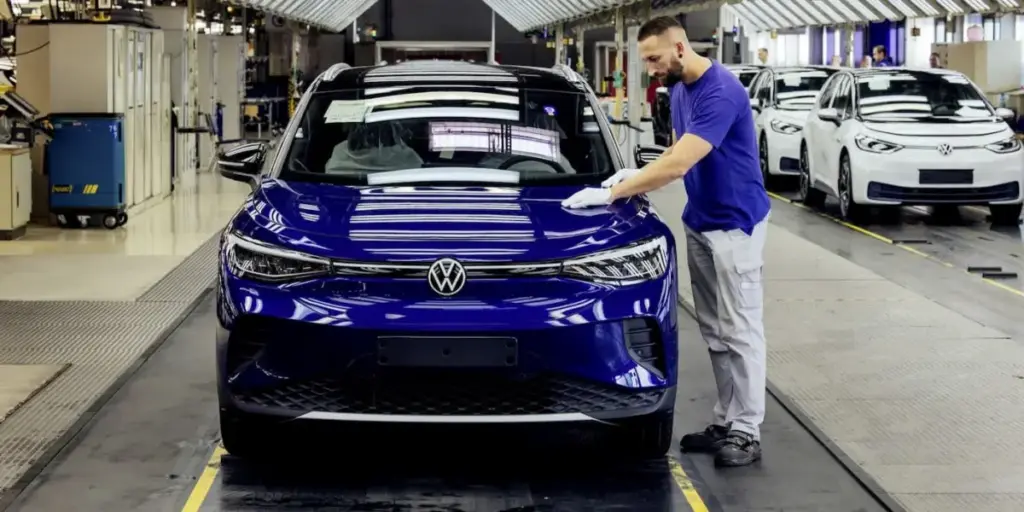
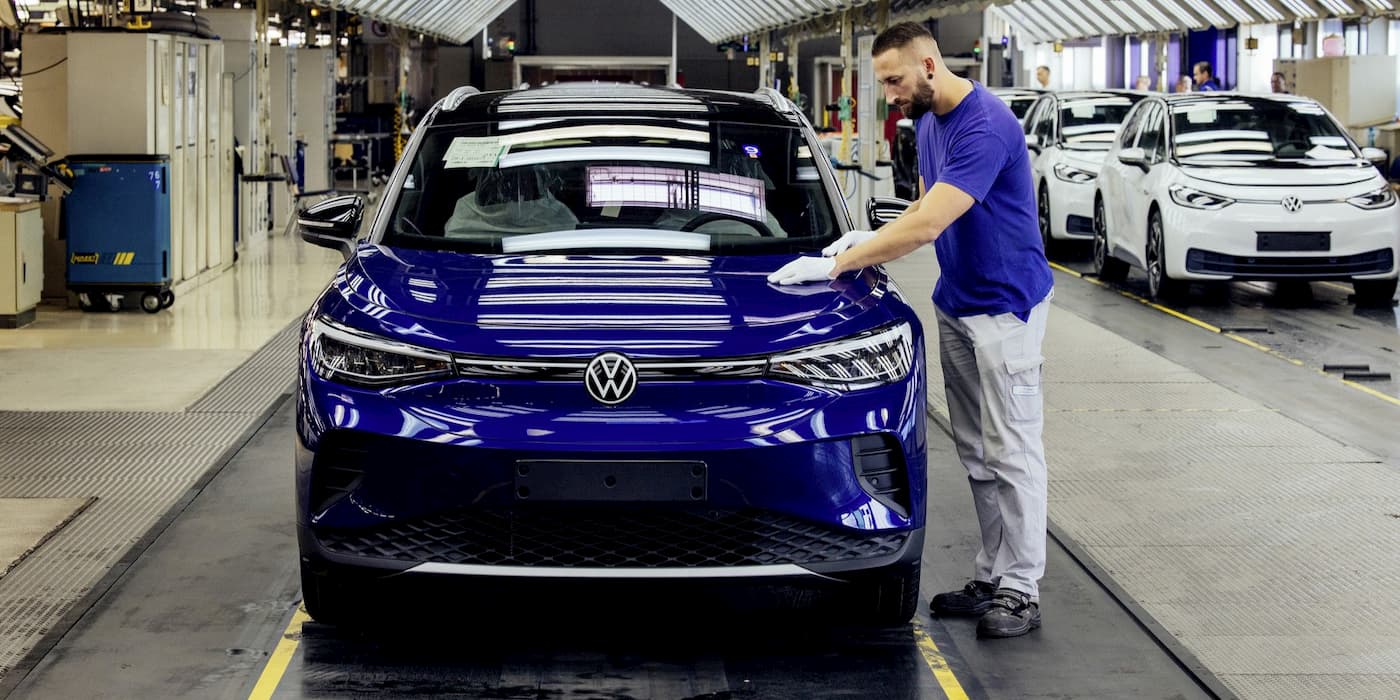
- Emden: A critical assembly hub for high-volume electric models, notably the ID.4 crossover and the ID.7 sedan.
- Hanover: The spiritual and physical home of the iconic microbus lineage, currently tasked with building the all-electric ID. Buzz and ID. Buzz Cargo.
- Neckarsulm (Audi): A high-end facility responsible for manufacturing Audi’s halo electric performance vehicle, the e-tron GT, alongside various combustion and plug-in hybrid models.
Because Volkswagen has not lined up successor vehicles to replace the models currently assigned to these facilities—with existing allocations ending at staggered intervals between 2031 and 2034—the facilities face the very real prospect of total vehicle production cessation unless alternative industrial uses can be found. Volkswagen has committed to formulating a comprehensive European production strategy by the end of June 2027 to address these looming operational voids.

Workforce Reductions: 100,000 Jobs on the Line
Volkswagen’s global employment footprint of approximately 650,000 workers is set to shrink by roughly 100,000 positions. The latest mandate introduces 50,000 fresh job cuts, heavily targeting administrative, managerial, and redundant corporate roles. This builds on top of an existing wave of 50,000 reductions previously designated across the group’s key brand pillars—Volkswagen Passenger Cars, Audi, Porsche, and the software subsidiary Cariad.
Product Portfolio Contraction
In a direct challenge to the modern automotive trend of infinite configuration options, VW is dramatically narrowing its focus:
- Model Lineup: Slashed by 50% by the year 2035.
- Options and Variants: Reduced by 75%, vastly simplifying the assembly line and supply chain.
- Business Portfolios: Non-core investments and subsidiary operations will be reduced by roughly one-third through strategic sell-offs or structural reorganizations.
Financial Commitments
Despite cutting operational fat, capital expenditure remains massive. Volkswagen has earmarked €135 billion ($157 billion) for capital investments and research and development between 2027 and 2031. The overarching financial goal is clear: stabilize the balance sheet to achieve 9 million annual vehicle sales and a 9% operating margin by 2030, securing an annual operating profit of approximately €31 billion ($36 billion).
Official Statements and Stakeholder Reactions
The path to passing Future Plan 2030 required delicate navigation of Germany’s powerful labor unions and employee representation boards, where works councils wield significant veto power over corporate strategy.
Labor’s Pragmatic Stance
Daniela Cavallo, Volkswagen’s chief employee representative and a fierce defender of worker rights, had previously drawn a hard line against plant closures. However, confronting the undeniable financial realities facing the automaker, Cavallo ultimately backed the plan—albeit with a stern caveat insisting that the workforce must not shoulder an unfair share of the turnaround burden.

"The Future Plan is a necessity to lead our Group successfully into the next decade — without placing the burden of that transformation solely on employees," Cavallo stated following the board’s approval. "In doing so, Volkswagen once again affirms that job security and economic viability carry equal weight as shared corporate goals."
Management’s Perspective
Executive leadership framed the cuts not as an admission of failure, but as a mandatory evolutionary step to survive a rapidly mutating global market. Executives pointed directly to structural cost disadvantages in Germany, soaring energy prices, and the blinding speed at which Chinese competitors are innovating, pricing, and deploying next-generation electric vehicles. By shedding bureaucratic weight and simplifying production footprints, management argues Volkswagen can preserve its long-term viability and safeguard the core of its remaining European operations.
Future Outlook: Can Volkswagen Outrun Its Past?
As Volkswagen embarks on this high-stakes transformation, the next several years will determine whether the legacy giant can successfully reinvent itself or if it will be permanently hobbled by its own downsizing.
The Software and Platform Hurdle
Central to VW’s future success is the stabilization of its software infrastructure. Cariad, the software arm plagued by years of delays and cost overruns, remains under intense scrutiny. For Future Plan 2030 to yield its targeted 9% operating margin, VW’s upcoming vehicle platforms must seamlessly integrate advanced driver-assistance systems and over-the-air update capabilities without the disastrous software bottlenecks that plagued previous vehicle rollouts.
Navigating the Geopolitical and Competitive Landscape
The external pressures showing no signs of easing. Chinese EV manufacturers continue to scale rapidly, utilizing lower domestic production costs and advanced battery supply chains to undercut European automakers both at home and abroad. While tariffs and trade barriers offer temporary breathing room, Volkswagen cannot rely on protectionism to secure its future. It must build cars that are not only technologically competitive but fundamentally more cost-effective to produce in Europe.

The Human Toll and Industrial Fallout
By 2027, when Volkswagen unveils its finalized European production blueprint, the true human and economic cost of the transition will come into sharper focus. The potential wind-down of operations in Zwickau, Emden, Hanover, and Neckarsulm risks sending shockwaves through local German economies that have relied on automotive manufacturing for generations.
Ultimately, Volkswagen’s Future Plan 2030 represents a brutal, necessary reckoning. By sacrificing historical scale, model variety, and workforce size, the company is betting that a smaller, leaner, and more disciplined Volkswagen can survive the crucible of the EV era. Whether this surgical contraction saves the automotive icon or permanently diminishes its global footprint remains the defining question for the remainder of the decade.



